Chapter Summaries
Daniel 3 — The Fiery Furnace and the Faithfulness of God
 Daniel 3 opens with Nebuchadnezzar making “an image of gold, whose height was threescore cubits, and the breadth thereof six cubits” and setting it up “in the plain of Dura, in the province of Babylon” (Daniel 3:1). This great image became the center of a state-commanded act of worship. The king gathered rulers, governors, captains, judges, treasurers, counsellors, sheriffs, and rulers of the provinces. At the sound of music, all were commanded to fall down and worship the golden image.
This chapter shows the union of political power and false religion. Nebuchadnezzar did not merely build a statue for admiration; he demanded worship. Those who refused would “the same hour be cast into the midst of a burning fiery furnace” (Daniel 3:6). This was not a small cultural pressure; it was a life-or-death test of obedience to God.
Shadrach, Meshach, and Abednego refused to bow. Their stand was not loud rebellion against government, but faithful obedience to the first commandment: “Thou shalt have no other gods before me” (Exodus 20:3). They would submit to civil authority as far as they could, but when the king commanded idolatry, they obeyed God rather than men.
Their answer is one of the great statements of faith in Scripture:
“Our God whom we serve is able to deliver us from the burning fiery furnace, and he will deliver us out of thine hand, O king.
But if not, be it known unto thee, O king, that we will not serve thy gods…”
— Daniel 3:17–18
They believed God was able to deliver them, but their obedience was not conditional upon deliverance. This is mature faith. They did not serve God because He would keep them from the furnace; they served God because He is God.
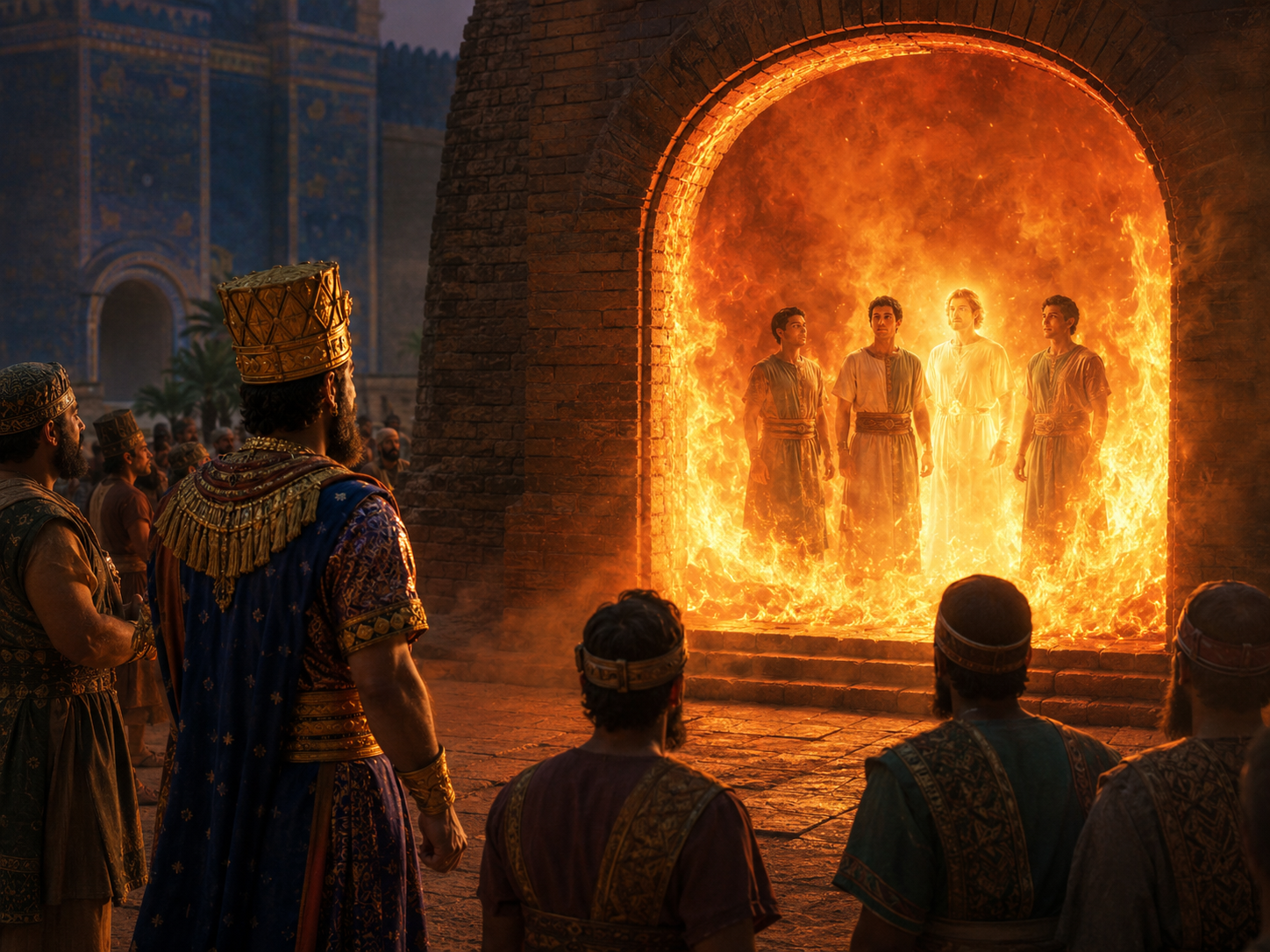
Nebuchadnezzar, full of fury, commanded the furnace to be heated “one seven times more than it was wont to be heated” (Daniel 3:19). The fire was so fierce that it slew the men who cast them in. Yet Shadrach, Meshach, and Abednego were preserved.
The king then saw four men walking loose in the fire, “and the form of the fourth is like the Son of God” (Daniel 3:25). The passage later says God “sent his angel, and delivered his servants” (Daniel 3:28). Conservative Bible believers have often seen here either a mighty angelic deliverer or a pre-incarnate appearance of Christ. At the very least, the text plainly teaches that God Himself intervened supernaturally to preserve His faithful servants.
When they came out, the fire had no power upon their bodies. “Nor was an hair of their head singed, neither were their coats changed, nor the smell of fire had passed on them” (Daniel 3:27). God did not merely help them endure; He preserved them completely.
The chapter ends with Nebuchadnezzar acknowledging the greatness of their God and promoting the three Hebrew men in Babylon. Yet this is not full spiritual maturity in Nebuchadnezzar. He still speaks as a Gentile king learning by judgment and wonder, not yet as a humble servant fully instructed in the fear of the LORD.
Daniel 4 — Nebuchadnezzar Humbled by the Most High
Daniel 4 is unusual because much of it is presented as Nebuchadnezzar’s own testimony. The chapter begins with the king addressing “all people, nations, and languages, that dwell in all the earth” (Daniel 4:1). He declares, “I thought it good to shew the signs and wonders that the high God hath wrought toward me” (Daniel 4:2).
The chapter’s central issue is pride. Nebuchadnezzar had power, wealth, empire, military success, and earthly glory. But he had not yet learned that “the most High ruleth in the kingdom of men, and giveth it to whomsoever he will” (Daniel 4:17).
The king had a troubling dream. He saw a great tree in the midst of the earth. It grew strong, reached unto heaven, and could be seen to the end of all the earth. Its leaves were fair, its fruit abundant, and beasts and birds found shelter in it. Then a watcher from heaven cried that the tree should be hewn down, its branches cut off, its leaves shaken, and its fruit scattered. Yet the stump and roots were to remain in the earth, bound with iron and brass.
The dream declared that a man would be driven from men, dwell with the beasts, eat grass as oxen, and have his heart changed from a man’s heart to a beast’s heart until “seven times” passed over him (Daniel 4:16).
Daniel, called Belteshazzar by the Babylonians, interpreted the dream. The tree represented Nebuchadnezzar himself. His greatness had grown and reached far, but God would bring him down. He would be driven from men and made to dwell with the beasts of the field until he learned “that the most High ruleth in the kingdom of men, and giveth it to whomsoever he will” (Daniel 4:25).
Daniel also gave a direct moral exhortation:
“Wherefore, O king, let my counsel be acceptable unto thee, and break off thy sins by righteousness, and thine iniquities by shewing mercy to the poor…”
— Daniel 4:27
This was not salvation by works. Rather, Daniel called the king to repent of his pride, injustice, and sin. True repentance is never merely verbal; it produces a changed direction.
Twelve months later, Nebuchadnezzar walked in the palace of Babylon and said, “Is not this great Babylon, that I have built… by the might of my power, and for the honour of my majesty?” (Daniel 4:30). While the word was still in his mouth, judgment fell. He was driven from men, ate grass as oxen, and his body was wet with the dew of heaven until his hairs were grown like eagles’ feathers and his nails like birds’ claws.
At the end of the appointed time, Nebuchadnezzar lifted up his eyes unto heaven, his understanding returned, and he blessed the Most High. He confessed:
“All the inhabitants of the earth are reputed as nothing: and he doeth according to his will… and none can stay his hand, or say unto him, What doest thou?”
— Daniel 4:35
The chapter ends with Nebuchadnezzar restored to his kingdom, but now humbled. He praises and honours “the King of heaven,” declaring that “those that walk in pride he is able to abase” (Daniel 4:37).
A conservative Baptist reading should be careful not to say more than the text says. Daniel 4 clearly shows Nebuchadnezzar humbled, restored, and confessing the sovereignty and righteousness of God. Whether one describes this as his genuine conversion must be handled carefully; the chapter certainly presents a profound turning from pride to praise of the true God.
Key People and Places
Daniel / Belteshazzar
Daniel is not central in chapter 3, but he is central in chapter 4 as the faithful interpreter of Nebuchadnezzar’s dream. His Babylonian name was Belteshazzar, but his true identity remained as Daniel, a servant of the living God.
Shadrach, Meshach, and Abednego
These are the Babylonian names of Hananiah, Mishael, and Azariah. They are the faithful Hebrew men who refused to bow to Nebuchadnezzar’s image. Their stand demonstrates separation from idolatry, courage under persecution, and faith in God’s power.
Nebuchadnezzar
The king of Babylon. In Daniel 3 he is proud, angry, and tyrannical, demanding worship through a golden image. In Daniel 4 he is humbled by God until he learns that the Most High rules over the kingdoms of men.
Babylon
The great Gentile empire where Daniel and his friends lived in captivity. Babylon represents earthly power, wealth, pride, false religion, and human glory under God’s sovereign rule.
The Plain of Dura
The location where Nebuchadnezzar set up the golden image. It became the scene of the public test of loyalty: bow to the king’s idol or obey the true God.
The Burning Fiery Furnace
The place of execution prepared for those who refused idolatrous worship. For the three Hebrew men, it became the place where God manifested His preserving power.
The Great Tree
In Daniel 4, the tree in Nebuchadnezzar’s dream symbolizes the king’s greatness, dominion, and pride. Its cutting down pictures his humiliation under God’s judgment.
Main Doctrinal or Spiritual Themes
1. God Alone Is Worthy of Worship
Daniel 3 is a direct confrontation between idolatry and true worship. The king commands men to bow to an image; the Hebrew men refuse. This agrees with the commandment, “Thou shalt have no other gods before me” (Exodus 20:3).
No government, ruler, religion, culture, or threat has the right to demand worship that belongs to God alone.
2. Obedience to God Comes Before Obedience to Men
The three Hebrew men were not rebels by nature. They had served faithfully in Babylon. But when the law of the king contradicted the law of God, they stood firm.
This agrees with the later apostolic principle: “We ought to obey God rather than men” (Acts 5:29).
3. Faith Does Not Require Guaranteed Earthly Deliverance
Their words, “But if not,” are central to the chapter. They believed God could deliver them, but they did not demand that He do so. Biblical faith trusts God’s character even when the outcome is suffering, loss, or death.
4. God Is Present with His People in the Trial
God did not keep them out of the furnace; He met them in it. The fourth figure in the fire shows that God is not absent when His people suffer for righteousness’ sake. The fire that was meant to destroy them became the setting for God’s glory.
5. Pride Brings Divine Humiliation
Daniel 4 teaches plainly that God abases the proud. Nebuchadnezzar’s fall was not random insanity or political misfortune. It was divine judgment upon pride.
His boast, “Is not this great Babylon, that I have built,” reveals the heart of man when he forgets God. Pride steals glory from the Lord and gives it to self.
6. God Rules Over Gentile Kingdoms
Daniel 4 repeatedly states that “the most High ruleth in the kingdom of men.” This is especially important in Daniel because the book deals with Gentile dominion. Babylon, Medo-Persia, Greece, Rome, and all earthly powers remain under the authority of God.
This does not erase the distinction between Israel and the Church. Daniel concerns Israel in captivity under Gentile rule, and it fits within God’s prophetic program for Israel and the nations.
7. God’s Judgment Is Righteous and Merciful
Nebuchadnezzar was warned before judgment fell. Daniel urged him to break off his sins. God gave him twelve months before the judgment came. Even in chastening, God showed longsuffering.
The judgment was severe, but it was also corrective. Nebuchadnezzar was brought low so that he might acknowledge the Most High.
8. Human Glory Is Temporary; God’s Kingdom Is Everlasting
Nebuchadnezzar’s kingdom was great, but it was not eternal. God’s kingdom alone is “an everlasting kingdom” (Daniel 4:3). Earthly empires rise and fall, but the Lord remains.
Practical Applications or Lessons
1. Do Not Bow to the Idols of the Age
Modern idols may not always be golden images, but believers are still pressured to bow. The world demands compromise in worship, morality, doctrine, and allegiance. The believer must answer as Shadrach, Meshach, and Abednego did: “we will not serve thy gods.”
2. Convictions Must Be Settled Before the Furnace
The three Hebrew men did not decide their doctrine while standing before the furnace. Their convictions were already settled. Christians need biblical convictions before pressure comes.
A believer who waits until persecution arrives to decide where he stands will likely fall.
3. Faithfulness May Bring Trouble, Not Immediate Comfort
Obedience put these men into the furnace. Daniel 3 does not teach that faithfulness always removes hardship. It teaches that God is worthy of obedience regardless of the cost.
4. God Can Deliver Completely
The fire did not singe their hair, change their coats, or leave the smell of smoke upon them. God is able to deliver with absolute power. The believer should never measure God’s ability by the size of the trial.
5. Beware of Pride in Success
Nebuchadnezzar’s pride came after great achievement. Success can become spiritually dangerous when a man begins to say, “I have built,” “my power,” and “my majesty.”
Every blessing, position, ability, and possession is under God’s authority.
6. God Knows How to Humble a Man
Daniel 4:37 gives the lesson plainly: “those that walk in pride he is able to abase.” God can humble kings, nations, churches, families, and individuals. No man is too high for God to bring low.
7. Repentance Should Not Be Delayed
Daniel warned Nebuchadnezzar, but the king continued in pride. Twelve months later, judgment came. When God deals with the heart, it is foolish to delay obedience.
8. Give God the Glory Publicly
Nebuchadnezzar’s testimony was public. He declared what God had done. Believers today should not be ashamed to confess the Lord’s greatness, mercy, and authority.
9. Civil Authority Has Limits
Daniel 3 teaches that government is not supreme. Civil rulers may command many things lawfully, but they have no right to command sin, idolatry, or disobedience to God.
10. God’s People Can Live Faithfully in a Hostile Culture
Daniel and his friends lived in Babylon, but Babylon did not have to live in them. They served where they were placed, but they refused to compromise worship and obedience.
That is a needed lesson for believers today: be faithful, be respectful, be useful, but do not bow.
Comments are closed