2 Samuel 4-7: David’s Kingdom and God’s Everlasting Promise
 Second Samuel 4-7 records the murder of Ishbosheth, David’s anointing as king over all Israel, the capture of Jerusalem, the bringing of the ark into the city of David, and God’s promise to establish David’s house and kingdom forever. These chapters present both the blessings of God’s faithfulness and the seriousness of obeying His Word.
David acknowledges the LORD as his deliverer, seeks His direction in battle, and responds to His promises with humble prayer. Yet the narrative also records actions and failures that must be evaluated by God’s commandments. The governing standard is what God has spoken, rather than the reputation of the person involved.
Chapter Summaries
2 Samuel 4: Ishbosheth’s Murder and David’s Judgment
A troubled kingdom: 2 Samuel 4:1-4
When Saul’s son hears that Abner has died in Hebron, “his hands were feeble, and all the Israelites were troubled” (2 Samuel 4:1). The verse explicitly records the distress caused by Abner’s death.
The chapter introduces Baanah and Rechab, two captains serving Saul’s son. They are brothers, sons of Rimmon the Beerothite, of Benjamin.
The narrative also identifies Mephibosheth, Jonathan’s son. He was five years old when news concerning Saul and Jonathan came from Jezreel. While his nurse hurried to escape with him, he fell and became lame (2 Samuel 4:4). Scripture records the circumstances of his injury without assigning moral blame to the child.
Murder presented as divine vengeance: 2 Samuel 4:5-8
Rechab and Baanah enter Ishbosheth’s house while he is resting at noon and kill him. They carry his head to David at Hebron and declare that the LORD has avenged David upon Saul and his seed.
Their claim must be distinguished from God’s judgment of their conduct. The statement in 2 Samuel 4:8 belongs to the murderers; it is not a divine endorsement of their crime.
David refuses to reward wickedness: 2 Samuel 4:9-12
David answers by acknowledging the living LORD, “who hath redeemed my soul out of all adversity” (2 Samuel 4:9). He recalls his judgment upon the messenger who expected a reward for announcing Saul’s death.
David then describes Rechab and Baanah as “wicked men” who have slain “a righteous person in his own house upon his bed” (2 Samuel 4:11). This description concerns Ishbosheth as the victim of their murderous act; it does not establish that everything in his life was righteous.
David commands their execution, and Ishbosheth’s head is buried in Abner’s sepulcher at Hebron. David’s response demonstrates that an apparent political advantage does not make murder acceptable.
2 Samuel 5: David Established as King over All Israel
The tribes acknowledge David: 2 Samuel 5:1-5
All the tribes of Israel come to David at Hebron. They acknowledge their kinship with him, his previous leadership, and the LORD’s declaration:
“Thou shalt feed my people Israel, and thou shalt be a captain over Israel.”
2 Samuel 5:2
The elders make a league with David before the LORD and anoint him king over Israel. The chapter records that David began reigning at thirty years of age. He reigned over Judah in Hebron for seven years and six months, and over all Israel and Judah in Jerusalem for thirty-three years.
The command to “feed my people Israel” presents kingship as a responsibility to care for God’s people, not merely an opportunity to exercise power.
Jerusalem becomes the city of David: 2 Samuel 5:6-10
David and his men go against the Jebusites at Jerusalem. Despite their challenge, David captures “the strong hold of Zion,” which is identified as the city of David (2 Samuel 5:7).
He dwells in the stronghold and builds around it. Scripture gives the central explanation for his increasing greatness:
“And David went on, and grew great, and the LORD God of hosts was with him.”
2 Samuel 5:10
The difficult wording about the blind and lame in 2 Samuel 5:6-8 occurs within this confrontation. It should not be expanded into a general doctrine about the worth of people with disabilities.
God’s purpose and David’s growing household: 2 Samuel 5:11-16
Hiram, king of Tyre, sends cedar, carpenters, and masons to build David a house. David recognizes that the LORD has established his kingdom “for his people Israel’s sake” (2 Samuel 5:12).
The chapter also records David taking additional wives and concubines. Recording this conduct does not authorize believers to imitate it. Deuteronomy 17:17 expressly commands that Israel’s king must not multiply wives to himself. God’s blessing upon David’s kingship does not cancel God’s commandments concerning his personal conduct.
Two battles and two inquiries: 2 Samuel 5:17-25
The Philistines come against David after hearing of his anointing over Israel. David inquires of the LORD, receives permission to advance, and defeats them at Baalperazim. He credits the LORD with breaking through his enemies, and David and his men burn the images the Philistines abandon.
When the Philistines return, David inquires again. This time God gives different instructions: David must come behind them near the mulberry trees and move when he hears the appointed sound.
The chapter concludes, “And David did so, as the LORD had commanded him” (2 Samuel 5:25). His example supports continued dependence upon God rather than assuming that a previous method must govern every new situation.
2 Samuel 6: God’s Holiness and the Bringing of the Ark
Celebration does not replace obedience: 2 Samuel 6:1-11
David gathers thirty thousand chosen men of Israel to bring up the ark of God. The ark is placed upon a new cart, which Uzzah and Ahio drive. David and the house of Israel celebrate before the LORD with musical instruments.
At Nachon’s threshingfloor, the oxen shake the ark. Uzzah reaches out and takes hold of it. The LORD strikes him, and he dies beside the ark.
The related commandments explain the seriousness of this action. Numbers 4:15 forbids touching the holy things upon penalty of death. Numbers 7:9 specifies that the service assigned to the sons of Kohath required bearing the holy objects upon their shoulders.
First Chronicles 15:13 supplies David’s own explanation of the earlier failure:
“For because ye did it not at the first, the LORD our God made a breach upon us, for that we sought him not after the due order.”
Uzzah’s action followed the shaking of the ark, but Scripture does not explicitly describe his inward motives or his eternal condition. The stated issue is his error and the failure to follow God’s appointed order. Matthew Henry likewise emphasizes that Israel was responsible to transport the ark according to God’s instructions.
David is displeased and afraid. He takes the ark aside to the house of Obededom the Gittite, where it remains three months. The LORD blesses Obededom and all his household.
The ark enters Jerusalem: 2 Samuel 6:12-19
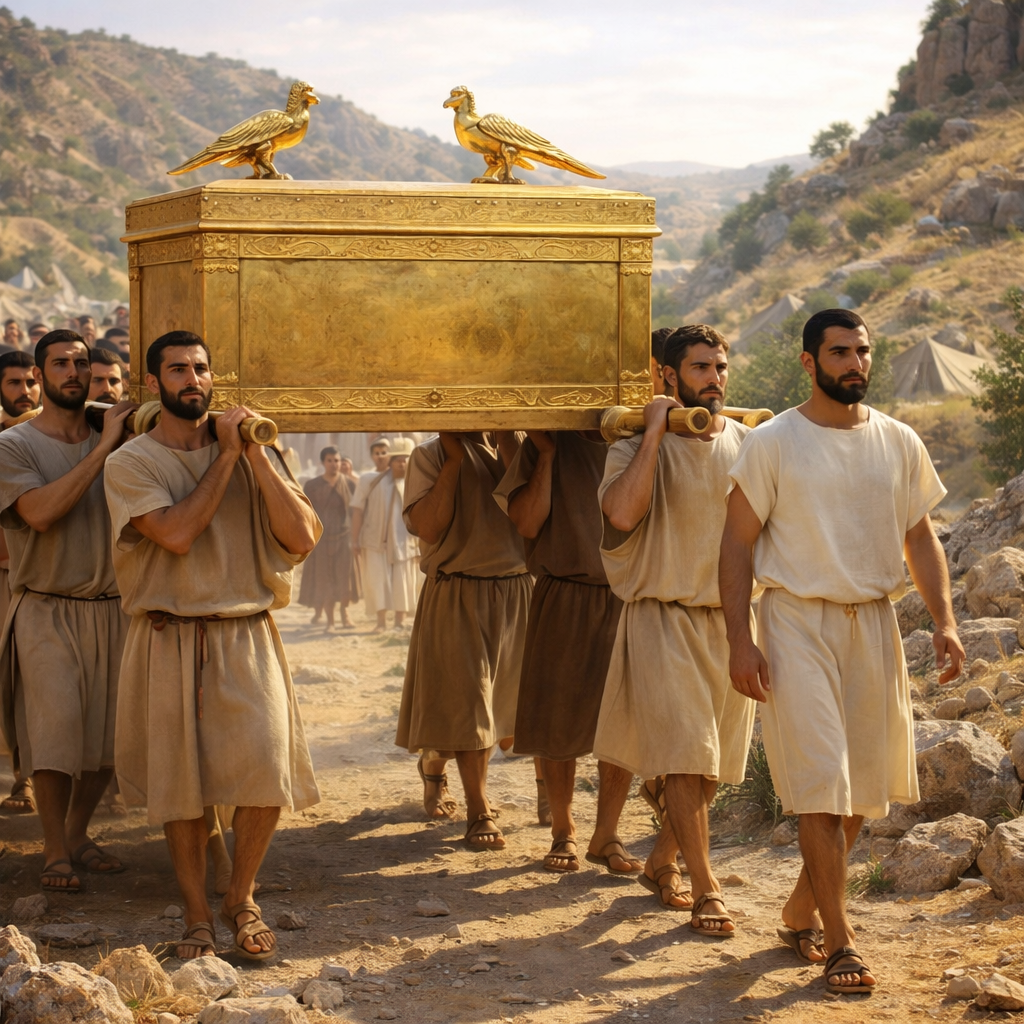
After hearing of that blessing, David brings the ark into the city of David with gladness. This account refers to people bearing the ark. First Chronicles 15:14-15 explicitly records the sanctification of the priests and Levites and the carrying of the ark upon shoulders with its staves, according to God’s command through Moses.
David dances before the LORD with all his might, wearing a linen ephod. The people accompany the ark with shouting and the sound of a trumpet.
They place it in the tabernacle David has pitched for it. David offers burnt offerings and peace offerings, blesses the people in the name of the LORD, and distributes provisions to the assembled men and women.
Michal’s contempt: 2 Samuel 6:16, 20-23
Michal sees David leaping and dancing before the LORD and despises him in her heart. When David returns to bless his household, she reproaches him.
Her accusation about his uncovering himself must be read alongside the narrator’s statement that he wore a linen ephod. First Chronicles 15:27 also describes David wearing a robe of fine linen. Her accusation should not be converted into a claim that Scripture describes David as completely naked.
David answers that his celebration was before the LORD, who had chosen him to rule Israel. He expresses willingness to be lowly in his own sight.
The chapter concludes, “Therefore Michal the daughter of Saul had no child unto the day of her death” (2 Samuel 6:23). The wording connects this outcome with the preceding account, but Scripture does not explicitly identify its physical or marital mechanism.
2 Samuel 7: God’s Promise to David and David’s Prayer
David’s desire and God’s direction: 2 Samuel 7:1-7
The LORD has given David rest from his surrounding enemies. David tells Nathan that he lives in a cedar house while the ark remains within curtains.
Nathan initially encourages him to do what is in his heart. That night, however, the word of the LORD comes to Nathan with the message he must deliver. The sequence distinguishes Nathan’s initial counsel from the revelation God subsequently gives him.
God has not commanded Israel’s leaders to build Him a cedar house. He will determine who builds the house for His name.
God promises to build David a house: 2 Samuel 7:8-17
The LORD reminds David that He took him from following sheep, made him ruler over Israel, accompanied him, and cut off his enemies.
David has spoken about a dwelling for the ark; God promises a continuing royal house for David:
“Also the LORD telleth thee that he will make thee an house.”
2 Samuel 7:11
The promises include:
- An appointed place and security for God’s people Israel (2 Samuel 7:10-11).
- David’s own offspring succeeding him, with his kingdom established by God (2 Samuel 7:12).
- That son building a house for God’s name (2 Samuel 7:13).
- A father-son relationship, with chastening for iniquity (2 Samuel 7:14).
- Mercy that will not be withdrawn as it was from Saul (2 Samuel 7:15).
- David’s house, kingdom, and throne established forever (2 Samuel 7:16).
Although the word covenant does not appear in this chapter, Psalm 89:3-4 expressly identifies God’s sworn promise to David as a covenant. Calling this the Davidic covenant therefore rests upon Scripture’s own explanation.
Solomon is explicitly identified as the son who would build the house in 1 Chronicles 22:9-10. The everlasting throne also points beyond Solomon to Jesus Christ. Luke 1:32-33 declares that the Lord God will give Jesus “the throne of his father David” and that His kingdom will have no end.
The provision for chastening in 2 Samuel 7:14 concerns iniquity in the royal offspring; it must not be used to suggest sin in Christ. Hebrews 4:15 expressly declares Him “without sin.” Hebrews 1:5 applies the father-son promise to Christ without applying the conditional statement about committing iniquity.
John MacArthur’s teaching likewise connects the Davidic covenant with Christ’s everlasting kingdom. That connection is controlled here by the explicit statements of Luke 1:32-33. Grace to You
David responds with humility and believing prayer: 2 Samuel 7:18-29
David sits before the LORD and asks:
“Who am I, O Lord GOD? and what is my house, that thou hast brought me hitherto?”
2 Samuel 7:18
He acknowledges God’s greatness, His unique deity, and His redemption of Israel. He credits God’s own heart and word for these gracious promises.
David then prays:
“And now, O LORD God, the word that thou hast spoken concerning thy servant, and concerning his house, establish it for ever, and do as thou hast said.”
2 Samuel 7:25
God’s promise leads David to prayer. He asks that God’s name be magnified and that his house receive the blessing God has promised. His confidence rests upon this confession: “thy words be true” (2 Samuel 7:28).
Key People and Places
Key People
- David: King over Judah and then all Israel; captures Jerusalem, brings in the ark, and receives God’s promise concerning his royal house.
- Ishbosheth: Saul’s son, murdered by Rechab and Baanah while resting in his house.
- Rechab and Baanah: Captains and sons of Rimmon the Beerothite; David condemns and executes them for Ishbosheth’s murder.
- Abner: His death troubles Ishbosheth and Israel; his sepulcher at Hebron becomes the burial place of Ishbosheth’s head.
- Mephibosheth: Jonathan’s son, whose childhood injury is described in 2 Samuel 4:4.
- Hiram: King of Tyre, who supplies workers and materials for David’s house.
- Uzzah and Ahio: Sons of Abinadab who drive the cart carrying the ark; Uzzah dies after touching it.
- Obededom: The Gittite whose household is blessed while the ark remains in his house.
- Michal: Saul’s daughter and David’s wife, who despises David’s celebration before the LORD.
- Nathan the prophet: Receives and delivers God’s message concerning David’s house. He is distinct from David’s son Nathan listed in 2 Samuel 5:14.
- Solomon: Listed among David’s sons in Jerusalem; explicitly identified in 1 Chronicles 22:9-10 as the son appointed to build God’s house.
Key Places
- Hebron: David’s royal residence during his reign over Judah and the place where Israel’s elders anoint him king over all Israel.
- Beeroth and Gittaim: Places mentioned in the background of Rechab and Baanah and the Beerothites.
- Jezreel: The place from which the news concerning Saul and Jonathan came when Mephibosheth was injured.
- Jerusalem, Zion, and the city of David: Jerusalem is the city David attacks; the captured stronghold of Zion is called the city of David.
- Tyre: Hiram’s kingdom, from which building supplies and craftsmen come.
- The valley of Rephaim: The Philistine gathering place in both campaigns described in chapter 5.
- Baalperazim: The place where David defeats the Philistines and acknowledges the LORD’s breakthrough.
- Geba and Gazer: Locations marking the extent of the victory in 2 Samuel 5:25.
- Baale of Judah: The starting location named in the expedition to bring up the ark.
- Nachon’s threshingfloor and Perezuzzah: The location of Uzzah’s death and the name David gives the place.
- The house of Obededom: The ark’s resting place for three months.
- The tabernacle David pitched: The tent in which the ark is placed in the city of David.
Main Doctrinal or Spiritual Themes
1. God’s Purposes Do Not Authorize Sinful Methods
Rechab and Baanah describe their crime as the LORD’s vengeance, but David calls them wicked men (2 Samuel 4:8-11). Their religious language does not make their actions righteous.
The corresponding Christian principle is explicit in Romans 3:8: doing evil so that good may come is condemned. Ministry goals, personal advancement, and favorable outcomes cannot excuse disobedience.
2. Leadership Is a Stewardship for the Good of Others
David is commanded to feed God’s people, and he recognizes that his kingdom has been exalted for Israel’s sake (2 Samuel 5:2, 12).
The church is not Israel’s monarchy, but the New Testament also commands spiritual leaders to feed God’s flock without acting as lords over it (1 Peter 5:2-3). Authority brings responsibility to serve.
3. God’s Holiness Governs Worship
The ark’s transportation demonstrates that enthusiasm, music, and a large gathering cannot substitute for obedience (2 Samuel 6:1-7; 1 Chronicles 15:13-15).
God’s instructions govern the approach to holy things. For Christians, Hebrews 12:28-29 calls for service “with reverence and godly fear.” Joy and reverence belong together.
4. Divine Blessing Does Not Approve Every Human Action
The LORD establishes David’s kingdom, while the same narrative records his multiplying wives (2 Samuel 5:12-13). Deuteronomy 17:17 supplies the moral standard.
A believer must evaluate conduct by Scripture rather than treating success, influence, or prosperity as proof that every decision pleases God.
5. God’s Covenant Faithfulness Includes Discipline
God promises enduring mercy while also declaring that iniquity will bring chastening (2 Samuel 7:14-16). Psalm 89:30-34 reinforces this distinction between punishment for disobedience and God’s faithfulness to His covenant.
The New Testament also teaches that God chastens His children (Hebrews 12:5-11). Grace never makes sin harmless.
6. Jesus Christ Is the Promised King
God’s promise concerning David’s everlasting throne finds its ultimate fulfillment in Jesus Christ (2 Samuel 7:16; Luke 1:32-33).
This connection is expressly taught in the New Testament. Christ’s royal identity does not depend upon treating the chapter as an allegory. He is identified as David’s descendant according to the flesh and as the risen Lord (Romans 1:3-4).
7. God’s Word Gives Confidence in Prayer
David prays because God has spoken (2 Samuel 7:27). His request seeks the fulfillment of God’s promise and the magnifying of God’s name.
Believers likewise have confidence when asking according to God’s will (1 John 5:14). The royal promises to David are not personal guarantees of wealth or family prominence for every Christian; they teach us to trust the God who faithfully keeps His Word.
Practical Applications or Lessons
- Refuse an advantage gained through wrongdoing. David would not reward the murder of Ishbosheth. Do not excuse dishonesty, cruelty, or manipulation because the result appears beneficial (2 Samuel 4:9-12).
- Seek God’s direction repeatedly. David inquires before both Philistine encounters. For believers today, this means prayerful dependence and obedience to Scripture, without assuming that every impression is a direct revelation from God (2 Samuel 5:19, 23; 2 Timothy 3:16-17).
- Give God credit for what He accomplishes. David acknowledges that the LORD established his kingdom. Receive responsibility and opportunity with gratitude rather than self-exaltation (2 Samuel 5:12).
- Bring methods under biblical authority. A new cart did not satisfy God’s instructions for carrying the ark. Examine how you serve, as well as what you hope to accomplish (2 Samuel 6:3; 1 Chronicles 15:13-15).
- Practice joyful, reverent worship. David rejoices before the LORD, while the chapter also displays the seriousness of God’s holiness. Neither careless familiarity nor contempt for sincere worship is a sound response (2 Samuel 6:12-16; Hebrews 12:28).
- Test counsel by God’s Word. Nathan’s initial encouragement is followed by a specific divine message directing the matter differently. Even respected counsel must remain subject to what God has revealed (2 Samuel 7:3-5; Acts 17:11).
- Accept the assignment God gives you. David desired to build, but God appointed his son to build the house. Faithful service includes accepting God’s direction when it differs from our preferred role (2 Samuel 7:12-13; 1 Chronicles 22:9-10).
- Let grace produce humility. David responds to extraordinary promises by asking, “Who am I?” God’s kindness should deepen gratitude rather than create a sense of entitlement (2 Samuel 7:18-22).
- Pray for God’s glory as you trust His promises. David asks that the LORD’s name be magnified. Shape requests around God’s revealed will and honor (2 Samuel 7:25-29).
Comments are closed