
2 Samuel 1-3 KJV: David’s Rise, Grief, and a Divided Kingdom
Second Samuel 1-3 records David’s mourning over Saul and Jonathan, his anointing as king over Judah, and the conflict between his house and the house of Saul. Abner’s negotiations with David offer the prospect of national unity, but Joab kills Abner in revenge for Asahel’s death.
These chapters distinguish God’s appointed kingship from the sinful actions of individuals involved in the struggle for power. David’s grief, dependence upon the Lord, and condemnation of bloodshed stand alongside the troubling realities of warfare and his expanding household.
Chapter Summaries
2 Samuel 1: David Mourns Saul and Jonathan
The Amalekite’s report and David’s response – 2 Samuel 1:1-16
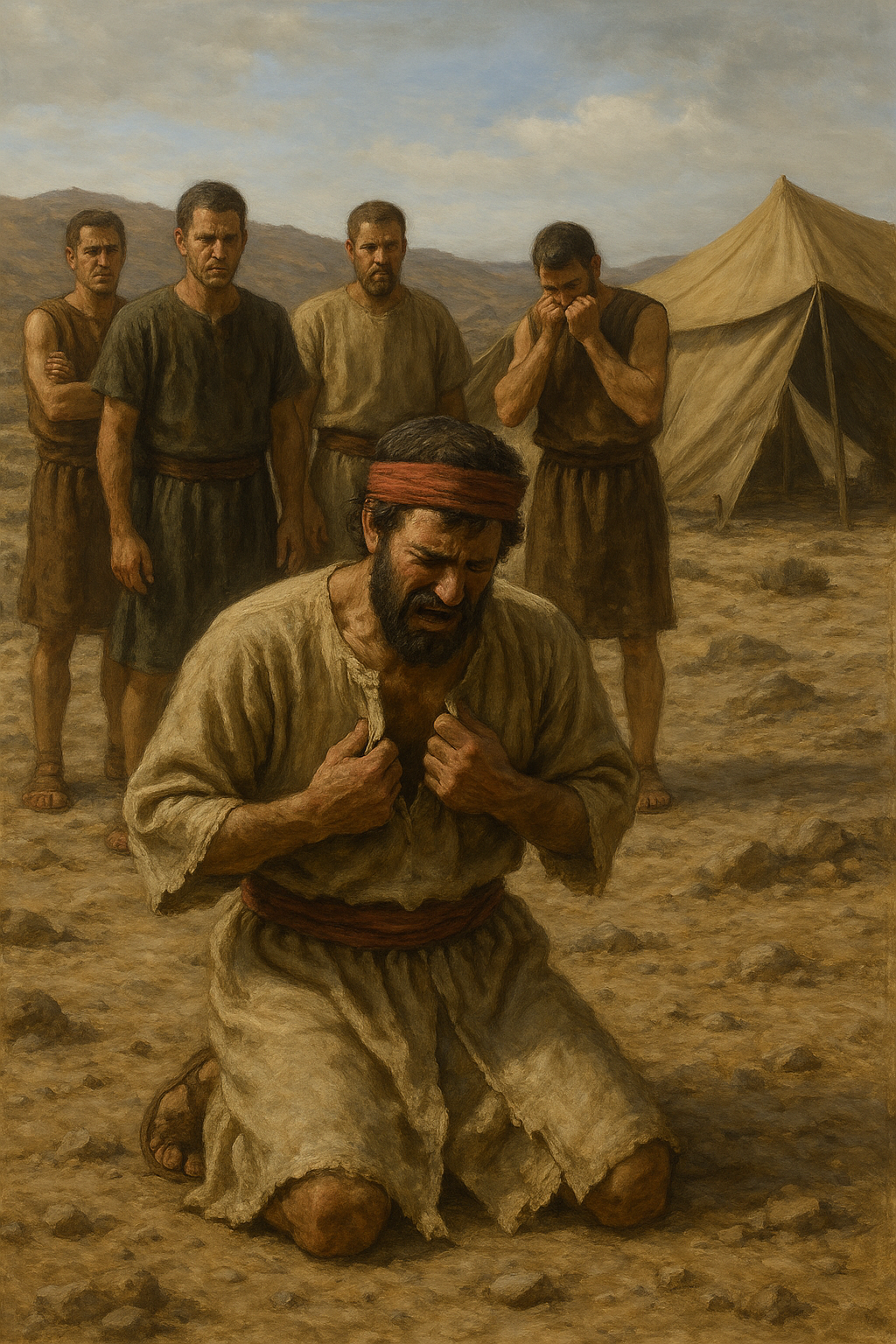
 David is in Ziklag following his return from the slaughter of the Amalekites. On the third day, a man arrives from Saul’s camp with torn clothing and earth upon his head. He reports Israel’s defeat and the deaths of Saul and Jonathan.
Identifying himself as an Amalekite, the messenger claims that he killed Saul at Saul’s request. He brings Saul’s crown and bracelet to David.
The distinction between the messenger’s testimony and the Bible’s historical account is important. First Samuel 31:4-6 states that Saul fell upon his own sword and that his armor bearer saw that Saul was dead. Second Samuel 1:6-10 records what the Amalekite claimed. His account must not replace the earlier inspired narrative. The suggestion that he fabricated his involvement to obtain favor is an inference; the text does not explicitly explain why he gave that account. kingjamesbibleonline.org
David and his men respond with grief:
“And they mourned, and wept, and fasted until even, for Saul, and for Jonathan his son, and for the people of the LORD, and for the house of Israel; because they were fallen by the sword.”
2 Samuel 1:12
David does not celebrate Saul’s death. Although Saul had pursued him, David mourns both the fallen king and Israel’s losses.
David asks the messenger why he was not afraid to destroy “the LORD’s anointed” and orders his execution. David identifies the man’s own testimony as the grounds for his judgment:
“Thy blood be upon thy head; for thy mouth hath testified against thee, saying, I have slain the LORD’s anointed.”
2 Samuel 1:16
The passage records David’s judgment upon the man’s confession. It does not say that the Lord separately commanded David to execute him.
David’s lament – 2 Samuel 1:17-27
David’s lament honors Saul and Jonathan and mourns Israel’s defeat. The repeated expression, “How are the mighty fallen,” emphasizes the magnitude of the loss.
He calls upon the daughters of Israel to weep over Saul and remembers the military courage of both Saul and Jonathan. This lament does not erase Saul’s disobedience, which Scripture records elsewhere, including 1 Samuel 15:22-23. Honoring what was commendable in a person’s life does not require denying what God condemned.
David expresses particular sorrow for Jonathan:
“I am distressed for thee, my brother Jonathan: very pleasant hast thou been unto me: thy love to me was wonderful, passing the love of women.”
2 Samuel 1:26
First Samuel 18:1-4 and 20:16-17 provide the context of their love and covenant friendship. Nothing in these passages describes a sexual relationship. David is mourning a beloved friend whose faithfulness had been demonstrated during dangerous circumstances.
2 Samuel 2: David Reigns in Hebron While Israel Is Divided
David seeks the Lord’s direction – 2 Samuel 2:1-4
David asks the Lord whether he should go into a city of Judah. When the Lord tells him to go, David asks where:
“And he said, Unto Hebron.”
2 Samuel 2:1
David obeys, bringing his wives, Ahinoam and Abigail, and his men with their households. The men of Judah anoint him king over the house of Judah.
Samuel had already anointed David in 1 Samuel 16:12-13. The anointing at Hebron is the recorded act of Judah acknowledging him as king. At this point in the narrative, his reign is over Judah, while Ishbosheth rules the opposing kingdom.
David honors the men of Jabeshgilead – 2 Samuel 2:4-7
David sends messengers to commend the men of Jabeshgilead for burying Saul. He calls their action a kindness and promises kindness in return.
Their care for Saul’s remains is described in 1 Samuel 31:11-13. David’s response shows that their loyalty to the deceased king did not prevent him from recognizing their honorable conduct.
David also informs them that Judah has anointed him king and encourages them to be strong and valiant.
Abner establishes Ishbosheth as king – 2 Samuel 2:8-11
Abner, captain of Saul’s army, brings Saul’s son Ishbosheth to Mahanaim and makes him king over Israel. Judah follows David.
Ishbosheth is forty years old when he begins to reign, and his reign lasts two years. David reigns over Judah in Hebron for seven years and six months. These are the durations the passage provides; it does not explain every chronological relationship between them.
Conflict at Gibeon and the death of Asahel – 2 Samuel 2:12-32
Abner’s men and David’s servants, led by Joab, meet at the pool of Gibeon. Abner proposes that young men compete before them, and Joab agrees. Twelve men from each side engage in deadly combat, followed by “a very sore battle” in which Abner’s forces are defeated.
Asahel, Joab’s brother, pursues Abner. Scripture describes Asahel as “as light of foot as a wild roe.” Abner repeatedly tells him to turn aside, but Asahel refuses. Abner then strikes and kills him.
The text records Asahel’s speed and determination but does not explicitly identify his inward motive. Calling his pursuit an attempt to gain fame or secure promotion would go beyond the passage.
Joab and Abishai continue the pursuit. Abner eventually asks:
“Shall the sword devour for ever? knowest thou not that it will be bitterness in the latter end?”
2 Samuel 2:26
Joab sounds a trumpet, and the pursuit stops. David’s servants have lost nineteen men and Asahel, while 360 of Abner’s men have died. Asahel is buried in his father’s sepulcher in Bethlehem. The chapter records both military victory and the grievous cost of conflict among brethren.
2 Samuel 3: Abner Seeks an Agreement and Joab Takes Revenge
The prolonged conflict and David’s household – 2 Samuel 3:1-5
The chapter begins:
“Now there was long war between the house of Saul and the house of David: but David waxed stronger and stronger, and the house of Saul waxed weaker and weaker.”
2 Samuel 3:1
Six sons are named as having been born to David in Hebron:
| Son | Mother |
|---|---|
| Amnon | Ahinoam the Jezreelitess |
| Chileab | Abigail, formerly Nabal’s wife |
| Absalom | Maacah, daughter of Talmai king of Geshur |
| Adonijah | Haggith |
| Shephatiah | Abital |
| Ithream | Eglah |
The record of David’s household is not a declaration that every feature of it pleased God. Deuteronomy 17:17 commands Israel’s king not to multiply wives to himself. Genesis 2:24 gives the foundational marriage pattern, which Jesus affirms in Matthew 19:4-6. David’s growing political strength must not be treated as divine approval of all his personal choices.
Ishbosheth’s accusation and Abner’s change of allegiance – 2 Samuel 3:6-11
Ishbosheth accuses Abner concerning Rizpah, Saul’s concubine. Abner becomes very angry and announces that he will transfer the kingdom to David.
Scripture records the accusation and Abner’s response, but it does not explicitly establish whether the accusation was true. Neither guilt nor innocence should be asserted as a settled fact.
Abner acknowledges what the Lord had sworn concerning David’s kingdom. Ishbosheth cannot answer him because he fears him.
The sequence connects Abner’s announcement with his anger at Ishbosheth. However, Scripture does not describe this change as repentance or provide a complete account of Abner’s inward motives.
Michal’s return and negotiations with Israel – 2 Samuel 3:12-21
Abner offers to make a league with David and help bring Israel under his rule. David requires the return of Michal, Saul’s daughter, whom he identifies as his wife.
First Samuel 18:27 records David’s marriage to Michal, and 1 Samuel 25:44 records Saul’s giving her to another man. In 2 Samuel 3:15-16, she is taken from Phaltiel, who follows her weeping until Abner orders him to return.
The text records Phaltiel’s grief but does not describe Michal’s feelings about this transfer. It also does not explicitly identify political advantage as David’s motive for requiring her return.
Abner speaks with the elders of Israel and the people of Benjamin. He reminds the elders that they had previously sought David as king and declares the Lord’s purpose to deliver Israel through David.
Abner then comes to Hebron with twenty men. David prepares a feast for them, and Abner promises to gather Israel to make a league with David. David sends him away in peace.
Joab kills Abner – 2 Samuel 3:22-30
When Joab returns and hears of the meeting, he accuses Abner of coming to deceive David. This is Joab’s accusation; the narrative does not establish that Abner’s visit was an act of espionage.
Without David’s knowledge, Joab sends messengers to bring Abner back. At Hebron’s gate, Joab takes him aside as though to speak privately and kills him.
The stated reason is “for the blood of Asahel his brother” in 2 Samuel 3:27. Verse 30 also assigns responsibility to Abishai, though it does not describe his precise role.
David declares himself and his kingdom guiltless concerning Abner’s blood and pronounces judgment upon Joab’s house. Abner had killed Asahel during battle; Joab kills Abner after David has dismissed him in peace. The narrative distinguishes these circumstances rather than presenting the two deaths as identical acts.
David publicly mourns Abner – 2 Samuel 3:31-39
David commands mourning, follows the bier, and weeps at Abner’s grave. He refuses food until sunset. The people understand that the killing was not ordered by the king.
David calls Abner “a prince and a great man” and acknowledges his own difficult position:
“And I am this day weak, though anointed king; and these men the sons of Zeruiah be too hard for me: the LORD shall reward the doer of evil according to his wickedness.”
2 Samuel 3:39
The chapter records David’s condemnation and mourning, but it does not record his imposing a judicial punishment upon Joab. His royal position did not mean that he exercised effective control over every powerful man around him.
Matthew Henry likewise emphasizes Joab’s wickedness and David’s evident sorrow over the murder. That observation agrees with David’s description of Abner falling before “wicked men” in 2 Samuel 3:34. Bible Study Tools
Key People and Places
Main People
- David: Anointed king over Judah at Hebron. He mourns Saul and Jonathan, seeks God’s direction, negotiates with Abner, and condemns Abner’s killing.
- Saul: Israel’s deceased king. His death and the continuation of his house’s rule form the background of these chapters.
- Jonathan: Saul’s son and David’s covenant friend, mourned in David’s lament.
- The Amalekite messenger: Brings Saul’s crown and bracelet and claims responsibility for Saul’s death.
- Abner: Son of Ner and captain of Saul’s army. Establishes Ishbosheth as king, negotiates with David, and is killed by Joab.
- Ishbosheth: Saul’s son, made king by Abner; fears Abner after their confrontation.
- Joab: Son of Zeruiah, leading David’s servants at Gibeon; kills Abner in revenge for Asahel.
- Abishai: Brother of Joab and Asahel; pursues Abner and shares responsibility for his death.
- Asahel: Swift-footed brother of Joab and Abishai; killed while pursuing Abner.
- Michal and Phaltiel: Michal is Saul’s daughter and David’s wife; Phaltiel is the husband from whom she is taken in 2 Samuel 3:15.
- Rizpah: Saul’s concubine, named in Ishbosheth’s accusation against Abner.
- Ahinoam, Abigail, Maacah, Haggith, Abital, and Eglah: Mothers of David’s six sons born in Hebron.
Main Places
- Ziklag: David’s location when the messenger brings news of Saul and Jonathan.
- Mount Gilboa: Site associated with Saul and Jonathan’s deaths and named in David’s lament.
- Gath and Askelon: Philistine cities where David does not want Israel’s defeat proclaimed as an occasion for rejoicing.
- Hebron: David’s royal residence during his reign over Judah; also the place of Abner’s death and burial.
- Judah: The house that follows David and anoints him king.
- Jabeshgilead: Community commended for burying Saul.
- Mahanaim: Place to which Abner brings Ishbosheth and returns after the fighting.
- Gibeon: Location of the pool, the deadly contest, and the ensuing battle.
- Bethlehem: Location of Asahel’s family burial place.
- Bahurim: Place to which Phaltiel follows Michal before being ordered back.
- The well of Sirah: Location from which Joab’s messengers bring Abner back.
- Geshur: Kingdom of Talmai, the father of Maacah.
- Dan and Beersheba: Places named by Abner when describing the extent of David’s proposed rule.
Main Doctrinal or Spiritual Themes
1. God’s Revealed Purpose Calls for Obedience
God had directed Samuel to anoint David in 1 Samuel 16:12-13. In 2 Samuel 3:9-10, Abner acknowledges the Lord’s declared purpose concerning David’s kingdom.
God’s appointment provides the foundation for David’s kingship. Military strength and political agreements do not create that divine appointment.
The application is submission to what God has revealed. Knowing biblical truth should lead to obedience, as James 1:22 commands.
2. God’s Purposes Do Not Excuse Sinful Conduct
David’s house grows stronger, but Joab’s killing of Abner is still condemned. A desired political outcome does not make treachery righteous.
Romans 3:8 rejects the principle of doing evil so that good may come. God’s people must judge their methods by His Word, not merely by their intended results.
3. Dependence upon God Belongs in Leadership
David seeks the Lord’s direction before moving to Judah and follows the answer he receives in 2 Samuel 2:1-3.
The passage records a specific divine answer to David. It does not promise that believers will receive the same form of communication for every decision. Christians should seek wisdom through prayer and submit their decisions to Scripture, which equips believers for good works (James 1:5; 2 Timothy 3:16-17).
4. Grief and Compassion Are Consistent with Faith
David’s mourning over Saul, Jonathan, and Abner is openly expressed. He weeps, fasts, and laments.
These actions provide examples of sorrow expressed without rejoicing over another person’s downfall. Proverbs 24:17 warns against rejoicing when an enemy falls, and Romans 12:15 commands believers to “weep with them that weep.”
5. Revenge Must Be Distinguished from Justice
Second Samuel 3:27-30 identifies Asahel’s death as the reason for Abner’s killing. David condemns the act and declares that the Lord will reward evil according to its wickedness.
Romans 12:19 forbids personal vengeance. Romans 13:1-4 separately addresses the responsibility of civil authority to punish wrongdoing. Personal injury does not authorize private revenge.
6. Respect for Authority Does Not Remove Accountability
David refers to Saul as “the LORD’s anointed.” In this setting, that expression concerns Saul’s appointment as Israel’s king.
It must not be turned into a claim that religious leaders are beyond correction. First Timothy 5:19-20 provides both safeguards against unsupported accusations and instructions concerning rebuke. Biblical respect and biblical accountability belong together.
7. Scripture Records Human Conduct Without Endorsing Every Action
David’s household, Abner’s accusations and negotiations, and Joab’s conduct must be evaluated by God’s commands.
Historical description is not automatically moral approval. Deuteronomy 17:17 remains relevant when reading about David’s multiple wives, just as the prohibition against murder remains relevant when reading about Joab’s revenge.
Practical Applications or Lessons
- Seek God’s direction before taking a significant step.
David asks both whether he should go and where he should go. Pray for wisdom and let Scripture govern your choices rather than treating an opportunity as sufficient proof of God’s approval (2 Samuel 2:1; James 1:5). - Do not rejoice over the downfall of someone who has opposed you.
David mourns Saul. Refuse the satisfaction of gloating over another person’s loss, even when that person has treated you unjustly (2 Samuel 1:11-12; Proverbs 24:17). - Distinguish a person’s statement from an established fact.
The Amalekite claims to have killed Saul, Ishbosheth accuses Abner, and Joab accuses Abner of deception. Faithful reading recognizes who is speaking and what the narrative actually confirms. Apply the same care when hearing accusations about others (Proverbs 18:13, 17). - Recognize kindness across personal or political divisions.
David commends the men who buried Saul. Do not allow loyalty to a group to prevent you from acknowledging another person’s honorable action (2 Samuel 2:5-6). - Let ability be governed by wisdom.
Asahel’s speed is explicitly stated, as are Abner’s warnings and Asahel’s refusal to turn aside. The practical lesson is that ability alone does not ensure a wise course. Scripture does not identify every motive behind Asahel’s pursuit (2 Samuel 2:18-23). - Take the consequences of conflict seriously.
The fighting at Gibeon leaves hundreds dead. Abner’s question about the sword’s continuing destruction invites sober consideration of where hostility leads. Believers should pursue peace so far as it depends upon them (2 Samuel 2:26; Romans 12:18). - Refuse revenge, even when grief is real.
Joab’s loss of Asahel does not make his killing of Abner righteous. Bring anger and injury under God’s authority instead of allowing them to govern your conduct (2 Samuel 3:27-30; Romans 12:19). - Make your opposition to wrongdoing clear.
David condemns Abner’s killing and publicly mourns him. Christian leaders should address wrongdoing truthfully and without favoritism, including when the offender belongs to their own circle (2 Samuel 3:28-37; 1 Timothy 5:21). - Do not confuse success with approval of every choice.
David’s increasing strength does not make every aspect of his household a model to follow. Examine conduct by Scripture rather than assuming that influence, growth, or prosperity proves faithfulness (2 Samuel 3:1-5; Deuteronomy 17:17). - Value faithful friendship while there is opportunity.
David’s lament expresses the depth of his loss. Jonathan’s covenant friendship reminds believers to practice loyalty and love rather than leaving appreciation unspoken (2 Samuel 1:26; 1 Samuel 20:17; Proverbs 17:17).
Comments are closed