
2 Samuel 8-11: David’s Victories, Covenant Kindness, and Sin
 Second Samuel 8-11 records David’s military victories, his kindness to Jonathan’s son Mephibosheth, renewed conflict with neighboring nations, and his sin involving Bathsheba and Uriah. These chapters place the LORD’s preservation of David alongside David’s personal responsibility to obey Him.
Two statements help frame the passage: “And the LORD preserved David whithersoever he went” (2 Samuel 8:14), and “But the thing that David had done displeased the LORD” (2 Samuel 11:27). God’s blessings did not excuse David’s disobedience, and royal authority did not place him above God’s judgment.
Chapter Summaries
2 Samuel 8: Victories and the Administration of Justice
The LORD preserves David in battle (2 Samuel 8:1-14).
David defeats the Philistines and takes Metheg-ammah from them. He also defeats Moab, whose survivors become his servants and bring gifts. The account includes David’s severe treatment of the Moabite captives, measuring them with lines to determine who would be put to death and who would be kept alive (2 Samuel 8:1-2). Scripture records what David did but does not explain his motive or give a specific divine command for that action.
David next defeats Hadadezer, king of Zobah. When the Syrians of Damascus come to help Hadadezer, David defeats them as well, places garrisons in Syria, and receives tribute. The text identifies the source of his success:
“And the LORD preserved David whithersoever he went” (2 Samuel 8:6).
Toi, king of Hamath, sends his son Joram to congratulate David because Hadadezer had fought against Toi. Joram brings vessels of silver, gold, and brass. David dedicates these to the LORD, together with the silver and gold taken from the nations he subdued (2 Samuel 8:9-12).
David also gains a name through victory in the valley of salt. He establishes garrisons throughout Edom, and the Edomites become his servants. Again, the account states that the LORD preserved him (2 Samuel 8:13-14).
These victories should be understood within Israel’s monarchy and God’s dealings with that nation. They do not authorize churches to advance the gospel through warfare. The New Testament describes the believer’s spiritual warfare by saying, “For the weapons of our warfare are not carnal” (2 Corinthians 10:4).
David governs the kingdom (2 Samuel 8:15-18).
The chapter moves from warfare to civil administration:
“And David reigned over all Israel; and David executed judgment and justice unto all his people” (2 Samuel 8:15).
The text names military, priestly, and administrative officers. Joab commands the host; Jehoshaphat serves as recorder; Zadok and Ahimelech serve as priests; Seraiah is the scribe; and Benaiah oversees the Cherethites and Pelethites. David’s sons are called “chief rulers.”
The chapter presents both military preservation and the responsibility to administer justice. Its favorable description of David’s government does not mean that every action he took was righteous. Chapter 11 will record conduct that directly contradicts the justice described here.
2 Samuel 9: Kindness to Mephibosheth for Jonathan’s Sake
David seeks someone to receive kindness (2 Samuel 9:1-5).
David asks:
“Is there yet any that is left of the house of Saul, that I may shew him kindness for Jonathan’s sake?” (2 Samuel 9:1).
This request agrees with the covenant relationship recorded between David and Jonathan. Jonathan had asked David to show kindness to his house, and their covenant included their descendants (1 Samuel 20:14-17, 42).
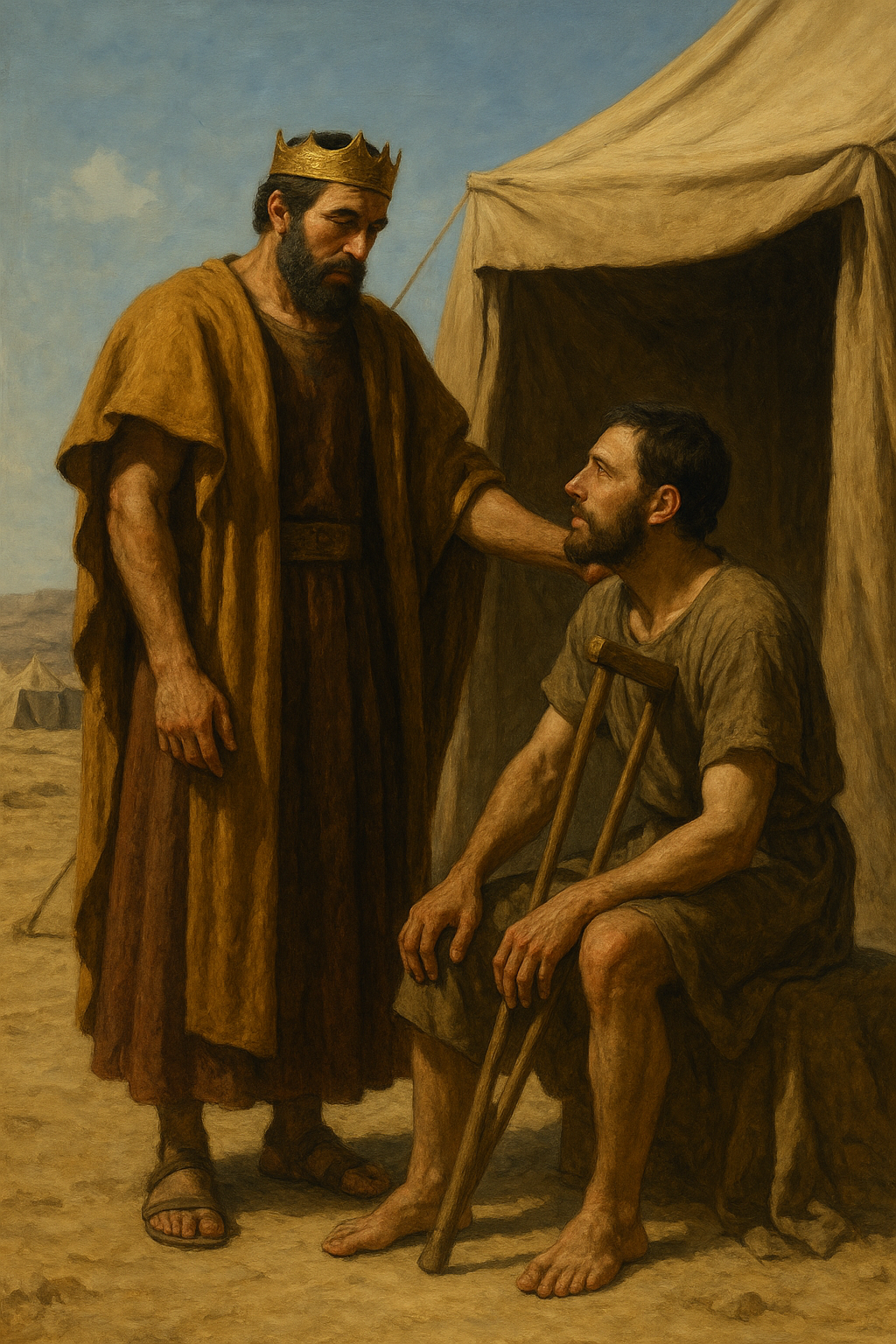
Ziba, a servant of Saul’s house, tells David that Jonathan has a son who is “lame on his feet” (2 Samuel 9:3). This is Mephibosheth. Second Samuel 4:4 explains that he became lame when his nurse fled with him after hearing of Saul and Jonathan’s deaths, and he fell.
Mephibosheth is living in the house of Machir, the son of Ammiel, in Lo-debar. David sends for him.
David restores property and gives Mephibosheth a place at his table (2 Samuel 9:6-13).
Mephibosheth falls on his face before David. David tells him:
“Fear not: for I will surely shew thee kindness for Jonathan thy father’s sake, and will restore thee all the land of Saul thy father; and thou shalt eat bread at my table continually” (2 Samuel 9:7).
David’s stated reason is his regard for Jonathan. The passage does not present Mephibosheth’s accomplishments as the basis for this kindness.
David instructs Ziba, his sons, and his servants to work the land and bring in its produce. Mephibosheth receives a continuing place at the king’s table, “as one of the king’s sons” (2 Samuel 9:11). This describes how David receives and provides for him; the passage does not state that David formally adopts him.
The chapter closes by recording that Mephibosheth lives in Jerusalem and continually eats at the king’s table. It also repeats that he is lame on both feet (2 Samuel 9:13). His welcome does not depend upon the removal of his disability.
David’s kindness can serve as an illustration of grace: a beneficiary receives favor because of another person’s relationship with the giver. However, the chapter does not explicitly identify David as a type of Christ or Mephibosheth as a type of the sinner. The doctrine of salvation by grace rests on direct teaching such as Ephesians 2:8-9.
2 Samuel 10: Rejected Kindness and War with Ammon and Syria
Hanun accepts a false interpretation of David’s intentions (2 Samuel 10:1-5).
After the king of Ammon dies, his son Hanun succeeds him. David sends servants to comfort Hanun concerning his father’s death, explaining:
“I will shew kindness unto Hanun the son of Nahash, as his father shewed kindness unto me” (2 Samuel 10:2).
The passage states that Nahash had shown David kindness but does not explain the circumstances.
The Ammonite princes accuse David’s servants of coming to search the city and overthrow it. Hanun accepts their accusation, shaves off half the men’s beards, cuts their garments, and sends them away.
David learns of their humiliation and tells them to remain at Jericho until their beards have grown, then return. His response provides for the men while they recover from the public shame inflicted upon them.
Joab faces enemies before and behind (2 Samuel 10:6-14).
The Ammonites hire Syrian forces. David sends Joab and the host of the mighty men. With the Ammonites positioned at the entrance of the gate and the Syrians in the field, Joab finds himself facing battle in two directions.
He selects men to face the Syrians and places the remaining forces under Abishai against the Ammonites. The brothers agree to help one another if either force becomes too strong.
Joab says:
“Be of good courage, and let us play the men for our people, and for the cities of our God: and the LORD do that which seemeth him good” (2 Samuel 10:12).
His words join courage, mutual responsibility, and submission to the LORD. He prepares for battle while acknowledging that the outcome belongs to God.
The Syrians flee before Joab, and the Ammonites flee before Abishai and enter the city.
David defeats the regrouped Syrian forces (2 Samuel 10:15-19).
The Syrians gather again. Hadarezer brings additional Syrians from beyond the river, under Shobach, the captain of his host. David gathers Israel, crosses Jordan, and comes to Helam.
The Syrians are defeated, and Shobach dies there. The kings who had served Hadarezer make peace with Israel and serve them. The chapter concludes:
“So the Syrians feared to help the children of Ammon any more” (2 Samuel 10:19).
The account begins with an intended act of kindness and develops into war after that kindness is misrepresented and David’s servants are dishonored.
2 Samuel 11: David’s Sin Against Bathsheba’s Marriage and Uriah’s Life
David remains in Jerusalem while the army besieges Rabbah (2 Samuel 11:1).
At the time “when kings go forth to battle,” David sends Joab, his servants, and all Israel against the Ammonites. They besiege Rabbah, “But David tarried still at Jerusalem.”
This contrast may suggest a neglected responsibility, but Scripture does not explicitly say that remaining in Jerusalem was itself a sin or explain David’s reason for staying. The clearly identified wrongdoing follows in his dealings with Bathsheba and Uriah.
David takes another man’s wife (2 Samuel 11:2-5).
David rises from his bed in the evening and walks on the roof of the king’s house. From there he sees a woman washing herself. He inquires about her and is told that she is Bathsheba, the daughter of Eliam and the wife of Uriah the Hittite.
Despite knowing she is married, David sends messengers and takes her. She comes to him, and he lies with her. She returns home and subsequently sends word that she is with child.
The commandment was explicit: “Thou shalt not commit adultery” (Exodus 20:14). David’s kingship did not exempt him from it.
Scripture does not state that Bathsheba intended to attract David, knew he was watching, or deliberately tempted him. The passage also does not describe her thoughts or establish whether she could freely refuse the king. Those details must not be supplied as facts. The narrative explicitly records David’s knowledge, commands, and actions.
David calls Uriah home (2 Samuel 11:6-13).
David sends for Uriah and asks about Joab, the people, and the war. He then tells Uriah to go to his house. Uriah instead sleeps at the door of the king’s house with David’s servants.
When questioned, Uriah explains:
“The ark, and Israel, and Judah, abide in tents; and my lord Joab, and the servants of my lord, are encamped in the open fields; shall I then go into mine house, to eat and to drink, and to lie with my wife?” (2 Samuel 11:11).
Uriah’s stated concern is solidarity with those remaining in the field. Scripture does not say that he knows what David has done.
David keeps Uriah in Jerusalem and makes him drunk, but Uriah still does not go to his house. The timing and repeated attempts to send him home may indicate that David intends to conceal the child’s paternity. The passage does not explicitly state that motive.
David orders Uriah’s death (2 Samuel 11:14-25).
David writes a letter to Joab and sends it by Uriah’s hand. It contains this order:
“Set ye Uriah in the forefront of the hottest battle, and retire ye from him, that he may be smitten, and die” (2 Samuel 11:15).
Here David’s intention is directly stated. He orders circumstances arranged to bring about Uriah’s death.
Joab assigns Uriah to a place where valiant enemy soldiers are defending the city. In the ensuing fighting, some of David’s servants fall, and Uriah dies also.
David bears responsibility even though enemy soldiers deliver the fatal blow. God’s subsequent indictment confirms this: “thou hast killed Uriah the Hittite with the sword” (2 Samuel 12:9).
When David receives the report, he tells the messenger to encourage Joab and says, “the sword devoureth one as well as another” (2 Samuel 11:25). His response treats the losses as an ordinary event of war, although he had deliberately ordered Uriah’s death.
The LORD declares His displeasure (2 Samuel 11:26-27).
Bathsheba mourns for her husband. After her mourning, David brings her into his house. She becomes his wife and bears him a son.
The chapter’s final statement gives God’s judgment:
“But the thing that David had done displeased the LORD” (2 Samuel 11:27).
Marriage to Bathsheba did not erase David’s previous actions. The chapter closes with divine displeasure; the confrontation and David’s acknowledgment of sin are recorded in chapter 12.
Key People and Places
People
- David: King of Israel. He receives military preservation from the LORD, administers justice, shows kindness to Mephibosheth, and commits grievous sin involving Bathsheba and Uriah.
- Joab: Commander of David’s army. He directs the fighting against Ammon and carries out David’s deadly instructions concerning Uriah.
- Abishai: Joab’s brother, entrusted with the forces facing the Ammonites in chapter 10.
- Mephibosheth: Jonathan’s son and Saul’s grandson. He is lame on both feet and receives restored property and a continuing place at David’s table.
- Jonathan: David’s covenant friend. David expressly shows kindness to Mephibosheth for Jonathan’s sake.
- Ziba: A servant of Saul’s house, assigned with his sons and servants to cultivate Mephibosheth’s land.
- Machir: Son of Ammiel, in whose house Mephibosheth is living when David sends for him.
- Hadadezer/Hadarezer: King of Zobah, named with these spelling forms in chapters 8 and 10, whose forces oppose David.
- Toi and Joram: King of Hamath and his son, who bring congratulations and gifts following David’s victory over Hadadezer.
- Nahash and Hanun: The deceased Ammonite king who had shown David kindness, and his son who dishonors David’s messengers.
- Shobach: Captain of Hadarezer’s host, who dies following the Syrian defeat at Helam.
- Bathsheba: Daughter of Eliam and wife of Uriah. David takes her while Uriah is living; after Uriah’s death and her mourning, she becomes David’s wife.
- Uriah the Hittite: Bathsheba’s husband, who refuses the comforts of home while the army remains in the field and is killed following David’s order.
Places
- Jerusalem: David’s royal residence, Mephibosheth’s home after receiving the king’s provision, and the setting of David’s actions involving Bathsheba and Uriah.
- Metheg-ammah: Taken by David from the Philistines in 2 Samuel 8:1.
- Moab and Edom: Nations brought under David’s authority in chapter 8.
- Zobah, Damascus, and Hamath: Kingdoms or cities involved in the military and diplomatic events of chapters 8 and 10.
- The valley of salt: Location associated with David’s victory in 2 Samuel 8:13.
- Lo-debar: Where Mephibosheth lives in Machir’s house before David summons him.
- Jericho: Where David directs his dishonored servants to remain until their beards grow.
- Helam: Where David confronts the assembled Syrian forces.
- Rabbah: The Ammonite city besieged by Israel’s army during chapter 11.
Main Doctrinal or Spiritual Themes
1. God’s Preservation Calls for Humility
The repeated statement that the LORD preserved David directs attention to God as the source of his military success (2 Samuel 8:6, 14). David’s dedication of silver and gold to the LORD also appears in this setting of victory (2 Samuel 8:11).
The practical principle is dependence upon God rather than self-exaltation. Achievements must never become grounds for assuming that obedience is unnecessary.
2. Authority Remains Subject to God’s Moral Law
David’s responsibility to administer justice is explicit in 2 Samuel 8:15. His conduct toward Uriah violates that responsibility.
God’s commandments against adultery and killing apply to rulers as surely as to their subjects (Exodus 20:13-14). Position, influence, and previous service do not change the moral character of sin.
3. Covenant Faithfulness Produces Concrete Kindness
David’s regard for Jonathan results in practical provision for Mephibosheth: land, support, and fellowship at the king’s table (2 Samuel 9:7-13).
This provides a direct example of keeping commitments and expressing kindness through action. Believers likewise are instructed to love “in deed and in truth” (1 John 3:18).
4. Courage and Submission to God Belong Together
Joab prepares carefully, arranges mutual assistance, and urges courage while leaving the outcome with the LORD (2 Samuel 10:9-12).
Submission to God’s will does not require passivity. The passage shows preparation and action alongside acknowledgment of God’s authority over the outcome.
5. Past Blessing Does Not Guarantee Present Faithfulness
The same David whom God preserved in chapter 8 commits the sins recorded in chapter 11. The text therefore gives no basis for treating past victories as protection from present temptation.
The New Testament warning is fitting: “Wherefore let him that thinketh he standeth take heed lest he fall” (1 Corinthians 10:12).
6. Responsibility Cannot Be Escaped Through Intermediaries
David uses messengers, a written order, Joab’s command, and enemy weapons. Nevertheless, God holds David responsible for Uriah’s death (2 Samuel 11:14-17; 12:9).
A person does not become innocent merely because someone else carries out his sinful instructions.
7. God’s Judgment Is More Important Than Human Appearance
Chapter 11 ends with David married to Bathsheba and a son born. Yet God’s verdict remains that David’s conduct displeased Him.
An outwardly settled situation does not establish God’s approval. His revealed Word, rather than circumstances or appearances, determines right and wrong.
Practical Applications or Lessons
- Give God the glory for His help. David’s victories are repeatedly attributed to the LORD’s preservation. Receive success with gratitude and humility (2 Samuel 8:6, 14).
- Practice justice in the authority entrusted to you. Responsibility in a home, church, ministry, or workplace must be exercised honestly. David’s treatment of Uriah demonstrates the seriousness of using authority to harm another person (2 Samuel 8:15; 11:14-17).
- Keep your commitments through practical kindness. David remembers Jonathan and acts for Mephibosheth’s benefit. Faithfulness should affect what we do with our time, resources, and influence (2 Samuel 9:1-13).
- Treat people with disabilities with dignity. David gives Mephibosheth a place at his table while the text continues to acknowledge his physical condition. Disability must not become a reason to withhold fellowship or respect (2 Samuel 9:11-13; James 2:1).
- Do not accept accusations merely because they sound plausible. Hanun’s counselors misrepresent David’s stated purpose. Their suspicion should warn us against treating an unproven accusation as established truth (2 Samuel 10:2-4).
- Be willing both to give help and to receive it. Joab and Abishai arrange mutual support. Their agreement provides a useful example of shared responsibility in difficult work (2 Samuel 10:9-11).
- Guard what you do after temptation appears. The account explicitly records David’s inquiry, knowledge that Bathsheba was married, and decision to take her. Knowing the truth must lead to obedient action (2 Samuel 11:2-4; James 1:14-15).
- Refuse the attempt to manage sin through further wrongdoing. Chapter 11 records adultery followed by David’s efforts involving Uriah and his explicit order for Uriah’s death. The biblical response to sin is confession and forsaking it: “whoso confesseth and forsaketh them shall have mercy” (Proverbs 28:13).
- Remember that your choices can injure others. Uriah dies, other servants fall, and Bathsheba mourns. Personal wrongdoing can have consequences extending beyond the person who commits it (2 Samuel 11:17, 26).
- Seek God’s approval above a respectable appearance. David’s royal position and subsequent marriage do not change the LORD’s verdict. Evaluate conduct by Scripture, including when it exposes something uncomfortable (2 Samuel 11:27).
Comments are closed