
Chapter Summaries
2 Kings 1 — Ahaziah’s Rebellion and Elijah’s Authority
After the death of Ahab, Moab rebels against Israel. Ahaziah, king of Israel, falls through a lattice and is injured. Instead of seeking the LORD, he sends messengers to inquire of Baal-zebub, the god of Ekron, whether he will recover. The angel of the LORD sends Elijah to intercept them with the rebuke: “Is it not because there is not a God in Israel?” (KJV).
Ahaziah sends a captain with fifty men to arrest Elijah; fire from heaven consumes them. This occurs twice. A third captain approaches humbly and pleads for mercy; his life is spared. Elijah then confronts Ahaziah directly and pronounces the LORD’s judgment: because the king sought a false god, he will die. Ahaziah dies, and Jehoram (his brother) reigns in his stead.
Background & Doctrine: This chapter underscores the exclusivity of the LORD as the only true God in Israel and affirms prophetic authority authenticated by divine power. It also shows that humility before God’s word brings mercy, while presumption invites judgment.
2 Kings 2 — Elijah Taken Up; Elisha’s Call Confirmed
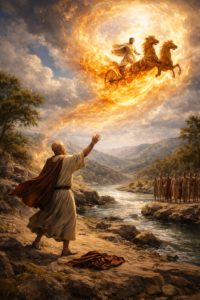 As the LORD prepares to take Elijah to heaven, he travels with Elisha from Gilgal to Bethel, Jericho, and the Jordan. Elisha refuses to leave his master and requests a double portion of Elijah’s spirit—an appeal consistent with the inheritance of a firstborn disciple.
Elijah parts the Jordan with his mantle; after crossing, a chariot of fire and horses of fire separate them, and Elijah is taken up by a whirlwind. Elisha takes up the fallen mantle and crosses back, demonstrating the transfer of prophetic authority. The sons of the prophets acknowledge, “The spirit of Elijah doth rest on Elisha.”
Elisha heals the waters at Jericho, showing God’s restorative power. He then judges mocking youths at Bethel, where they are mauled by bears—an act affirming God’s holiness and the seriousness of despising His appointed servant.
Background & Doctrine: God sovereignly calls and equips His servants. Translation without death prefigures victory over death, while the mantle signifies continuity of God’s work. God is both gracious and holy.
2 Kings 3 — Water in the Wilderness; Victory by the LORD
Jehoram of Israel, Jehoshaphat of Judah, and the king of Edom join forces against Moab. Marching through the wilderness of Edom, they face a water crisis. Jehoshaphat seeks a prophet of the LORD; Elisha is consulted. Though he rebukes Jehoram, Elisha ministers for Jehoshaphat’s sake.
At the LORD’s command, trenches are dug without wind or rain. God miraculously provides water, and the Moabites, seeing the water red as blood, misinterpret it and are routed. When the king of Moab offers his son as a burnt offering, great indignation follows, and Israel withdraws.
Background & Doctrine: God delivers when His word is sought in faith and obedience. Victory comes from the LORD, not human strength. Pagan practices are exposed as abhorrent, and reliance on God—not alliances or desperation—remains central.
Key People and Places
-
Elijah — Prophet of judgment and power; taken up by the LORD.
-
Elisha — Successor to Elijah; prophet of grace and authority.
-
Ahaziah — King of Israel; judged for seeking Baal.
-
Jehoram (Joram) — King of Israel; compromised but used by God in deliverance.
-
Jehoshaphat — God-fearing king of Judah; seeks the LORD’s counsel.
-
Baal-zebub — False god of Ekron.
-
Gilgal, Bethel, Jericho, Jordan — Sites marking prophetic transition.
-
Moab, Edom — Nations involved in conflict with Israel.
Main Doctrinal or Spiritual Themes
-
The Exclusivity of the LORD — God alone is to be sought and trusted.
-
Prophetic Authority — God validates His word through His servants.
-
Holiness and Judgment — God judges rebellion and irreverence.
-
Succession and Faithfulness — God’s work continues through obedient servants.
-
Dependence on God — Deliverance comes through obedience and faith, not human schemes.
Practical Applications or Lessons
-
Seek the LORD first in times of crisis, not substitutes or false hopes.
-
Approach God’s word with humility; pride invites discipline.
-
Remain faithful in service; God honors perseverance.
-
Recognize God’s holiness alongside His mercy.
-
Trust God to provide in barren places when His instructions are obeyed.
Comments are closed