Chapter Summaries
2 Kings 4 — Elisha’s miracles among the faithful remnant
-
The widow’s oil multiplied (4:1–7). A widow of “one of the sons of the prophets” cries that her husband is dead and the creditor is coming to take her two sons as bondmen. Elisha asks, “What hast thou in the house?” She has “not any thing… save a pot of oil.” He commands her to borrow “vessels abroad… not a few,” shut the door, and pour out. The oil continues until the vessels are full; when there is no vessel, the oil stays. Elisha instructs her to sell the oil, pay the debt, and live on the rest.
-
Key KJV phrasing: “borrow… not a few,” “shut the door,” “the oil stayed.”
-
Doctrinal note: God provides through obedient faith, often beginning with what seems small.
-
-
The Shunammite woman and the promised son (4:8–17). In Shunem, a “great woman” urges Elisha to eat bread, then provides a “little chamber… on the wall” with a bed, table, stool, and candlestick. Elisha seeks to bless her; she has no child and her husband is old. Elisha promises, “About this season… thou shalt embrace a son.” The promise is fulfilled.
-
The child dies and is raised (4:18–37). The child later falls ill (“my head, my head”) and dies on his mother’s knees. She lays him on Elisha’s bed, goes to Elisha at Carmel, and refuses to accept dismissal until he comes. Elisha eventually arrives, prays, and stretches himself upon the child; the child’s flesh waxes warm. After repeated intercession and action, the child sneezes seven times and opens his eyes. The mother receives her son alive.
-
Key KJV phrasing: “It is well” (her steady confession amid grief), “he sneezed seven times.”
-
Doctrinal note: God is Lord over life and death; prayer and persistence are emphasized, not technique or superstition.
-
-
Death in the pot made harmless (4:38–41). During famine, the sons of the prophets gather pottage. Someone unknowingly puts in “wild gourds,” and the men cry, “O thou man of God, there is death in the pot.” Elisha casts meal into it, and it becomes safe.
-
Theme: God can correct what man corrupts; He can turn danger into provision.
-
-
Feeding of a hundred men (4:42–44). A man brings “bread of the firstfruits, twenty loaves of barley, and full ears of corn.” Elisha says, “Give unto the people, that they may eat.” Though his servant doubts, Elisha declares, “They shall eat, and shall leave thereof,” and it happens.
-
Theme: The LORD’s word overrules visible limitation.
-
2 Kings 5 — Naaman healed, and Gehazi judged
-
 Naaman’s leprosy and the witness of a captive maid (5:1–6). Naaman, captain of the host of Syria, is “a great man… because by him the LORD had given deliverance unto Syria,” yet “he was a leper.” A little maid from Israel tells Naaman’s wife that a prophet in Samaria would recover him. The king of Syria sends Naaman with a letter and gifts (silver, gold, raiment) to Israel’s king.
 -
Israel’s king panics; Elisha intervenes (5:7–8). The king of Israel rends his clothes, fearing a trap: “Am I God, to kill and to make alive?” Elisha hears and says, “Let him come now to me, and he shall know that there is a prophet in Israel.”
-
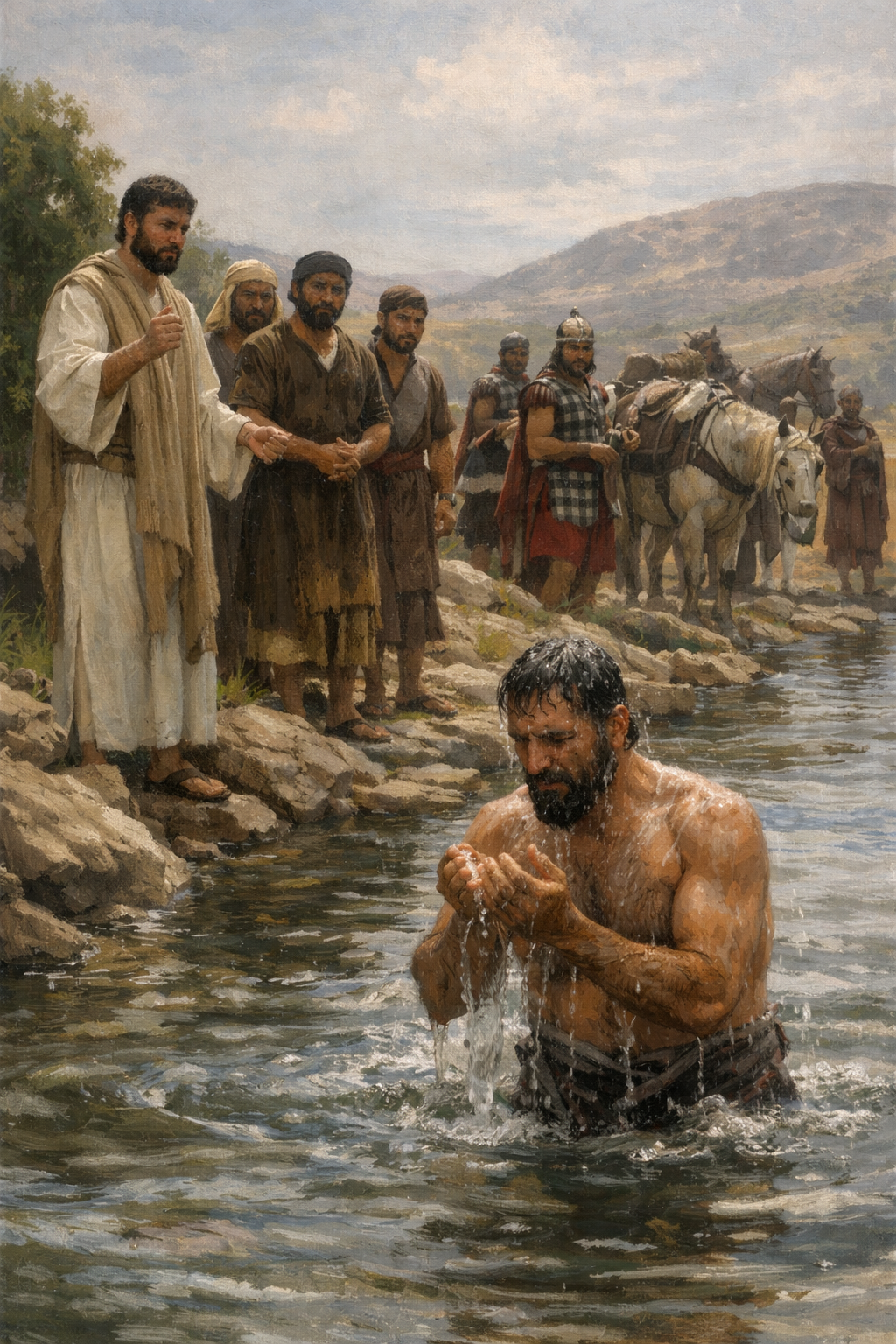
The simple command and Naaman’s pride (5:9–14). Naaman arrives with horses and chariot. Elisha does not come out; he sends a messenger: “Go and wash in Jordan seven times, and thy flesh shall come again to thee, and thou shalt be clean.” Naaman is wroth—he expected Elisha to “come out… and call on the name of the LORD his God… and recover the leper.” He prefers the rivers of Damascus to the Jordan. His servants reason with him: if the prophet asked a great thing, would you not do it? Naaman humbles himself, dips seven times, and “his flesh came again like unto the flesh of a little child, and he was clean.”
-
Key KJV phrasing: “wash… seven times,” “like unto the flesh of a little child.”
-
Doctrinal note: God’s remedy is often plain, and pride is the main obstacle.
-
-
Grace received, payment refused (5:15–19). Naaman returns confessing: “Behold, now I know that there is no God in all the earth, but in Israel.” He urges Elisha to take a blessing; Elisha refuses: “As the LORD liveth… I will receive none.” Naaman requests two mules’ burden of earth and vows he will no longer offer sacrifice to other gods. He also asks pardon regarding his duty in the house of Rimmon. Elisha says, “Go in peace.”
-
Theme: Salvation/help is by God’s mercy, not purchase. Also, a new convert may have real questions as he leaves old entanglements; Elisha does not sell grace.
-
-
Gehazi’s greed and leprosy (5:20–27). Gehazi runs after Naaman and lies, claiming Elisha has visitors and needs silver and raiment. Naaman gives generously. Gehazi hides it, then lies again to Elisha. Elisha exposes him: “Went not mine heart with thee…?” Elisha pronounces judgment: “the leprosy therefore of Naaman shall cleave unto thee, and unto thy seed for ever.” Gehazi goes out “a leper as white as snow.”
-
Theme: Ministry is not merchandise. Covetousness, deceit, and hypocrisy bring severe chastening.
-
Key People and Places
-
Elisha — Prophet in Israel; instrument of God’s power and mercy; models refusal to commercialize God’s work.
-
Widow of a son of the prophets — Picture of helplessness; her deliverance comes through obedient faith.
-
Sons of the prophets — Prophetic community; shown needy in famine but cared for by God.
-
Shunammite woman (a “great woman”) — Hospitable, discerning, steadfast in trial (“It is well”); receives a son and later receives him restored.
-
Shunem — Town in Issachar region; setting for hospitality and miracle.
-
Mount Carmel — Where Elisha is found when the Shunammite seeks him.
-
Naaman — Syrian commander; outwardly great, inwardly needy; healed when humbled to obey God’s word.
-
Little maid of Israel — Captive servant; faithful witness pointing to God’s prophet.
-
King of Syria / King of Israel — Political powers; Israel’s king shows fear and unbelief; God works anyway.
-
Jordan River — Place of Naaman’s humbling obedience.
-
Gehazi — Elisha’s servant; example of corrupted motives; judged with leprosy.
-
Rimmon — Syrian idol temple tied to Naaman’s former official duties.
Main Doctrinal or Spiritual Themes
-
God’s sovereign mercy to the helpless (widow, famine-stricken prophets, grieving mother, leper).
-
Faith expressed through obedient action (borrowing vessels, pouring oil, the Shunammite’s pursuit, dipping in Jordan).
-
God’s power over death and uncleanness (resurrection of the child; cleansing of leprosy; healing of poisoned food).
-
Humility vs. pride (Naaman’s rage contrasted with his later submission; God resists proud expectations).
-
Grace cannot be bought (Elisha refuses gifts; God’s work is not for sale).
-
The danger of covetousness in spiritual service (Gehazi’s lie and judgment).
-
Testimony and missionary witness (the little maid’s simple faith spreads knowledge of the true God).
Practical Applications or Lessons
-
Bring your need to the Lord honestly. The widow tells the truth about her desperation; God meets real needs.
-
Obey even when God’s instructions seem “too simple.” Naaman’s cleansing came when he stopped arguing with God’s method.
-
Hospitality for God’s servants matters. The Shunammite’s provision wasn’t flashy—just faithful and thoughtful.
-
In grief, keep moving toward the Lord. The Shunammite’s “It is well” isn’t denial; it’s refusing despair while seeking God’s help.
-
Don’t mix greed with ministry. Gehazi shows how quickly a heart can ruin a testimony; integrity matters more than “profit.”
-
Be a witness where God planted you. The captive maid didn’t have ideal circumstances, yet she pointed others to truth.
-
Give God the glory for deliverance. Elisha’s refusal of payment protects the message: this is the LORD’s doing, not a prophet’s business.
Comments are closed