Chapter Summaries
Isaiah 4 – The Purification and Future Glory of Zion
 Isaiah 4 continues the aftermath of the judgment described in the previous chapters. Because of war and divine chastisement, many men in Judah will perish. The prophet states:
“And in that day seven women shall take hold of one man, saying, We will eat our own bread, and wear our own apparel: only let us be called by thy name, to take away our reproach.” (Isaiah 4:1)
This verse reflects the devastation that will come upon Judah. In ancient Israel, widowhood and singleness could bring social reproach. The imbalance caused by war will leave many women without husbands.
Yet immediately the chapter shifts from judgment to restoration and hope.
Isaiah introduces a Messianic title:
“In that day shall the branch of the LORD be beautiful and glorious, and the fruit of the earth shall be excellent and comely for them that are escaped of Israel.” (4:2)
The phrase “the Branch of the LORD” is widely recognized by conservative commentators as a prophetic reference to the Messiah. Later prophets use the same title (Jeremiah 23:5; Zechariah 3:8). The Branch represents the righteous King who will arise from the line of David.
The chapter then describes the spiritual cleansing of Jerusalem:
“When the Lord shall have washed away the filth of the daughters of Zion… by the spirit of judgment, and by the spirit of burning.” (4:4)
This indicates purifying judgment. God removes sin through discipline and chastisement.
Finally, Isaiah depicts the restored presence of God over Zion:
“The LORD will create upon every dwelling place of mount Zion… a cloud and smoke by day, and the shining of a flaming fire by night.” (4:5)
This imagery deliberately echoes the pillar of cloud and fire that led Israel in the wilderness (Exodus 13). It symbolizes God’s protective presence.
The chapter ends with the promise that Zion will become a place of divine shelter:
“And there shall be a tabernacle for a shadow in the daytime from the heat.” (4:6)
Thus Isaiah 4 moves from devastation to Messianic hope and restoration.
Isaiah 5 – The Song of the Vineyard and the Six Woes
Isaiah 5 opens with a parable known as the Song of the Vineyard.
“My wellbeloved hath a vineyard in a very fruitful hill.” (5:1)
God describes Israel as His vineyard. Everything necessary for fruitfulness had been provided:
- A fertile hill
- Protection (a hedge)
- Stones removed
- A watchtower and winepress
Yet despite these blessings:
“He looked that it should bring forth grapes, and it brought forth wild grapes.” (5:2)
The vineyard represents Israel’s spiritual failure. Instead of righteousness, the nation produced corruption and injustice.
Isaiah interprets the parable plainly:
“For the vineyard of the LORD of hosts is the house of Israel.” (5:7)
God expected judgment, but saw oppression; He looked for righteousness, but heard a cry.
The chapter then pronounces six prophetic woes, exposing the sins of Judah.
1. Woe to Covetous Landowners (5:8–10)
Those who accumulate land and wealth while oppressing others are condemned.
2. Woe to Drunken Pleasure Seekers (5:11–17)
People indulge in pleasure and ignore God’s works.
3. Woe to Those Who Mock Sin (5:18–19)
They draw sin “as with a cart rope,” defiantly challenging God.
4. Woe to Moral Inversion (5:20)
“Woe unto them that call evil good, and good evil.”
This describes moral confusion—something that occurs when societies reject God’s truth.
5. Woe to Pride in Human Wisdom (5:21)
Self-sufficient pride replaces humility before God.
6. Woe to Corrupt Justice (5:22–23)
Bribery and injustice prevail.
Because of these sins, Isaiah announces coming judgment through foreign invasion:
“He will lift up an ensign to the nations from far.” (5:26)
This refers historically to Assyria, which would later invade Israel and Judah.
The chapter closes with vivid imagery of a fierce invading army sent by God as judgment.
Isaiah 6 – Isaiah’s Vision and Call
Isaiah 6 records one of the most powerful scenes in the Old Testament.
“In the year that king Uzziah died I saw also the Lord sitting upon a throne, high and lifted up.” (6:1)
The earthly king has died, but the heavenly King reigns.
Isaiah sees God in His holiness, surrounded by seraphim crying:
“Holy, holy, holy, is the LORD of hosts: the whole earth is full of his glory.” (6:3)
The triple declaration emphasizes God’s absolute holiness.
Confronted with God’s holiness, Isaiah becomes aware of his own sin:
“Woe is me! for I am undone; because I am a man of unclean lips.” (6:5)
This is genuine repentance.
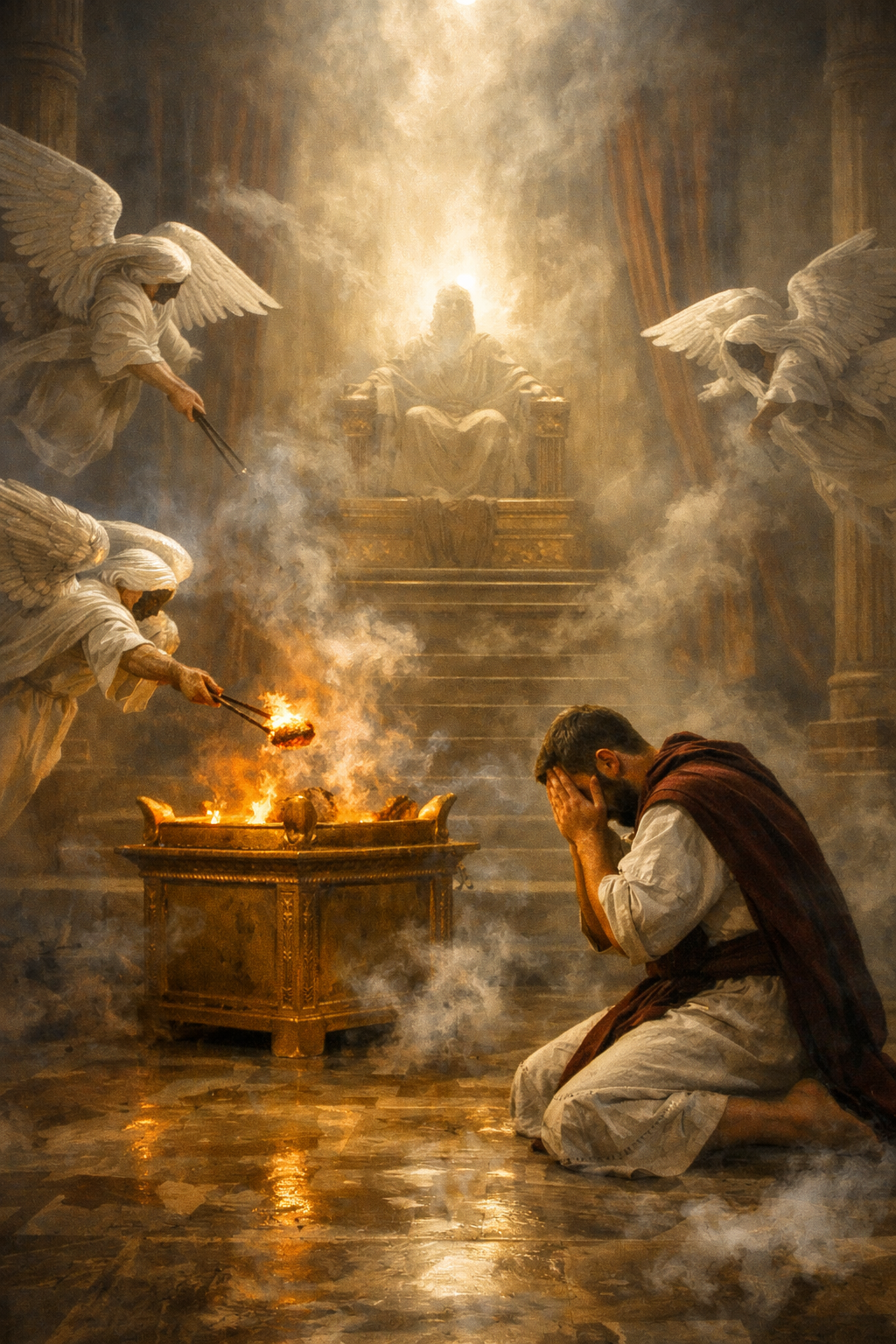
A seraph touches Isaiah’s lips with a live coal from the altar, symbolizing purification and forgiveness:
“Thine iniquity is taken away, and thy sin purged.” (6:7)
After cleansing comes the call to service.
God asks:
“Whom shall I send, and who will go for us?”
Isaiah responds:
“Here am I; send me.” (6:8)
However, Isaiah’s mission will be difficult. The people will largely reject the message.
“Hear ye indeed, but understand not; and see ye indeed, but perceive not.” (6:9)
This prophecy describes spiritual blindness in Israel. The passage is later quoted multiple times in the New Testament (Matthew 13; John 12; Acts 28).
The chapter ends with a small promise of hope:
“The holy seed shall be the substance thereof.” (6:13)
Though the nation will be judged, a remnant will remain.
Isaiah 7 – The Sign of Immanuel
Isaiah 7 occurs during the reign of King Ahaz of Judah.
Two northern kings—Rezin of Syria and Pekah of Israel—form an alliance against Judah.
Ahaz and the people become terrified:
“His heart was moved, and the heart of his people, as the trees of the wood are moved with the wind.” (7:2)
God sends Isaiah to reassure Ahaz that the enemy alliance will fail.
Isaiah tells the king:
“Take heed, and be quiet; fear not.” (7:4)
The two attacking kings are described as “two tails of these smoking firebrands.” Their power is fading.
God even invites Ahaz to request a miraculous sign to confirm His promise:
“Ask thee a sign of the LORD thy God.” (7:11)
But Ahaz refuses, pretending humility while actually rejecting faith.
Because of this unbelief, God gives a sign anyway:
“Behold, a virgin shall conceive, and bear a son, and shall call his name Immanuel.” (7:14)
Immanuel means “God with us.”
Conservative interpreters recognize a dual aspect:
- A near-term sign relevant to Ahaz’s time
- A prophetic foreshadowing fulfilled in the birth of Christ (Matthew 1:23)
The chapter concludes with warnings that Judah will still suffer future judgment through the rising power of Assyria because of Ahaz’s unbelief.
Key People and Places
Isaiah
The prophet of Judah called by God during the reigns of several kings. His ministry emphasized both judgment and future Messianic hope.
King Uzziah
A strong king whose death marked the time of Isaiah’s vision (Isaiah 6).
King Ahaz
A wicked king of Judah who refused to trust God during the Syro-Ephraimite crisis.
Rezin
King of Syria (Aram) who allied with Israel against Judah.
Pekah
King of Israel (Northern Kingdom) who joined the attack against Judah.
Mount Zion / Jerusalem
The spiritual center of Judah where God’s presence is associated with His covenant people.
Assyria
The powerful empire God would use as an instrument of judgment against Israel and Judah.
Main Doctrinal or Spiritual Themes
1. The Holiness of God
Isaiah’s vision in chapter 6 emphasizes God’s absolute purity and majesty.
2. Human Sinfulness
Judah’s moral corruption is exposed in the vineyard parable and the six woes.
3. Divine Judgment
God disciplines nations that reject righteousness.
4. The Remnant Principle
Even during judgment, God preserves a faithful remnant.
5. The Messianic Hope
The “Branch of the LORD” and the prophecy of Immanuel point toward the coming Messiah.
6. Faith Versus Unbelief
Ahaz represents the danger of refusing to trust God’s promises.
Practical Applications or Lessons
God expects fruit from His people.
Like the vineyard, believers who receive God’s blessings should produce righteousness.
Sin eventually brings consequences.
The woes in Isaiah 5 show that moral corruption leads to divine discipline.
A clear vision of God produces humility.
Isaiah’s reaction to God’s holiness reminds believers of the importance of repentance.
God calls and uses cleansed servants.
Isaiah could only say “Here am I; send me” after his sin was purged.
Unbelief robs believers of God’s blessings.
Ahaz’s refusal to trust God led Judah into deeper trouble.
God always keeps His promises.
The prophecy of Immanuel ultimately points to Christ, proving that God’s redemptive plan unfolds exactly as foretold.
Comments are closed