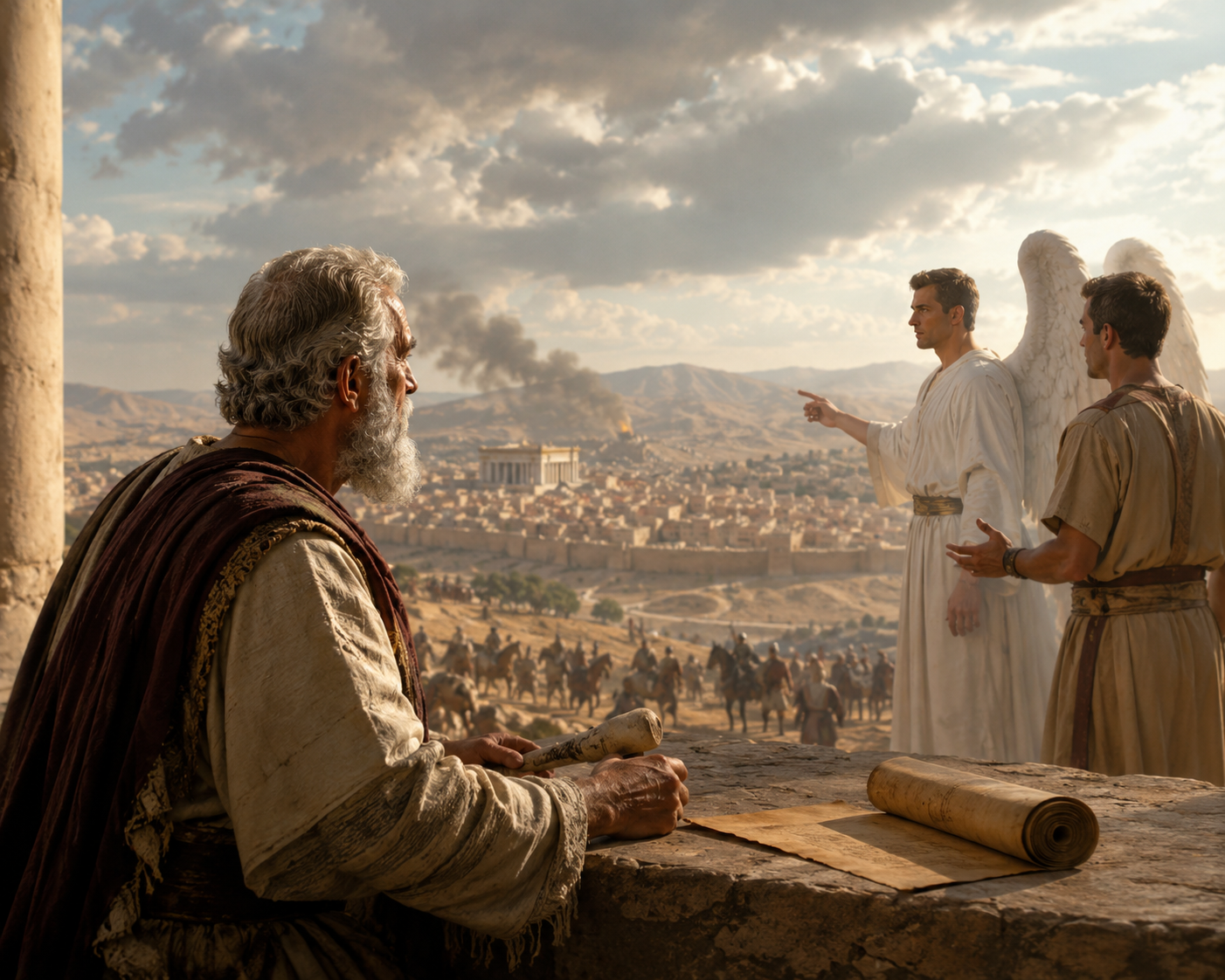
 Daniel 11–12 brings Daniel’s final recorded vision to its conclusion. These chapters contain some of the most detailed prophecy in the Old Testament. Much of Daniel 11 gives a precise prophetic outline of conflicts between kingdoms after Persia, especially involving the Greek empire after Alexander the Great and the later struggles between the kings of the north and south. The chapter then moves toward the latter days and the final wicked ruler who exalts himself against God. Daniel 12 closes the book with tribulation, deliverance, resurrection, judgment, and the sealing of the prophecy until “the time of the end.”
From a conservative Baptist, premillennial viewpoint, Daniel 11 contains both fulfilled historical prophecy and future prophecy. Antiochus Epiphanes is a major historical figure in the chapter, but he also serves as a foreshadowing of the final Antichrist. Daniel 12 looks forward beyond Daniel’s day to Israel’s final trouble, the resurrection of the dead, and the promised kingdom.
Chapter Summaries
Daniel 11 — The Conflict of Kingdoms and the Rise of the Final Wicked King
Daniel 11 continues the angelic message that began in Daniel 10. The messenger tells Daniel that truth is being revealed: “And now will I shew thee the truth” (Daniel 11:2). This is not guesswork, political prediction, or human speculation. God is revealing history before it happens.
Persia and Greece
Daniel 11:2 speaks of coming Persian kings. “There shall stand up yet three kings in Persia; and the fourth shall be far richer than they all.” This points to the continuing Persian empire after Daniel’s time. The wealthy Persian king stirred up conflict against Greece.
Then Daniel 11:3 says, “And a mighty king shall stand up, that shall rule with great dominion.” This is commonly understood to refer to Alexander the Great, whose Greek empire spread rapidly and powerfully. Yet verse 4 says that when he stood up, “his kingdom shall be broken, and shall be divided toward the four winds of heaven.” Alexander’s empire did not pass intact to his own descendants but was divided among his generals.
This agrees with Daniel’s earlier visions: the belly and thighs of brass in Daniel 2, the leopard with four wings and four heads in Daniel 7, and the great horn of the goat being broken in Daniel 8.
Kings of the South and North
Much of Daniel 11 describes conflict between the “king of the south” and the “king of the north.” Historically, these refer mainly to the Ptolemies in Egypt to the south of Israel and the Seleucids in Syria to the north of Israel. Israel was caught between these powers geographically and politically.
This section shows that God knew every shift of power before it happened. Marriages, alliances, betrayals, military campaigns, and political schemes are all under the eye of God. Men may plot, but the Lord rules over the nations.
Daniel 11:6 speaks of an attempted political alliance: “the king’s daughter of the south shall come to the king of the north to make an agreement.” But the agreement would fail. This reminds us that political peace built merely on human manipulation cannot secure what only righteousness and truth can sustain.
The Vile Person: Antiochus Epiphanes
Daniel 11:21 introduces “a vile person.” Historically, this points to Antiochus IV Epiphanes, the Seleucid ruler who bitterly persecuted the Jews and defiled the temple. He gained power by flatteries and deceit rather than honorable right.
Daniel 11:31 says, “And arms shall stand on his part, and they shall pollute the sanctuary of strength, and shall take away the daily sacrifice, and they shall place the abomination that maketh desolate.”
Antiochus did exactly this historically when he desecrated the Jewish temple and sought to crush Jewish worship. Yet this also points forward prophetically because the Lord Jesus later referred to “the abomination of desolation, spoken of by Daniel the prophet” in Matthew 24:15 as something connected with future tribulation events.
So Antiochus is both a historical persecutor and a prophetic foreshadowing of the final Antichrist.
Faithful Resistance
Daniel 11:32 says, “but the people that do know their God shall be strong, and do exploits.” This is one of the great practical verses in Daniel. In a day of compromise, pressure, persecution, and deceit, those who truly know God will stand.
This does not mean they will avoid suffering. Verse 33 says that some “shall fall by the sword, and by flame, by captivity, and by spoil, many days.” Their strength is not worldly safety but spiritual faithfulness. God’s people may suffer under wicked rulers, but they are not abandoned by God.
Daniel 11:35 says some will fall “to try them, and to purge, and to make them white, even to the time of the end.” God uses persecution to refine His people. This is not liberal optimism about human progress. It is biblical truth: God sanctifies His people even through suffering.
The Final King
Beginning around Daniel 11:36, the prophecy appears to move beyond Antiochus and point toward the final end-time ruler, commonly understood in conservative premillennial interpretation as the Antichrist.
Daniel 11:36 says, “And the king shall do according to his will; and he shall exalt himself, and magnify himself above every god.” This agrees with the description of the “man of sin” in 2 Thessalonians 2, who “opposeth and exalteth himself above all that is called God.”
This final ruler is marked by pride, blasphemy, self-will, military power, and hatred toward the true God. He honors “the God of forces” and is consumed with conquest and domination. Yet his end is certain: “he shall come to his end, and none shall help him” (Daniel 11:45).
That is a sober but comforting truth. The final enemy may rise, rage, and deceive, but he cannot overthrow God’s decree. Evil has a deadline.
Daniel 12 — Trouble, Resurrection, Reward, and the Time of the End
Daniel 12 continues directly from the end of Daniel 11. The final wicked ruler is active, Israel is in great trouble, and heavenly deliverance is promised.
Michael Stands Up
Daniel 12:1 says, “And at that time shall Michael stand up, the great prince which standeth for the children of thy people.”
Michael is the angelic prince associated with Israel. He was already mentioned in Daniel 10. Here he is connected with Israel’s final time of distress and deliverance.
The verse continues: “and there shall be a time of trouble, such as never was since there was a nation even to that same time.” This is commonly understood as the Great Tribulation, especially in light of Matthew 24:21, where Jesus speaks of “great tribulation, such as was not since the beginning of the world.”
Yet the verse also gives hope: “and at that time thy people shall be delivered, every one that shall be found written in the book.” God has not forgotten Israel. The promises of God are not erased by persecution, Gentile dominion, or satanic opposition.
Resurrection and Judgment
Daniel 12:2 is one of the clearest Old Testament statements on resurrection:
“many of them that sleep in the dust of the earth shall awake, some to everlasting life, and some to shame and everlasting contempt.”
This verse teaches bodily resurrection and eternal destiny. The righteous are raised to everlasting life. The wicked are raised to shame and everlasting contempt.
This agrees with the broader teaching of Scripture. There is a resurrection of life and a resurrection of damnation, as Jesus taught in John 5:28–29. Death is not the end. Eternity is real. Judgment is certain.
The Wise Shine
Daniel 12:3 says, “And they that be wise shall shine as the brightness of the firmament; and they that turn many to righteousness as the stars for ever and ever.”
This verse honors faithful witnesses. Those who know God and point others to righteousness will not be forgotten. In Daniel’s context, this includes those who stand true during persecution. In application, it encourages all believers to live wisely, witness faithfully, and seek the eternal reward of God rather than the applause of men.
The Book Sealed
Daniel 12:4 says, “shut up the words, and seal the book, even to the time of the end.” This does not mean the book is meaningless. It means the full understanding of these prophecies would become clearer as the time of fulfillment approached.
Daniel is then shown two others standing by the river, and one asks, “How long shall it be to the end of these wonders?” The answer includes “a time, times, and an half” (Daniel 12:7), commonly understood as three and a half years, connected with the final period of intense tribulation.
Purified and Wicked
Daniel 12:10 says, “Many shall be purified, and made white, and tried; but the wicked shall do wickedly.”
This is a serious division. Trouble does not automatically make men holy. Some are purified through trial. Others continue in wickedness. The issue is not merely pressure but the condition of the heart before God.
The verse continues: “none of the wicked shall understand; but the wise shall understand.” Spiritual understanding is not merely intellectual. It is tied to reverence, faith, obedience, and the fear of the Lord.
The 1,290 and 1,335 Days
Daniel 12:11–12 mentions 1,290 days and 1,335 days. These numbers are connected with the taking away of the daily sacrifice and the abomination that maketh desolate.
The exact details are debated among conservative interpreters, but from a premillennial view they relate to the closing events of the Tribulation and the transition into Christ’s kingdom. The important point is that God has measured the days. The persecution is not endless. The Antichrist will not rule one day beyond what God permits.
Daniel 12:12 says, “Blessed is he that waiteth, and cometh to the thousand three hundred and five and thirty days.” Those who endure to God’s appointed end are blessed.
Daniel’s Personal Promise
The book ends with a personal word to Daniel:
“But go thou thy way till the end be: for thou shalt rest, and stand in thy lot at the end of the days” (Daniel 12:13).
Daniel would die and rest, but death would not cancel God’s promise. He would “stand” in resurrection and receive his appointed portion. This is a precious ending. Daniel had served faithfully in Babylon, under pagan kings, through visions of coming trouble, and now God assures him of future resurrection and reward.
Key People and Places
Daniel
The aged prophet and servant of God. He receives the final vision and is shown events reaching from the Persian period to the time of the end. Daniel is faithful, reverent, and humble, even when he does not fully understand everything revealed.
The Angelic Messenger
The heavenly messenger continues explaining the vision begun in Daniel 10. He reveals “the truth” to Daniel and shows that earthly kingdoms are subject to divine prophecy.
Michael
The great angelic prince associated with Israel. In Daniel 12:1 he stands for Daniel’s people during the final time of trouble.
Persia
The empire ruling during Daniel’s later years. Daniel 11 begins by describing coming Persian kings before moving to Greece.
Greece
The empire represented by the “mighty king” in Daniel 11:3, commonly understood as Alexander the Great. His kingdom would be divided after his death.
King of the South
Generally associated historically with the Ptolemaic rulers of Egypt. The south is south in relation to Israel.
King of the North
Generally associated historically with the Seleucid rulers of Syria. The north is north in relation to Israel.
Antiochus Epiphanes
The “vile person” of Daniel 11:21 in the historical fulfillment. He persecuted the Jews, corrupted worship, and defiled the sanctuary. He foreshadows the final Antichrist.
The Final King / Antichrist Figure
The self-exalting ruler described especially in Daniel 11:36–45. He magnifies himself above every god, uses military power, and comes to his end without help.
Israel
Daniel’s people are central to the prophecy. These chapters concern the future of Israel, Gentile powers, persecution, deliverance, and the final kingdom promises.
The Sanctuary
The Jewish temple worship is central in Daniel 11:31 and 12:11, especially with the taking away of the daily sacrifice and the abomination that maketh desolate.
Main Doctrinal or Spiritual Themes
1. God’s Sovereignty Over History
Daniel 11 is one of the strongest chapters in Scripture showing that God rules over history before it unfolds. Kingdoms rise, kings plot, armies march, alliances form, and betrayals occur — but none of it surprises God.
The Lord does not merely react to history. He declares the end from the beginning. The precision of Daniel 11 reminds believers that God is never confused by world events.
2. Prophecy Is the Word of God, Not Human Guesswork
The angel says, “I will shew thee the truth.” Biblical prophecy is not fortune-telling, probability, or political theory. It is divine revelation.
This strengthens confidence in Scripture. Fulfilled prophecy proves the reliability of God’s Word and gives confidence that future prophecy will also be fulfilled.
3. The Reality of Spiritual Conflict
Daniel 10 already revealed conflict in the unseen realm. Daniel 11–12 shows that earthly political events are not merely earthly. Satanic opposition, wicked rulers, persecution, and attacks on worship are part of a larger spiritual conflict.
Believers must not view the world only through politics or economics. There is a spiritual war behind much of what happens among nations.
4. The Danger of Flattery and Deceit
Daniel 11 repeatedly mentions corrupt dealings, deceit, and flatteries. The vile person obtains power through flatteries. Daniel 11:32 says he will corrupt “by flatteries.”
False religion and wicked leadership often use smooth words, not merely open force. The believer must be grounded in truth so he is not carried away by charming deception.
5. Faithfulness Under Persecution
“The people that do know their God shall be strong, and do exploits” is not a promise of an easy life. It is a promise of spiritual strength under pressure.
Daniel 11 teaches that some of God’s faithful people suffer severely. Yet suffering does not mean defeat. God purifies His people and records their faithfulness.
6. The Future Tribulation
Daniel 12:1 speaks of a time of trouble unlike any before it. This fits with the Great Tribulation described by the Lord Jesus in Matthew 24 and with later prophecy concerning the final period before Christ’s kingdom.
From a conservative premillennial Baptist view, Daniel 12 points toward Israel’s future distress and deliverance during the end times.
7. The Resurrection of the Dead
Daniel 12:2 clearly teaches resurrection. Some awake to everlasting life; others to shame and everlasting contempt.
This refutes the idea that death ends all things. It also refutes the idea that all men share the same eternal destiny. Scripture teaches eternal life for the saved and eternal judgment for the lost.
8. Eternal Reward for Faithful Witnesses
Daniel 12:3 honors those who are wise and those who “turn many to righteousness.” God sees faithful witness. Soul-winning, teaching truth, standing for righteousness, and guiding others toward God have eternal value.
9. The Certainty of God’s Timetable
The days in Daniel 12 show that God measures the end. Evil is not unlimited. The Antichrist’s reign, the abomination, and the final trouble all occur under divine limitation.
The believer can rest in this: God has not lost control, and God’s calendar will not fail.
10. Rest and Resurrection Hope
Daniel is told he will “rest” and later “stand” in his lot. This beautifully summarizes the believer’s hope. Death is rest for the righteous, but it is not the final state. Resurrection and reward are coming.
Practical Applications or Lessons
1. Trust God When the Nations Are Shaken
Daniel 11 is filled with wars, political schemes, shifting empires, and cruel rulers. Yet God was ruling over every detail. The believer today should not panic when nations are unstable.
God’s throne is higher than every earthly throne.
2. Do Not Be Deceived by Smooth Words
The wicked ruler corrupts by flatteries. Satan often uses attractive language, religious compromise, political promises, and worldly success to draw people away from truth.
Believers must judge teaching, leadership, and movements by Scripture, not by charm.
3. Know God Personally and Deeply
Daniel 11:32 does not say merely that those who know about God shall be strong. It says “the people that do know their God.”
Strength in evil days comes from knowing God — His Word, His character, His promises, His holiness, and His faithfulness.
4. Expect Opposition, but Remain Faithful
Daniel’s prophecy does not promise that God’s people will avoid all suffering. Some are tried, purged, and made white. Faithfulness may cost something.
The believer must not measure God’s favor only by outward comfort.
5. Remember That Evil Has an End
The final wicked king “shall come to his end, and none shall help him.” No matter how proud, powerful, or blasphemous evil becomes, God has already appointed its destruction.
This is a comfort to the righteous and a warning to the wicked.
6. Live in Light of the Resurrection
Daniel 12:2 forces every person to think beyond this life. There is everlasting life, and there is everlasting contempt.
The gospel issue is eternal. Men need more than religion, morality, politics, or reform. They need salvation.
7. Be a Faithful Witness
Daniel 12:3 gives special honor to those who “turn many to righteousness.” Believers should be concerned about souls, not merely survival.
A faithful witness may seem unnoticed now, but God records it for eternity.
8. Wait Patiently for God’s Time
Daniel wanted to understand, but he was not given every detail. He was told to go his way. Some things belonged to the time of the end.
Believers must study prophecy seriously, but they must also avoid proud speculation. Where God has spoken, we believe. Where God has not revealed every detail, we wait.
9. Rest in God’s Personal Promise
Daniel’s final word is personal: “thou shalt rest, and stand in thy lot at the end of the days.”
This is a fitting close to the book. Daniel had lived through captivity, pagan courts, spiritual warfare, visions of beasts, and prophecies of coming trouble. Yet God’s last word to him was rest, resurrection, and reward.
The same God who ruled Babylon, Persia, Greece, and the future kingdom also keeps His promises to His servants.
Closing Summary
Daniel 11–12 shows that God rules history, reveals truth, preserves His people, judges wickedness, and will raise the dead. Antiochus Epiphanes stands as a historical persecutor and a shadow of the coming Antichrist. The final days will bring severe trouble, but not final defeat for God’s people.
The book ends not with Babylon, Persia, Greece, or Antichrist, but with God’s promise: resurrection, reward, and the certainty that His servants will stand in their appointed lot “at the end of the days.”
Comments are closed