
Daniel 8–10 moves from visions of Gentile kingdoms to one of the clearest prophetic passages in the Old Testament concerning Israel’s future, Messiah’s coming, and the spiritual warfare behind earthly events. These chapters show that God rules history, reveals truth to His servants, judges prideful rulers, and answers the prayers of His people in His appointed time.
Daniel is no longer interpreting dreams for heathen kings here; he is receiving direct revelation from God. The visions are troubling, detailed, and prophetic. They concern the rise and fall of empires, the suffering of the Jews, the coming of Messiah, and the unseen spiritual conflict behind world powers.
Chapter Summaries
Daniel 8 — The Ram, the He Goat, and the Little Horn
Daniel 8 takes place “in the third year of the reign of king Belshazzar” (Daniel 8:1). This means the vision occurs before Babylon falls in Daniel 5, even though it appears later in the book. Daniel sees himself at Shushan in the palace, in the province of Elam, by the river Ulai.
 The Ram with Two Horns
Daniel sees a ram with two horns. One horn is higher than the other, and the higher came up last. The ram pushes westward, northward, and southward, and no beast can stand before him.
Gabriel later explains plainly:
“The ram which thou sawest having two horns are the kings of Media and Persia” (Daniel 8:20).
The two horns picture the Medo-Persian Empire. The higher horn coming up last fits Persia becoming the stronger power after Media. This is not guesswork; the Bible gives the interpretation.
The He Goat from the West
Daniel then sees a he goat coming from the west “on the face of the whole earth,” moving so swiftly that he “touched not the ground” (Daniel 8:5). The goat has a notable horn between his eyes. He attacks the ram with fury, breaks his two horns, casts him down, and stamps upon him.
Gabriel explains:
“And the rough goat is the king of Grecia: and the great horn that is between his eyes is the first king” (Daniel 8:21).
This points to Greece, and the first great king is commonly understood to be Alexander the Great. His rapid conquest fits the image of the goat moving so swiftly that it seemed not to touch the ground.
The Great Horn Broken
When the goat becomes strong, the great horn is broken. In its place come up four notable horns toward the four winds of heaven.
Gabriel explains:
“Now that being broken, whereas four stood up for it, four kingdoms shall stand up out of the nation, but not in his power” (Daniel 8:22).
Historically, after Alexander’s death, his empire was divided among his generals. The prophecy is exact: the one great power does not continue under his son with the same strength, but is divided into four lesser kingdoms.
The Little Horn
Out of one of those divisions comes a “little horn,” which becomes exceeding great toward the south, east, and “the pleasant land” (Daniel 8:9). This horn casts down some of the host and stars, magnifies himself even “to the prince of the host,” takes away the daily sacrifice, and casts down the sanctuary.
This historically points to Antiochus IV Epiphanes, the wicked ruler who persecuted the Jews and defiled the temple. He is also a prophetic type of the coming Antichrist. In conservative interpretation, Daniel 8 has a near fulfillment in Antiochus but also foreshadows the end-time man of sin who will oppose God and persecute Israel.
The chapter says:
“And an host was given him against the daily sacrifice by reason of transgression, and it cast down the truth to the ground” (Daniel 8:12).
That phrase is sobering: “it cast down the truth to the ground.” Wicked rulers and false religious systems often seek not merely political power, but the destruction of truth itself.
The 2,300 Days
Daniel hears one saint ask how long the vision will be concerning the daily sacrifice and sanctuary being trodden under foot. The answer is:
“Unto two thousand and three hundred days; then shall the sanctuary be cleansed” (Daniel 8:14).
There are different views among conservative interpreters on the exact calculation of these days, but the main point is clear: God sets a limit on the desecration. Evil may appear to triumph, but it is measured by God. The sanctuary will be cleansed. The Lord does not surrender His program to the enemy.
Gabriel Explains the Vision
Daniel seeks understanding, and Gabriel is commanded:
“Gabriel, make this man to understand the vision” (Daniel 8:16).
Daniel falls on his face, afraid. Gabriel tells him that the vision concerns “the time of the end” (Daniel 8:17). This does not erase the historical fulfillment in the Greek period, but it shows the vision reaches beyond Antiochus as a pattern of end-time rebellion.
The final ruler described is “a king of fierce countenance” (Daniel 8:23). He understands dark sentences, destroys wonderfully, prospers, destroys the mighty and holy people, and stands up against “the Prince of princes” (Daniel 8:25).
But the end is certain:
“He shall be broken without hand” (Daniel 8:25).
This means his destruction comes by divine power, not merely human force.
Daniel is so affected by the vision that he faints and is sick certain days. Afterward, he rises and does the king’s business, but he remains astonished at the vision.
Daniel 9 — Daniel’s Prayer and the Seventy Weeks
Daniel 9 is one of the greatest prophetic chapters in Scripture. It combines a model prayer of confession with a precise prophecy concerning Israel, Jerusalem, Messiah, and the future tribulation.
The chapter occurs “in the first year of Darius the son of Ahasuerus” (Daniel 9:1). Babylon has fallen. Daniel understands by the writings of Jeremiah that the desolations of Jerusalem would last seventy years.
Daniel Studies the Scriptures
Daniel says:
“I Daniel understood by books the number of the years” (Daniel 9:2).
This is important. Daniel was a prophet, but he still studied the written Word of God. He did not despise Scripture because he received visions. He submitted himself to the written Word.
He read Jeremiah and understood that the captivity would be seventy years. That knowledge did not make him passive. It drove him to prayer.
Daniel’s Prayer of Confession
Daniel sets his face unto the Lord God “to seek by prayer and supplications, with fasting, and sackcloth, and ashes” (Daniel 9:3).
His prayer is humble, reverent, and full of confession. He begins with God’s greatness:
“O Lord, the great and dreadful God, keeping the covenant and mercy to them that love him” (Daniel 9:4).
Daniel does not blame God. He confesses Israel’s sin:
“We have sinned, and have committed iniquity, and have done wickedly” (Daniel 9:5).
This is striking because Daniel himself is one of the godliest men in Scripture. Yet he identifies with his people. He does not pray as a proud critic over them, but as an intercessor among them.
He confesses that Israel has rebelled against God’s commandments, ignored the prophets, and refused to obey the voice of the Lord. He acknowledges that the curse written in the law of Moses has been poured out upon them because they sinned against God.
Daniel appeals not to Israel’s righteousness, but to God’s mercy:
“For we do not present our supplications before thee for our righteousnesses, but for thy great mercies” (Daniel 9:18).
That is one of the clearest statements of grace in the Old Testament. Daniel understands that restoration must be based on mercy, not merit.
He pleads:
“O Lord, hear; O Lord, forgive; O Lord, hearken and do” (Daniel 9:19).
Daniel’s concern is not merely personal comfort. He prays for Jerusalem, the sanctuary, and the honor of God’s name.
Gabriel Comes with the Answer
While Daniel is praying, Gabriel comes swiftly and says:
“O Daniel, I am now come forth to give thee skill and understanding” (Daniel 9:22).
Daniel is told he is “greatly beloved” (Daniel 9:23). The answer comes while he is still praying. God had already heard.
The Seventy Weeks
Gabriel gives Daniel one of the most important prophetic timelines in Scripture:
“Seventy weeks are determined upon thy people and upon thy holy city” (Daniel 9:24).
The “weeks” are commonly understood as weeks of years. Seventy weeks equals 490 years. This period is specifically determined upon “thy people” and “thy holy city,” meaning Israel and Jerusalem. The church is not the direct subject of this prophecy.
Six purposes are listed:
- “To finish the transgression”
- “To make an end of sins”
- “To make reconciliation for iniquity”
- “To bring in everlasting righteousness”
- “To seal up the vision and prophecy”
- “To anoint the most Holy”
These purposes are not all completed in Daniel’s day. They point forward to Messiah’s work and the final restoration of Israel under God’s kingdom program.
From the Commandment to Messiah
Daniel 9:25 says that from the commandment to restore and build Jerusalem unto Messiah the Prince shall be seven weeks and threescore and two weeks — 69 weeks total.
This points to a prophetic period leading to the coming of Messiah. Conservative premillennial Baptist interpretation commonly understands this as fulfilled in the coming of Jesus Christ, especially His presentation to Israel before His crucifixion.
Messiah Cut Off
Daniel 9:26 says:
“And after threescore and two weeks shall Messiah be cut off, but not for himself.”
This is a powerful prophecy of the death of Christ. “Cut off” speaks of violent death. “But not for himself” shows substitution. The Messiah would die, not for His own sin, but for others.
This agrees with Isaiah 53, where the suffering Servant is wounded for our transgressions and bruised for our iniquities. It also agrees with the New Testament truth that Christ died for our sins according to the Scriptures.
The Destruction of Jerusalem
Daniel 9:26 also says:
“And the people of the prince that shall come shall destroy the city and the sanctuary.”
This was fulfilled when the Romans destroyed Jerusalem and the temple in A.D. 70. The text says “the people of the prince that shall come,” which indicates that the coming prince is connected to the people who destroyed Jerusalem. Conservative dispensational interpretation commonly sees this future prince as the Antichrist, arising from a revived form of the Roman sphere.
The Final Week
Daniel 9:27 says:
“And he shall confirm the covenant with many for one week.”
This final week is understood as the seventieth week of Daniel — a future seven-year period. In the midst of the week, he causes the sacrifice and oblation to cease, and the abomination of desolation follows.
Jesus referred to “the abomination of desolation, spoken of by Daniel the prophet” in Matthew 24:15, placing its ultimate fulfillment in the future tribulation period.
This means Daniel 9 gives the framework for the coming seventieth week, commonly called the tribulation. The church age fits between the sixty-ninth and seventieth weeks as a mystery not revealed in Daniel’s prophecy. God’s prophetic clock concerning Israel will resume in the tribulation.
Daniel 10 — Daniel’s Mourning and the Unseen Spiritual Battle
Daniel 10 begins “in the third year of Cyrus king of Persia” (Daniel 10:1). Daniel receives a revelation concerning “a great warfare” or “the thing was true, but the time appointed was long.”
Daniel understands the thing and the vision, but it burdens him deeply.
Daniel’s Mourning
Daniel says:
“In those days I Daniel was mourning three full weeks” (Daniel 10:2).
He eats no pleasant bread, neither flesh nor wine, and does not anoint himself. This is a partial fast and a time of serious spiritual seeking.
This mourning likely connects with the condition of the Jewish people and the future troubles revealed to him. Though some Jews had returned under Cyrus, the full restoration had not yet come. Daniel is burdened for God’s people and God’s program.
The Man Clothed in Linen
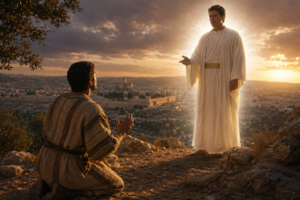
Daniel sees a glorious heavenly messenger:
“A certain man clothed in linen, whose loins were girded with fine gold of Uphaz” (Daniel 10:5).
His body is like beryl, his face like lightning, his eyes like lamps of fire, his arms and feet like polished brass, and his voice like the voice of a multitude.
Some conservative interpreters see this as a mighty angel; others see a Christophany, an appearance of the preincarnate Christ. The description resembles the vision of Christ in Revelation 1, though the following verses describe angelic conflict in a way that leads many to distinguish the messenger from the Lord Himself. Either way, Daniel is overwhelmed by heavenly glory.
The men with Daniel do not see the vision, but a great quaking falls upon them, and they flee. Daniel is left alone and loses his strength.
Daniel Strengthened
Daniel falls into a deep sleep with his face toward the ground. A hand touches him and sets him on his knees and palms. The messenger says:
“O Daniel, a man greatly beloved, understand the words that I speak unto thee” (Daniel 10:11).
Daniel trembles, but he is told not to fear.
The messenger explains that from the first day Daniel set his heart to understand and chasten himself before God, his words were heard.
That is a tremendous encouragement: the answer was not delayed because God was indifferent. Daniel was heard from the first day.
The Prince of Persia
The messenger says:
“But the prince of the kingdom of Persia withstood me one and twenty days” (Daniel 10:13).
This is not speaking of a mere human prince. The context indicates a spiritual ruler behind Persia — a demonic power associated with that kingdom.
Then Michael, “one of the chief princes,” comes to help. Michael is later connected especially with Israel in Daniel 12:1.
This chapter pulls back the curtain and shows that earthly kingdoms are influenced by spiritual powers. There is visible history, and there is invisible conflict. God’s people must not think that politics, kingdoms, laws, and wars are merely human events. There is a spiritual battlefield behind them.
The Vision Concerns the Latter Days
The messenger tells Daniel:
“Now I am come to make thee understand what shall befall thy people in the latter days” (Daniel 10:14).
Again, the focus is Daniel’s people — Israel. The prophecy stretches into the latter days. Daniel becomes speechless and weak, but he is touched and strengthened again.
The messenger says:
“O man greatly beloved, fear not: peace be unto thee, be strong, yea, be strong” (Daniel 10:19).
Daniel is strengthened by the word of God’s messenger.
The chapter ends by preparing for the detailed prophecy of Daniel 11. The messenger says he must return to fight with the prince of Persia, and afterward the prince of Grecia will come. He also says that Michael is the chief heavenly prince standing with him in this conflict.
Key People and Places
Daniel
Daniel is the prophet, servant, intercessor, and recipient of these visions. He is faithful in Babylon and Persia, yet deeply burdened over Israel’s future. He studies Scripture, prays with confession, mourns over God’s people, and receives prophetic revelation.
Gabriel
Gabriel appears in Daniel 8 and 9 to give understanding. He explains the vision of the ram and goat and later brings the prophecy of the seventy weeks. Gabriel’s role is that of a messenger sent from God to reveal truth.
Michael
Michael appears in Daniel 10 as “one of the chief princes.” He helps in the spiritual conflict against the prince of Persia. Daniel 12:1 later connects Michael especially with the children of Daniel’s people, Israel.
Belshazzar
Belshazzar is mentioned in Daniel 8:1 as the king during whose third year Daniel received the vision. His reign places the vision before the fall of Babylon.
Darius
Darius is mentioned in Daniel 9:1. In his first year, Daniel studies Jeremiah and understands the seventy years of Jerusalem’s desolations.
Cyrus
Cyrus king of Persia is mentioned in Daniel 10:1. His reign connects with the return of the Jews from captivity, though Daniel remains burdened because the full prophetic restoration is yet future.
The Ram
The ram represents Media and Persia. Its two horns picture the twofold nature of the empire, with Persia becoming dominant.
The He Goat
The goat represents Greece. The notable horn points to the first great king, commonly understood as Alexander the Great.
The Little Horn of Daniel 8
The little horn in Daniel 8 historically points to Antiochus Epiphanes, who persecuted the Jews and defiled the temple. He also foreshadows the future Antichrist, who will oppose God and persecute Israel in the latter days.
Messiah the Prince
Daniel 9:25–26 points to the coming of Messiah and His being “cut off, but not for himself.” This is a prophetic reference to the Lord Jesus Christ and His substitutionary death.
The Prince That Shall Come
Daniel 9:26–27 speaks of a future ruler connected with the people who destroyed Jerusalem. Conservative premillennial interpretation understands this as the Antichrist, who will confirm a covenant and then break it in the middle of the seventieth week.
Shushan
Shushan is where Daniel sees himself in the vision of chapter 8. It later becomes a significant Persian royal city, also appearing in the book of Esther.
The River Ulai
The Ulai is the river or canal near Shushan where Daniel receives the vision of the ram and goat.
Jerusalem
Jerusalem is central in Daniel 9. Daniel prays for the holy city, and the seventy weeks are determined upon Daniel’s people and holy city.
The Sanctuary
The sanctuary is defiled in Daniel 8 and later connected to future events in Daniel 9. The temple and its worship are central to Israel’s prophetic program.
Persia
Persia appears both as a historical empire and as a realm with spiritual conflict behind it. The “prince of Persia” in Daniel 10 shows demonic opposition connected with world powers.
Grecia
Greece is represented by the he goat in Daniel 8. Daniel 10 also mentions the coming “prince of Grecia,” indicating future conflict connected with that empire.
Main Doctrinal or Spiritual Themes
1. God Rules Over World Empires
Daniel 8 shows that Media-Persia and Greece did not rise by accident. Their rise, victories, divisions, and decline were known to God beforehand. The Lord rules over kings and kingdoms.
Human empires appear powerful, but they are temporary. God sets their boundaries and determines their end.
2. Prophecy Is Exact Because God Is Sovereign
Daniel 8 and 9 contain detailed prophecy. The ram, goat, horns, division of kingdoms, Messiah’s coming, Jerusalem’s destruction, and the final week all show that God knows and controls history.
Biblical prophecy is not vague religious imagination. It is revelation from the God who declares the end from the beginning.
3. Messiah Would Be Cut Off for Others
Daniel 9:26 says:
“Messiah be cut off, but not for himself.”
This is one of the strongest Old Testament prophecies of Christ’s death. The Lord Jesus did not die for His own sins. He died as the sinless substitute for sinners.
This agrees with the gospel: Christ died for our sins, was buried, and rose again the third day according to the Scriptures.
4. Israel Still Has a Prophetic Future
The seventy weeks are determined upon “thy people” and “thy holy city.” Daniel’s people are Israel, and the holy city is Jerusalem.
This supports the conservative premillennial view that God has not permanently cast away Israel. The church is not Israel. God will fulfill His promises to Israel in His time.
5. Sin Brings Chastening
Daniel’s prayer acknowledges that Jerusalem’s desolations came because Israel sinned against God. Daniel does not accuse God of unfairness. He confesses that God is righteous and Israel is guilty.
National sin, religious rebellion, and rejection of God’s Word bring judgment.
6. Prayer Should Be Grounded in Scripture
Daniel’s prayer begins with Bible study. He reads Jeremiah, understands the seventy years, and then prays.
True prayer is not a substitute for the Word of God. It is strengthened and guided by the Word of God.
7. Confession Is Essential to Revival
Daniel repeatedly says, “we have sinned.” He confesses rebellion, disobedience, and failure to heed the prophets.
Revival does not begin with excuses. It begins with humility, confession, and appeal to God’s mercy.
8. God Hears Prayer Immediately, Even When the Answer Seems Delayed
Daniel 10 shows that Daniel was heard from the first day he prayed. Yet the messenger was delayed by spiritual conflict.
Believers should not assume God has ignored them because the answer is not visible yet. Heaven may be working before earth sees the result.
9. There Is Real Spiritual Warfare
Daniel 10 reveals spiritual conflict behind earthly kingdoms. The prince of Persia and the prince of Grecia show demonic influence connected with world powers.
This does not mean believers should become obsessed with demons, but it does mean we should be sober. Our battle is not merely flesh and blood.
10. God Strengthens His Servants
Daniel becomes weak, speechless, trembling, and overwhelmed. Yet God sends strength through His messenger. The repeated words are:
“Be strong, yea, be strong” (Daniel 10:19).
God does not merely reveal burdens; He gives strength to bear them.
Practical Applications or Lessons
1. Study the Bible Seriously
Daniel was a prophet, yet he studied “by books.” He read Jeremiah and took the written Word literally. Believers today should not live on feelings, dreams, religious trends, or secondhand opinions. We need the Scriptures.
A believer who studies the Bible will pray better, discern better, and stand stronger.
2. Let Prophecy Produce Holiness, Not Curiosity Alone
Daniel’s visions did not make him proud or sensational. They humbled him. He fainted, mourned, prayed, and confessed sin.
Prophecy should not produce wild speculation or date-setting. It should produce reverence, holiness, urgency, and faithfulness.
3. Confess Sin Honestly
Daniel did not soften Israel’s sin. He said, “we have sinned.” He did not blame circumstances, culture, Babylon, or Persia. He acknowledged guilt before God.
Modern believers need that same honesty. Sin should be confessed plainly, not renamed or excused.
4. Appeal to God’s Mercy, Not Personal Merit
Daniel said:
“For we do not present our supplications before thee for our righteousnesses, but for thy great mercies.”
That is how sinners must come to God. No one is saved by personal righteousness. No church is revived by human merit. No nation is restored by pride. Mercy is the only hope.
5. Keep Serving Even When Troubled
At the end of Daniel 8, Daniel is astonished and sick certain days, yet he says he afterward “rose up, and did the king’s business” (Daniel 8:27).
Spiritual burdens do not excuse laziness. A faithful servant may be heavy-hearted and still keep doing his duty.
6. Remember That Evil Has a Limit
The little horn prospers for a time. The sanctuary is defiled for a time. The wicked ruler destroys for a time. But God sets the limit.
No enemy of God is permanent. Every Antichrist spirit, every persecutor, every proud kingdom, and the final Antichrist himself will be broken by God.
7. Pray for God’s People
Daniel prayed for Jerusalem and Israel. He cared about God’s name, God’s sanctuary, and God’s people.
Believers should pray beyond their own needs. We should pray for churches, missionaries, families, pastors, backsliders, and the spiritual condition of our nation.
8. Do Not Be Shocked by Spiritual Opposition
Daniel 10 reminds us that opposition is real. When God’s people pray, serve, preach, witness, and stand for truth, there will be resistance.
But the existence of opposition does not mean defeat. Michael came to help. God’s messengers were active. Heaven was not silent.
9. Take Comfort That God Knows the Future
Daniel saw frightening events, but none of them surprised God. The future is not uncertain to the Lord.
Believers may not understand every detail of world events, but we can trust the God who already knows the end.
10. Christ Is the Center of Prophecy
Daniel 9 points clearly to Messiah the Prince. Kingdoms rise and fall, Jerusalem is judged and restored, rulers make covenants and break them, but the central hope is Messiah.
The greatest truth in these chapters is not merely that empires change. It is that Christ came, was cut off not for Himself, and will yet bring in everlasting righteousness.
Concluding Summary
Daniel 8–10 shows the hand of God over history, prophecy, prayer, and spiritual warfare. Daniel sees the rise of Medo-Persia and Greece, the wickedness of a persecuting ruler, the coming and death of Messiah, the future seventieth week, and the unseen conflict behind earthly kingdoms.
These chapters teach that God is sovereign, Scripture is sure, prayer matters, sin must be confessed, spiritual warfare is real, and Messiah is the hope of Israel and the world.
Daniel is left weak, trembling, and astonished, but not abandoned. God strengthens him and gives him understanding. That is still the believer’s need today: truth from God, humility before God, strength through God, and hope in the coming King.
Comments are closed