Sin, Repentance, and Trouble in David’s House – 2 Samuel 12-13 KJV
Chapter Summaries
2 Samuel 12 – David Confronted, Forgiven, and Chastened
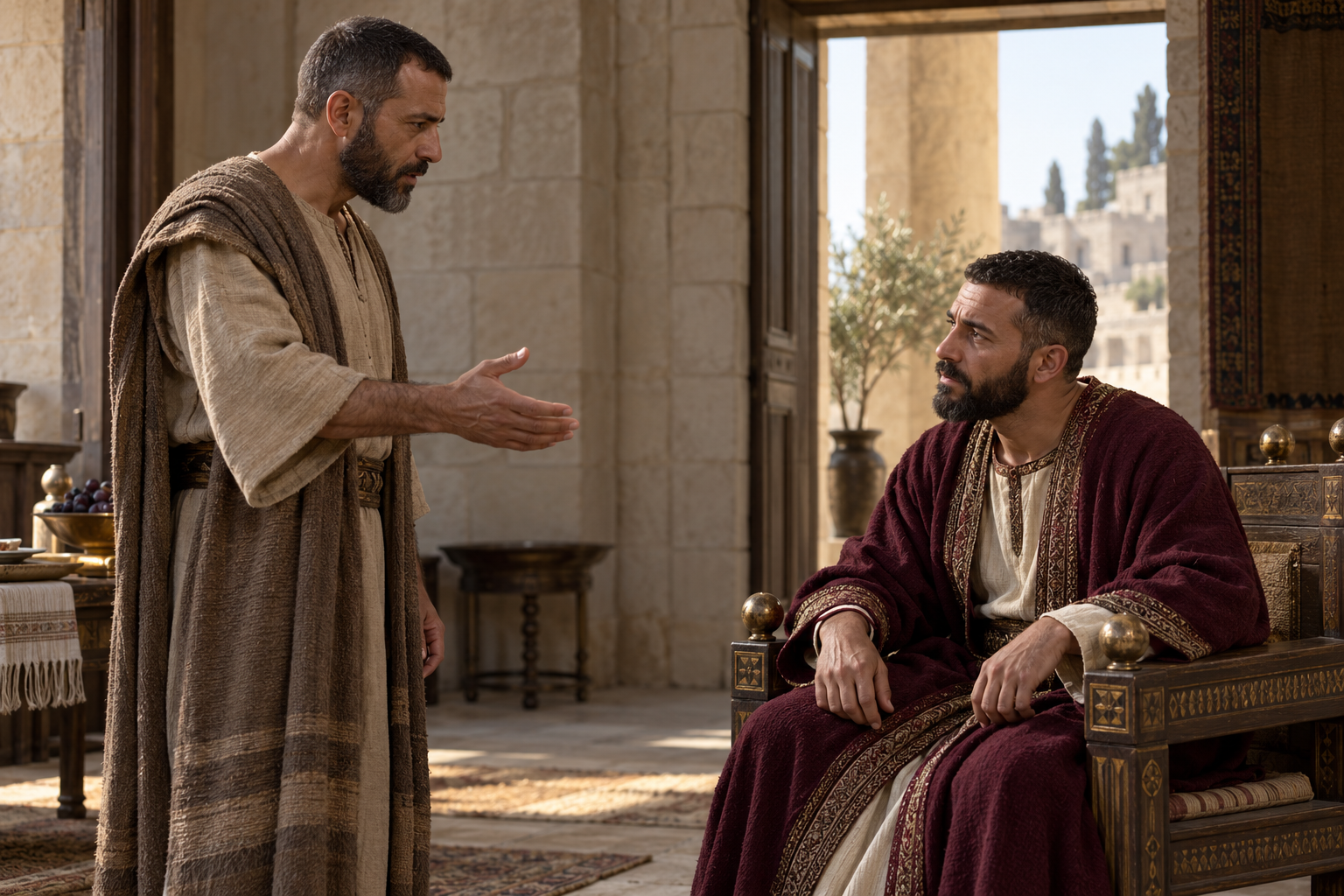
Nathan confronts David with the word of the LORD (2 Samuel 12:1-12).
 The chapter opens with God’s initiative: “And the LORD sent Nathan unto David” (2 Samuel 12:1). The background is David’s taking of Bathsheba and his arrangement for Uriah to be killed in battle, recorded in 2 Samuel 11. Although David used others to carry out his instructions, God held him responsible.
Nathan tells David about a rich man with many flocks and herds who took a poor man’s only little ewe lamb to prepare a meal for a traveler. David becomes angry at the injustice and declares that the offender deserves death and must restore the lamb fourfold because he had no pity.
Nathan then declares, “Thou art the man” (2 Samuel 12:7).
The LORD reminds David that He had anointed him king, delivered him from Saul, and given him abundant provision. David’s conduct was therefore more than wrongdoing against other people. It was contempt for God’s commandment:
“Wherefore hast thou despised the commandment of the LORD, to do evil in his sight?” – 2 Samuel 12:9
God specifically charges David with killing Uriah and taking his wife. David’s use of the Ammonite sword did not remove his guilt: “thou hast slain him with the sword of the children of Ammon” (2 Samuel 12:9).
The announced judgment reaches into David’s household. The sword will never depart from his house, and evil will arise against him from within it. What David did secretly will be answered by public humiliation (2 Samuel 12:10-12). The fulfillment involving his concubines is explicitly recorded in 2 Samuel 16:21-22.
David acknowledges his sin, and Nathan announces forgiveness (2 Samuel 12:13-14).
David answers plainly:
“I have sinned against the LORD.” – 2 Samuel 12:13
He does not blame Bathsheba, Uriah, the pressures of kingship, or the circumstances. Nathan responds:
“The LORD also hath put away thy sin; thou shalt not die.” – 2 Samuel 12:13
God’s forgiveness is real, but the announced consequences are also real. Nathan declares that the child born to David will die, connecting this judgment with the occasion David’s conduct had given the LORD’s enemies to blaspheme (2 Samuel 12:14).
The passage distinguishes forgiveness from the removal of earthly consequences. It does not authorize us to explain every child’s illness or death as punishment for a parent’s particular sin. Here, the reason is known because God expressly revealed it through Nathan.
David pleads for the child, then worships after the child’s death (2 Samuel 12:15-23).
The LORD strikes the child, and the child becomes very sick. David seeks God, fasts, and lies upon the earth. He refuses the efforts of the elders of his house to raise him or persuade him to eat.
On the seventh day, the child dies. David’s servants fear telling him because of the intensity of his grief. When David learns what has happened, he rises, washes, anoints himself, changes his clothing, enters the house of the LORD, and worships. Afterward, he returns home and eats.
David explains why he had fasted:
“Who can tell whether GOD will be gracious to me, that the child may live?” – 2 Samuel 12:22
His prayer was an appeal to God’s grace, not a claim that God owed him a different outcome. After the child’s death, David recognizes that continued fasting will not bring the child back:
“I shall go to him, but he shall not return to me.” – 2 Samuel 12:23
This statement is often understood as expressing hope of reunion. However, the verse does not explicitly name heaven or fully explain the child’s eternal condition. Its immediate emphasis is that David cannot reverse the death: he will go to the child, but the child will not return to him. A fuller doctrine concerning children who die should not be made to rest on this verse alone.
Solomon is born, and the LORD expresses His love for him (2 Samuel 12:24-25).
David comforts Bathsheba, who bears a son named Solomon. Scripture expressly states, “and the LORD loved him” (2 Samuel 12:24).
Through Nathan, the child receives the name Jedidiah, “because of the LORD” (2 Samuel 12:25). These verses place an unmistakable declaration of God’s love alongside the account of judgment. God’s dealings with David include both righteous chastening and continued mercy.
The passage does not describe Bathsheba’s private thoughts or provide a detailed account of her spiritual response. Those details should not be supplied as though Scripture recorded them.
David completes the conquest of Rabbah (2 Samuel 12:26-31).
Joab fights against Rabbah of the Ammonites and takes the royal city. He sends word that he has taken “the city of waters” and urges David to gather the remaining people and complete the capture, lest the city be called after Joab’s name.
David gathers the people, goes to Rabbah, and takes it. The account records the taking of the king’s crown, abundant spoil, and severe treatment of the conquered inhabitants. David and the people then return to Jerusalem.
The KJV describes the treatment in verse 31 with the words “put them under saws” and “made them pass through the brickkiln.” Because explanations of the precise activity differ, the wording should not be expanded into a detailed reconstruction or confidently softened into ordinary employment.
2 Samuel 13 – Tamar Wronged and Absalom’s Revenge
Amnon desires Tamar and follows Jonadab’s counsel (2 Samuel 13:1-5).
The chapter introduces Tamar, the beautiful sister of Absalom, and Amnon, another son of David. Their family relationships identify Tamar as Amnon’s half sister; their parentage is further established in 2 Samuel 3:2-3 and 1 Chronicles 3:9.
Amnon becomes so troubled over Tamar that he grows sick. The text initially says he “loved her” (2 Samuel 13:1), but his subsequent actions reveal a desire willing to violate her.
Jonadab, David’s nephew and Amnon’s friend, is described as “a very subtil man” (2 Samuel 13:3). He advises Amnon to pretend to be sick and ask David to send Tamar to prepare food for him.
The recorded counsel establishes the deceptive means by which Tamar is brought to Amnon. Scripture does not explicitly say that Jonadab instructed him to commit the assault.
Amnon forces Tamar despite her clear refusal (2 Samuel 13:6-14).
David sends Tamar to Amnon’s house at Amnon’s request. She prepares food, but Amnon refuses to eat and sends the others away. He then asks Tamar to bring the food into the chamber.
When he takes hold of her, Tamar protests:
“Nay, my brother, do not force me; for no such thing ought to be done in Israel: do not thou this folly.” – 2 Samuel 13:12
She speaks of the shame that would fall upon her and the wickedness of his proposed act. Nevertheless, Amnon refuses to listen and, being stronger, forces her.
The account places responsibility on Amnon. Tamar refuses, reasons with him, and resists the wrong. Nothing in the passage makes her responsible for his sin.
Tamar also urges him to speak to the king, saying that David would not withhold her from him (2 Samuel 13:13). Scripture records her words without explaining their reasoning or saying that such a marriage would have been lawful. God’s law forbade sexual relations between half siblings (Leviticus 18:9, 11; 20:17). Her plea must not be treated as divine approval of that union.
Amnon rejects Tamar, and she remains desolate (2 Samuel 13:15-20).
Afterward, Amnon’s attitude changes sharply:
“Then Amnon hated her exceedingly; so that the hatred wherewith he hated her was greater than the love wherewith he had loved her.” – 2 Samuel 13:15
He commands her to leave. When she protests the further wrong of sending her away, he orders his servant to put her outside and bolt the door.
Tamar puts ashes on her head, tears her garment of divers colors, places her hand on her head, and goes away crying. The narrative identifies that garment as the clothing worn by the king’s virgin daughters (2 Samuel 13:18).
Absalom speaks to her about what Amnon has done and tells her to hold her peace. Tamar then remains “desolate in her brother Absalom’s house” (2 Samuel 13:20).
Her brother’s instruction is part of the account, not a command that victims of wrongdoing must remain silent. The text records her sorrow and desolation; it does not describe a resolution of her suffering.
David is angry, while Absalom harbors hatred (2 Samuel 13:21-22).
When David hears what has happened, “he was very wroth” (2 Samuel 13:21). However, this chapter records no punishment that David administered to Amnon.
That distinction matters. Scripture explicitly records David’s anger. It does not explicitly explain why no disciplinary action is recorded. Claims that guilt, favoritism, or political calculation caused his response would go beyond these verses.
Absalom does not speak to Amnon “neither good nor bad,” because he hates him for forcing Tamar (2 Samuel 13:22). His silence does not signify reconciliation.
Absalom arranges Amnon’s death after two full years (2 Samuel 13:23-29).
At a sheepshearing gathering in Baal-hazor, Absalom invites the king’s sons. David declines to attend. After Absalom presses his request, David permits Amnon and the other princes to go.
Absalom instructs his servants to kill Amnon when his heart is merry with wine. He tells them to act at his command and not to fear. They obey, and the other king’s sons flee.
Amnon’s crime was grievous, but Absalom’s planned killing was personal revenge. Scripture’s record of his anger does not make his action righteous. God’s prohibition of vengeance remains clear (Leviticus 19:18; Romans 12:19).
False news reaches David, and Absalom flees to Geshur (2 Samuel 13:30-39).
David first receives a report that Absalom has killed all the king’s sons. He tears his garments and lies on the earth.
Jonadab corrects the report, explaining that Amnon alone is dead and connecting the killing with Absalom’s determination since Tamar was forced. The surviving princes arrive, and David, his sons, and his servants weep greatly.
Absalom flees to Talmai, king of Geshur, and remains there three years. Second Samuel 3:3 identifies Talmai as the father of Absalom’s mother, Maacah.
The chapter ends by stating that David’s soul longed to go forth to Absalom and that he was comforted concerning Amnon because he was dead. It does not record reconciliation between David and Absalom within this chapter.
Key People and Places
| Person or place | Context |
|---|---|
| David | King of Israel, confronted for his sin against Uriah and Bathsheba; father of Amnon, Absalom, Tamar, and Solomon. |
| Nathan | Prophet sent by the LORD to confront David and announce both forgiveness and judgment. |
| Bathsheba | Formerly Uriah’s wife; mother of the child who dies and of Solomon. |
| Uriah the Hittite | The man whose death David arranged; God directly holds David responsible for killing him. |
| The unnamed child | David and Bathsheba’s son whose illness and death are recorded in 2 Samuel 12:15-23. |
| Solomon / Jedidiah | David and Bathsheba’s son, expressly described as loved by the LORD. |
| Joab | Military commander who calls David to complete the capture of Rabbah. |
| Amnon | David’s firstborn son, who forces Tamar and is killed at Absalom’s command. |
| Tamar | David’s daughter and Absalom’s sister, who resists Amnon and suffers his wrongdoing. |
| Absalom | Tamar’s brother, who hates Amnon, arranges his death, and flees to Geshur. |
| Jonadab | Son of David’s brother Shimeah; Amnon’s subtil friend and adviser. |
| Talmai | King of Geshur and Absalom’s maternal grandfather. |
| Jerusalem | David’s royal city, to which he returns after the campaign against Rabbah. |
| Rabbah | Ammonite city captured during the campaign described in 2 Samuel 12. |
| Baal-hazor | Place beside Ephraim where Absalom holds the sheepshearing gathering. |
| Geshur | Kingdom where Absalom takes refuge for three years. |
Main Doctrinal or Spiritual Themes
1. God’s holiness exposes sin regardless of a person’s position.
David’s kingship did not place him above God’s commandments. The LORD named his wrongdoing and held him accountable. Spiritual responsibility and past blessings never grant permission to disobey God (2 Samuel 12:7-12).
2. Sin against people is also sin against God.
David acknowledged that he had sinned against the LORD. That confession did not erase the wrong done to Uriah and Bathsheba. God’s own indictment included those specific acts (2 Samuel 12:9, 13).
3. Forgiveness and chastening are distinct.
“The LORD also hath put away thy sin” stands alongside announced judgment upon David’s household. Forgiveness does not require that every earthly consequence disappear. Hebrews 12:6 likewise teaches that the Lord chastens those whom He loves.
4. God’s sovereignty does not excuse human wickedness.
God announced trouble within David’s house. Nevertheless, Amnon remained responsible for forcing Tamar, and Absalom remained responsible for ordering Amnon’s death. Divine judgment must not be used to excuse the sinful choices recorded in chapter 13.
5. Desire is not the measure of righteous love.
Amnon’s desire did not restrain him from harming Tamar, and afterward it gave way to hatred. Biblical charity “seeketh not her own” and “Rejoiceth not in iniquity” (1 Corinthians 13:5-6). Strong feelings cannot make selfish or forbidden conduct holy.
6. God condemns both sexual wrongdoing and personal vengeance.
Amnon’s offense did not authorize Absalom to arrange a killing. Responding to one grievous sin with another compounds wrongdoing. God’s standard requires justice without private revenge (Leviticus 19:18; Romans 12:19).
7. Worship belongs to God even in grief.
David prayed earnestly while the child lived and worshiped after the child died. The text presents both petition and submission. Faith can seek God’s mercy while acknowledging that His answer cannot be controlled (2 Samuel 12:16-23).
Practical Applications or Lessons
- Receive correction by the Word of God. Nathan’s confrontation required David to face his own guilt. When Scripture exposes sin, the proper response is confession rather than self-defense.
- Do not confuse recognizing another person’s sin with examining your own. David readily condemned the rich man’s cruelty before Nathan applied the account to him. We should bring our own conduct under the same biblical standard we apply to others.
- Take responsibility for wrongdoing carried out through others. David did not personally wield the weapon that killed Uriah, but God held him responsible. Directing or arranging evil does not remove guilt.
- Do not presume upon forgiveness. God’s mercy is no permission to sin. Forgiven wrongdoing can still leave serious consequences in families, relationships, and public testimony.
- Listen to clear refusals and respect God’s moral boundaries. Tamar’s words were unmistakable. Desire never grants a right to another person’s body or overrides God’s commandments.
- Treat those who have been wronged with care and dignity. Tamar’s suffering must not be minimized or blamed on her. Believers should help bear burdens and “weep with them that weep” (Romans 12:15).
- Judge counsel by its moral direction. Jonadab’s clever plan helped Amnon gain access to Tamar through deception. Advice that makes wrongdoing easier is dangerous, however skillfully presented.
- Do not mistake anger for a complete response to evil. David’s anger is recorded, but punishment of Amnon is not recorded in this chapter. The practical lesson is that strong feelings alone do not establish that wrongdoing has been properly addressed.
- Reject revenge while pursuing what is right. Absalom’s hatred led to a planned killing. Entrusting vengeance to God does not require pretending that an offense was small; it requires refusing to answer sin with sin.
- Continue to seek and worship God in sorrow. David’s example shows earnest prayer before the outcome and worship afterward. Grief and dependence upon God can exist together.
Comments are closed