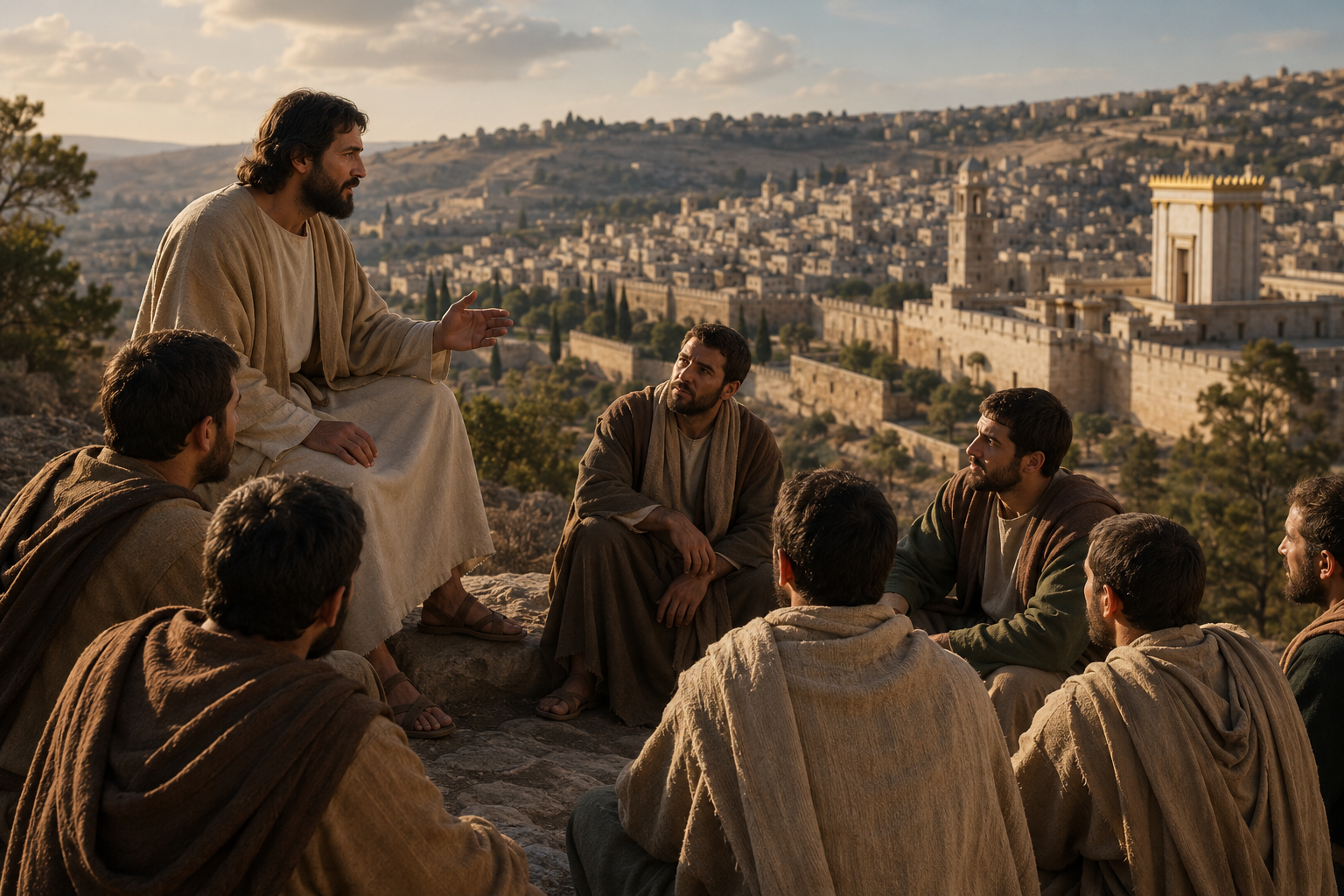
 Matthew 23–24 records a solemn transition in the earthly ministry of the Lord Jesus Christ. Matthew 23 contains Christ’s public condemnation of the hypocrisy of the scribes and Pharisees, His pronouncement of judgment upon that religious leadership, and His lament over Jerusalem. Matthew 24 begins with His prophecy concerning the destruction of the temple and continues with His answer to the disciples concerning His coming and “the end of the world.”
The chapters should be read in sequence. The rejection described in Matthew 23 leads directly into the prophetic discourse of Matthew 24. At the same time, care must be taken not to make Matthew 24 say more than its actual wording says. Some portions have an obvious Jewish and Judean setting; some prophetic details are interpreted differently even among conservative believers. The plain statements of the KJV must therefore remain primary.
Chapter Summaries
Matthew 23 — Christ Condemns Religious Hypocrisy and Laments Jerusalem
Matthew 23 opens with Jesus speaking “to the multitude, and to his disciples” concerning the scribes and Pharisees.
Christ acknowledges their position in connection with the law of Moses:
“The scribes and the Pharisees sit in Moses’ seat:”
— Matthew 23:2
He immediately distinguishes between what they taught and how they lived:
“All therefore whatsoever they bid you observe, that observe and do; but do not ye after their works: for they say, and do not.”
— Matthew 23:3
The central charge is hypocrisy. They placed heavy burdens upon others while failing to practice what they demanded. They performed religious works “for to be seen of men” and loved positions of public honor.
Christ then teaches humility:
“And whosoever shall exalt himself shall be abased; and he that shall humble himself shall be exalted.”
— Matthew 23:12
Beginning in verse 13, Jesus pronounces a series of eight woes in the KJV text.
The first woe condemns those who “shut up the kingdom of heaven against men” while refusing to enter themselves.
The second condemns the devouring of widows’ houses while making “long prayer” for a pretense.
The third condemns missionary zeal that produces converts corrupted by the same false religious system.
The fourth exposes the Pharisees as “blind guides” in their dishonest distinctions concerning oaths.
The fifth condemns meticulous attention to minor religious duties while neglecting matters Christ identifies as more important:
“Woe unto you, scribes and Pharisees, hypocrites! for ye pay tithe of mint and anise and cummin, and have omitted the weightier matters of the law, judgment, mercy, and faith…”
— Matthew 23:23
Jesus does not condemn obedience in small matters. He says:
“these ought ye to have done, and not to leave the other undone.”
Their error was outward precision without inward righteousness.
Christ vividly describes the imbalance:
“Ye blind guides, which strain at a gnat, and swallow a camel.”
— Matthew 23:24
The sixth woe compares them to vessels outwardly clean while inwardly filled with corruption.
The seventh compares them to “whited sepulchres,” beautiful outwardly but inwardly associated with death and uncleanness:
“Even so ye also outwardly appear righteous unto men, but within ye are full of hypocrisy and iniquity.”
— Matthew 23:28
The eighth woe concerns their honoring of the tombs of former prophets while manifesting the same spirit of opposition toward God’s messengers.
Christ declares that they were filling up “the measure of your fathers” and warns of judgment upon that generation.
In verses 37–39, the tone changes from denunciation to lamentation:
“O Jerusalem, Jerusalem, thou that killest the prophets, and stonest them which are sent unto thee, how often would I have gathered thy children together, even as a hen gathereth her chickens under her wings, and ye would not!”
— Matthew 23:37
The wording plainly emphasizes human unwillingness: “ye would not.”
Jesus then declares:
“Behold, your house is left unto you desolate.”
— Matthew 23:38
He closes with:
“For I say unto you, Ye shall not see me henceforth, till ye shall say, Blessed is he that cometh in the name of the Lord.”
— Matthew 23:39
The verse explicitly contains a future “till.” It may suggest a future reception of Messiah by Jerusalem or Israel, but Matthew 23:39 itself should not be made to say more than its wording. It states that they will not see Him again until they say, “Blessed is he that cometh in the name of the Lord.”
Historically, Jerusalem and its temple were destroyed by Roman forces in A.D. 70. That is historical background rather than wording supplied by Matthew itself. The destruction provides a significant historical setting for understanding Christ’s judgment statements, while Matthew 24 also describes events whose language extends beyond that historical catastrophe.
Matthew 24 — The Temple, the Tribulation, the Coming of Christ, and the Command to Watch
Matthew 24 begins when Jesus leaves the temple.
The disciples draw His attention to the temple buildings. Jesus replies:
“Verily I say unto you, There shall not be left here one stone upon another, that shall not be thrown down.”
— Matthew 24:2
Later, while He sits upon the mount of Olives, the disciples privately ask:
“Tell us, when shall these things be? and what shall be the sign of thy coming, and of the end of the world?”
— Matthew 24:3
Their question contains more than one element, and Christ’s answer unfolds a broad prophetic picture.
In verses 4–8, Jesus warns first against deception.
False Christs will arise. Wars and rumors of wars will occur. Nations and kingdoms will rise against one another. Famines, pestilences, and earthquakes will occur.
Yet Christ says:
“see that ye be not troubled: for all these things must come to pass, but the end is not yet.”
— Matthew 24:6
He describes these conditions as:
“All these are the beginning of sorrows.”
— Matthew 24:8
Verses 9–14 describe persecution, betrayal, false prophets, increasing iniquity, and the cooling of love.
Jesus says:
“But he that shall endure unto the end, the same shall be saved.”
— Matthew 24:13
This verse must not be isolated and turned into a doctrine of justification by human perseverance. Scripture plainly teaches salvation by grace through faith apart from works. Ephesians 2:8–9 says:
“For by grace are ye saved through faith; and that not of yourselves: it is the gift of God:
Not of works, lest any man should boast.”
Matthew 24:13 occurs in a prophetic context of severe persecution and endurance. Whatever full aspect of deliverance is involved, the verse cannot contradict the Bible’s plain teaching that works do not earn justification.
Christ continues:
“And this gospel of the kingdom shall be preached in all the world for a witness unto all nations; and then shall the end come.”
— Matthew 24:14
In verse 15, Jesus directly refers to Daniel:
“When ye therefore shall see the abomination of desolation, spoken of by Daniel the prophet, stand in the holy place, (whoso readeth, let him understand:)”
The text explicitly names Daniel, an “abomination of desolation,” and “the holy place.”
A future temple structure is often inferred in dispensational interpretation from this language and related prophecy. Matthew 24:15 itself, however, says “the holy place”; it does not explicitly use the words “rebuilt temple.” That distinction should be maintained.
Jesus then gives instructions particularly connected with Judaea:
“Then let them which be in Judaea flee into the mountains:”
— Matthew 24:16
He also says:
“But pray ye that your flight be not in the winter, neither on the sabbath day:”
— Matthew 24:20
These explicit references to Judaea and the sabbath strongly establish a Jewish geographical and cultural setting in this portion of the prophecy.
The conservative dispensational understanding therefore sees a strong Israel-centered character in these verses. That conclusion is supported by the explicit wording, although conclusions about every individual represented among “the elect” should not be asserted beyond what Scripture identifies.
Christ then says:
“For then shall be great tribulation, such as was not since the beginning of the world to this time, no, nor ever shall be.”
— Matthew 24:21
The severity described is unparalleled.
Verse 22 adds:
“And except those days should be shortened, there should no flesh be saved: but for the elect’s sake those days shall be shortened.”
False Christs and false prophets will seek to deceive, and Christ warns against believing claims that Messiah has secretly appeared in some isolated place.
His actual coming will be unmistakable:
“For as the lightning cometh out of the east, and shineth even unto the west; so shall also the coming of the Son of man be.”
— Matthew 24:27
Verses 29–31 give an explicit chronological statement:
“Immediately after the tribulation of those days…”
Cosmic disturbances are described, followed by the appearing of “the sign of the Son of man in heaven.”
Then:
“they shall see the Son of man coming in the clouds of heaven with power and great glory.”
— Matthew 24:30
This is a visible, glorious coming of Christ.
Verse 31 describes angels gathering His elect:
“from the four winds, from one end of heaven to the other.”
From a conservative premillennial and dispensational standpoint, this passage concerns Christ’s return in glory in connection with the conclusion of the Tribulation and the establishment of His kingdom.
Matthew 24 does not explicitly describe the pre-tribulational catching away of the Church in the terminology used in 1 Thessalonians 4:13–18 or 1 Corinthians 15:51–52. The pre-tribulational Rapture is a biblical doctrine established from other passages, but it should not be forced into Matthew 24 where the text does not explicitly name it.
Verses 32–35 contain the lesson of the fig tree. When its branch becomes tender and produces leaves, summer is near. Likewise, when the predicted things occur, the fulfillment is near.
Christ says:
“Verily I say unto you, This generation shall not pass, till all these things be fulfilled.”
— Matthew 24:34
Scripture does not explicitly define “this generation” here as a technical synonym for the nation or race of Israel. A common conservative futurist interpretation is that the generation witnessing the climactic prophetic signs will also witness their completion. That is an interpretation consistent with the context, but the exact explanatory formula should not be presented as though it were directly stated in the verse.
What is absolutely certain is Christ’s next declaration:
“Heaven and earth shall pass away, but my words shall not pass away.”
— Matthew 24:35
The prophecy rests upon the unfailing authority of Christ’s words.
Verse 36 introduces another certainty:
“But of that day and hour knoweth no man, no, not the angels of heaven, but my Father only.”
Therefore, date-setting is contrary to Christ’s own statement.
Jesus then compares the conditions surrounding His coming to “the days of Noe.”
People before the flood continued ordinary activities—eating, drinking, marrying, and giving in marriage—without recognizing the approaching judgment.
Then:
“the flood came, and took them all away; so shall also the coming of the Son of man be.”
— Matthew 24:39
Verses 40–41 speak of one being taken and another left.
The text does not explicitly identify this as the Rapture of the Church. In fact, the immediately preceding comparison speaks of those in Noah’s day being “took…away” by the flood in judgment. Therefore, caution is necessary before assigning the “taken” individuals in verses 40–41 to the Rapture.
The main point Christ explicitly emphasizes is readiness:
“Watch therefore: for ye know not what hour your Lord doth come.”
— Matthew 24:42
And:
“Therefore be ye also ready: for in such an hour as ye think not the Son of man cometh.”
— Matthew 24:44
The chapter closes with the illustration of the faithful and wise servant contrasted with an evil servant.
The faithful servant continues performing his appointed duty while his lord is absent.
The evil servant says:
“My lord delayeth his coming;”
and begins living wickedly.
His lord returns unexpectedly and judges him severely, appointing:
“his portion with the hypocrites: there shall be weeping and gnashing of teeth.”
— Matthew 24:51
The passage warns against empty profession and careless living. The text does not explicitly state that the evil servant represents a genuinely regenerated believer losing salvation, and it should not be used to contradict the security of salvation taught elsewhere in Scripture.
Key People and Places
- Jesus Christ / the Son of man — The central figure of both chapters. He rebukes hypocrisy, pronounces judgment, laments over Jerusalem, foretells coming events, and promises His visible return “with power and great glory.”
- The scribes and Pharisees — Religious leaders repeatedly condemned for hypocrisy, spiritual blindness, outward religion without inward righteousness, and opposition to God’s messengers.
- The multitude — Present when Jesus begins His teaching in Matthew 23.
- The disciples — Receive Christ’s instruction in Matthew 23 and privately question Him concerning future events in Matthew 24.
- Moses — Mentioned in connection with “Moses’ seat” in Matthew 23:2.
- Daniel the prophet — Explicitly named by Christ in Matthew 24:15 concerning “the abomination of desolation.”
- Noah — Called “Noe” in the KJV. His days provide Christ’s illustration of sudden judgment and human unpreparedness.
- False Christs and false prophets — Predicted deceivers whose signs and claims must not be believed.
- The elect — Mentioned in Matthew 24:22, 24, and 31. The chapter itself does not give a complete theological definition of everyone included in the term.
- Jerusalem — The city over which Christ laments: “O Jerusalem, Jerusalem.”
- The temple — The buildings admired by the disciples whose destruction Christ foretells.
- The mount of Olives — The location where the disciples privately ask Christ about His coming and the end of the world.
- Judaea — Specifically named in Matthew 24:16 as the region from which people are commanded to flee when the predicted event occurs.
- The mountains — The place of flight commanded for those in Judaea.
- The holy place — The location where Christ says the “abomination of desolation” will stand.
Main Doctrinal or Spiritual Themes
Religious hypocrisy is hateful to God. Matthew 23 demonstrates that external religion cannot substitute for inward truth. The Pharisees appeared righteous before men while Christ declared that inwardly they were “full of hypocrisy and iniquity.”
Truth must govern both doctrine and conduct. Christ condemns those who “say, and do not.” Biblical truth is not merely something to be spoken; it must govern the life.
Humility is required of God’s servants. Christ plainly says that the self-exalting man will be abased and the humble man exalted.
God distinguishes between outward observance and weightier spiritual realities. Christ identifies “judgment, mercy, and faith” as weightier matters without excusing neglect of legitimate lesser duties.
Religious zeal does not prove spiritual truth. The Pharisees could “compass sea and land to make one proselyte,” yet Christ still condemned their system. Activity, sacrifice, and missionary effort cannot make false doctrine true.
God holds spiritual leaders accountable. Much of Matthew 23 is directed toward men whose religious position increased rather than diminished their responsibility.
Christ genuinely lamented over Jerusalem. His words, “how often would I…and ye would not,” reveal both His compassion and their refusal.
Sin brings judgment. Matthew 23 ends with desolation; Matthew 24 begins with the predicted destruction of the temple. Judgment is not contrary to God’s holiness but proceeds from it.
Christ’s prophetic word is certain. Jesus says:
“Heaven and earth shall pass away, but my words shall not pass away.”
No political development, religious deception, or passage of time can make His words fail.
Deception will characterize the period preceding Christ’s return. One of His first warnings is:
“Take heed that no man deceive you.”
False Christs and false prophets are repeatedly mentioned.
The Tribulation is real and severe. Christ calls it “great tribulation” and describes it in unparalleled terms. A conservative premillennial interpretation receives this language literally rather than reducing it to an allegory of ordinary Christian difficulties.
Israel and the Church should not be confused. Matthew 24 explicitly speaks of Judaea, the sabbath, Daniel’s prophecy, and the holy place. These details establish a distinct Jewish setting in an important portion of the chapter. Conservative dispensational interpretation therefore refuses to erase Israel by making every prophetic promise merely symbolic of the Church.
The Second Coming of Christ will be visible and glorious. Christ does not describe His appearing as secret:
“they shall see the Son of man coming in the clouds of heaven with power and great glory.”
The Rapture and the glorious appearing should not be carelessly collapsed into one passage. The pre-tribulational Rapture of the Church is established elsewhere in Scripture. Matthew 24 itself explicitly places the visible coming of the Son of man “immediately after the tribulation.”
No man knows the day or hour. All attempts to set the date of Christ’s return violate the plain warning of Matthew 24:36.
Watchfulness is a moral duty. Prophecy was not given merely to satisfy curiosity. Christ repeatedly connects prophecy with readiness, faithfulness, and obedience.
Salvation is not earned by works or endurance. Matthew 24:13 cannot cancel the plain teaching that salvation is the gift of God received by faith. Perseverance under persecution must be interpreted within its prophetic context rather than turned into a works-based plan of salvation.
Practical Applications or Lessons
Beware of appearing spiritual without being spiritually right. Matthew 23 warns that a person may look righteous before others while hiding hypocrisy and iniquity. God sees the inside as clearly as the outside.
Practice what you teach. Christ’s words, “they say, and do not,” remain a searching warning to every preacher, teacher, parent, and believer.
Do not substitute minor religious details for major moral obedience. Biblical separation and careful obedience matter, but they must never become an excuse for neglecting judgment, mercy, faith, truthfulness, and holiness.
Do not seek religious prestige. The Pharisees loved titles, greetings, prominent seats, and public recognition. Christian service must seek God’s approval rather than the praise of men.
Religious activity cannot compensate for false doctrine or an unchanged heart. A person may travel far, sacrifice much, speak often, and remain spiritually wrong.
Take Christ’s warnings about deception seriously. Believers should test teaching by the written Word of God rather than by impressive personalities, signs, popularity, or claims of special revelation.
Do not interpret every war, earthquake, or crisis as proof that the end has arrived. Christ Himself said concerning such events, “the end is not yet.” Prophetic sobriety is more biblical than sensationalism.
Do not set dates for Christ’s return. Christ plainly says no man knows the day or hour.
Keep Israel and the Church distinct where Scripture does. The references to Judaea, the sabbath, Daniel, and the holy place should be allowed to retain their natural meaning rather than being automatically spiritualized into Church terminology.
Do not force the Rapture into verses that do not explicitly identify it. Matthew 24:40–41 should not automatically be labeled the Rapture merely because one person is “taken.” The surrounding Noah comparison requires careful reading.
Live ready rather than merely studying readiness. Christ’s repeated conclusion is not “calculate,” but “watch” and “be ye also ready.”
Faithfulness during the Master’s apparent absence matters. The faithful servant continues doing what his lord commanded. A right expectation of Christ’s coming encourages service rather than idleness.
Never interpret delayed judgment as canceled judgment. The evil servant says, “My lord delayeth his coming,” and then lives wickedly. The Lord’s timing never makes His warning uncertain.
Remember that Christ’s words cannot fail. Governments change, civilizations fall, temples can be destroyed, and the heavens and earth themselves will pass away, but Christ declared:
“my words shall not pass away.”
Matthew 23 therefore warns against false religion, hypocrisy, pride, and rejection of God’s truth. Matthew 24 warns against prophetic deception, unbelief, carelessness, and spiritual unpreparedness. Together the chapters point the reader away from outward religion and human confidence and toward submission to the words of Christ, sober expectation of His return, and faithful service until God’s prophetic purposes are fulfilled.
Comments are closed