Watchfulness, Judgment, Betrayal, and Gethsemane
 Matthew 25–26 moves from the closing portion of the Lord Jesus Christ’s Olivet discourse into the events immediately preceding His crucifixion. Matthew 25 emphasizes readiness for the coming of the Son of man, faithful stewardship, divine judgment, and eternal consequences. Matthew 26 records the conspiracy against Christ, His anointing at Bethany, Judas Iscariot’s betrayal agreement, the Passover meal, the bread and cup, Christ’s prayer in Gethsemane, His arrest and examination before the Jewish leaders, and Peter’s threefold denial.
The controlling principle in interpreting these chapters is to allow the KJV text to say exactly what it says without forcing every detail of a parable into an unsupported symbolic system. Where Scripture identifies a meaning, that meaning should be affirmed. Where Scripture does not identify one, restraint is required.
Chapter Summaries
Matthew 25 — Readiness, Stewardship, and the Coming Judgment
Matthew 25 continues the prophetic discourse begun in Matthew 24. The immediate setting concerns the coming of the Son of man and the need to be ready for Him. Matthew 24:29–31 explicitly places the glorious coming of the Son of man after the tribulation described there. Matthew 25 therefore continues that atmosphere of watchfulness, accountability, and kingdom judgment.
The parable of the ten virgins — Matthew 25:1–13
Jesus begins:
“Then shall the kingdom of heaven be likened unto ten virgins, which took their lamps, and went forth to meet the bridegroom.” — Matthew 25:1
Five are wise and five are foolish. The wise take oil in their vessels with their lamps; the foolish take their lamps but take no oil with them. While the bridegroom tarries, all ten “slumbered and slept.”
That detail is important. The distinction between the wise and foolish is not that one group slept and the other remained physically awake. The KJV explicitly says they all slept. The difference is that the wise were prepared when the cry came:
“Behold, the bridegroom cometh; go ye out to meet him.” — Matthew 25:6
The foolish attempt to obtain oil after the announcement, but while they are gone, the bridegroom arrives:
“and they that were ready went in with him to the marriage: and the door was shut.” — Matthew 25:10
When the others return, they hear:
“Verily I say unto you, I know you not.” — Matthew 25:12
Christ gives the stated lesson Himself:
“Watch therefore, for ye know neither the day nor the hour wherein the Son of man cometh.” — Matthew 25:13
The explicit teaching is readiness and watchfulness concerning the coming of the Son of man.
Scripture does not explicitly identify the oil as the Holy Spirit, nor does Matthew explicitly identify the ten virgins as the Church. Those interpretations are sometimes proposed, but they go beyond what Christ specifically explains in the passage. The safe doctrinal emphasis is the one Christ Himself gives: “Watch therefore.”
Likewise, this parable should not be used by itself as the primary proof-text for the pre-tribulation rapture of the Church. The pre-tribulational catching away of believers is taught from passages such as 1 Thessalonians 4:13–18 and related Scriptures. Matthew 24–25 is especially concerned with the coming of the Son of man in glory and the accompanying kingdom accountability.
The parable of the talents — Matthew 25:14–30
Jesus next compares the kingdom setting to:
“a man travelling into a far country, who called his own servants, and delivered unto them his goods.” — Matthew 25:14
One servant receives five talents, another two, and another one:
“to every man according to his several ability.” — Matthew 25:15
The servants receiving five and two talents faithfully use what has been entrusted to them. The servant receiving one talent hides his lord’s money in the earth.
After “a long time” the lord returns and reckons with them.
The faithful servants hear:
“Well done, thou good and faithful servant: thou hast been faithful over a few things, I will make thee ruler over many things: enter thou into the joy of thy lord.” — Matthew 25:21
The one-talent servant attempts to justify his conduct by accusing his lord of being “an hard man.” His lord answers:
“Thou wicked and slothful servant…” — Matthew 25:26
His talent is removed, and he is cast into “outer darkness,” where there is “weeping and gnashing of teeth.”
The central lesson is accountability for what the Master entrusts. The five-talent servant is not praised for possessing five, nor is the two-talent servant condemned for possessing only two. Both faithful servants receive the same words of commendation. The issue is faithfulness.
The passage therefore gives a serious warning against wasted opportunity, neglect, spiritual slothfulness, and presumption upon the Master’s absence.
It should not be interpreted as teaching salvation by religious productivity. Scripture explicitly teaches:
“For by grace are ye saved through faith; and that not of yourselves: it is the gift of God: Not of works…” — Ephesians 2:8–9
The saved are nevertheless “created in Christ Jesus unto good works” according to Ephesians 2:10. Faithful service is the proper result of belonging to Christ, not the purchase price of eternal life.
The Son of man judges the nations — Matthew 25:31–46
The scene now changes from parable to a direct description of the Son of man coming in glory:
“When the Son of man shall come in his glory, and all the holy angels with him, then shall he sit upon the throne of his glory.” — Matthew 25:31
All nations are gathered before Him, and He separates them:
“as a shepherd divideth his sheep from the goats.” — Matthew 25:32
The sheep are placed at His right hand and the goats at His left.
The King tells those on His right:
“Come, ye blessed of my Father, inherit the kingdom prepared for you from the foundation of the world.” — Matthew 25:34
He then cites their treatment of Him when He was hungry, thirsty, a stranger, naked, sick, and imprisoned. The righteous ask when they did these things directly to Him. The King answers:
“Inasmuch as ye have done it unto one of the least of these my brethren, ye have done it unto me.” — Matthew 25:40
Those on the left are condemned because they did not minister in this way. The chapter closes with one of Scripture’s clearest statements concerning the everlasting duration of both destinies:
“And these shall go away into everlasting punishment: but the righteous into life eternal.” — Matthew 25:46
Both destinies are presented with equal grammatical permanence: “everlasting punishment” and “life eternal.”
The passage explicitly locates this judgment at the coming of the Son of man in glory. In conservative premillennial dispensational interpretation, this is best understood as a judgment connected with Christ’s Second Advent and entrance into His earthly kingdom, rather than the judgment seat of Christ for the Church described elsewhere or the great white throne judgment of Revelation 20.
The precise identity of “these my brethren” is not defined within Matthew 25 itself. A dispensational interpretation may suggest a special relationship to Christ’s faithful people or messengers during the period surrounding His return, and many understand the expression particularly in connection with His Jewish brethren. However, Matthew 25 itself does not explicitly define the group, so that identification should not be stated more strongly than Scripture states it.
The passage does not overthrow salvation by grace. Rather, conduct toward Christ’s own may indicate the genuine attitude of the heart toward the King. Works reveal allegiance; they do not purchase redemption.
Matthew 26 — Betrayal, Passover, Gethsemane, Arrest, and Denial
Matthew 26 turns from prophetic teaching to the approaching crucifixion.
Jesus foretells His crucifixion — Matthew 26:1–2
Jesus tells His disciples plainly:
“Ye know that after two days is the feast of the passover, and the Son of man is betrayed to be crucified.” — Matthew 26:2
His death is therefore not presented as an unforeseen disaster. Christ knows what is coming and tells His disciples beforehand.
The conspiracy against Jesus — Matthew 26:3–5
The chief priests, scribes, and elders assemble:
“unto the palace of the high priest, who was called Caiaphas.” — Matthew 26:3
They consult about taking Jesus “by subtilty” and killing Him, while saying:
“Not on the feast day, lest there be an uproar among the people.” — Matthew 26:5
Matthew explicitly records both their murderous intention and their concern about public reaction.
The anointing at Bethany — Matthew 26:6–13
Jesus is in Bethany:
“in the house of Simon the leper.” — Matthew 26:6
Scripture calls him Simon the leper. It does not state in this passage whether he was presently diseased or had previously been healed, so nothing further should be asserted from the title alone.
A woman comes with:
“an alabaster box of very precious ointment”
and pours it upon Jesus’ head as He sits at meat.
The disciples call this wasteful and reason that the ointment could have been sold for much and given to the poor. Jesus rebukes their criticism:
“Why trouble ye the woman? for she hath wrought a good work upon me.” — Matthew 26:10
He then says:
“For in that she hath poured this ointment on my body, she did it for my burial.” — Matthew 26:12
Christ Himself gives the act its burial significance. There is therefore no need to speculate concerning motives that the text does not state.
Jesus promises that wherever the gospel is preached throughout the whole world, what she has done will be spoken of “for a memorial of her.”
Judas agrees to betray Jesus — Matthew 26:14–16
Judas Iscariot, one of the twelve, goes to the chief priests and asks:
“What will ye give me, and I will deliver him unto you?” — Matthew 26:15
They covenant with him for “thirty pieces of silver.”
Matthew then says:
“And from that time he sought opportunity to betray him.” — Matthew 26:16
The passage gives no excuse for Judas. His betrayal is deliberate.
His position among the twelve did not itself prove saving faith. Elsewhere Christ calls Judas “the son of perdition” in John 17:12. Religious position, outward association, and proximity to sacred things cannot substitute for genuine faith in Christ.
The Passover and identification of the betrayer — Matthew 26:17–25
The disciples prepare the Passover according to Christ’s instruction. During the meal Jesus announces:
“Verily I say unto you, that one of you shall betray me.” — Matthew 26:21
The disciples are exceedingly sorrowful.
Judas asks:
“Master, is it I?”
Jesus answers:
“Thou hast said.” — Matthew 26:25
Christ’s knowledge of the betrayal is again evident before Judas carries it out.
The bread and cup — Matthew 26:26–29
As they eat, Jesus takes bread, blesses it, breaks it, and gives it to the disciples:
“Take, eat; this is my body.” — Matthew 26:26
He then takes the cup, gives thanks, and says:
“Drink ye all of it; For this is my blood of the new testament, which is shed for many for the remission of sins.” — Matthew 26:27–28
The conservative Baptist understanding rejects any doctrine that makes the bread and cup saving sacraments or teaches that they literally become Christ’s physical flesh and blood.
The larger KJV witness gives the ordinance a memorial character. First Corinthians 11:24–26 repeatedly speaks of doing it “in remembrance of me” and of showing “the Lord’s death till he come.” Matthew 26:29 also continues to refer to the contents of the cup as:
“this fruit of the vine.”
The saving reality is not in the elements. The saving reality is the blood Christ actually shed:
“which is shed for many for the remission of sins.”
Forgiveness is grounded in Christ’s sacrificial death, not in consuming a sacramental substance.
Jesus also looks ahead to the kingdom:
“I will not drink henceforth of this fruit of the vine, until that day when I drink it new with you in my Father’s kingdom.” — Matthew 26:29
This supports the real future expectation of Christ’s kingdom rather than reducing kingdom promises merely to inward religious experience.
The Mount of Olives and Peter’s confidence — Matthew 26:30–35
After singing a hymn, they go to the mount of Olives.
Jesus tells the disciples:
“All ye shall be offended because of me this night.”
He cites the smiting of the shepherd and the scattering of the sheep.
Peter confidently replies:
“Though all men shall be offended because of thee, yet will I never be offended.” — Matthew 26:33
Jesus answers:
“That this night, before the cock crow, thou shalt deny me thrice.” — Matthew 26:34
Peter insists:
“Though I should die with thee, yet will I not deny thee.”
The other disciples say likewise.
The passage is a sober warning concerning self-confidence. Strong declarations are not a substitute for dependence upon God.
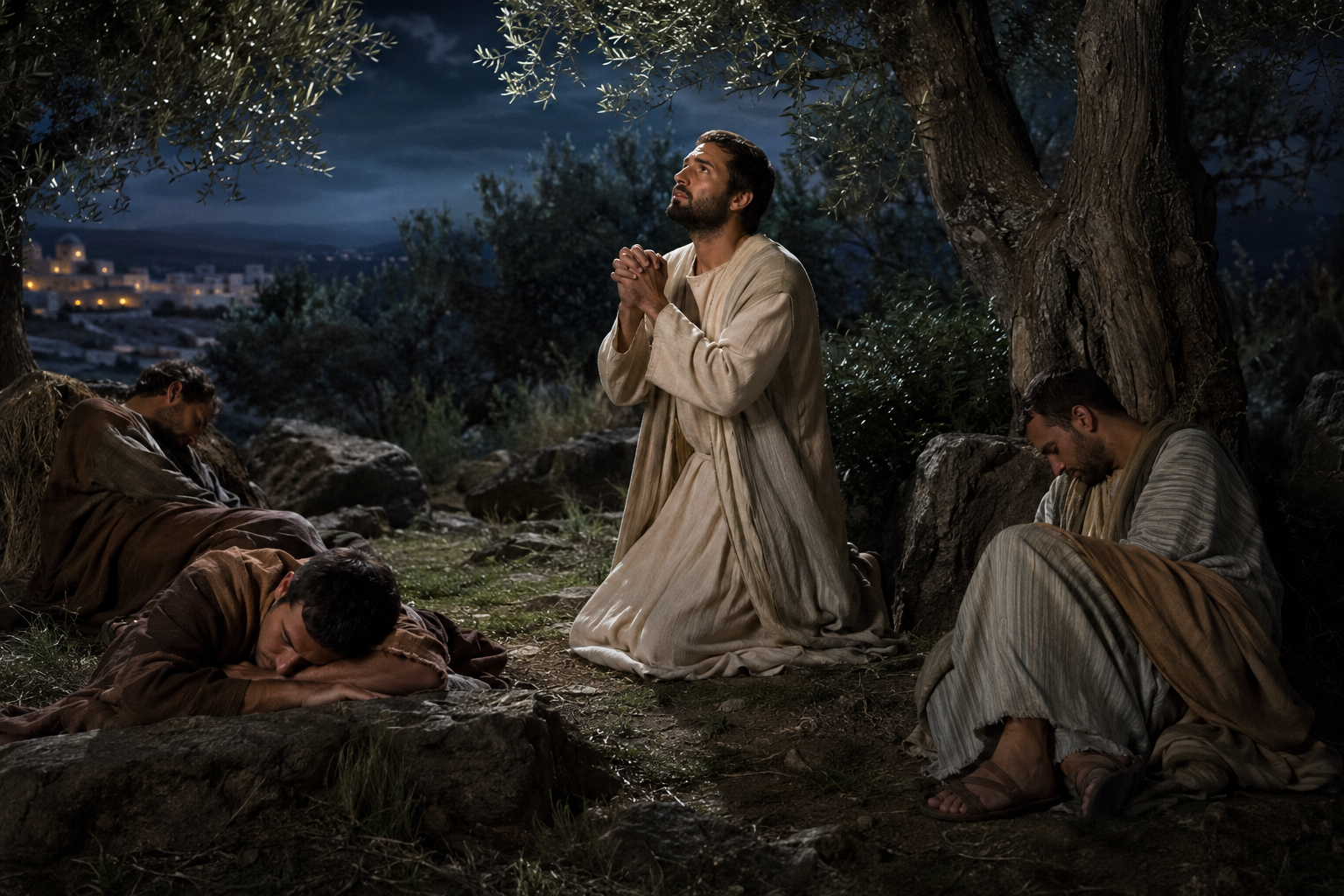
Christ prays in Gethsemane — Matthew 26:36–46
Jesus comes:
“unto a place called Gethsemane.” — Matthew 26:36
He takes Peter and the two sons of Zebedee farther with Him and becomes “sorrowful and very heavy.”
He tells them:
“My soul is exceeding sorrowful, even unto death: tarry ye here, and watch with me.” — Matthew 26:38
Christ falls on His face and prays:
“O my Father, if it be possible, let this cup pass from me: nevertheless not as I will, but as thou wilt.” — Matthew 26:39
This is not unwillingness to obey the Father. His own prayer explicitly submits to the Father’s will.
The disciples sleep. Jesus asks Peter:
“What, could ye not watch with me one hour?”
Then comes the enduring command:
“Watch and pray, that ye enter not into temptation: the spirit indeed is willing, but the flesh is weak.” — Matthew 26:41
Christ prays again:
“O my Father, if this cup may not pass away from me, except I drink it, thy will be done.” — Matthew 26:42
His submission is complete.
The passage reveals both the genuine suffering of Christ and His perfect obedience to the Father.
The betrayal and arrest — Matthew 26:47–56
Judas arrives with:
“a great multitude with swords and staves, from the chief priests and elders of the people.” — Matthew 26:47
His sign is a kiss.
Jesus addresses him:
“Friend, wherefore art thou come?” — Matthew 26:50
One of those with Jesus draws a sword and cuts off the ear of the high priest’s servant. Matthew does not name that disciple in this chapter. John 18:10 identifies him as Simon Peter, but Matthew itself simply says “one of them which were with Jesus.”
Jesus commands:
“Put up again thy sword into his place: for all they that take the sword shall perish with the sword.” — Matthew 26:52
He adds that He could pray to His Father and receive:
“more than twelve legions of angels.”
His arrest therefore does not mean He lacks power to escape. He consciously submits so that Scripture may be fulfilled:
“But how then shall the scriptures be fulfilled, that thus it must be?” — Matthew 26:54
Matthew concludes:
“Then all the disciples forsook him, and fled.” — Matthew 26:56
Jesus before Caiaphas — Matthew 26:57–68
Jesus is taken to Caiaphas the high priest, where the scribes and elders are assembled.
The council seeks false witness against Him. Eventually two false witnesses come forward.
The high priest then puts Jesus under direct examination:
“I adjure thee by the living God, that thou tell us whether thou be the Christ, the Son of God.” — Matthew 26:63
Jesus answers:
“Thou hast said: nevertheless I say unto you, Hereafter shall ye see the Son of man sitting on the right hand of power, and coming in the clouds of heaven.” — Matthew 26:64
The high priest tears his clothes and accuses Him of blasphemy. The council answers:
“He is guilty of death.” — Matthew 26:66
They spit in His face, buffet Him, smite Him, and mock Him.
The chapter presents a striking contrast: the One who will sit upon “the throne of his glory” in Matthew 25:31 is mocked and condemned by men in Matthew 26.
Peter denies the Lord — Matthew 26:69–75
While Jesus is being examined, Peter is outside.
A maid identifies him as being with Jesus of Galilee. Peter denies it.
Another maid speaks against him, and he again denies knowing Jesus.
Those standing nearby then say:
“Surely thou also art one of them; for thy speech bewrayeth thee.” — Matthew 26:73
Peter begins:
“to curse and to swear, saying, I know not the man.” — Matthew 26:74
Immediately the cock crows.
Peter remembers Christ’s words:
“Before the cock crow, thou shalt deny me thrice.”
Matthew ends the chapter:
“And he went out, and wept bitterly.” — Matthew 26:75
The chapter does not minimize Peter’s failure. His earlier confidence is followed by exactly the three denials Christ foretold.
Key People and Places
- Jesus Christ / the Son of man / the King — Central throughout both chapters. He warns of His return and judgment, foretells His crucifixion, gives the bread and cup, submits to the Father in Gethsemane, permits His arrest, and testifies before Caiaphas.
- The ten virgins — Figures in Christ’s parable illustrating readiness and failure to be prepared.
- The bridegroom — Central figure in the ten-virgins parable. Scripture does not require every incidental detail surrounding him to receive a separate symbolic interpretation.
- The servants receiving talents — Illustrate faithfulness, stewardship, reckoning, reward, and judgment.
- The sheep and goats — Christ’s imagery for those separated by the King when the nations are gathered before Him.
- “These my brethren” — A group specifically identified by the King as His brethren, though Matthew 25 does not further define their identity.
- Chief priests, scribes, and elders — Religious leaders who conspire against Jesus and participate in the proceedings against Him.
- Caiaphas — Explicitly identified as the high priest.
- Simon the leper — Owner or occupant of the Bethany house where Jesus is anointed. Scripture gives the title but does not explain his medical condition at that time.
- The unnamed woman at Bethany — Pours very precious ointment upon Christ. Jesus calls her act “a good work” and connects it with His burial.
- Judas Iscariot — One of the twelve who covenants to betray Jesus for thirty pieces of silver.
- Peter — Confidently promises faithfulness, accompanies Christ farther into Gethsemane, and afterward denies Him three times as Christ had foretold.
- The two sons of Zebedee — Accompany Jesus with Peter farther into Gethsemane.
- The high priest’s servant — Has his ear struck by the sword of one of Jesus’ companions.
- False witnesses — Sought against Christ during His examination.
- Bethany — Location of the anointing in the house of Simon the leper.
- The city — The disciples are instructed to enter it to prepare the Passover. The surrounding Gospel narrative identifies the setting as Jerusalem.
- Mount of Olives — Jesus and the disciples go there after the Passover meal.
- Gethsemane — The place where Jesus prays in deep sorrow and submits Himself fully to the Father’s will.
- The palace of Caiaphas — Location associated with the religious examination of Jesus in Matthew 26.
Main Doctrinal or Spiritual Themes
1. The certainty of Christ’s return
Matthew 25 does not present Christ’s coming as a possibility but as an approaching certainty. The question concerns readiness:
“Watch therefore…”
Biblical watchfulness does not require date-setting. Christ specifically says:
“ye know neither the day nor the hour wherein the Son of man cometh.” — Matthew 25:13
2. Personal accountability before the Lord
Both the talents and the judgment scene emphasize reckoning. God-given opportunity carries responsibility.
A believer should therefore reject the attitude that present life has no eternal accountability.
3. Faithfulness matters more than comparison
The five-talent and two-talent servants both receive the same commendation:
“Well done, thou good and faithful servant.”
The emphasis is faithfulness with what the Master has entrusted, not competition with another servant.
4. Salvation is not earned by works
Nothing in Matthew 25 overturns the plain KJV doctrine that salvation is by grace through faith apart from works.
Good works are the fruit that should accompany genuine faith. They are not the price paid for justification.
5. Eternal punishment is literal and everlasting
Matthew 25:46 places “everlasting punishment” alongside “life eternal.” Conservative biblical interpretation has no warrant to weaken the permanence of one while affirming the permanence of the other.
6. Israel, the nations, and the future kingdom should not be collapsed into the Church
Matthew 25:31–46 explicitly involves the Son of man coming in glory, the nations gathered before Him, and the righteous being told to “inherit the kingdom.”
A conservative dispensational reading therefore preserves the distinction between Christ’s dealings with the Church and prophetic events surrounding His glorious return and earthly kingdom.
The text should not be forced into an interpretation in which every reference to the kingdom automatically means the Church.
7. Christ knew His death beforehand
Jesus explicitly foretells His crucifixion, betrayal, the disciples’ scattering, and Peter’s denial.
The cross is not presented as Christ losing control of events.
8. Christ’s blood is the basis of remission
Jesus says:
“this is my blood of the new testament, which is shed for many for the remission of sins.” — Matthew 26:28
Forgiveness depends upon Christ’s sacrificial blood, not upon human merit, religious ceremony, baptism, church membership, or sacramental observance.
9. The Lord’s Supper is memorial, not saving
The bread and cup direct attention to Christ’s body and shed blood. First Corinthians 11 explicitly connects the observance with remembrance and proclaiming His death.
The elements do not impart regeneration or justification.
10. Christ perfectly submits to the Father
His prayer is:
“nevertheless not as I will, but as thou wilt.”
The sinless Son submits without rebellion.
11. Prayer and watchfulness guard against temptation
Christ tells the disciples:
“Watch and pray, that ye enter not into temptation.”
He immediately adds:
“the spirit indeed is willing, but the flesh is weak.”
Good intentions alone are insufficient protection against temptation.
12. Scripture must be fulfilled
During His arrest Jesus repeatedly directs attention to the fulfillment of Scripture.
“But how then shall the scriptures be fulfilled, that thus it must be?”
The Word of God governs the interpretation of the events rather than the events sitting in judgment upon the Word of God.
13. Religious proximity is not the same as saving faith
Judas was numbered among the twelve and shared outward privileges with them, yet betrayed Christ.
No church position, ministry association, heritage, or outward familiarity with Christianity can replace personal faith in the Lord Jesus Christ.
14. Self-confidence is spiritually dangerous
Peter sincerely believed his own declaration:
“yet will I never be offended.”
Within the same chapter he denies Christ three times.
The lesson is not that Christians should live in constant fear of inevitable failure, but that confidence must rest in the Lord rather than in the strength of the flesh.
Practical Applications or Lessons
- Be ready for Christ rather than merely appearing religious.
The foolish virgins possessed lamps and traveled with the others, but outward association did not change Christ’s final words: “I know you not.” - Do not build doctrine upon unexplained details of parables.
Christ explicitly commands watchfulness. Scripture does not explicitly say, for example, “the oil is the Holy Spirit.” Sound interpretation stops where the text stops. - Use faithfully whatever God has placed in your stewardship.
Ability, opportunity, possessions, time, knowledge, and ministry responsibility should be handled as things for which one must answer to the Lord. - Do not measure faithfulness merely by another person’s visible results.
The two-talent servant receives the same commendation as the five-talent servant. - Remember that Christ takes the treatment of His own seriously.
Matthew 25 shows the King identifying Himself with “these my brethren.” Cruelty, neglect, and contempt toward Christ’s people are not insignificant matters to Him. - Never use Christian service as a substitute for the gospel.
Feeding the hungry and caring for suffering people are right, but sinners are justified by faith in Christ, not by accumulating benevolent deeds. - Give Christ wholehearted devotion even when others misunderstand it.
The disciples criticized the woman’s act, but Christ called it “a good work.” - Guard the heart against covetousness and betrayal.
Judas deliberately asks what he will receive for delivering Jesus to His enemies. - Keep the cross central to worship.
Christ directs the bread and cup toward His body and His blood “shed for many for the remission of sins.” - Reject sacramental confidence.
Participation in the Lord’s Supper cannot wash away sin. Christ’s shed blood saves; the ordinance remembers and proclaims His death. - Pray honestly while submitting completely to God’s will.
Gethsemane shows that genuine prayer can express deep sorrow while remaining wholly surrendered: “thy will be done.” - Take temptation seriously before failure occurs.
Jesus does not merely tell the disciples to regret sin afterward. He commands beforehand: “Watch and pray.” - Do not trust the flesh because of yesterday’s courage or today’s confidence.
Peter’s bold declaration did not prevent his denial. - Do not attempt to advance Christ’s purposes by fleshly violence.
Jesus commands the sword to be put away and reminds His disciples that heavenly power was available to Him if He chose to call for it. - Trust the written Word even when circumstances look contrary.
Christ’s arrest looked like the triumph of His enemies, but He explicitly states that the Scriptures must be fulfilled. - Remember that the rejected Christ will return as King.
Matthew 26 shows men condemning and mocking Him. Matthew 25 shows that same Son of man seated upon “the throne of his glory.” Human rejection does not alter His kingship. - Live with eternity in view.
Matthew 25 ends with only two destinations: “everlasting punishment” and “life eternal.” No temporary or intermediate final destiny is presented.
Overall Message of Matthew 25–26
Matthew 25 calls men to readiness for the coming King. Matthew 26 shows the King submitting Himself to betrayal, suffering, and the approaching cross.
The One who says, “Watch therefore,” is the same One who says, “thy will be done.”
The One who will separate the nations is the One whose blood is “shed for many for the remission of sins.”
The One whom men arrest, falsely accuse, spit upon, buffet, and mock is the Son of man who will come:
“sitting on the right hand of power, and coming in the clouds of heaven.” — Matthew 26:64
These chapters therefore join prophecy, salvation, stewardship, judgment, the blood atonement, obedience, prayer, and the certainty of Christ’s kingdom.
The conservative Baptist conclusion is clear: salvation is by grace through faith in Jesus Christ, His blood alone provides remission of sins, believers are commanded to live faithfully and watchfully, the Church must not be confused with Israel or the nations in prophecy, Christ will literally return, His kingdom is real, and every person will ultimately answer to Him.
Comments are closed