Historical and Doctrinal Background
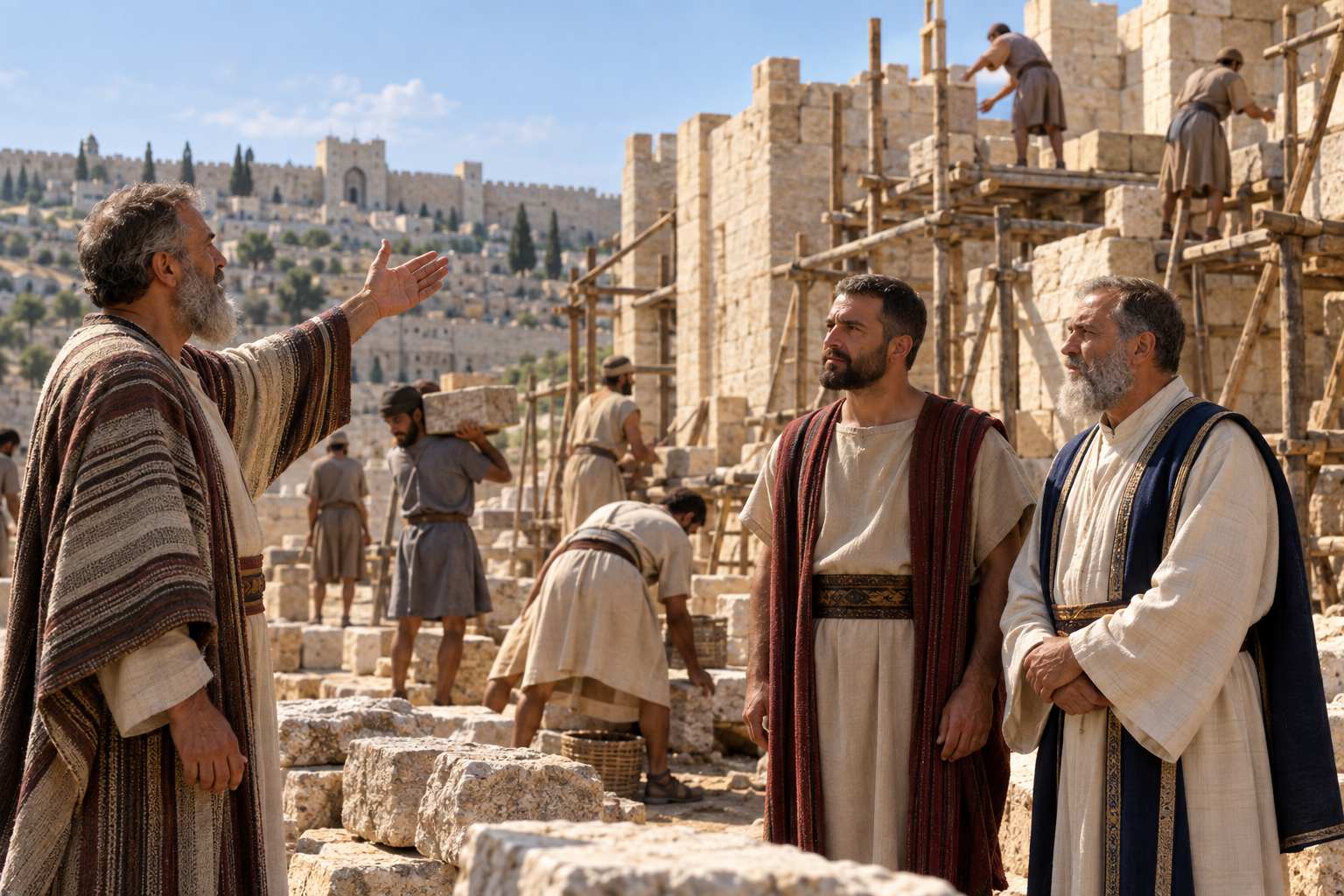
 The book of Haggai records the word of the LORD delivered through “Haggai the prophet” during “the second year of Darius the king” (Haggai 1:1). Haggai identifies Zerubbabel as “governor of Judah” and Joshua as “the high priest.” Ezra 4:24 identifies Darius as “king of Persia,” and Ezra 5:1–2 directly connects the preaching of Haggai and Zechariah with Zerubbabel and Jeshua as the Jews resumed building “the house of God which is at Jerusalem.”
The KJV therefore places Haggai’s ministry in the period when the Jewish remnant was rebuilding the house of God at Jerusalem. This is directly related to Israel and the temple and should not be transferred indiscriminately to the New Testament church. Spiritual applications may properly be drawn from the principles of obedience, priorities, holiness, faith, and service, but the historical promises belong in their stated context.
Haggai contains several precisely dated messages:
- Haggai 1:1 — first day of the sixth month.
- Haggai 1:15 — work on the house resumed on the twenty-fourth day of the sixth month.
- Haggai 2:1 — another word came on the twenty-first day of the seventh month.
- Haggai 2:10 — another word came on the twenty-fourth day of the ninth month.
- Haggai 2:20 — another word came to Haggai that same twenty-fourth day.
The repeated title “LORD of hosts” emphasizes God’s sovereign authority over His people, the nations, the natural world, and the kingdoms that He promises eventually to shake.
Chapter Summaries
Haggai 1 — “Consider Your Ways”
The chapter opens with the LORD addressing Zerubbabel and Joshua through Haggai. The people were saying:
“The time is not come, the time that the LORD’S house should be built.” — Haggai 1:2
God immediately confronts their priorities:
“Is it time for you, O ye, to dwell in your cieled houses, and this house lie waste?” — Haggai 1:4
The problem was not merely unfinished construction. Their conduct demonstrated that their own concerns were receiving attention while the LORD’S house remained neglected.
Twice the LORD commands:
“Consider your ways.” — Haggai 1:5, 7
Their experience demonstrated the seriousness of God’s chastening. They had sown much but brought in little. They ate without satisfaction, drank without being filled, clothed themselves without becoming warm, and the wage earner put his earnings into “a bag with holes” (1:6).
God does not leave the cause uncertain:
“Ye looked for much, and, lo, it came to little; and when ye brought it home, I did blow upon it. Why? saith the LORD of hosts. Because of mine house that is waste, and ye run every man unto his own house.” — Haggai 1:9
The drought was therefore not merely an unfortunate circumstance. The LORD explicitly states:
“I called for a drought upon the land.” — Haggai 1:11
This particular drought was direct divine chastening upon that people for their disobedience. Scripture does not authorize believers to assume that every financial difficulty, crop failure, illness, or hardship today is caused by some particular act of disobedience.
The proper response followed.
“Then Zerubbabel the son of Shealtiel, and Joshua the son of Josedech, the high priest, with all the remnant of the people, obeyed the voice of the LORD their God…” — Haggai 1:12
They also “did fear before the LORD.”
God then gave one of the most encouraging statements in the book:
“I am with you, saith the LORD.” — Haggai 1:13
The LORD stirred the spirit of Zerubbabel, Joshua, and “all the remnant of the people,” and they came and worked on His house (1:14).
The sequence is important:
God speaks ? the people hear ? the people obey ? they fear the LORD ? God assures them of His presence ? God stirs them to the work.
The chapter closes by recording that the work began on the twenty-fourth day of the sixth month.
Haggai 2 — Encouragement, Holiness, Blessing, and the Coming Shaking
Haggai 2 contains three major prophetic messages after the work had resumed.
1. Be Strong and Work — Haggai 2:1–9
On the twenty-first day of the seventh month, God addresses Zerubbabel, Joshua, and the remnant.
He asks:
“Who is left among you that saw this house in her first glory? and how do ye see it now? is it not in your eyes in comparison of it as nothing?” — Haggai 2:3
Scripture asks whether any present had seen the former glory. We should not state more confidently than the verse does concerning precisely which individuals had personally seen it.
Their present work may have appeared insignificant by comparison, but the LORD did not permit discouragement to stop them.
Three times the command to strength is emphasized:
“Yet now be strong, O Zerubbabel, saith the LORD; and be strong, O Joshua… and be strong, all ye people of the land, saith the LORD, and work…” — Haggai 2:4
The reason was not their resources or numerical strength:
“for I am with you, saith the LORD of hosts.”
God further reminds them of His covenant faithfulness:
“According to the word that I covenanted with you when ye came out of Egypt, so my spirit remaineth among you: fear ye not.” — Haggai 2:5
Their security rested upon the faithful LORD who had entered into covenant with Israel.
The prophecy then expands far beyond the immediate building project:
“Yet once, it is a little while, and I will shake the heavens, and the earth, and the sea, and the dry land; And I will shake all nations…” — Haggai 2:6–7
Hebrews 12:26–28 explicitly takes up this language and points toward the removal of things that can be shaken and the reception of “a kingdom which cannot be moved.” Therefore, the prophecy has an unmistakable future kingdom dimension.
Haggai continues:
“and the desire of all nations shall come: and I will fill this house with glory, saith the LORD of hosts.” — Haggai 2:7
Historic conservative Christian interpretation commonly understands “the desire of all nations” as a Messianic reference to Christ. Haggai 2 itself does not explicitly identify the phrase by the name Jesus Christ, so that identification should be stated as an interpretation drawn together with the fuller revelation of Scripture, rather than as though Haggai explicitly names Him there.
God also declares:
“The silver is mine, and the gold is mine, saith the LORD of hosts.” — Haggai 2:8
The comparative modesty of the rebuilding work did not indicate any deficiency in God’s resources.
Then comes the promise:
“The glory of this latter house shall be greater than of the former, saith the LORD of hosts: and in this place will I give peace…” — Haggai 2:9
The text explicitly promises greater glory and peace. Conservative dispensational interpretation properly keeps this promise connected with God’s purposes for Israel, Jerusalem, His Messiah, and His coming kingdom rather than transferring Israel’s temple promises to the church.
2. Holiness Cannot Be Transferred, but Defilement Spreads — Haggai 2:10–19
On the twenty-fourth day of the ninth month, God instructs Haggai to question the priests concerning the law.
If a man carried holy flesh in the skirt of his garment and touched other food with that skirt, the priests correctly answered that the contacted food did not thereby become holy.
Haggai then asked whether one who was unclean by a dead body would make something unclean by touching it.
The priests answered:
“It shall be unclean.” — Haggai 2:13
God then applies the lesson:
“So is this people, and so is this nation before me, saith the LORD; and so is every work of their hands; and that which they offer there is unclean.” — Haggai 2:14
The lesson is sobering. Merely being associated with holy things does not automatically make a person holy. Defilement, however, contaminates.
Religious activity cannot substitute for a right relationship of obedience toward God.
The LORD again commands them to consider their previous condition. Before the renewed work on His house, their expected abundance repeatedly fell short. God says:
“I smote you with blasting and with mildew and with hail in all the labours of your hands; yet ye turned not to me, saith the LORD.” — Haggai 2:17
Then comes a decisive promise:
“from this day will I bless you.” — Haggai 2:19
In its direct context, this is God’s promise to this particular remnant as they returned to obedience. It should not be distorted into a prosperity-gospel formula promising material wealth to every Christian who begins a religious project.
3. Zerubbabel, the Shaking of Kingdoms, and God’s Chosen Purpose — Haggai 2:20–23
The word of the LORD came again on the same day, specifically to Zerubbabel.
God says:
“I will shake the heavens and the earth; And I will overthrow the throne of kingdoms, and I will destroy the strength of the kingdoms of the heathen…” — Haggai 2:21–22
Human governments ultimately stand beneath the sovereignty of God. Military power, political authority, horses, riders, and kingdoms cannot frustrate His appointed purpose.
The book concludes:
“In that day, saith the LORD of hosts, will I take thee, O Zerubbabel, my servant, the son of Shealtiel, saith the LORD, and will make thee as a signet: for I have chosen thee, saith the LORD of hosts.” — Haggai 2:23
Zerubbabel was explicitly God’s servant, God’s chosen man for the role described, and one whom God said He would make “as a signet.”
Matthew 1:12–13 places Zorobabel in the recorded genealogy leading to Jesus Christ. That canonical connection gives Zerubbabel an important place in the Messianic line. Haggai 2:23 itself, however, speaks directly to Zerubbabel and should not be made to say more than its words declare.
Key People and Places
- Haggai — Identified explicitly as “Haggai the prophet.” He delivered the word of the LORD to Judah’s leaders and remnant.
- Zerubbabel — “Son of Shealtiel” and “governor of Judah” (1:1). He participated in rebuilding the LORD’S house and is called God’s “servant” and chosen “as a signet” in 2:23.
- Joshua the son of Josedech — “The high priest” (1:1). He joined Zerubbabel and the remnant in responding obediently to God’s word.
- The remnant of the people — Those who heard, obeyed, feared the LORD, and worked on His house (1:12–14).
- Darius — Called “the king” in Haggai; Ezra 4:24 explicitly calls him “Darius king of Persia.”
- Judah — The territory over which Zerubbabel served as governor.
- Jerusalem — Ezra 5:1–2 explicitly locates the rebuilding work connected with Haggai at Jerusalem.
- The house of the LORD — Central to both chapters. Its neglected condition exposes the people’s misplaced priorities, and its rebuilding becomes the immediate work commanded by God.
- Egypt — Mentioned in Haggai 2:5 as God reminds Israel of the covenant word associated with their coming out of Egypt.
- The nations — Haggai 2 looks ahead to God’s shaking of “all nations” and His overthrow of worldly kingdoms.
Main Doctrinal or Spiritual Themes
1. God’s Word Has Supreme Authority
Haggai repeatedly says, “Thus saith the LORD of hosts” and records “the word of the LORD” coming through the prophet. The people’s opinions concerning whether the time had come to build could not override what God had spoken.
The believer’s question must remain: What hath God said?
2. God Demands Proper Priorities
The central rebuke of chapter 1 was that the people attended to their own houses while God’s house remained waste.
“Consider your ways.”
The principle remains applicable: God’s interests must not continually receive what is left over after personal comfort, possessions, and ambitions have been satisfied.
3. Disobedience Has Consequences
God explicitly connected their diminished harvest, drought, and frustration with their conduct.
This establishes the biblical truth that God takes obedience seriously. It does not establish that every hardship suffered by a believer is direct punishment for a specific sin.
4. Genuine Response to God’s Word Produces Obedience
Haggai 1:12 does not merely say that the people agreed with Haggai.
They “obeyed the voice of the LORD their God.”
Biblical conviction should result in action.
5. The Fear of the LORD Accompanies Obedience
The people “did fear before the LORD” (1:12). Biblical fear is not casual familiarity with God. He is holy, sovereign, and worthy of reverence.
6. God’s Presence Strengthens His Servants
“I am with you, saith the LORD.” — Haggai 1:13
And again:
“I am with you, saith the LORD of hosts.” — Haggai 2:4
The work was difficult, but the essential encouragement was God’s presence, not human applause or visible greatness.
7. God’s Spirit Enables His Work
The LORD “stirred up the spirit” of the leaders and remnant in Haggai 1:14, and He declared in 2:5:
“my spirit remaineth among you: fear ye not.”
God’s work requires more than outward organization. His people are dependent upon Him.
8. Holiness Cannot Be Obtained by Mere Religious Association
Haggai 2:11–14 shows that ceremonial contact with something holy did not make everything else holy, while uncleanness could defile.
A person is not made right with God merely by being near religious things, attending services, possessing a Bible, knowing preachers, or participating in outward ministry.
For the New Testament believer, salvation is wholly by grace through faith in Christ, not by religious works or ceremonial association.
9. God Owns All Resources
“The silver is mine, and the gold is mine.” — Haggai 2:8
God’s servants are never justified in unbelief merely because their visible resources appear small.
10. God Will Shake the Kingdoms of This World
Haggai 2:6–7 and 2:21–22 reveal divine judgment upon the world’s unstable powers. Hebrews 12:26–28 confirms the future significance of this shaking and contrasts it with the coming “kingdom which cannot be moved.”
From a conservative premillennial perspective, earthly kingdoms are temporary. Christ’s kingdom will not be displaced by another human empire.
11. God Remains Faithful to His Covenant Purposes for Israel
Haggai speaks to Judah, the remnant, the temple, and promises connected to them. The church does not replace Israel in these passages.
God’s covenant purposes cannot be cancelled by the weakness of the remnant or the strength of Gentile kingdoms.
12. The Book Points Forward to Messianic Hope
The promised shaking of the nations, the greater glory, the coming peace, and Zerubbabel’s place in the genealogy of Christ give Haggai a significant Messianic and kingdom setting when read in light of the rest of the KJV.
That fuller prophetic significance should be affirmed without forcing details beyond what Scripture explicitly reveals.
Practical Applications or Lessons
Consider your ways. Haggai’s repeated command demands serious self-examination. A believer should ask whether God’s will genuinely governs his time, money, ambitions, relationships, and service.
Do not excuse disobedience by appealing to timing. The people said, “The time is not come.” God exposed that claim. A delayed obedience for which Scripture gives no warrant remains disobedience.
Do not give personal comfort greater priority than God’s will. The contrast between their “cieled houses” and God’s house lying waste revealed misplaced priorities.
Respond to preaching with action. The remnant did more than hear Haggai. They obeyed and worked.
Do not despise apparently small work. The rebuilding appeared unimpressive compared with former glory, yet God said, “be strong” and “work.” Faithfulness is not measured solely by outward size.
Work because God is with you. The greatest encouragement in Haggai is not that circumstances became easy but that the LORD said, “I am with you.”
Fear God more than circumstances.
“my spirit remaineth among you: fear ye not.” — Haggai 2:5
Faith rests in God’s character and promises.
Guard against spiritual defilement. Haggai 2 shows that holiness is not transferred merely through association, while uncleanness contaminates. Believers should practice biblical separation from sin rather than assuming religious activity makes compromise harmless.
Do not mistake material prosperity for the entire meaning of divine blessing. “From this day will I bless you” was spoken in a definite historical situation. It is not a promise that obedient Christians will always become materially prosperous.
Remember that God owns everything. Scarcity does not diminish God’s resources:
“The silver is mine, and the gold is mine.”
Keep earthly kingdoms in perspective. Governments rise and fall under God’s sovereign authority. God’s coming kingdom cannot be shaken.
Remain faithful even when results seem modest. Haggai teaches that God’s evaluation of obedient labor is more important than human comparison.
Keep Christ and His coming kingdom in view. The present world is temporary. The believer’s ultimate confidence is not in political stability, economic security, buildings, or human institutions, but in the Lord and the kingdom that “cannot be moved” (Hebrews 12:28).
Overall Message of Haggai
Haggai is a short book with a forceful message: put God’s revealed will first, consider your ways, repent of neglect, obey what He has said, work in His strength, walk in holiness, and trust His sovereign purposes for the future.
The remnant had become occupied with their own affairs while the LORD’S house lay waste. God corrected them, they obeyed, and He assured them, “I am with you.” He then lifted their eyes beyond the smallness of their immediate circumstances to a future in which He will shake nations, overthrow worldly power, establish His purposes, fill His house with glory, and give peace.
Haggai therefore moves from neglect to obedience, from discouragement to strength, from uncleanness to blessing, and from an unfinished house to the certainty of God’s unshakable kingdom purposes.
Comments are closed