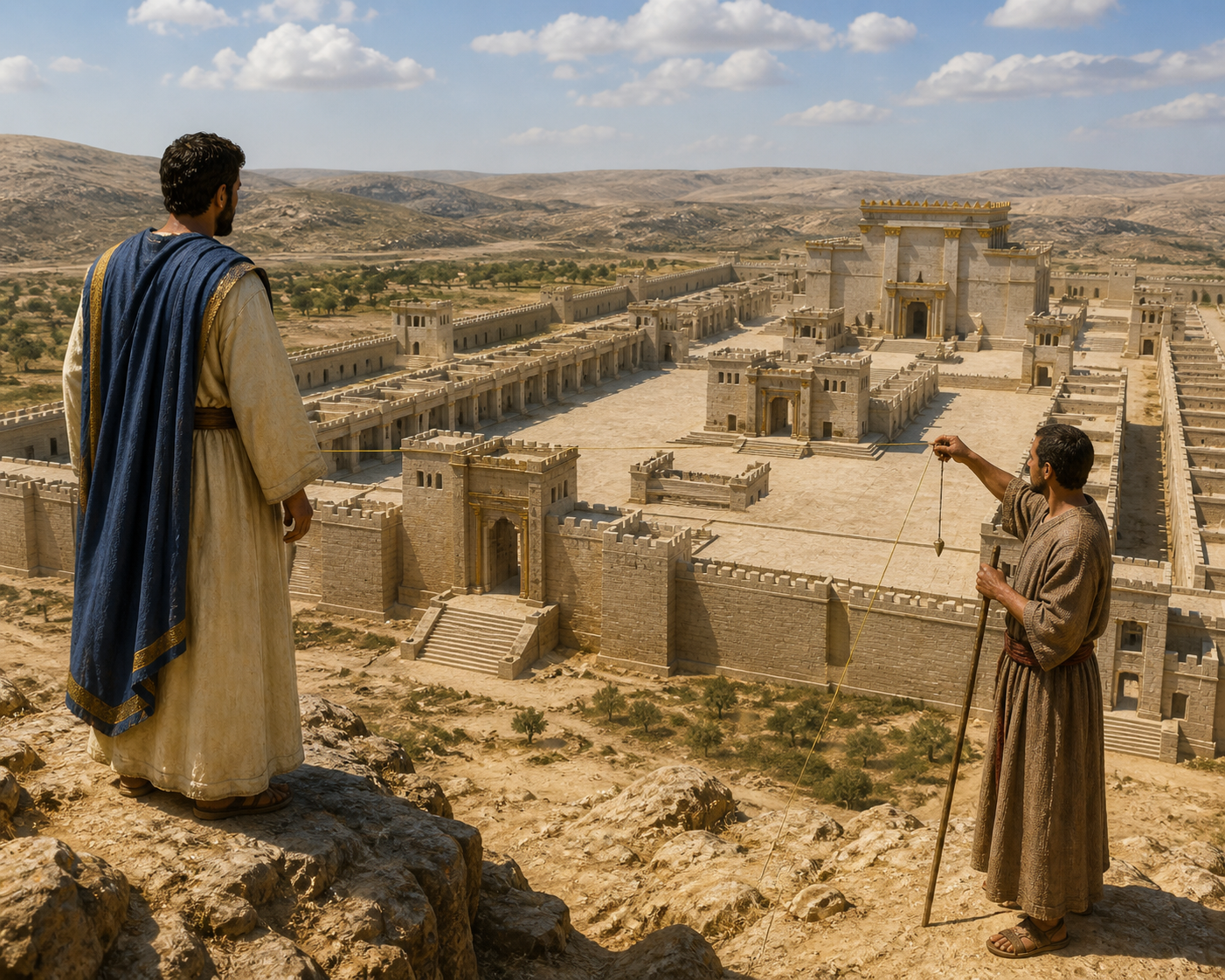
 Ezekiel 40 begins the final major vision of the book of Ezekiel, extending through chapter 48. The prophet is shown a future temple, a restored land, renewed worship, and the glory of the LORD returning. From a conservative Baptist, premillennial, dispensational standpoint, Ezekiel 40 should be read plainly as a real prophetic vision of a future temple connected with Israel’s restoration and the millennial kingdom of Christ.
This is not the church replacing Israel, nor is it merely an allegory of Christian experience. The chapter gives careful measurements, gates, courts, chambers, posts, arches, steps, and ordinances. The plain reading points to a literal temple yet future.
Chapter Summaries
1. The Time and Setting of the Vision — Ezekiel 40:1-4
Ezekiel dates the vision very carefully:
“In the five and twentieth year of our captivity, in the beginning of the year, in the tenth day of the month…”
He also says it was:
“in the fourteenth year after that the city was smitten.”
Jerusalem had already fallen. The temple of Solomon had been destroyed. Israel was in captivity. Yet God gives Ezekiel a vision not of final abandonment, but of future restoration.
This is important doctrinally. God’s judgment on Israel did not cancel His covenant purposes for Israel. The nation had sinned grievously, but Jehovah had not forgotten His promises.
Ezekiel says:
“the hand of the LORD was upon me, and brought me thither.”
This was not Ezekiel’s imagination. It was a prophetic vision given by God. He is brought “into the land of Israel,” and set “upon a very high mountain.” From there he sees “as the frame of a city on the south.”
Ezekiel then sees “a man, whose appearance was like the appearance of brass.” This man has “a line of flax” and “a measuring reed.” His work throughout the chapter is to measure the future temple structure.
The prophet is commanded:
“Son of man, behold with thine eyes, and hear with thine ears, and set thine heart upon all that I shall shew thee.”
That command matters. Ezekiel was not merely to glance at the vision. He was to observe it carefully, hear it carefully, and give it faithfully to “the house of Israel.”
Spiritual note: God’s Word deserves careful attention. The believer should approach Scripture with the same seriousness: behold, hear, and set the heart upon what God has spoken.
2. The Measuring of the Outer Wall — Ezekiel 40:5
Ezekiel sees “a wall on the outside of the house round about.” The measuring reed is described as “six cubits long by the cubit and an hand breadth.”
The wall is measured:
“the breadth of the building, one reed; and the height, one reed.”
A wall around the temple speaks of separation. God’s house is not common ground. Holy things are to be distinguished from profane things. This will become a major emphasis later in Ezekiel, especially in the restored order of worship.
From a doctrinal standpoint, the measuring also shows divine order. God is not careless in His worship. The temple is not arranged according to man’s preference, but according to God’s pattern.
3. The East Gate — Ezekiel 40:6-16
The man first comes to “the gate which looketh toward the east.” He ascends “the stairs thereof” and begins measuring.
The east gate includes:
- The threshold of the gate
- Little chambers
- Spaces between the chambers
- The porch
- Posts
- Arches
- Windows
The repeated measuring shows precision. Nothing is vague. God gives exact details.
The little chambers likely relate to the service and order of temple worship. The posts, porches, and arches display structure and dignity. The windows are described as “narrow windows,” showing planned design and function.
The eastward direction is significant in Ezekiel. Earlier in the book, the glory of the LORD departed from the temple toward the east. Later, in Ezekiel 43, the glory of the God of Israel returns from the way of the east. Ezekiel 40 prepares the way for that coming glory.
This gate is not merely architectural; it is connected to the larger theme of God’s presence returning to Israel.
4. The Outward Court and Its Chambers — Ezekiel 40:17-19
Ezekiel is then brought “into the outward court.” There he sees:
“chambers, and a pavement made for the court round about.”
There are “thirty chambers upon the pavement.”
The outer court is measured from the forefront of the lower gate to the forefront of the inner court:
“an hundred cubits eastward and northward.”
The outward court shows order in approach. One does not rush carelessly into the holiest areas. There is movement from outside to inside, from lower to higher, from common approach toward sacred service.
This teaches a practical truth: worship must be reverent. God is gracious, but He is never casual. His holiness governs the way men approach Him.
5. The North Gate — Ezekiel 40:20-23
The man then measures “the gate of the outward court that looked toward the north.”
The north gate corresponds in design to the east gate:
“the little chambers thereof were three on this side and three on that side.”
The measurements are consistent:
“the length thereof was fifty cubits, and the breadth five and twenty cubits.”
This repeated pattern reinforces the divine order of the temple. God’s design is balanced and purposeful.
Verse 23 says:
“the gate of the inner court was over against the gate toward the north, and toward the east.”
There is symmetry between the outer and inner courts. This is not random architecture. It is a measured sanctuary.
6. The South Gate — Ezekiel 40:24-27
Ezekiel is then brought “toward the south,” and the south gate is measured.
Again, the same general pattern appears: posts, arches, windows, steps, and measurements.
The south gate also has “seven steps to go up to it.” The repeated mention of steps suggests elevation as one approaches nearer to the temple proper.
The number seven often appears in Scripture in connection with completeness, though we should not force symbolism beyond the text. Here, plainly, the steps are part of the physical structure. Any spiritual lesson must remain secondary to the literal meaning.
The south gate confirms that access to the temple is ordered on multiple sides, but always according to God’s measured design.
7. The Gates of the Inner Court — Ezekiel 40:28-37
Ezekiel is brought from the outer court to the inner court. The south, east, and north gates of the inner court are measured.
The inner gates also have chambers, posts, arches, windows, and steps. One notable difference is that the inner court gates have “eight steps.”
The movement inward continues. The closer one comes to the temple service, the more solemn the approach becomes.
This section emphasizes that holiness is not disorderly. The nearer one comes to God’s worship, the more exactness and reverence are seen.
A practical Baptist application is clear: the service of God should not be treated lightly. Whether in preaching, singing, prayer, giving, or ministry, the Lord deserves reverence, obedience, and order.
8. The Tables for Sacrifices — Ezekiel 40:38-43
This section describes chambers and tables connected with the offerings.
Verse 39 says:
“And in the porch of the gate were two tables on this side, and two tables on that side, to slay thereon the burnt offering and the sin offering and the trespass offering.”
Additional tables are described, along with instruments:
“hooks, an hand broad, fastened round about.”
The mention of burnt offerings, sin offerings, and trespass offerings raises an important doctrinal question. Since Christ has already offered Himself once for all, how should these future sacrifices be understood?
From a conservative dispensational Baptist position, these sacrifices do not save, and they do not compete with the finished work of Christ. Salvation has always been by grace through faith. Old Testament sacrifices pointed forward to Christ. In the future kingdom, these sacrifices may function as memorials looking back to Christ’s finished work, much as the Lord’s supper now looks back to Calvary.
Hebrews makes clear that Christ’s sacrifice is final and sufficient. Ezekiel’s future sacrificial system must therefore be interpreted in a way that does not deny the finished blood atonement of the Lord Jesus Christ.
So Ezekiel 40 does not teach salvation by ritual. It shows restored temple worship under God’s future kingdom order for Israel.
9. Chambers for the Singers and Priests — Ezekiel 40:44-47
Ezekiel sees chambers in the inner court. These are connected with singers and priests.
Verse 45 says:
“This chamber, whose prospect is toward the south, is for the priests, the keepers of the charge of the house.”
Verse 46 says:
“And the chamber whose prospect is toward the north is for the priests, the keepers of the charge of the altar.”
These priests are identified as:
“the sons of Zadok among the sons of Levi, which come near to the LORD to minister unto him.”
The sons of Zadok are significant because they were faithful in priestly service when others failed. Later in Ezekiel, this distinction becomes more prominent.
The phrase “keepers of the charge” is important. Ministry is a stewardship. God’s servants are not free to invent worship; they are to keep the charge committed to them.
The singers also remind us that worship includes praise, but praise must be connected to holiness and order. Biblical worship is not entertainment. It is service rendered unto the LORD.
10. The Porch of the House — Ezekiel 40:48-49
The chapter closes with the measuring of “the porch of the house.”
The porch has posts, breadth, length, and steps. Ezekiel says:
“there were pillars by the posts, one on this side, and another on that side.”
This brings the vision closer to the temple house itself. The chapter has moved from the outer wall, to the gates, to the courts, to the chambers, to the priestly areas, and finally to the porch.
The flow of the chapter is deliberate. God is showing Ezekiel an ordered approach to His dwelling place. The temple is not presented first as a place of human activity, but as a place defined by God’s measurements, God’s holiness, and God’s presence.
Key People and Places
Ezekiel
Ezekiel is the prophet and priest in captivity. God gives him this vision to declare to “the house of Israel.” His role is to see, hear, set his heart upon the vision, and report it faithfully.
The LORD
The LORD is the giver of the vision. Though His glory does not return until later in the vision, this chapter is already governed by His authority. The temple belongs to Him.
The Man Whose Appearance Was Like Brass
This man measures the temple with “a line of flax” and “a measuring reed.” He functions as Ezekiel’s guide through the vision. The text does not require us to identify him beyond what is written, though his heavenly role is clear.
The House of Israel
The vision is to be declared to Israel. This matters doctrinally. The passage concerns Israel’s future restoration, not the church replacing Israel.
The Land of Israel
Ezekiel is brought “into the land of Israel.” The setting is geographical and covenantal. God’s promises to Israel include land, temple, worship, and national restoration.
The Very High Mountain
Ezekiel is set “upon a very high mountain.” From there he sees the frame of the future temple area. This elevated setting fits the grandeur and holiness of the vision.
The Temple
The central place of the chapter. Its walls, gates, courts, chambers, tables, and porch are measured carefully. The temple points forward to restored worship in the future kingdom.
East, North, and South Gates
These gates structure the movement into the temple courts. The east gate is especially important in Ezekiel because the glory of the LORD later returns from the east.
The Inner Court and Outward Court
These courts show ordered access to the temple. The arrangement teaches separation, reverence, and holiness.
The Sons of Zadok
Priests from the sons of Levi who are appointed to “come near to the LORD to minister unto him.” They represent faithful priestly service.
Main Doctrinal or Spiritual Themes
1. God Keeps His Covenant Promises to Israel
Ezekiel 40 comes after judgment, destruction, and captivity. Yet God shows a future temple in the land of Israel. This supports the biblical truth that Israel has not been permanently cast away.
The church does not erase Israel. God’s promises to Israel will be fulfilled literally under the reign of Christ.
2. God Is Holy
The temple structure teaches holiness. Walls, courts, gates, chambers, and priestly divisions all show that God’s worship is separated from common use.
God is loving and gracious, but He is also holy. Men must not approach Him according to fleshly imagination.
3. God’s Worship Must Be According to God’s Pattern
The repeated measurements show that God determines the order of His house. Man does not have liberty to redesign divine worship according to preference.
This principle applies today. A church should be governed by Scripture, not entertainment, trends, emotionalism, or worldly methods.
4. God Restores After Judgment
Jerusalem had fallen, but God gave Ezekiel a restoration vision. Chastening does not mean God has lost control. Judgment may be severe, but God’s promises remain sure.
For Israel, this points to future national restoration. For the believer, it reminds us that God is able to restore usefulness, fellowship, and hope when there is repentance and obedience.
5. Access to God Requires Reverence
The chapter repeatedly shows movement inward: wall, gate, outer court, inner court, priestly chambers, porch. The approach is ordered and solemn.
This teaches reverence. God is not to be approached flippantly.
6. Priesthood and Service Require Faithfulness
The sons of Zadok are marked out for nearness in ministry. They are “keepers of the charge.”
Service to God is not merely activity. It is faithfulness to what God has commanded.
7. Sacrifice Points to the Seriousness of Sin
The mention of burnt offerings, sin offerings, and trespass offerings reminds us that sin requires atonement. In the full light of the New Testament, all acceptable sacrifice is understood in relation to the finished work of Christ.
Future sacrifices in Ezekiel’s temple must never be understood as replacing Christ’s blood. They are subordinate to and dependent upon the once-for-all sacrifice of the Lord Jesus Christ.
8. God Is a God of Order
The measurements are exact. The layout is deliberate. The repetition is purposeful.
God’s work should not be careless. Whether in doctrine, worship, family life, or church ministry, order matters.
Practical Applications or Lessons
1. Give Careful Attention to the Word of God
Ezekiel was told:
“behold with thine eyes, and hear with thine ears, and set thine heart upon all that I shall shew thee.”
That is a good pattern for Bible study. The believer should not skim the Word of God casually. He should look, listen, and set his heart upon it.
2. Do Not Let Present Ruin Destroy Confidence in Future Promise
Ezekiel received this vision after Jerusalem had been smitten. The visible situation looked hopeless, but God’s promises were still alive.
A believer may see ruin, chastening, or decline, but God’s Word remains sure.
3. Worship Must Be Reverent
Ezekiel 40 rebukes casual religion. The temple vision is marked by holiness, separation, and order.
Modern churches should beware of turning worship into performance. God’s house is not a theater. Preaching, prayer, singing, giving, and service should be done in the fear of God.
4. God Cares About Details
The chapter may seem difficult because of its many measurements, but those measurements teach that details matter to God.
Obedience is not merely general sincerity. God cares how His work is done.
5. Separation Is Biblical
The wall around the temple reminds us that holy things are to be separated from unholy things. The believer is called to live differently from the world.
Separation is not pride. Biblical separation is obedience to a holy God.
6. Faithfulness Matters in Ministry
The priests are called “keepers of the charge.” That phrase should speak to every pastor, preacher, teacher, parent, and servant of God.
The question is not, “What do I prefer?” but, “What has God charged me to keep?”
7. Christ’s Sacrifice Must Remain Central
Though Ezekiel 40 mentions sacrifices, the believer must view all sacrifice through the final, sufficient work of Christ. No ritual can save. No priestly system can replace the blood of Jesus Christ.
Salvation is by grace through faith, not by works, sacraments, ceremonies, or law-keeping.
8. God’s Future Kingdom Will Be Real and Ordered
Ezekiel 40 encourages confidence in the literal fulfillment of prophecy. Christ will reign. Israel will be restored. God’s glory will be manifested.
The believer should not surrender prophetic Scripture to allegory. God means what He says.
Conservative Baptist Doctrinal Summary
Ezekiel 40 is a literal prophetic vision of a future temple connected with Israel’s restoration. It should be interpreted according to the plain sense of the KJV text. The chapter does not teach salvation by sacrifice, nor does it authorize allegorizing Israel into the church. It reveals God’s holiness, His covenant faithfulness, His order in worship, and His future purpose for Israel in the kingdom.
The main burden of the chapter is this: God judged Jerusalem, but He was not finished with Israel. The temple had fallen, but God showed Ezekiel a future house. The glory had departed, but the stage was being set for the glory to return.
Comments are closed