Ezekiel 41–43 continues Ezekiel’s vision of the future temple. From a conservative Baptist, premillennial, dispensational position, these chapters are best understood as a literal prophetic description connected with Israel’s future restoration and Christ’s millennial reign. This is not the Church replacing Israel, nor merely a symbolic picture of Christian worship. The passage concerns Israel, Jerusalem, the temple, the altar, and the return of “the glory of the LORD.”
Chapter Summaries
Ezekiel 41 — The Inner Temple Described
 Ezekiel is brought farther into the temple structure. The measuring angel measures the temple itself, including the holy place, the most holy place, the side chambers, the foundations, the separate place, and the surrounding buildings.
The chapter opens with the measuring of “the temple” and its posts, doors, and breadths. Ezekiel is then brought into the inner sanctuary: “So he measured the length thereof, twenty cubits; and the breadth, twenty cubits, before the temple: and he said unto me, This is the most holy place” (Ezekiel 41:4).
This “most holy place” reminds the reader of the holiness of God. Access to God is never common, casual, or man-made. God Himself determines the order of His worship.
The side chambers are described in detail, including their arrangement around the house. The repeated measuring shows that God’s future program is orderly, exact, and sovereignly designed. The temple is not presented as a vague spiritual idea but as a carefully measured structure.
The decorations include “cherubims and palm trees” (Ezekiel 41:18). The cherubim speak of holiness, guardianship, and the presence of God. The palm trees suggest victory, beauty, and kingdom blessing. The description says, “Every cherub had two faces; so that the face of a man was toward the palm tree on the one side, and the face of a young lion toward the palm tree on the other side” (Ezekiel 41:19). This imagery is majestic and reverent, fitting the dwelling place of the holy God.
The chapter also mentions an altar-like table: “This is the table that is before the LORD” (Ezekiel 41:22). Worship before God is not self-directed; it is God-centered.
Flow of the chapter:
Ezekiel moves from the temple entrance, to the holy place, to the most holy place, to the side chambers, to the ornamentation and furnishings. The emphasis is holiness, order, separation, and reverent worship.
Ezekiel 42 — Chambers for the Priests and the Separation of the Holy
Ezekiel is brought into the outer court, where the man measures chambers connected with priestly service. These chambers are not ordinary rooms. They are associated with the priests who approach the LORD.
The text says, “These are the holy chambers, where the priests that approach unto the LORD shall eat the most holy things” (Ezekiel 42:13). The priests are also to lay the holy garments there. This shows a clear distinction between the holy and the common.
The garments of ministry were not to be treated carelessly. Ezekiel 42:14 says, “When the priests enter therein, then shall they not go out of the holy place into the utter court, but there they shall lay their garments wherein they minister; for they are holy.” God’s service requires reverence, separation, and obedience.
The chapter ends with the measuring of the entire area around the temple. The purpose is plainly stated: “to make a separation between the sanctuary and the profane place” (Ezekiel 42:20).
That phrase is one of the key statements in these chapters. God is holy, and He requires a distinction between what belongs to Him and what is profane. In Scripture, true worship is never built upon blending holiness with worldliness.
Flow of the chapter:
The chambers are measured, their priestly use is explained, the holy garments are addressed, and the entire sanctuary area is measured to mark separation between holy and profane.
Ezekiel 43 — The Glory of the LORD Returns
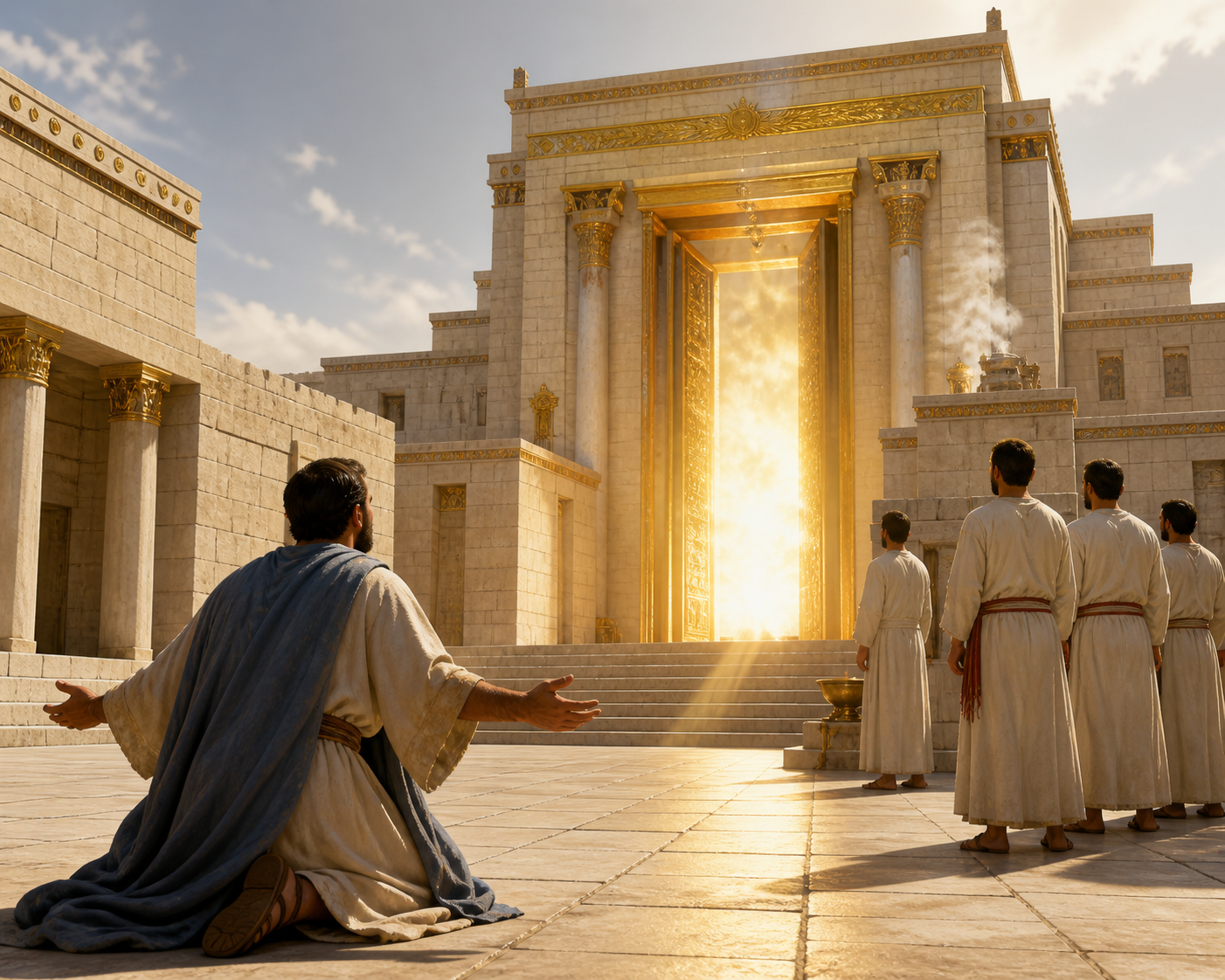
This is the spiritual high point of the section. Ezekiel is brought to “the gate, even the gate that looketh toward the east” (Ezekiel 43:1). There he sees the return of God’s glory.
The text says, “And, behold, the glory of the God of Israel came from the way of the east” (Ezekiel 43:2). This is especially significant because earlier in Ezekiel the glory of the LORD departed from the temple because of Israel’s sin and abominations. In Ezekiel 43, the glory returns.
The description is majestic: “his voice was like a noise of many waters: and the earth shined with his glory” (Ezekiel 43:2). Ezekiel falls upon his face, as he had done before in the presence of divine glory.
Then comes the great statement: “And the glory of the LORD came into the house by the way of the gate whose prospect is toward the east” (Ezekiel 43:4). The Spirit then takes Ezekiel into the inner court, “and, behold, the glory of the LORD filled the house” (Ezekiel 43:5).
The LORD declares: “Son of man, the place of my throne, and the place of the soles of my feet, where I will dwell in the midst of the children of Israel for ever” (Ezekiel 43:7). This language is covenantal, national, and tied to Israel. It should not be erased by replacement theology. God still has future purposes for Israel.
The LORD also rebukes Israel’s past defilement: “they have defiled my holy name by their abominations that they have committed” (Ezekiel 43:8). God calls them to put away their whoredom and the carcases of their kings. Restoration does not ignore sin; it requires cleansing and holiness.
Ezekiel is told to show the house to Israel: “that they may be ashamed of their iniquities: and let them measure the pattern” (Ezekiel 43:10). The vision of God’s holy order was meant to produce repentance and shame over sin.
The chapter then gives the law of the house: “Upon the top of the mountain the whole limit thereof round about shall be most holy. Behold, this is the law of the house” (Ezekiel 43:12).
The latter part of the chapter describes the altar and its consecration. Sacrifices are mentioned, including sin offerings and burnt offerings. From a dispensational premillennial view, these sacrifices do not compete with or add to the finished work of Christ. Hebrews makes clear that Christ’s sacrifice is once for all. In the millennial setting, these offerings are best understood as memorial and ceremonial in connection with restored Israel and temple worship, looking back to the finished work of Christ rather than replacing it.
Flow of the chapter:
The glory of the LORD returns from the east, fills the house, God declares His dwelling among Israel, Israel’s past sins are rebuked, the holiness of the house is stated, and the altar is consecrated.
Key People and Places
Key People
Ezekiel
The prophet and priest who receives the vision. He is shown the temple, the chambers, the altar, and the return of the glory of the LORD.
The measuring man / angelic guide
The man who measures the temple structure and guides Ezekiel through the vision. His measuring emphasizes divine order, precision, and certainty.
The LORD / the God of Israel
The central Person of the passage. His glory returns to the temple, and He declares His intention to dwell in the midst of Israel.
The priests
They are connected with holy chambers, holy garments, offerings, and service before the LORD. Their ministry underscores separation and reverence.
The house of Israel
The nation addressed in connection with shame, repentance, restoration, and the future dwelling of God among them.
Key Places
The temple / house
The central structure in the vision. It is measured in detail and filled with the glory of the LORD.
The most holy place
The inner sanctuary, emphasizing the holiness and majesty of God.
The side chambers
Rooms connected to the temple structure, showing the order and design of the house.
The holy chambers
Rooms for the priests, where they eat holy things and lay holy garments.
The east gate
The gate through which the glory of the LORD returns. This is significant because the glory had previously departed eastward.
The inner court
The area into which Ezekiel is brought when the glory of the LORD fills the house.
The altar
The place of sacrifice and consecration, described in detail in Ezekiel 43.
The sanctuary and the profane place
Ezekiel 42:20 stresses a separation “between the sanctuary and the profane place.” This is a major principle in the passage.
Main Doctrinal or Spiritual Themes
1. The Holiness of God
The repeated measurements, the most holy place, the priestly chambers, and the separation from the profane all declare that God is holy. Worship must be according to God’s pattern, not man’s imagination.
“Behold, this is the law of the house” (Ezekiel 43:12) centers the entire vision on holiness.
2. God’s Glory Must Be Central
The greatest event in these chapters is not the architecture itself but the return of “the glory of the LORD.” A temple without God’s glory would be empty religion. The presence of the LORD is what gives meaning to worship.
“And the glory of the LORD came into the house” (Ezekiel 43:4).
3. God Keeps His Promises to Israel
The LORD says this is “where I will dwell in the midst of the children of Israel for ever” (Ezekiel 43:7). A plain reading maintains the distinction between Israel and the Church. God has not cast away His covenant purposes for Israel.
These chapters fit naturally with a premillennial understanding of Christ’s future kingdom.
4. Worship Requires Separation
Ezekiel 42:20 states that the sanctuary was measured “to make a separation between the sanctuary and the profane place.” God’s people must not blur the line between holy and unholy.
This applies spiritually today in personal holiness, church practice, doctrine, music, fellowship, and moral conduct.
5. Sin Defiles Worship
God rebukes Israel for defiling His holy name by their abominations. Religious activity cannot cover rebellion. God requires repentance, cleansing, and obedience.
“Now let them put away their whoredom, and the carcases of their kings, far from me” (Ezekiel 43:9).
6. God’s Order Is Exact
The detailed measurements show that God is not careless. His work has pattern, structure, boundaries, and purpose. Disorderly worship and man-centered religion do not reflect the God of Ezekiel 41–43.
7. Sacrifice Points to God’s Provision
The altar and offerings in Ezekiel 43 remind us that sinful man cannot approach God apart from blood and atonement. For the New Testament believer, the final and sufficient sacrifice is the Lord Jesus Christ. The believer does not look to animal sacrifices for salvation, but to Christ alone.
Salvation remains by grace through faith, apart from works.
Practical Applications or Lessons
1. God Must Be Worshipped His Way
Ezekiel did not design the temple; he was shown it. Likewise, believers do not have the right to redesign worship according to preference, culture, or convenience. God’s Word must govern God’s worship.
2. Reverence Matters
The holiness of the temple, the priestly chambers, and the return of the glory of the LORD teach reverence. God is not to be approached casually or flippantly. The Christian life should reflect fear of the LORD, humility, and obedience.
3. Separation Is Still Biblical
The distinction between “the sanctuary and the profane place” has present application. Christians are called to live separated lives, not isolated from sinners, but separated from sin, false doctrine, and worldly compromise.
4. God’s Presence Is Greater Than Religious Form
The temple was measured and beautiful, but the great moment was when “the glory of the LORD filled the house.” Churches today may have buildings, programs, music, and activity, but without obedience to God and dependence upon Him, outward religion is empty.
5. Sin Should Produce Shame and Repentance
God told Ezekiel to show Israel the house “that they may be ashamed of their iniquities” (Ezekiel 43:10). A right view of God’s holiness should cause believers to take sin seriously.
True conviction is not despair; it is the path back to obedience.
6. God Restores What Sin Has Ruined
Earlier in Ezekiel, the glory departed. In Ezekiel 43, the glory returns. This shows both the severity of sin and the mercy of God. Israel’s restoration is based on God’s faithfulness, not Israel’s merit.
The same principle is seen devotionally in the believer’s walk: sin brings loss of fellowship, but God is merciful to restore the repentant.
7. The Future Kingdom Is Certain
These chapters strengthen confidence in the prophetic Word. God gave Ezekiel exact details because His promises are exact. The future reign of Christ is not a vague hope but a certain kingdom.
8. The Lord Jesus Christ Is the Final Hope of Israel and the World
Although Ezekiel 41–43 focuses on the temple and Israel’s future restoration, the broader prophetic hope rests in the Messiah. The glory of God dwelling among His people points forward to the righteous reign of Christ. Israel’s hope, the Church’s hope, and the world’s only hope are found in the Lord Jesus Christ.
Concluding Summary
Ezekiel 41–43 presents the measured temple, the holy chambers, the separation between holy and profane, the return of the glory of the LORD, and the consecration of the altar. The passage teaches that God is holy, His worship must be ordered by His Word, sin defiles, separation matters, and God will keep His promises to Israel.
The conservative Baptist position is that these chapters should be read plainly as part of God’s future prophetic program for Israel, connected with the millennial kingdom. The Church does not replace Israel, and the glory of God will yet be manifested according to His covenant faithfulness.
Comments are closed