Chapter Summaries
Isaiah 36
 This chapter records the Assyrian invasion under Sennacherib king of Assyria during the reign of Hezekiah king of Judah. The historical setting is the same crisis described in 2 Kings 18–19 and 2 Chronicles 32. After taking “all the defenced cities of Judah,” Sennacherib sends Rabshakeh from Lachish to Jerusalem with a proud and blasphemous message (Isa. 36:1-2).
Rabshakeh stands “by the conduit of the upper pool in the highway of the fuller’s field,” a place already associated with earlier prophetic confrontation in Isaiah 7. There he challenges Judah’s confidence and mocks Hezekiah’s leadership. He asks, “What confidence is this wherein thou trustest?” (v. 4). His speech is a mixture of military intimidation, political propaganda, half-truth, and open blasphemy.
He attacks Judah on several fronts:
First, he mocks reliance on Egypt, calling it “the staff of this broken reed” (v. 6). On that point, his criticism is actually correct. Scripture repeatedly condemns trusting Egypt instead of the Lord. Second, he misrepresents Hezekiah’s reforms, suggesting that because Hezekiah removed high places and altars, he has offended God (v. 7). This shows pagan ignorance. Hezekiah had not weakened true worship; he had purified it according to the will of God. Third, Rabshakeh mocks Judah’s military weakness, even offering horses if Judah can find riders for them (vv. 8-9). Fourth, he claims divine authority for the invasion, saying, “the LORD said unto me, Go up against this land, and destroy it” (v. 10). That is the most dangerous lie of all: he cloaks satanic pride in religious language.
When Eliakim, Shebna, and Joah ask him to speak in Syrian rather than in the Jews’ language, Rabshakeh deliberately speaks louder to the common people on the wall, trying to break morale (vv. 11-12). He promises peace, prosperity, and survival if they surrender, but his words are deceitful. He compares the Lord to the powerless gods of the nations and says, “Who are they among all the gods of these lands, that have delivered their land out of my hand, that the LORD should deliver Jerusalem out of my hand?” (v. 20). That statement moves the matter beyond politics into a direct challenge against the God of Israel.
The people obey Hezekiah’s command and “held their peace” (v. 21). That silence is significant. Sometimes faith answers blasphemy not with panic, but with restraint while waiting on the Lord.
Isaiah 37
This chapter shows the right response to a crisis that is too great for human strength. When Hezekiah hears the report, he rends his clothes, covers himself with sackcloth, and goes “into the house of the LORD” (v. 1). That is the turning point. The king does not begin with military boasting, diplomatic maneuvering, or self-confidence. He humbles himself before God.
He sends Eliakim, Shebna, and the elders of the priests to Isaiah the prophet, describing the day as “a day of trouble, and of rebuke, and of blasphemy” (v. 3). Hezekiah sees clearly that the deepest issue is not merely national danger but divine dishonor. He asks for prayer: “wherefore lift up thy prayer for the remnant that is left” (v. 4). This is a godly king seeking God’s word through God’s prophet.
The Lord answers quickly through Isaiah: “Be not afraid of the words that thou hast heard” (v. 6). God promises to send a blast upon Sennacherib, cause him to hear a rumor, return to his own land, and fall by the sword there (v. 7). God is never disturbed by the raging of proud men. He answers exactly and sovereignly.
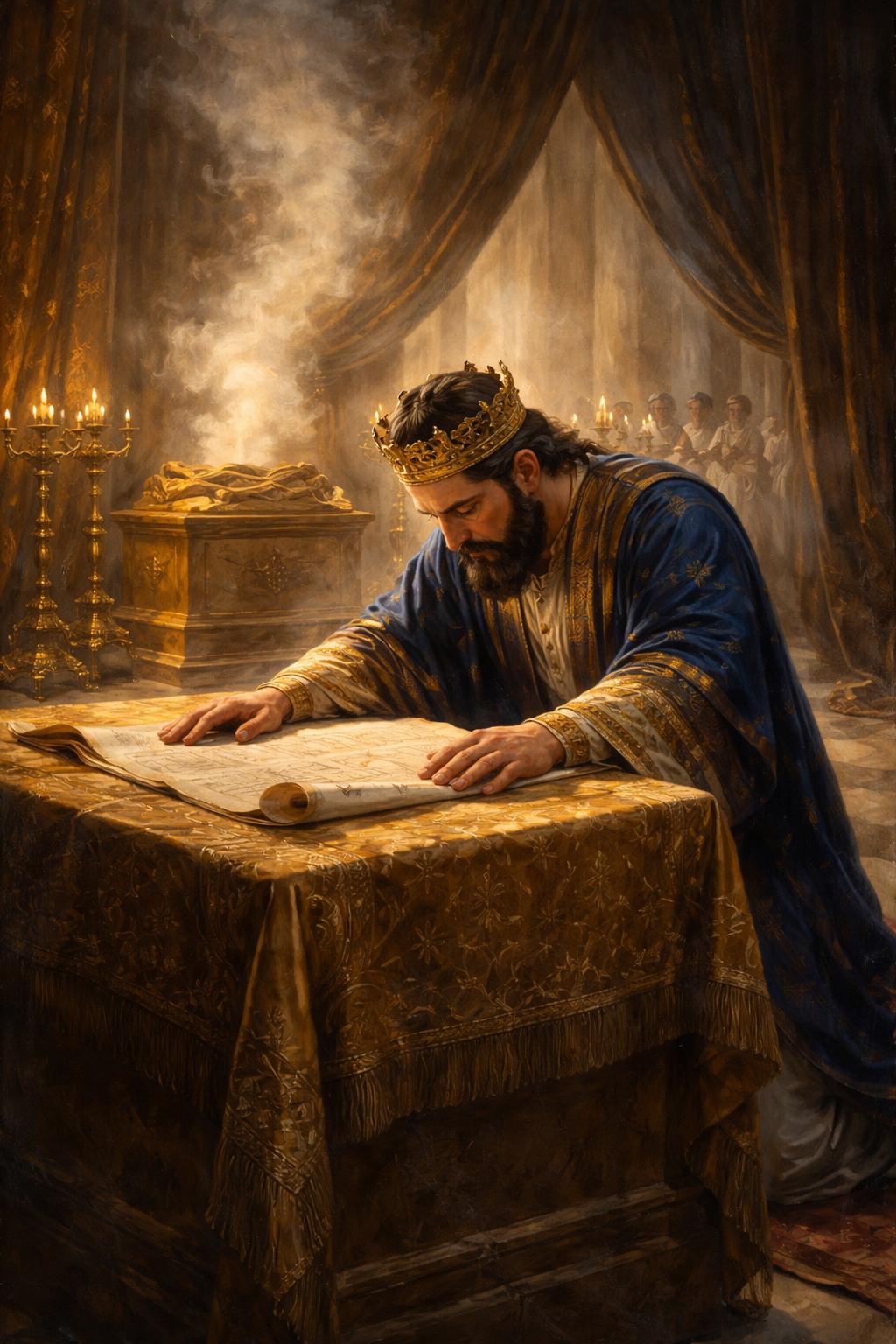
Sennacherib sends another threatening letter, again exalting himself above the Lord and listing other conquered lands and kings (vv. 8-13). Then comes one of the great prayer scenes in Scripture. Hezekiah goes up into the house of the Lord and spreads the letter before the Lord (v. 14). He prays not merely for survival but for God’s glory: “save us from his hand, that all the kingdoms of the earth may know that thou art the LORD, even thou only” (v. 20).
That prayer is followed by Isaiah’s message of judgment against Assyria and comfort for Judah. God rebukes Sennacherib’s pride: “Whom hast thou reproached and blasphemed?… even against the Holy One of Israel” (v. 23). The Lord reminds Assyria that all its apparent achievements were permitted by divine sovereignty (vv. 26-27). He knows Sennacherib’s rage and promises to turn him back like a beast controlled by bit and bridle (v. 29).
God also gives a sign to His people concerning recovery in the land and promises that “the zeal of the LORD of hosts shall do this” (v. 32). Jerusalem will not fall to Assyria. The Lord declares, “I will defend this city to save it for mine own sake, and for my servant David’s sake” (v. 35). That points to God’s covenant faithfulness.
Then comes the miraculous deliverance: “the angel of the LORD went forth, and smote in the camp of the Assyrians a hundred and fourscore and five thousand” (v. 36). Assyria’s terrifying army is destroyed in one night by divine power alone. Later, Sennacherib returns to Nineveh, and while worshiping in the house of Nisroch his god, he is slain by his own sons (vv. 37-38). God’s word is fulfilled exactly.
Isaiah 38
This chapter turns from national crisis to personal crisis. Hezekiah, who had just seen God deliver Jerusalem, now faces his own mortality. “In those days was Hezekiah sick unto death” (v. 1). Isaiah comes with a sobering message: “Set thine house in order: for thou shalt die, and not live.” This is one of the clearest examples in Scripture of preparing for death with seriousness and spiritual honesty.
Hezekiah turns his face to the wall and prays unto the Lord, weeping sore (vv. 2-3). His prayer appeals to the sincerity of his walk: “I have walked before thee in truth and with a perfect heart.” This is not sinless boasting, but the cry of a godly man conscious that he has sought to serve the Lord. God hears him. Before Isaiah has gone out into the middle court, the word of the Lord comes again: Hezekiah will live another fifteen years, and God will also deliver the city from the king of Assyria (vv. 4-6).
The Lord gives a confirming sign: the shadow on the sun dial of Ahaz goes backward ten degrees (vv. 7-8). This is a supernatural sign of divine control over time, nature, kings, sickness, and history. The God who rules empires also rules the shadow on a dial.
The remainder of the chapter includes Hezekiah’s writing after his recovery (vv. 9-20). It is a deeply personal meditation on death, sorrow, chastening, and restored praise. He speaks of feeling cut off “in the midst of my days” (v. 10), of mourning “as a dove” (v. 14), and of his soul being delivered from “the pit of corruption” (v. 17). He recognizes that suffering had spiritual profit: “thou in love to my soul hast delivered it” (v. 17). He also sees that the living—not the dead in the grave—are the ones who publicly praise God and declare His truth to the next generation (vv. 18-19).
The chapter closes with the practical means God used in healing: a lump of figs laid on the boil (v. 21). This is a helpful reminder that God may work miraculously, yet still use ordinary means. Divine healing and practical remedies are not enemies when both are under God’s providence.
Key People and Places
Hezekiah – King of Judah. A godly ruler who trusted the Lord in national danger and cried to Him in personal sickness.
Sennacherib – King of Assyria. A proud, blasphemous conqueror who exalted himself against the Lord and was brought down by divine judgment.
Rabshakeh – Assyrian spokesman or military official sent to intimidate Jerusalem with threatening and blasphemous words.
Isaiah – The prophet of the Lord who delivered God’s word of comfort, rebuke, promise, and prophecy during this crisis.
Eliakim – A leading official in Hezekiah’s court, sent to hear and report Rabshakeh’s words.
Shebna – A scribe or official serving under Hezekiah during this episode.
Joah – Recorder in Hezekiah’s administration.
Jerusalem – Capital city of Judah, besieged and threatened by Assyria, yet preserved by the Lord.
Lachish – A major Judean city captured or used as Assyria’s operational base during the campaign.
The conduit of the upper pool / highway of the fuller’s field – The location where Rabshakeh confronted Judah’s representatives; a place linked with earlier prophetic dealings in Isaiah.
Egypt – Mentioned as an unreliable object of trust, “this broken reed.”
Nineveh – Capital city of Assyria, where Sennacherib returned and later died.
House of Nisroch – Place of Sennacherib’s false worship, where judgment overtook him.
The house of the LORD – Repeatedly central in chapter 37; the place to which Hezekiah turned in humility and prayer.
The dial of Ahaz – The instrument associated with the miraculous sign of the shadow going backward.
Main Doctrinal or Spiritual Themes
The supremacy of the true God over all nations and idols
Rabshakeh and Sennacherib spoke as though the God of Israel were just another tribal deity. But these chapters prove that the Lord is absolutely unique. He is not one god among many. He is the sovereign Lord over Assyria, Judah, sickness, life, death, and time itself.
Faith versus carnal trust
Rabshakeh correctly exposed the weakness of trusting in Egypt, though his motives were wicked. The broader biblical principle stands: God’s people must not lean on worldly power in place of the Lord. Hezekiah’s strength was not in horses, alliances, or military resources, but in seeking God.
The blasphemy of pride
Sennacherib’s boastfulness was not mere arrogance against man; it was defiance against God. Pride always rises too high. The Lord has a settled opposition to human self-exaltation. Assyria became the rod of God’s chastening in earlier chapters, but when that rod magnified itself, God judged it.
The power of prayer
Hezekiah’s response in both public and private crisis was prayer. He prayed in the temple for the nation; he prayed facing the wall for his life. These chapters show that prayer is not a last resort of weakness, but the appointed path of faith.
God’s covenant faithfulness
The Lord promised to defend Jerusalem “for mine own sake, and for my servant David’s sake.” His deliverance was tied to His own name and covenant purpose. God’s promises cannot fail.
The ministry of the prophet and the authority of God’s word
Isaiah did not offer human optimism. He brought the exact word of the Lord. In every age, the people of God need not human speculation but divine truth.
The reality of death and the mercy of extended life
Hezekiah’s sickness teaches the seriousness of death and the need to set one’s house in order. His healing teaches that life is a mercy from God, not a right.
God’s use of means without diminishing His power
The miraculous sign and the fig poultice stand together. God can act supernaturally and still employ ordinary means. Scripture never presents providence and power as contradictory.
The duty of testimony to the next generation
Hezekiah says, “the father to the children shall make known thy truth” (38:19). One of the great purposes of preserved life is to testify of God’s faithfulness.
Practical Applications or Lessons
1. Believers must answer threats with faith, not panic.
The pressure on Jerusalem was intense, yet Hezekiah eventually did the right thing: he took the matter to the Lord. When enemies, circumstances, or fears speak loudly, God’s people must learn to quiet themselves before Him.
2. Satan often mixes truth with lies.
Rabshakeh was right that Egypt could not save Judah, but he used that truth to push them away from trusting God. That is how deception often works. Discernment is needed.
3. A godly leader points people toward the Lord.
Hezekiah was not flawless, but in these chapters he models humility, prayerfulness, and dependence on God. Leadership in home, church, or nation is strongest when it bows before the Lord.
4. Blasphemy will not go unanswered.
Men may speak proudly for a season, but God hears every reproach against His name. No empire, government, ideology, or individual can defy Him safely.
5. Prayer should be specific and God-centered.
Hezekiah spread the letter before the Lord. He dealt with the exact burden in God’s presence. He also prayed for God’s honor, not only his own safety. That is a pattern worth following.
6. Times of sickness should drive us to self-examination and preparation.
“Set thine house in order” is a solemn word. Every believer should live ready to die, with spiritual matters settled and practical responsibilities arranged.
7. Tears are not contrary to faith.
Hezekiah wept sore, yet he prayed. Scripture does not condemn godly sorrow. A broken heart that turns to God is not unbelief.
8. God deserves public praise for answered prayer.
Hezekiah did not keep his deliverance private. He wrote about it. When the Lord delivers, heals, or sustains, His people should testify.
9. The living should use their days for God’s glory.
Hezekiah’s reflection in chapter 38 reminds us that life is brief and valuable. Extra years are not merely for comfort, but for worship, obedience, and declaring God’s truth.
10. The Lord is able to deliver suddenly and completely.
One night changed everything for Judah. The Assyrian army that looked unstoppable was destroyed by the Lord. No case is too hard for Him.
Isaiah 36–38 forms a powerful historical and spiritual unit. In chapter 36, the enemy mocks. In chapter 37, the king prays and God delivers. In chapter 38, the king suffers personally, prays again, and God restores. Together these chapters teach that the Lord is worthy of trust in both public danger and private affliction. He can silence empires and soften a sickbed. He humbles the proud, hears the praying, preserves His name, and proves again that “the zeal of the LORD of hosts shall do this.”
Comments are closed