Chapter Summaries
Isaiah 39
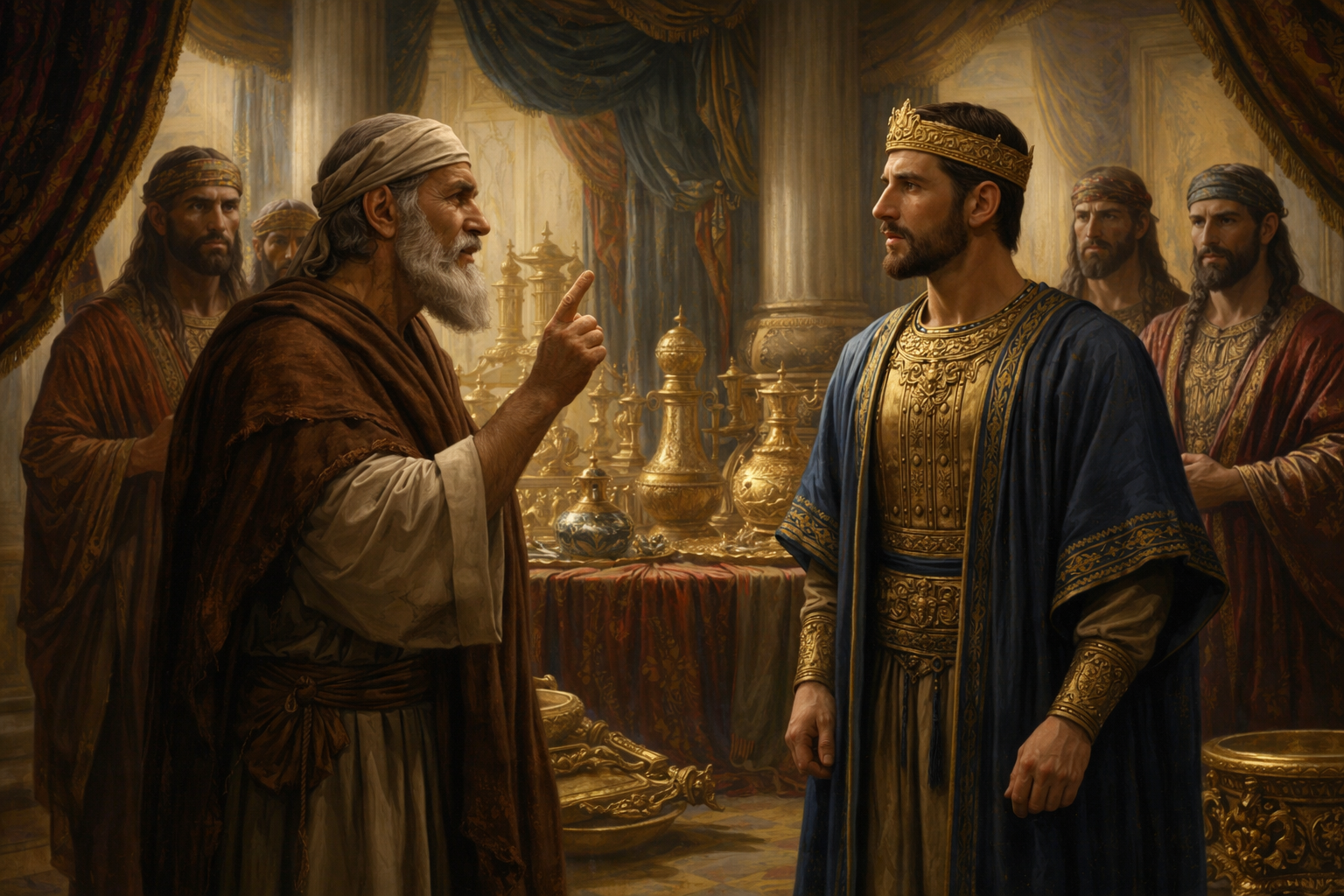
 This chapter records Hezekiah’s failure after the great deliverance and healing of the previous chapters. Merodach-baladan the king of Babylon sent letters and a present to Hezekiah, for he had heard that he had been sick and was recovered. Instead of giving the glory wholly to the LORD and maintaining wise restraint, Hezekiah “was glad of them, and shewed them the house of his precious things” (Isa. 39:2). He displayed his treasures, silver, gold, spices, precious ointment, armor, and all that was found in his storehouses. The chapter presents a sad spiritual turn: the man who had prayed in dependence before the LORD now acts with fleshly vanity before foreign envoys.
Isaiah the prophet then confronted Hezekiah directly. He asked who these men were and what they had seen. Hezekiah admitted that he had shown them everything. Isaiah then delivered the word of the LORD: “Behold, the days come, that all that is in thine house… shall be carried to Babylon: nothing shall be left” (Isa. 39:6). He also foretold that some of Hezekiah’s sons would be taken away and made eunuchs in the palace of the king of Babylon. This prophecy looks ahead to the Babylonian captivity, showing that Judah’s downfall would come not merely through political weakness, but through sin, pride, and disobedience.
Hezekiah’s response is sobering. He said, “Good is the word of the LORD which thou hast spoken,” and added, “for there shall be peace and truth in my days” (Isa. 39:8). There is humility in accepting God’s word, yet there is also a trace of sadness in his limited outlook, being relieved that judgment would not fall in his own lifetime. Historically, this chapter serves as a hinge between the Assyrian crisis in earlier chapters and the Babylonian horizon that dominates the latter part of Isaiah.
Isaiah 40
Isaiah 40 opens a major new section with the tender words, “Comfort ye, comfort ye my people, saith your God” (Isa. 40:1). The tone shifts from warning and judgment to consolation, though not by ignoring sin. Jerusalem had received “double for all her sins” in the sense of full chastening under God’s hand. Then comes the voice crying in the wilderness, “Prepare ye the way of the LORD” (Isa. 40:3). In the immediate setting, this points to the LORD’s coming in deliverance for His people; in the broader biblical unfolding, the New Testament applies this to John the Baptist preparing the way for Christ.
The chapter emphasizes the frailty of man and the permanence of God’s Word: “All flesh is grass… but the word of our God shall stand for ever” (Isa. 40:6-8). Zion is told to lift up her voice with strength and declare, “Behold your God!” The LORD is then revealed in both majesty and tenderness. He comes “with strong hand,” yet “he shall feed his flock like a shepherd: he shall gather the lambs with his arm” (Isa. 40:10-11). This is a glorious presentation of the sovereign God who is both King and Shepherd.
The middle section magnifies the incomparableness of God. He measures the waters in the hollow of His hand, weighs the mountains in scales, and sits upon “the circle of the earth” while its inhabitants are “as grasshoppers” (Isa. 40:12, 22). The nations are “as a drop of a bucket,” and the princes of the earth are brought to nothing. Idolatry is exposed as folly, because no graven image can compare to the everlasting God.
The chapter closes with one of the most beloved promises in Scripture. God does not faint or grow weary. His understanding is unsearchable. He gives power to the faint, and “they that wait upon the LORD shall renew their strength; they shall mount up with wings as eagles” (Isa. 40:31). This is not a promise of a trouble-free life, but of God-given endurance for those who trust Him.
Isaiah 41
Isaiah 41 continues the declaration of God’s absolute sovereignty over nations, idols, and history. The chapter begins with God summoning the nations to silence before Him and asking who has “raised up the righteous man from the east” (Isa. 41:2). In context, this most naturally points to Cyrus as God’s instrument, though named explicitly later. The point is that world rulers do not rise by accident; they are raised up by the Lord of history to fulfill His purposes.
The nations respond to fear with more idolatry, encouraging one another and fastening their idols so “that it should not be moved” (Isa. 41:7). In contrast to the fearful heathen world, Israel is addressed as God’s chosen servant: “thou, Israel, art my servant, Jacob whom I have chosen” (Isa. 41:8). The covenant language recalls Abraham, “my friend,” and reassures the people that though chastened, they are not abandoned. The repeated command is, “Fear thou not; for I am with thee: be not dismayed; for I am thy God” (Isa. 41:10). That verse is one of the strongest Old Testament declarations of divine help, strengthening, and upholding grace.
The LORD promises to deal with Israel’s enemies and even transform weak Jacob into a new sharp threshing instrument. Though Israel is pictured as a “worm,” helpless in itself, God says, “I will help thee” and identifies Himself as “thy redeemer, the Holy One of Israel” (Isa. 41:14). The chapter then moves to imagery of provision and restoration, with rivers in high places, fountains in valleys, and trees planted in the wilderness, so that all may see that “the hand of the LORD hath done this” (Isa. 41:20).
The chapter ends with a courtroom scene in which idols are challenged to declare the former things or show things to come. They cannot. They are exposed as vanity: “Behold, they are all vanity; their works are nothing” (Isa. 41:29). The living God alone declares the end from the beginning. Thus the chapter is both a word of comfort to God’s people and a crushing exposure of false religion.
Key People and Places
Hezekiah — King of Judah; a godly king in many respects, yet in Isaiah 39 he stumbled through pride and misplaced display before Babylonian envoys.
Isaiah — Prophet of the LORD; faithfully rebuked Hezekiah and declared both coming judgment and future comfort for God’s people.
Merodach-baladan — King of Babylon who sent letters and a gift to Hezekiah; his embassy became the occasion for Hezekiah’s pride and Isaiah’s prophecy of Babylonian captivity.
Babylon — Rising power in Isaiah 39; later the nation that would carry Judah into captivity. It becomes a major background theme for the second half of Isaiah.
Jerusalem / Zion — Capital city of Judah; the immediate object of both chastening and promised comfort. Zion is told to proclaim, “Behold your God!”
Judah — Southern kingdom; preserved for a time under Hezekiah, yet moving toward future judgment because of sin.
The wilderness / desert places — In Isaiah 40 and 41 these settings carry both literal and spiritual significance, associated with preparation, divine coming, and miraculous provision.
Abraham — Recalled in Isaiah 41 as “my friend,” underscoring God’s covenant faithfulness to the seed of Abraham.
Jacob / Israel — The covenant people addressed as God’s servant; weak in themselves yet upheld by the LORD.
The one from the east — Most naturally Cyrus in prophetic anticipation, used by God as an instrument in world affairs.
Main Doctrinal or Spiritual Themes
1. The danger of pride after blessing
Isaiah 39 warns that spiritual victories do not make a believer immune to later failure. Hezekiah, after answered prayer and miraculous deliverance, fell into self-display. Prosperity often reveals the heart as much as adversity does.
2. The certainty of God’s chastening word
When God speaks judgment, it is not empty warning. The prophecy concerning Babylon would surely come to pass. God’s Word governs history.
3. The comfort of God toward His chastened people
Isaiah 40 does not deny Judah’s sin, but it shows that God’s covenant mercy remains. The same God who chastens also comforts. This is consistent with the character of the Lord throughout Scripture.
4. The greatness and incomparability of God
Isaiah 40 especially exalts the LORD as Creator, Ruler, Shepherd, and everlasting God. No nation, ruler, or idol can compare to Him.
5. The permanence of Scripture over human frailty
“All flesh is grass,” but “the word of our God shall stand for ever.” Man is fading and weak; God’s truth is fixed and eternal.
6. The LORD as Shepherd
The tenderness of Isaiah 40:11 anticipates the fuller revelation of Christ as the Good Shepherd. God’s strength does not cancel His gentleness.
7. God’s sovereignty over kings and nations
Isaiah 41 shows that rulers rise and fall under divine providence. History is not random. The LORD directs the nations for His own glory and purpose.
8. God’s covenant faithfulness to Israel
Though judged, Israel is still addressed as chosen and not cast off. This fits a plain reading of the prophetic text and supports the ongoing significance of God’s covenant dealings with Israel.
9. The folly of idolatry
The idols cannot save, speak, predict, or act. They are the work of men’s hands. This includes literal idols and, by application, anything man trusts in place of God.
10. Strength for those who wait on the LORD
Isaiah 40 closes with the doctrine of dependent faith. Divine strength is given not to the self-sufficient but to those who wait upon the LORD.
Practical Applications or Lessons
1. Success can be more dangerous than crisis
Hezekiah prayed well in trouble, but acted poorly in prosperity. Believers must guard the heart after answered prayer, victory, growth, or public recognition.
2. Do not parade what God has entrusted to you
Hezekiah displayed his treasures before Babylon. There is a practical lesson here about pride, loose speech, and carnal impressiveness. What God gives us is to be stewarded, not flaunted.
3. Receive rebuke from God’s Word with humility
Isaiah confronted Hezekiah, and the king did bow before the word of the LORD. When Scripture exposes sin, the right response is submission, not argument.
4. God’s comfort is rooted in His character, not our worthiness
Isaiah 40 is precious because the comfort comes from who God is. Weak saints can rest in His compassion and faithfulness.
5. Lift your eyes above men and nations
The chapter calls us away from man-centered fear. Nations are as a drop of a bucket before God. Modern anxiety often comes from looking horizontally instead of upward.
6. Feed faith by remembering the greatness of God
A high view of God strengthens the soul. When the believer sees God as Creator, King, and Shepherd, lesser fears shrink.
7. Wait on the LORD instead of forcing your own strength
The promise of renewed strength belongs to those who wait. This speaks of trust, patience, prayer, and dependence rather than restless self-effort.
8. Fear is answered by God’s presence
Isaiah 41 does not merely say, “Fear not,” but gives the reason: “for I am with thee.” Courage in the Christian life is not self-confidence; it is confidence in God.
9. God can use the weak for His purposes
Israel is called a worm, yet God promises help and victory. The lesson is clear: God delights to use weakness that depends on Him.
10. Reject idols in every form
Though many today do not bow before carved images, people still trust wealth, power, politics, reputation, or human solutions. Anything that replaces confidence in God becomes an idol.
These chapters together move from human failure to divine comfort, and from earthly pride to heavenly assurance. Isaiah 39 humbles the reader; Isaiah 40 and 41 lift the eyes back to the majesty, tenderness, and faithfulness of the LORD.
Comments are closed