 Numbers 5–6 continues the ordering of Israel around the tabernacle. After the numbering and arrangement of the tribes and Levites in Numbers 1–4, these chapters emphasize the holiness of the camp, responsibility for sin, purity in marriage, voluntary separation unto the LORD, and the gracious blessing God placed upon Israel through Aaron and his sons.
A governing truth through both chapters is that the LORD was dwelling in the midst of Israel. Therefore uncleanness, dishonesty, moral impurity, and careless living could not simply be treated as private matters.
Chapter Summaries
Numbers 5 — Holiness, Restitution, and the Law of Jealousies
1. The unclean are put outside the camp — Numbers 5:1–4
The LORD commands Moses:
“Command the children of Israel, that they put out of the camp every leper, and every one that hath an issue, and whosoever is defiled by the dead:” — Numbers 5:2
Both men and women who came under these stated forms of ceremonial uncleanness were to be put outside the camp.
The stated reason is especially important:
“that they defile not their camps, in the midst whereof I dwell.” — Numbers 5:3
This is explicit in the text: the requirement was connected with the LORD dwelling among His covenant people.
This separation should not be confused with New Testament church discipline in every detail. Numbers 5 concerns Israel under the Mosaic covenant and the ceremonial holiness of Israel’s camp. Nevertheless, the underlying truth remains: God’s holiness is not compatible with treating defilement as insignificant.
The New Testament likewise commands believers:
“But as he which hath called you is holy, so be ye holy in all manner of conversation;” — 1 Peter 1:15
The church does not reproduce Israel’s ceremonial uncleanness laws, but believers are still commanded to live holy lives.
2. Confession and restitution for trespass — Numbers 5:5–10
The next section concerns a man or woman who commits a trespass.
Numbers 5:6 describes such conduct as:
“any sin that men commit, to do a trespass against the LORD”
That wording is significant. Wrong committed in human relationships could also constitute a trespass against the LORD.
When guilt was present, God required confession:
“Then they shall confess their sin which they have done:” — Numbers 5:7
Restitution was also required. The guilty person was to restore what had been wrongfully taken or withheld and:
“add unto it the fifth part thereof”
That is twenty percent in addition to the principal amount.
If the injured person had no kinsman to whom restitution could be made, the recompense was given unto the LORD for the priest, in addition to:
“the ram of the atonement, whereby an atonement shall be made for him.” — Numbers 5:8
The passage therefore joins several important truths:
- Sin must be acknowledged.
- Genuine repentance does not excuse a person from making wrongs right where restitution is possible.
- Sin against another person is also accountable before God.
- Atonement was necessary under the Mosaic sacrificial system.
For the Christian, those sacrifices are not repeated. Christ’s sacrifice is sufficient and final:
“For by one offering he hath perfected for ever them that are sanctified.” — Hebrews 10:14
Making restitution does not purchase salvation. Salvation remains wholly by grace through faith:
“For by grace are ye saved through faith; and that not of yourselves: it is the gift of God:” — Ephesians 2:8
Restitution is therefore a matter of righteousness and obedience, not a means of justification.
3. The law of jealousies — Numbers 5:11–31
This is the largest section of Numbers 5 and requires careful reading because Scripture describes a very specific circumstance.
The text concerns a husband whose wife is suspected of adultery when the matter has been concealed:
“and there be no witness against her, neither she be taken with the manner;” — Numbers 5:13
The passage then says that:
“the spirit of jealousy come upon him” — Numbers 5:14
The husband brings his wife to the priest together with the prescribed offering.
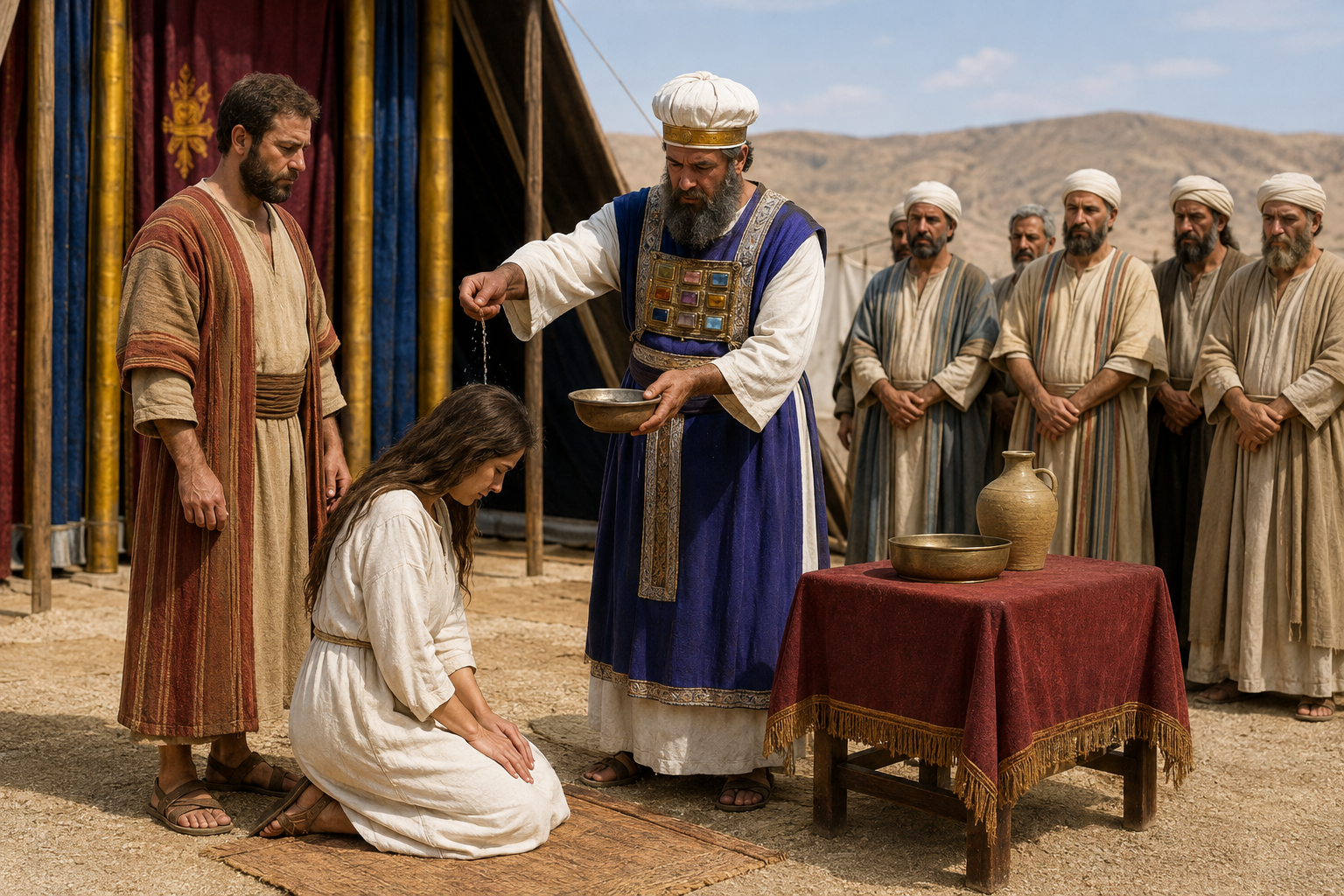
The priest uses:
“holy water in an earthen vessel”
and:
“of the dust that is in the floor of the tabernacle”
The woman is set:
“before the LORD” — Numbers 5:18
The priest administers the prescribed oath and the woman answers:
“Amen, amen.” — Numbers 5:22
She then drinks the “bitter water,” and the outcome reveals whether she is guilty or innocent according to the ordinance God gave Israel.
If guilty, the text says:
“her belly shall swell, and her thigh shall rot” — Numbers 5:27
If innocent:
“then she shall be free, and shall conceive seed.” — Numbers 5:28
An important textual restraint
Numbers 5 does not explicitly call this procedure an abortion, nor does the chapter explicitly say that the woman is pregnant when she undergoes the ordinance. Those conclusions should therefore not be inserted into the passage.
The KJV states exactly what the judgment was: “her belly shall swell, and her thigh shall rot.” We should leave the wording where Scripture leaves it rather than replace it with a modern medical description that the passage itself does not give.
Likewise, the text does not authorize a husband to punish his wife merely because he is suspicious. In the circumstance described, the matter is brought to the priest and the woman is placed “before the LORD.”
The central issue is divine judgment concerning a hidden matter.
God knows what human witnesses may not know.
“The eyes of the LORD are in every place, beholding the evil and the good.” — Proverbs 15:3
The passage also reinforces the seriousness of marital faithfulness. Adultery is not treated casually in Scripture.
For Christians, however, the ceremonial procedure of Numbers 5 is not an ordinance of the New Testament church. There is no New Testament command instructing pastors or churches to reproduce the bitter-water ceremony. It belonged to Israel’s Mosaic priestly order.
The continuing moral truth is purity:
“For this is the will of God, even your sanctification, that ye should abstain from fornication:” — 1 Thessalonians 4:3
Numbers 6 — The Nazarite and the Priestly Blessing
1. The Nazarite vow — Numbers 6:1–21
The LORD speaks to Moses concerning a special voluntary separation:
“When either man or woman shall separate themselves to vow a vow of a Nazarite, to separate themselves unto the LORD:” — Numbers 6:2
Several points are directly stated.
First, either a man or a woman could take the vow.
Second, its purpose was:
“to separate themselves unto the LORD”
The emphasis is therefore consecration to God.
The chapter does not restrict the vow to priests or Levites.
2. Abstinence from the fruit of the vine
During the days of the vow, the Nazarite was to abstain from:
“wine and strong drink” — Numbers 6:3
The restriction went considerably farther than intoxicating beverages.
The Nazarite could not eat:
“any thing that is made of the vine tree, from the kernels even to the husk.” — Numbers 6:4
Thus the restriction included the entire fruit of the vine for the period of separation.
A careful distinction is necessary: Numbers 6 does not impose every Nazarite restriction upon every Israelite. These requirements belong specifically to the Nazarite vow described here.
Nevertheless, the principle is instructive. Consecration to God may involve voluntarily relinquishing things a person might otherwise lawfully possess or enjoy in order to devote himself more completely to the LORD.
3. No razor upon the head
The LORD commands:
“There shall no razor come upon his head:” — Numbers 6:5
Instead:
“he shall be holy, and shall let the locks of the hair of his head grow.”
This was a divinely prescribed sign connected specifically with the Nazarite vow.
It would therefore be improper to use Numbers 6:5 as a universal command that Christian men must grow long hair. The New Testament addresses men’s hair separately:
“Doth not even nature itself teach you, that, if a man have long hair, it is a shame unto him?” — 1 Corinthians 11:14
The Nazarite requirement was an exceptional feature of this particular Old Testament vow, not the ordinary standard for Christian men.
4. Separation from the dead
During the period of separation:
“All the days that he separateth himself unto the LORD he shall come at no dead body.” — Numbers 6:6
The restriction included even the closest family relationships:
“He shall not make himself unclean for his father, or for his mother, for his brother, or for his sister, when they die:” — Numbers 6:7
The reason given is:
“because the consecration of his God is upon his head.”
Again the great emphasis is separation unto the LORD.
5. Accidental defilement and renewed separation
The chapter even addresses an unexpected death occurring near the Nazarite:
“And if any man die very suddenly by him” — Numbers 6:9
The Nazarite was thereby defiled according to the ordinance.
After cleansing, shaving, and the required sacrifices, verse 12 says:
“the days that were before shall be lost, because his separation was defiled.”
This demonstrates the strictness with which God regulated this vow.
The defilement described here was not necessarily intentional misconduct. The text specifically allows for a man dying “very suddenly by him.” Nevertheless, ceremonial defilement still affected the Nazarite’s separation.
This teaches an important principle without forcing the ceremonial details upon the church: God’s service should never be approached carelessly.
6. Completion of the vow
Numbers 6:13 says:
“And this is the law of the Nazarite, when the days of his separation are fulfilled”
He was brought:
“unto the door of the tabernacle of the congregation”
and the prescribed sacrifices and offerings were presented.
The Nazarite then shaved:
“the head of his separation” — Numbers 6:18
and the hair was placed:
“in the fire which is under the sacrifice of the peace offerings.”
After the required ceremony was completed:
“after that the Nazarite may drink wine.” — Numbers 6:20
That last statement confirms that the restrictions described in the chapter belonged specifically to the period of separation governed by this vow.
Numbers 6 does not teach that these observances earned salvation. They were acts of consecration by a person already living within Israel’s covenant order.
7. The blessing of Aaron and his sons — Numbers 6:22–27
The chapter closes with one of the most familiar blessings in Scripture.
The LORD tells Moses:
“Speak unto Aaron and unto his sons, saying, On this wise ye shall bless the children of Israel” — Numbers 6:23
The blessing is:
“The LORD bless thee, and keep thee:
The LORD make his face shine upon thee, and be gracious unto thee:
The LORD lift up his countenance upon thee, and give thee peace.”
— Numbers 6:24–26
Then God explains:
“And they shall put my name upon the children of Israel; and I will bless them.” — Numbers 6:27
The final words are crucial:
“I will bless them.”
Aaron and his sons pronounced the blessing, but the LORD Himself was the source of the blessing.
The blessing contains several dimensions of God’s favor:
“The LORD bless thee” — every true blessing ultimately comes from God.
“and keep thee” — God is able to preserve and guard His people.
“make his face shine upon thee” — this expresses divine favor.
“be gracious unto thee” — Israel’s blessings depended upon God’s grace, not merely human merit.
“lift up his countenance upon thee” — the language speaks of God’s favorable regard.
“give thee peace” — genuine peace is a gift from the LORD.
We should not force hidden meanings into the threefold repetition of “The LORD.” The chapter itself does not explicitly identify that repetition as a revelation of the Trinity. The doctrine of the Trinity is firmly biblical, but it should be established from passages that state the distinctions within the Godhead more directly rather than by making Numbers 6 say more than it says.
Key People and Places
The LORD — The central Person throughout both chapters. He gives the commandments, dwells among Israel, judges hidden guilt, regulates separation, and ultimately blesses His people.
Moses — Receives the commands directly from the LORD and communicates them to Israel.
Aaron — Israel’s high priest. He and his sons are commissioned to pronounce God’s blessing upon Israel.
Aaron’s sons / the priests — Administer the prescribed ordinances, sacrifices, and priestly responsibilities.
The children of Israel — The covenant nation to whom these laws are given.
The husband and wife of Numbers 5 — The individuals involved in the specific law of jealousies when adultery is suspected but not established by a witness.
The Nazarite — Either a man or woman who voluntarily vows special separation unto the LORD under the regulations of Numbers 6.
The camp of Israel — The community from which certain ceremonially unclean persons were temporarily separated because the LORD said He dwelt in the midst of their camps.
Outside the camp — The location assigned to those under the forms of uncleanness specified in Numbers 5:1–4.
The tabernacle of the congregation — The central place associated with Israel’s worship and priestly ministry. The Nazarite is brought to its door when the days of separation are fulfilled.
The wilderness of Sinai — The broader geographical setting is explicitly identified earlier in Numbers 1:1. Numbers 5–6 does not repeat the place-name, so this should be understood as the surrounding narrative context rather than wording found inside these two chapters themselves.
Main Doctrinal or Spiritual Themes
1. God is holy, and His presence demands holiness
Numbers 5:3 gives the reason for cleansing the camp:
“in the midst whereof I dwell.”
God’s presence was not to be treated casually.
The Christian is likewise commanded:
“Be ye holy; for I am holy.” — 1 Peter 1:16
The ceremonial regulations differ, but God’s holiness has not changed.
2. Sin against people is also sin against God
Numbers 5:6 calls wrongdoing:
“a trespass against the LORD”
Biblical morality therefore cannot be divided into “religious” sins and supposedly insignificant wrongs against other people.
Dishonesty, theft, fraud, and failure to make wrongs right matter before God.
3. Confession should be accompanied by practical repentance
“Then they shall confess their sin which they have done” — Numbers 5:7
Confession did not erase the responsibility for restitution.
A person should not claim repentance while knowingly retaining the fruits of his wrongdoing when those wrongs can be corrected.
Restitution does not save the sinner. It is evidence of taking sin seriously.
4. God knows concealed sin
Numbers 5 specifically addresses a matter that may be hidden from human witnesses.
Human ignorance is never divine ignorance.
“For God shall bring every work into judgment, with every secret thing” — Ecclesiastes 12:14
Secret sin is secret only from other men.
5. Marriage fidelity matters to God
Numbers 5 treats adultery as a serious covenant and moral matter.
The New Testament maintains that standard:
“Marriage is honourable in all, and the bed undefiled: but whoremongers and adulterers God will judge.” — Hebrews 13:4
Biblical marriage is therefore not merely a social arrangement. Purity within marriage is a moral obligation before God.
6. Separation is first separation unto the LORD
The Nazarite did not merely separate from certain things.
Numbers 6 repeatedly emphasizes separation:
“unto the LORD”
Biblical separation is therefore not merely negative. Its proper object is devotion to God.
Christian holiness is not simply a list of things one refuses to do. It is a life belonging to Jesus Christ.
“ye are not your own” — 1 Corinthians 6:19
“For ye are bought with a price: therefore glorify God in your body, and in your spirit, which are God’s.” — 1 Corinthians 6:20
7. Consecration may involve voluntary surrender
The Nazarite willingly surrendered ordinary privileges during the period of his vow.
A useful Christian principle follows: believers should be willing to surrender even lawful things when those things hinder wholehearted service to God.
Paul expressed the principle:
“All things are lawful for me, but all things are not expedient” — 1 Corinthians 6:12
This does not mean Christians are under the Nazarite law. It means wholehearted devotion may require personal self-denial.
8. Religious dedication does not save
Nothing in Numbers 6 teaches salvation by taking a vow.
Likewise, Christian salvation is not obtained through vows, abstinence, sacrifice, church membership, baptism, personal reform, or separation.
“Not by works of righteousness which we have done, but according to his mercy he saved us” — Titus 3:5
Consecration follows a right relationship with God; it does not purchase one.
9. Israel and the Church must remain distinct
Numbers 5–6 belongs to God’s covenant administration of Israel under Moses.
The tabernacle priesthood, ritual uncleanness regulations, jealousy ordinance, sacrifices, and Nazarite requirements are not ordinances imposed upon the New Testament church.
The Christian should learn the doctrine, holiness, moral principles, and spiritual lessons God has preserved in these chapters without attempting to place the church back under Israel’s Mosaic ceremonial system.
That distinction protects both the plain meaning of Numbers and the believer’s liberty under the New Testament.
10. True blessing comes from the LORD
The priests pronounced:
“The LORD bless thee”
but God concluded:
“I will bless them.”
Men may preach God’s Word, pray for others, and pronounce Scriptural blessing, but no preacher or priest possesses divine blessing in himself.
God alone is its source.
Practical Applications or Lessons
Keep God’s holiness central. Numbers 5 begins by reminding Israel that God was in their midst. A believer should never become so familiar with spiritual things that he loses reverence for the holiness of God.
Make wrongs right whenever possible. Confessing wrongdoing while refusing reasonable restitution is inconsistent. If something was stolen, return it. If money is owed, pay it. If someone was defrauded, correct the wrong as far as possible.
Never confuse restitution with salvation. Making amends cannot erase guilt before God. Only the blood of Jesus Christ provides redemption. Good works follow salvation; they do not produce it.
Remember that hidden sin is seen by God. Numbers 5 deals directly with circumstances beyond ordinary human knowledge. A believer should therefore fear God more than he fears being discovered by men.
Protect marital purity. Faithfulness within marriage is God’s standard. Scripture does not treat adultery, fornication, or sexual impurity as harmless private choices.
Do not act as though suspicion equals proof. Numbers 5 does not simply allow human accusation to substitute for truth. The prescribed matter was brought before the LORD according to His ordinance. Christians should likewise avoid gossip, reckless accusation, and judgment based merely upon suspicion.
Live separated unto God. Numbers 6 places the positive purpose before us: separation was “unto the LORD.” Biblical holiness is devotion to God, not merely outward distinctiveness.
Be willing to surrender lawful things for spiritual usefulness. The Nazarite vow demonstrates that dedication may cost something. A Christian should be willing to deny himself when a liberty interferes with testimony, ministry, holiness, or usefulness.
Take consecration seriously. The detailed regulations surrounding the Nazarite show that a vow before God was not a casual emotional promise.
Ecclesiastes gives the same warning:
“When thou vowest a vow unto God, defer not to pay it” — Ecclesiastes 5:4
Do not manufacture Old Testament ordinances for the church. The church has no biblical authority to reproduce the jealousy ritual or impose the Nazarite vow. Sound interpretation receives the spiritual instruction of the passage while respecting its dispensational setting.
Seek God’s blessing rather than man’s approval. Numbers 6 closes not with human achievement but with the LORD’s blessing, keeping, grace, favor, and peace.
The final emphasis belongs where Scripture places it:
“And I will bless them.” — Numbers 6:27
Overall Message of Numbers 5–6
Numbers 5 moves from cleansing the camp, to confession and restitution, to God’s judgment concerning concealed marital unfaithfulness. Numbers 6 then moves from voluntary consecration unto the LORD to the beautiful declaration of God’s blessing upon Israel.
Together the chapters show that the God who dwells among His people is holy, knows what is hidden, requires righteousness, honors wholehearted separation unto Himself, and remains the true source of grace, keeping, and peace.
Holiness is not the price of salvation. Under the New Testament, salvation is entirely by grace through faith in Jesus Christ. But those who belong to God ought to desire lives that are clean, honest, faithful, separated from sin, and devoted unto Him.
Comments are closed