
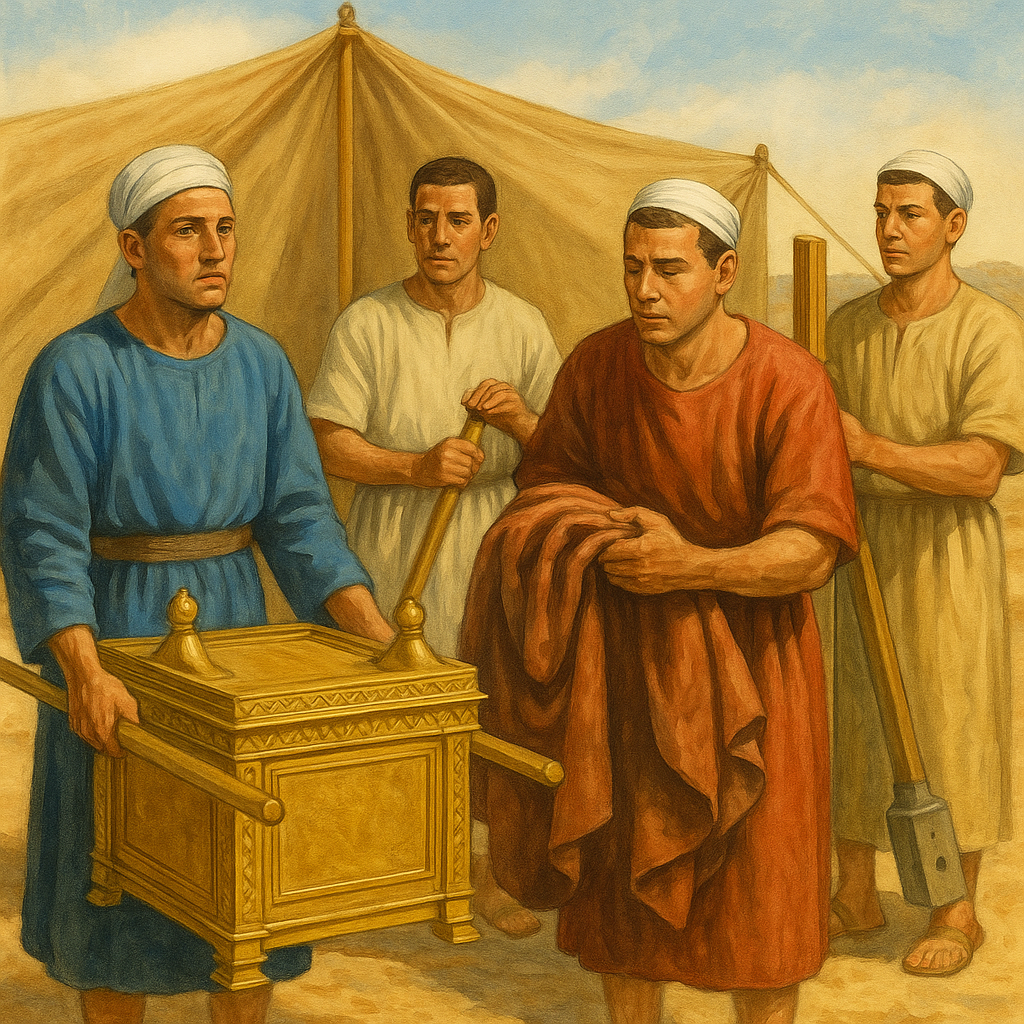
 Numbers 3–4 sets forth the divinely ordered ministry of the tribe of Levi around the tabernacle. These chapters emphasize that the LORD Himself determines who serves, where they serve, what they carry, how holy things are handled, and under whose authority the work is performed.
The immediate setting of the book is “the wilderness of Sinai” (Numbers 1:1). Numbers 3:1 expressly refers to “the day that the LORD spake with Moses in mount Sinai.” The regulations in these chapters concern Israel under the Mosaic economy. They are not ordinances for the New Testament church, though the principles of holiness, obedience, order, stewardship, and accountable service remain instructive.
Chapter Summaries
Numbers 3 — The Levites Given to the LORD for Tabernacle Service
1. Aaron’s priestly family — Numbers 3:1–4
The chapter begins by identifying the sons of Aaron:
- Nadab
- Abihu
- Eleazar
- Ithamar
They had been “anointed priests, whom he consecrated to minister in the priest’s office” (Numbers 3:3).
Concerning Nadab and Abihu, Scripture explicitly states:
“And Nadab and Abihu died before the LORD, when they offered strange fire before the LORD, in the wilderness of Sinai, and they had no children: and Eleazar and Ithamar ministered in the priest’s office in the sight of Aaron their father.”
— Numbers 3:4
The text therefore establishes a solemn background for the instructions that follow: service connected with God’s sanctuary was not to be performed according to human preference. Nadab and Abihu had already demonstrated the deadly seriousness of approaching God’s service contrary to His command.
One should not invent motives for Nadab and Abihu beyond what Scripture states. Numbers 3 says specifically that they “offered strange fire before the LORD.”
2. The Levites are appointed to assist Aaron — Numbers 3:5–10
The LORD commanded Moses:
“Bring the tribe of Levi near, and present them before Aaron the priest, that they may minister unto him.”
— Numbers 3:6
Their duties involved keeping Aaron’s charge, the charge of the congregation, and “the charge of all the instruments of the tabernacle of the congregation” (Numbers 3:7–8).
God further said:
“And thou shalt give the Levites unto Aaron and to his sons: they are wholly given unto him out of the children of Israel.”
— Numbers 3:9
Yet priesthood itself remained restricted:
“And thou shalt appoint Aaron and his sons, and they shall wait on their priest’s office: and the stranger that cometh nigh shall be put to death.”
— Numbers 3:10
There was therefore a distinction even within sacred service. Levites assisted, but Aaron and his sons held the priestly office. Religious sincerity did not authorize a man to assume an office God had not given him.
3. The Levites are taken instead of Israel’s firstborn — Numbers 3:11–13
The LORD explicitly explains why the Levites belonged especially to Him:
“And I, behold, I have taken the Levites from among the children of Israel instead of all the firstborn that openeth the matrix among the children of Israel: therefore the Levites shall be mine;”
— Numbers 3:12
God then connects this arrangement with the death of Egypt’s firstborn:
“Because all the firstborn are mine; for on the day that I smote all the firstborn in the land of Egypt I hallowed unto me all the firstborn in Israel, both man and beast: mine shall they be: I am the LORD.”
— Numbers 3:13
This is explicit substitutionary language: the LORD took the Levites “instead of all the firstborn.”
The underlying claim of divine ownership reaches back to God’s deliverance from Egypt. Exodus 13:2 had commanded:
“Sanctify unto me all the firstborn… it is mine.”
Numbers 3 now explains how the Levites were taken in their place for the LORD’s service.
This should not be turned into an unsupported allegory in which every detail is assigned a hidden New Testament meaning. The explicit truth is that God claimed Israel’s firstborn and then took the Levites in their stead.
4. The Levites are numbered by their families — Numbers 3:14–39
Unlike Israel’s military numbering beginning at twenty years old, the Levites in this chapter were numbered:
“Every male from a month old and upward shalt thou number them.”
— Numbers 3:15
The three principal Levitical families came from the sons of Levi:
- Gershon
- Kohath
- Merari
The Gershonites — Numbers 3:21–26
The numbered males of Gershon were 7,500 (v. 22).
Their appointed position was behind the tabernacle westward (v. 23).
Their charge included:
- the tabernacle
- the tent
- its covering
- the hanging for the door
- hangings of the court
- the curtain for the court entrance
- the cords connected with its service
Eliasaph the son of Lael was chief of the house of the Gershonites (v. 24).
The Kohathites — Numbers 3:27–32
The numbered males of Kohath were 8,600 (v. 28).
They camped on the side of the tabernacle southward (v. 29).
Their charge concerned especially:
- the ark
- the table
- the candlestick
- the altars
- vessels of the sanctuary
- the hanging
- the service connected with them
Elizaphan the son of Uzziel was chief of the Kohathites (v. 30).
Eleazar, Aaron’s son, was:
“chief over the chief of the Levites, and have the oversight of them that keep the charge of the sanctuary.”
— Numbers 3:32
The Merarites — Numbers 3:33–37
The numbered males of Merari were 6,200 (v. 34).
They camped on the side of the tabernacle northward (v. 35).
Their charge included:
- boards of the tabernacle
- bars
- pillars
- sockets
- associated vessels
- pillars around the court
- sockets
- pins
- cords
Zuriel the son of Abihail was chief of the Merarites (v. 35).
Moses, Aaron, and Aaron’s sons — Numbers 3:38
They camped:
“before the tabernacle toward the east, even before the tabernacle of the congregation eastward.”
Their charge concerned the sanctuary “for the charge of the children of Israel.”
Again the warning appears:
“and the stranger that cometh nigh shall be put to death.”
God established both proximity and boundaries.
5. A numerical point requiring textual restraint — Numbers 3:22, 28, 34, 39
The family figures given are:
- Gershon: 7,500
- Kohath: 8,600
- Merari: 6,200
Those figures total 22,300.
Yet Numbers 3:39 explicitly states:
“All that were numbered of the Levites… all the males from a month old and upward, were twenty and two thousand.”
The chapter does not explicitly explain the 300-person difference.
A commonly proposed explanation is that 300 of the Levites may themselves have been firstborn and therefore could not serve as substitutes for Israel’s other firstborn. Scripture does not explicitly say this in Numbers 3, so it should be regarded only as a possible inference, not as a stated fact.
For the redemption transaction which follows, the inspired text itself uses 22,000 Levites.
6. Israel’s firstborn are numbered — Numbers 3:40–43
The LORD commanded Moses to number:
“all the firstborn of the males of the children of Israel from a month old and upward.”
Their number was:
“twenty and two thousand two hundred and threescore and thirteen.”
— Numbers 3:43
That is 22,273 firstborn males.
7. The 273 excess firstborn are redeemed — Numbers 3:44–51
The LORD again states:
“Take the Levites instead of all the firstborn among the children of Israel… and the Levites shall be mine: I am the LORD.”
— Numbers 3:45
Since there were 22,273 firstborn but only 22,000 Levites used in the exchange, 273 firstborn remained beyond the number of the Levites.
God commanded:
“And thou shalt take five shekels apiece by the poll…”
— Numbers 3:47
The redemption money totaled:
“a thousand three hundred and threescore and five shekels, after the shekel of the sanctuary.”
— Numbers 3:50
That is 1,365 shekels.
Moses then:
“gave the money of them that were redeemed unto Aaron and to his sons, according to the word of the LORD, as the LORD commanded Moses.”
— Numbers 3:51
The emphasis ends exactly where much of Numbers places it: Moses acted “according to the word of the LORD.”
Numbers 4 — The Levites and Their Assigned Burdens
Numbers 4 turns from the broader numbering of Levite males to those selected for active tabernacle service during Israel’s movements.
The qualifying age stated repeatedly is:
“From thirty years old and upward even until fifty years old…”
— Numbers 4:3
The chapter does not merely identify workers. It specifies exactly what each family was responsible to carry and how the holiest objects had to be prepared before the Kohathites approached them.
1. The Kohathites and the most holy things — Numbers 4:1–20
The LORD told Moses and Aaron to number the Kohathites:
“From thirty years old and upward even until fifty years old, all that enter into the host, to do the work in the tabernacle of the congregation.”
— Numbers 4:3
Their service concerned:
“the most holy things.”
— Numbers 4:4
Before the Kohathites could carry these objects, Aaron and his sons were responsible for covering and preparing them.
Among the items described are:
- the ark of testimony
- the table of shewbread
- the candlestick
- the golden altar
- instruments of ministry
- altar
- associated vessels
The instructions are detailed. The holy objects were not simply loaded and transported according to convenience.
After Aaron and his sons finished covering the sanctuary and its vessels:
“after that, the sons of Kohath shall come to bear it”
— Numbers 4:15
But God immediately imposed a boundary:
“but they shall not touch any holy thing, lest they die.”
— Numbers 4:15
This is one of the central warnings of the chapter.
The Kohathites were legitimately appointed servants of God. Nevertheless, their legitimate appointment did not permit them to ignore God’s prescribed method.
Eleazar had oversight concerning:
“the oil for the light, and the sweet incense, and the daily meat offering, and the anointing oil”
— Numbers 4:16
God then specifically warned Moses and Aaron not to allow the Kohathite families to be cut off through improper handling of their duties.
Aaron and his sons were to:
“appoint them every one to his service and to his burden”
— Numbers 4:19
The Kohathites were also forbidden:
“to see when the holy things are covered, lest they die.”
— Numbers 4:20
The text therefore teaches that sacred service was governed by revelation, not curiosity, personal privilege, or human improvisation.
2. The Gershonites — Numbers 4:21–28
The Gershonites aged thirty through fifty were also numbered for service.
Their responsibility included carrying:
- curtains of the tabernacle
- tabernacle of the congregation
- its covering
- covering of badgers’ skins
- hanging for the door
- hangings of the court
- hanging for the gate
- cords
- instruments connected with their service
Their service was performed:
“according to the appointment of Aaron and his sons”
— Numbers 4:27
God required specific accountability:
“and ye shall appoint unto them in charge all their burdens.”
Their service was under the hand of Ithamar the son of Aaron the priest (v. 28).
3. The Merarites — Numbers 4:29–33
The Merarites of the same age range were numbered.
Their burden included:
- boards of the tabernacle
- bars
- pillars
- sockets
- pillars of the court
- sockets
- pins
- cords
- instruments
A particularly instructive statement appears in Numbers 4:32:
“and by name ye shall reckon the instruments of the charge of their burden.”
Their work was not vague. Particular objects were assigned and accounted for.
Their ministry was also under Ithamar the son of Aaron the priest (v. 33).
4. The working Levites are numbered — Numbers 4:34–49
The chapter then gives the totals of those between thirty and fifty years old who qualified for this work.
Kohathites
“two thousand seven hundred and fifty.”
— Numbers 4:36
2,750
Gershonites
“two thousand and six hundred and thirty.”
— Numbers 4:40
2,630
Merarites
“three thousand and two hundred.”
— Numbers 4:44
3,200
Total
“eight thousand and five hundred and fourscore.”
— Numbers 4:48
8,580
The closing verse provides an excellent summary of the chapter:
“According to the commandment of the LORD they were numbered by the hand of Moses, every one according to his service, and according to his burden: thus were they numbered of him, as the LORD commanded Moses.”
— Numbers 4:49
The work was individual, assigned, measurable, and performed under divine command.
Key People and Places
Moses
God’s appointed servant through whom the LORD gave these instructions. Moses numbered the Levites and Israel’s firstborn and carried out the redemption transaction “as the LORD commanded Moses” (Numbers 3:51).
Aaron
Israel’s high priest and father of Nadab, Abihu, Eleazar, and Ithamar. Aaron and his sons had priestly responsibilities distinct from the duties assigned to the other Levites.
Nadab and Abihu
Sons of Aaron who:
“died before the LORD, when they offered strange fire before the LORD”
— Numbers 3:4
Numbers 3 also explicitly states that they “had no children.”
Eleazar
A surviving son of Aaron. Numbers 3:32 places him as “chief over the chief of the Levites.” Numbers 4:16 assigns him oversight of several items associated with sanctuary service.
Ithamar
Another surviving son of Aaron. He had oversight of the work of the Gershonites and Merarites in Numbers 4:28, 33.
Levi
Ancestor of the tribe set apart for tabernacle service. His three sons named here were Gershon, Kohath, and Merari.
Gershon
His descendants were responsible particularly for the tabernacle curtains, coverings, hangings, cords, and related materials.
Kohath
His descendants carried the sanctuary furnishings after Aaron and his sons had properly covered them. They were specifically forbidden to touch the holy things.
Merari
His descendants were charged particularly with the structural materials of the tabernacle and court: boards, bars, pillars, sockets, pins, cords, and associated instruments.
Wilderness of Sinai
The larger geographical setting given in Numbers 1:1. Numbers 3:1 also expressly refers to the LORD speaking with Moses “in mount Sinai.”
Mount Sinai
Specifically named in Numbers 3:1 as the location associated with the LORD speaking to Moses.
Tabernacle of the Congregation
The center around which the Levitical families were stationed and the place whose holy furnishings and structural materials they were assigned to guard, prepare, and transport.
The Camp of Israel
The Levites occupied designated locations around the tabernacle: Gershon westward, Kohath southward, Merari northward, with Moses, Aaron, and Aaron’s sons eastward before the tabernacle.
Main Doctrinal or Spiritual Themes
1. God’s Holiness
The strongest truth running through these chapters is that God is holy and determines how men approach sacred things.
The warning:
“they shall not touch any holy thing, lest they die”
— Numbers 4:15
shows that God’s holiness was not ceremonial theater. His commands carried real consequences.
Nadab and Abihu in Numbers 3:4 provide a solemn historical reminder that God does not surrender the regulation of His worship to human invention.
For the believer today, this does not mean reproducing Levitical ceremonial regulations. It does mean that God’s character remains holy.
2. God Determines the Manner of His Service
Nearly every section is governed by divine appointment.
The Levites did not choose their own family responsibilities. God assigned them.
Numbers 4:49 says each was numbered:
“according to his service, and according to his burden.”
Biblical ministry must therefore begin with submission to what God has revealed rather than with man’s creativity overriding Scripture.
3. Distinction of Offices
The priests and the Levites were not interchangeable.
The Levites were:
“wholly given unto him”
— Numbers 3:9
meaning given to Aaron for their appointed ministry, but Aaron and his sons alone were assigned the priest’s office in this arrangement.
This demonstrates a recurring biblical principle: God establishes order and distinctions in service.
Under the New Testament, the church does not possess an Aaronic priesthood. These Mosaic offices should therefore not be transferred directly into church government.
4. Divine Ownership
The LORD repeatedly says:
“the Levites shall be mine”
— Numbers 3:12
and concerning the firstborn:
“all the firstborn are mine”
— Numbers 3:13
God’s claim rested upon His own act of deliverance in Egypt.
Deliverance creates an obligation of consecration to the Deliverer.
For the Christian, this broader principle harmonizes with 1 Corinthians 6:19–20:
“ye are not your own… For ye are bought with a price: therefore glorify God in your body, and in your spirit, which are God’s.”
That New Testament application comes from its own explicit statement and should not be confused with placing the church under Israel’s Levitical system.
5. Substitution in Numbers 3
The wording is explicit:
“I have taken the Levites… instead of all the firstborn”
— Numbers 3:12
The Levites occupied the place otherwise belonging to Israel’s firstborn for the purpose described in the chapter.
That is an actual historical substitution established by God.
It is appropriate to recognize substitution as a broader biblical principle, but Scripture does not explicitly declare in Numbers 3 that every detail of this arrangement is a direct prophetic type of Christ. Conservative interpretation should stop where the text stops.
6. Redemption and God’s Exact Requirement
The 273 firstborn exceeding the number of Levites were redeemed by the precise amount God commanded.
There was:
- a defined number needing redemption,
- a defined redemption price,
- an appointed recipient,
- and exact obedience by Moses.
Yet this should not be confused with New Testament salvation. Numbers 3 describes a commanded transaction involving Israel’s firstborn under the Mosaic arrangement.
It does not teach that eternal salvation can be purchased with money.
New Testament salvation remains:
“For by grace are ye saved through faith… Not of works, lest any man should boast.”
— Ephesians 2:8–9
7. Order in God’s Work
Nothing in Numbers 3–4 is disorderly.
God specified:
- who served,
- where families camped,
- which objects they handled,
- who supervised them,
- when they approached,
- what age group performed the work,
- and what each man’s burden was.
Biblical order is therefore not opposed to spirituality. In these chapters, order is the direct product of God’s command.
8. Authority and Accountability
The Gershonites and Merarites served under Ithamar. Eleazar had particular oversight responsibilities. Aaron and his sons prepared holy objects before the Kohathites approached.
Responsibility was accompanied by accountability.
Numbers 4:32 is especially striking:
“and by name ye shall reckon the instruments of the charge of their burden.”
God’s work was not treated carelessly because it was religious work.
9. Nearness to Holy Things Does Not Remove the Need for Obedience
The Kohathites were appointed by God to carry holy objects. Yet they could die if they touched those objects improperly.
Being genuinely called to a task did not give them permission to disregard God’s method.
That is an important spiritual lesson: legitimate service never places the servant above Scripture.
10. Israel and the Church Must Remain Distinct
These commands concern the tribe of Levi, the Aaronic priesthood, Israel’s firstborn, the tabernacle, and Israel’s wilderness arrangement.
The New Testament church is not commanded to reproduce:
- Levitical tribal service,
- Aaronic priesthood,
- tabernacle transportation,
- firstborn redemption payments,
- or Israel’s wilderness camp arrangement.
Nevertheless, Romans 15:4 says:
“For whatsoever things were written aforetime were written for our learning…”
Thus we learn from these chapters without confusing Israel’s covenant administration with New Testament church practice.
Practical Applications or Lessons
1. Do God’s work God’s way
The repeated expression “as the LORD commanded Moses” is foundational.
Good intentions do not authorize disobedience. Scripture, not personal preference, determines acceptable obedience.
A believer should therefore ask not merely, “Am I doing something for God?” but, “Am I obeying what God has actually said?”
2. Every assigned service has value
Kohath carried holy furnishings. Gershon carried curtains and coverings. Merari carried boards, bars, sockets, pillars, pins, and cords.
Some assignments may have appeared more prominent than others, but every assignment came from God.
The believer should not despise a task because another person’s service appears more visible.
3. Carry the burden God assigns you
Numbers 4:49 says:
“every one according to his service, and according to his burden.”
There is wisdom in fulfilling the responsibility God has actually placed before us instead of coveting another person’s place.
In New Testament church service, believers have differing functions, while Christ remains Head of the church.
4. Details matter when God has spoken
The coverings, poles, vessels, curtains, sockets, boards, cords, and assignments are given in considerable detail.
This teaches against careless obedience.
Where God has spoken clearly, seemingly small details are not ours to dismiss.
5. Leadership should help protect those under its charge
Aaron and his sons had to prepare the holy things before the Kohathites approached them.
Numbers 4:18–19 shows that their actions were connected with preventing the Kohathites from being cut off.
A legitimate application is that spiritual leadership should not recklessly expose others to situations that violate God’s Word. Leaders have responsibilities toward those whose work they oversee.
6. Privilege does not cancel boundaries
The Kohathites enjoyed a remarkable privilege in bearing the holy things, but their privilege came with strict boundaries.
They could carry what they were not allowed to touch.
They served near what they were not permitted to inspect contrary to God’s command.
Spiritual privilege should therefore produce greater reverence, not presumption.
7. God’s servants belong to Him
The LORD said:
“the Levites shall be mine.”
While Christians are not Levites, the New Testament explicitly teaches that believers belong to God.
The proper response to redemption is therefore not self-ownership but consecration.
8. Faithfulness is more important than prominence
Merari’s work with sockets, boards, pins, and cords may appear less striking to a casual reader than the Kohathites’ association with the ark and sanctuary furniture.
Scripture, however, treats Merari’s burden as divinely assigned work.
God’s servant should value faithfulness to his assignment rather than public recognition.
9. Never use ministry as an excuse for disobedience
Nadab and Abihu were priests. The Kohathites were appointed Levites.
Their religious standing did not make violation of God’s command acceptable.
No preacher, teacher, church worker, or other believer becomes exempt from Scripture because he is engaged in ministry.
10. Reverence and carefulness belong together
Numbers 3–4 presents holy service as both reverent and carefully ordered.
Biblical reverence is more than an emotional feeling. It produces obedience, restraint, attention to God’s commands, and recognition that the work belongs to Him.
Overall Message of Numbers 3–4
Numbers 3 establishes who belonged to the LORD for Levitical service, why the Levites were taken instead of Israel’s firstborn, where the Levitical families were stationed, and how the remaining 273 firstborn were redeemed.
Numbers 4 establishes how the qualified Levites were to perform their burdens, with carefully defined responsibilities for Kohath, Gershon, and Merari.
Together the chapters teach that the holy God has the right to determine the order of His own service.
The repeated lesson is not human ingenuity but revealed obedience:
“According to the commandment of the LORD they were numbered by the hand of Moses, every one according to his service, and according to his burden.”
— Numbers 4:49
The Levite did not invent his burden. He received it.
He did not decide how the sanctuary should be handled. God had spoken.
He did not measure faithfulness by whether another man’s assignment appeared more honorable. His responsibility was to perform “his service” and carry “his burden.”
For the believer today, the enduring lesson is clear: take God’s Word seriously, respect the boundaries He has established, fulfill the service He has given, and never substitute religious enthusiasm for biblical obedience.
Comments are closed