 Leviticus 26–27 brings the book to a solemn conclusion. Chapter 26 sets before Israel the consequences of covenant obedience and disobedience: blessing for walking in God’s statutes, increasingly severe chastening for rebellion, dispersion among the nations, and yet the promise that God will remember His covenant when Israel confesses her iniquity. Chapter 27 then regulates voluntary vows, things dedicated to the LORD, firstlings, devoted things, and tithes.
The closing statement identifies the setting plainly:
Leviticus 27:34: “These are the commandments, which the LORD commanded Moses for the children of Israel in mount Sinai.”
This establishes an important dispensational boundary. These commandments were given directly to the children of Israel under the Mosaic covenant. The Church should learn from their revelation of God’s holiness, faithfulness, justice, ownership, and the seriousness of obedience, but the national covenant promises concerning Israel’s land must not simply be transferred to the Church.
Chapter Summaries
Leviticus 26 — Blessing, Chastening, Judgment, and Covenant Remembrance
Leviticus 26 begins by restating foundational matters of Israel’s separation unto the LORD.
The people were forbidden to make idols, graven images, standing images, or images of stone before which they would bow. They were also commanded to keep God’s sabbaths and reverence His sanctuary.
Leviticus 26:1–2: “Ye shall make you no idols nor graven image, neither rear you up a standing image, neither shall ye set up any image of stone in your land, to bow down unto it: for I am the LORD your God. Ye shall keep my sabbaths, and reverence my sanctuary: I am the LORD.”
The repeated declaration “I am the LORD” establishes the basis of the commandments. Israel belonged to Jehovah and was therefore obligated to obey Him rather than the gods, customs, and religious practices of the nations.
Blessings for obedience — Leviticus 26:3–13
The blessings are introduced conditionally:
Leviticus 26:3: “If ye walk in my statutes, and keep my commandments, and do them;”
God then promises Israel rain, fruitful harvests, sufficient food, safety, victory over enemies, multiplication of the people, and His continuing presence among them.
One of the highest statements in the section is:
Leviticus 26:12: “And I will walk among you, and will be your God, and ye shall be my people.”
These promises concern Israel’s covenant relationship with God and include very tangible blessings associated with their life in the land.
The chapter does not teach that an individual sinner earns eternal salvation by keeping the law. It is describing covenant blessing for Israel’s obedience. Scripture elsewhere makes justification apart from law-keeping unmistakable:
Romans 3:20: “Therefore by the deeds of the law there shall no flesh be justified in his sight: for by the law is the knowledge of sin.”
Thus Leviticus 26 should not be used to teach salvation by works.
God also reminds Israel that He had delivered them from Egyptian bondage:
Leviticus 26:13: “I am the LORD your God, which brought you forth out of the land of Egypt, that ye should not be their bondmen…”
Their obedience was therefore to be rendered to the God who had already acted mightily on their behalf.
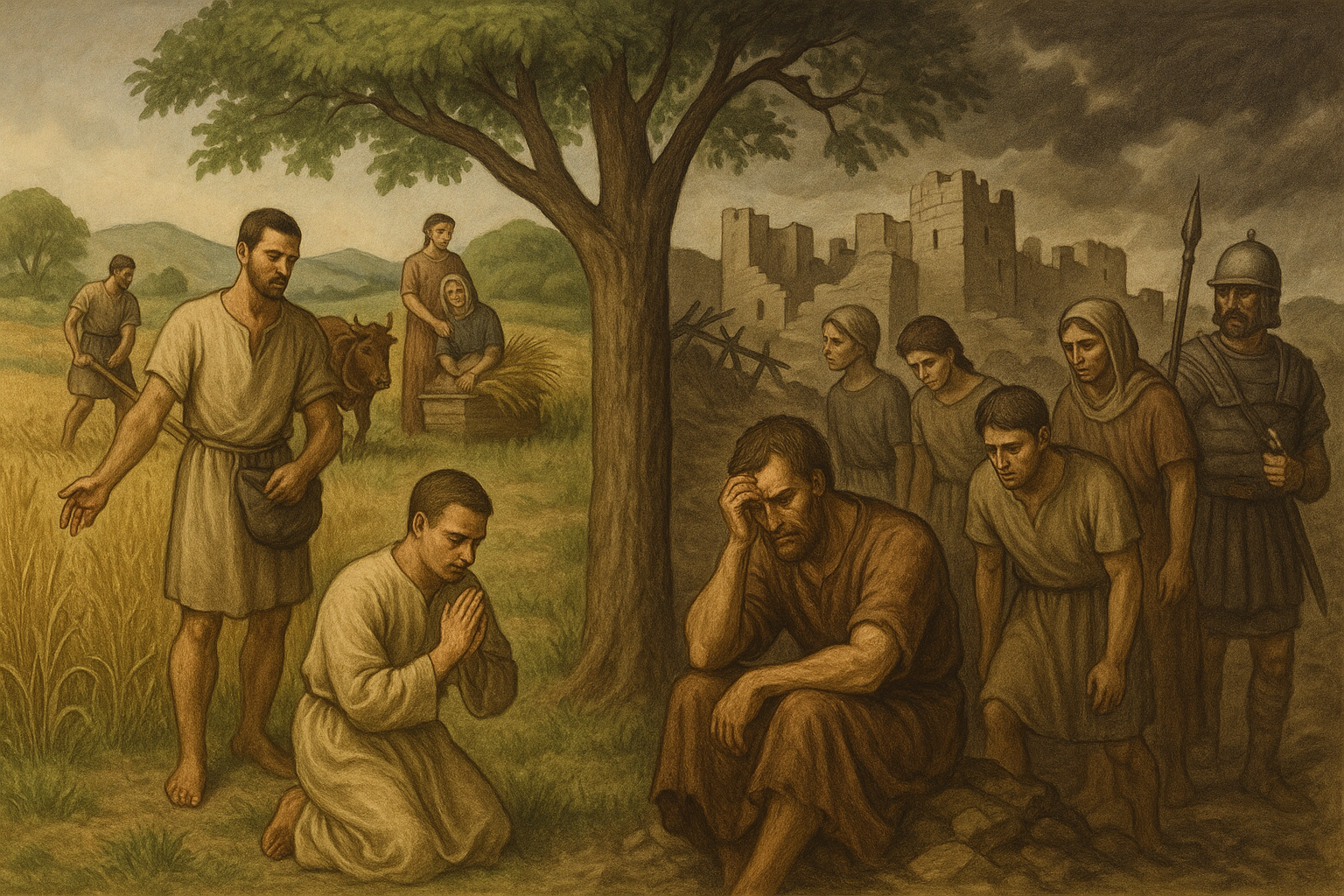
Consequences of rebellion — Leviticus 26:14–39
Verse 14 begins the opposite condition:
Leviticus 26:14: “But if ye will not hearken unto me, and will not do all these commandments;”
The passage then describes escalating divine chastening.
The progression includes terror and disease, agricultural failure, defeat before enemies, further punishment when the people refuse correction, attacks by wild beasts, the sword, pestilence, famine, desolation, destruction of idolatrous worship, ruined cities and sanctuaries, and finally scattering among the heathen.
Several times God warns that continued resistance will bring punishment “seven times more for your sins” (Leviticus 26:18, 21, 24, 28).
The phrase indicates an intensification of judgment. Scripture does not require us to interpret the number here as a secret prophetic formula; the plain context emphasizes increasingly severe chastisement because Israel refuses to be corrected.
The chapter reaches an especially severe description of famine in verse 29. The language demonstrates how terrible the consequences of continued national rebellion could become. There is no need to embellish the description beyond what Scripture states.
The land enjoying its sabbaths
When Israel is scattered, God says:
Leviticus 26:34: “Then shall the land enjoy her sabbaths, as long as it lieth desolate, and ye be in your enemies’ land; even then shall the land rest, and enjoy her sabbaths.”
The land itself had been included in God’s legislation concerning sabbatical rest. Their removal from the land would result in the neglected sabbaths being realized during its desolation.
Later biblical history explicitly connects the Babylonian captivity with the land enjoying her sabbaths in 2 Chronicles 36:20–21. Therefore, that connection is not merely a historical guess; Scripture itself makes it.
Confession and covenant remembrance — Leviticus 26:40–46
The chapter does not end with destruction.
God speaks of Israel confessing her sin:
Leviticus 26:40: “If they shall confess their iniquity, and the iniquity of their fathers, with their trespass which they trespassed against me…”
They are also to acknowledge that God had walked contrary unto them because they had walked contrary unto Him.
Then comes this promise:
Leviticus 26:42: “Then will I remember my covenant with Jacob, and also my covenant with Isaac, and also my covenant with Abraham will I remember; and I will remember the land.”
This is significant. God’s discipline does not mean that He has forgotten His covenant promises.
Even while Israel is in the land of her enemies, God says:
Leviticus 26:44: “And yet for all that, when they be in the land of their enemies, I will not cast them away, neither will I abhor them, to destroy them utterly, and to break my covenant with them: for I am the LORD their God.”
From a conservative dispensational standpoint, this is important testimony concerning God’s faithfulness to Israel. The Church does not erase Israel or cause God to break the covenants He made with Israel.
The chapter closes by identifying these laws specifically with Israel at Sinai:
Leviticus 26:46: “These are the statutes and judgments and laws, which the LORD made between him and the children of Israel in mount Sinai by the hand of Moses.”
Leviticus 27 — Vows, Dedications, Devoted Things, and Tithes
Chapter 27 concerns things voluntarily set apart to the LORD and the rules governing their valuation or redemption.
It should be read as the legal regulation of vows and dedicated property rather than as a scale measuring the spiritual worth of different classes of people.
Persons involved in vows — Leviticus 27:1–8
When a person made a “singular vow”, a monetary estimation was assigned according to sex and age.
The chapter provides different estimations for males and females at various stages of life. For example, between twenty and sixty years, the estimation was fifty shekels for a male and thirty for a female.
The text is establishing a financial valuation connected with the vow. It does not state that one person possesses greater spiritual worth before God than another.
Provision was also made for poverty:
Leviticus 27:8: “But if he be poorer than thy estimation, then he shall present himself before the priest, and the priest shall value him; according to his ability that vowed shall the priest value him.”
Thus the law itself recognizes differences in financial ability.
Animals dedicated to the LORD — Leviticus 27:9–13
If an animal suitable for sacrifice was given to the LORD, it became holy and was not to be exchanged merely because the giver reconsidered.
Leviticus 27:10: “He shall not alter it, nor change it, a good for a bad, or a bad for a good…”
If an exchange was attempted, both animals became holy.
An unclean beast could be valued by the priest and, if redeemed, one fifth was added to its valuation.
The principle is plain: a dedication to God was not to be treated lightly or manipulated for personal advantage.
Houses and fields — Leviticus 27:14–25
A man could sanctify his house unto the LORD, after which the priest would estimate it.
If the owner wished to redeem the house, he was required to add “the fifth part of the money of thy estimation unto it” (Leviticus 27:15).
Fields were likewise valued under prescribed rules. Their valuation was connected with the amount of seed required and with the remaining time until the jubilee.
This continues themes already established in Leviticus 25: Israel’s property arrangements were governed by God’s law and the jubilee structure.
Firstlings — Leviticus 27:26–27
A firstling that already belonged to the LORD could not be newly sanctified as though the owner were voluntarily giving God something that was already His.
Leviticus 27:26: “Only the firstling of the beasts, which should be the LORD’S firstling, no man shall sanctify it; whether it be ox, or sheep: it is the LORD’S.”
This is a straightforward lesson in divine ownership: a man cannot present as an additional voluntary gift something God has already claimed by command.
Devoted things — Leviticus 27:28–29
The chapter distinguishes something “devoted” from the ordinary forms of dedication that could sometimes be redeemed.
Leviticus 27:28: “Notwithstanding no devoted thing, that a man shall devote unto the LORD of all that he hath… shall be sold or redeemed: every devoted thing is most holy unto the LORD.”
Verse 29 adds:
“None devoted, which shall be devoted of men, shall be redeemed; but shall surely be put to death.”
The verse plainly says this. However, Scripture does not explicitly explain within Leviticus 27 every circumstance under which a person would lawfully fall into this particular category of devotion. It is therefore wiser not to construct speculative scenarios beyond the wording of the passage.
The tithe belongs to the LORD — Leviticus 27:30–33
The agricultural tithe is stated plainly:
Leviticus 27:30: “And all the tithe of the land, whether of the seed of the land, or of the fruit of the tree, is the LORD’S: it is holy unto the LORD.”
If a man redeemed part of his tithe, he added a fifth.
Regarding herds and flocks:
Leviticus 27:32: “And concerning the tithe of the herd, or of the flock, even of whatsoever passeth under the rod, the tenth shall be holy unto the LORD.”
He was not to manipulate the process by choosing which animal would count as the tenth.
Chapter 27 then ends the legislation with the declaration that these commandments were given by the LORD through Moses to Israel at Mount Sinai.
Key People and Places
The LORD
The central Person throughout both chapters. He gives the commandments, promises blessing, administers chastening, remembers His covenant, determines what is holy, and declares what belongs to Him.
His repeated declaration, “I am the LORD,” emphasizes His authority and Israel’s accountability to Him.
Moses
Explicitly identified as God’s human mediator in delivering these commandments.
Leviticus 26:46 says the laws were given “by the hand of Moses,” while Leviticus 27:34 says the LORD commanded Moses for the children of Israel.
The children of Israel
The direct covenant recipients of these commandments.
This is stated explicitly in both Leviticus 26:46 and 27:34. That identification is essential to a proper dispensational interpretation of the passage.
Abraham, Isaac, and Jacob
Named in Leviticus 26:42 when God promises to remember His covenant.
Their appearance demonstrates that the chapter’s covenant setting reaches back to God’s promises to Israel’s patriarchs.
The priest
In Leviticus 27, the priest is responsible for making several official estimations concerning people, animals, houses, and fields dedicated in vows.
Mount Sinai
Explicitly identified as the setting in both Leviticus 26:46 and 27:34.
This places the legislation within God’s covenant dealings with Israel through Moses.
Israel’s land
Leviticus 26 repeatedly speaks of “your land” and later of the land enjoying her sabbaths.
The chapters themselves do not repeatedly name the land geographically, so it is best to retain Scripture’s own wording rather than add unnecessary details.
“The land of your enemies”
This phrase appears in the judgment and restoration portions of Leviticus 26. Israel’s disobedience could result in removal from their land and residence among hostile nations.
Main Doctrinal or Spiritual Themes
1. The holiness and absolute authority of God
Everything begins with:
“I am the LORD your God.”
God determines what is holy, how He is to be worshipped, what belongs to Him, and how His people are to live.
Biblical holiness is not self-defined. God establishes the standard.
2. Obedience matters to God
Leviticus 26 does not present obedience as an optional expression of religious enthusiasm. God expects His commandments to be taken seriously.
“If ye walk in my statutes, and keep my commandments, and do them…”
Faith in God’s Word should produce respect for what He has commanded.
3. Idolatry is incompatible with allegiance to God
The chapter begins by prohibiting idols and images used for worship.
God’s people cannot give the worship belonging to Him to another.
For believers today, this principle extends beyond carved images. Anything given the allegiance, devotion, fear, or supremacy belonging to God becomes spiritually dangerous. Scripture does not call every possession an idol, however, so the term should not be applied carelessly.
4. God disciplines persistent rebellion
Leviticus 26 repeatedly shows judgment increasing when Israel refuses correction.
The passage demonstrates that divine patience should never be mistaken for divine indifference.
God is longsuffering, but His holiness is real and His warnings are not empty.
5. God’s judgments are righteous
Israel’s coming hardships are not presented as random disasters. Within this covenant context, God explicitly identifies them as responses to disobedience.
We should therefore avoid reducing biblical judgment to mere natural circumstances when Scripture itself attributes the judgment to God.
6. Confession requires acknowledging sin
Leviticus 26:40 does not describe confession as excuse-making.
“If they shall confess their iniquity, and the iniquity of their fathers…”
True confession agrees with God’s judgment concerning sin.
7. God remains faithful to His covenant
One of the great truths of Leviticus 26 is that Israel’s unfaithfulness does not make God unfaithful.
“I will remember my covenant…”
And:
“I will not cast them away… to destroy them utterly, and to break my covenant with them.”
This supports a clear distinction between Israel and the Church. God has not authorized us to spiritualize Israel out of the promises He made to Israel.
8. The law cannot be turned into a doctrine of salvation by works
Leviticus 26 describes consequences under Israel’s covenant administration. It does not overturn the biblical doctrine of justification by faith.
Salvation is never earned by human merit.
The law exposes sin and establishes God’s righteous standard; it does not provide sinful man with a ladder by which he can earn eternal life.
9. God takes vows and dedication seriously
Leviticus 27 teaches that something promised to God was not to be treated casually.
Dedication was not merely emotional language. It carried obligation.
10. God owns what He declares to be His
The firstling was already the LORD’s.
The tithe was “the LORD’S.”
The devoted thing was “most holy unto the LORD.”
The chapter therefore repeatedly confronts the assumption that man possesses an absolute right over everything in his hands.
11. Human spiritual worth should not be confused with legal valuation
Leviticus 27 assigns differing monetary estimations for purposes connected with vows.
The text does not say these monetary assessments measure how much a soul is worth to God.
Keeping those two categories distinct prevents an unnecessary conclusion that the passage itself does not make.
Practical Applications or Lessons
Take God’s Word seriously
Israel was repeatedly warned to “hearken” unto God. A believer should approach Scripture with the intention to believe it and obey what God has given for him.
Knowledge without submission easily produces pride rather than holiness.
Do not attempt to bargain with God
Leviticus 27 shows that vows were regulated precisely because words spoken before God mattered.
A Christian should therefore avoid dramatic promises made during emotional moments and then forgotten when circumstances change.
Ecclesiastes 5:4: “When thou vowest a vow unto God, defer not to pay it…”
Do not offer God what costs nothing in sincerity or commitment
The regulations concerning dedicated possessions show that devotion to God was not to be manipulated after the fact.
Once something was solemnly set apart under these laws, the worshipper could not simply redefine the commitment for personal convenience.
The devotional lesson is that God deserves sincerity rather than religious performance.
Receive divine correction humbly
One repeated tragedy of Leviticus 26 is that correction did not automatically produce repentance.
Several judgments are followed by the warning that if Israel “will not for all this hearken unto me”, further chastening will follow.
The wise response to God’s correction is humility, examination, confession, and obedience.
Remember that sin has consequences beyond the individual
In Leviticus 26, Israel’s corporate rebellion affects crops, cities, national safety, the sanctuary, and the land itself.
While believers should not transfer these specific covenant punishments directly to modern nations or churches without biblical warrant, the passage clearly teaches that sin is never harmless.
Separation from idolatry remains essential
The book closes its final major covenant warning where biblical holiness must always begin: the LORD alone deserves worship.
The Christian must not allow culture, possessions, personalities, institutions, or personal ambition to occupy the place that belongs to God.
God’s faithfulness should encourage repentance, not presumption
God’s promise to remember His covenant does not excuse Israel’s rebellion. Rather, His faithfulness provides hope in the midst of chastening.
Grace should never become an argument for continued sin.
Respect the distinction between Israel and the Church
Leviticus 26–27 explicitly identifies these commandments as given to “the children of Israel in mount Sinai.”
Therefore, promises of agricultural prosperity, victory over national enemies, exile from the land, and restoration of that land belong to the covenant setting in which God gave them.
The Church may rightly learn spiritual and moral principles from these chapters, but it should not erase Israel by claiming that every national promise has been transferred to itself.
Recognize God’s ownership
The final portion of Leviticus teaches repeatedly that certain things were “the LORD’S.”
For the believer, stewardship begins when we stop thinking of ourselves as ultimate owners and recognize God’s superior claim over our lives and possessions.
Overall Message of Leviticus 26–27
Leviticus closes by bringing together holiness, obedience, covenant faithfulness, accountability, worship, stewardship, and the seriousness of dedication to God.
Chapter 26 declares that the God who redeemed Israel expected Israel to walk according to His commandments. Obedience brought covenant blessing; persistent rebellion brought increasingly severe chastisement. Yet even in judgment God declared that He would remember His covenant and would not utterly cast Israel away.
Chapter 27 then teaches that what is promised or set apart to God must be treated as holy. Vows, possessions, animals, fields, firstlings, devoted things, and tithes were all placed under divine regulation.
The two chapters therefore form a fitting conclusion to Leviticus: the LORD is holy, His Word is authoritative, His people belong to Him, His judgments are righteous, His promises are dependable, and what is devoted to Him must never be treated lightly.
Comments are closed