 Leviticus 24–25 continues the LORD’s instruction to Israel concerning holiness in worship, holiness in conduct, justice among the people, stewardship of the land, care for the poor, and the principle of redemption. Chapter 24 moves from the continual service of the tabernacle to a serious case of blasphemy and then to laws of justice. Chapter 25 concerns the sabbath year, the year of jubile, redemption of property, relief of impoverished brethren, and the status of servants.
These commandments were given specifically to Israel under the Mosaic covenant. Leviticus 25:1 explicitly places the revelation at Mount Sinai, and verse 2 addresses “the children of Israel” concerning “the land which I give you.” The church should therefore learn the moral and spiritual truths revealed here without turning Israel’s national land laws, sabbatical system, or jubile legislation into ordinances for the New Testament church.
Chapter Summaries
Leviticus 24 — Holy Worship, the Holy Name, and Righteous Judgment
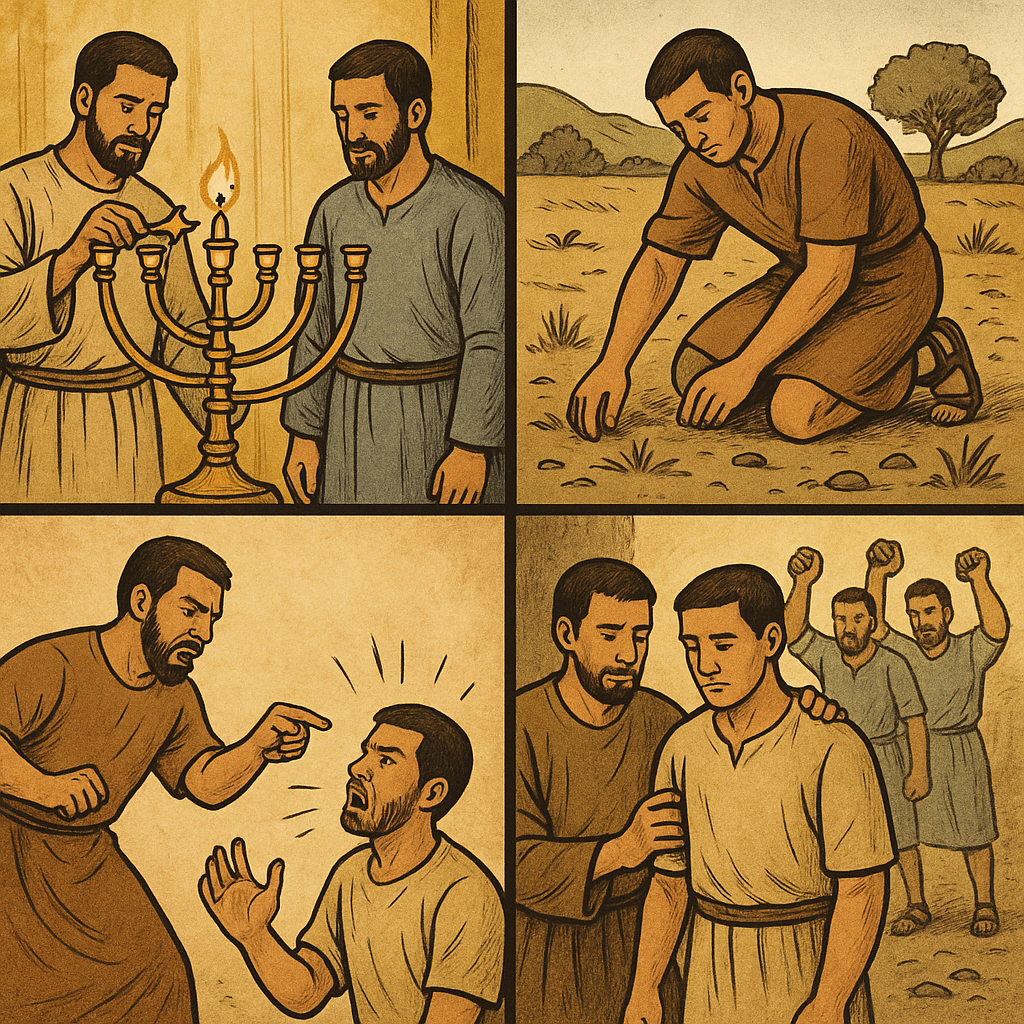
1. Pure oil and the continual lamps — Leviticus 24:1–4
The LORD commanded Moses that the children of Israel were to bring:
“pure oil olive beaten for the light, to cause the lamps to burn continually”
— Leviticus 24:2
Aaron was responsible for ordering the lamps before the LORD. Verse 3 states that they were to be maintained “from the evening unto the morning before the LORD continually.”
The emphasis in the text is upon purity, order, continuity, and obedience in the worship prescribed by God. Israel was not at liberty to redesign the service of the sanctuary according to preference. God gave the instructions, and His servants were responsible to follow them.
The chapter does not explicitly assign a symbolic meaning to the oil or lamps. Therefore, it is safest to emphasize what the text plainly teaches: God required His sanctuary service to be maintained faithfully and continually according to His commandment.
There are other passages of Scripture in which light carries spiritual significance, but Leviticus 24 itself does not explicitly tell the reader to interpret this lamp oil as a particular New Testament doctrine.
2. The twelve loaves upon the pure table — Leviticus 24:5–9
The LORD next commanded that twelve cakes be made from fine flour. They were arranged:
“in two rows, six on a row, upon the pure table before the LORD.”
— Leviticus 24:6
Pure frankincense was placed with the rows as “a memorial.”
Every sabbath the bread was to be set in order before the LORD continually. Afterward it belonged to Aaron and his sons, who were to eat it “in the holy place.”
The number twelve is explicit in the text. Because Israel consisted of twelve tribes, the arrangement may naturally suggest Israel’s tribes standing covenantally before the LORD, but Leviticus 24 does not explicitly state that the twelve cakes symbolized the twelve tribes. That association should therefore be treated as a possible inference rather than as an expressed interpretation of the chapter.
What the passage explicitly establishes is that the bread was part of Israel’s holy service before the LORD and was regulated by His command.
The repeated expressions “before the LORD,” “continually,” “pure,” and “holy” show that worship was not casual. God established the manner in which His sanctuary was to be served.
3. The son of an Israelitish woman blasphemes — Leviticus 24:10–12
The narrative then changes abruptly.
A man whose mother was an Israelitish woman and whose father was Egyptian “went out among the children of Israel.” He and an Israelitish man strove together in the camp.
Scripture specifically identifies his mother:
- Shelomith
- daughter of Dibri
- of the tribe of Dan
During the conflict:
“the Israelitish woman’s son blasphemed the name of the LORD, and cursed.”
— Leviticus 24:11
He was brought to Moses.
The Israelites did not immediately invent a punishment for the case. They put him in ward:
“that the mind of the LORD might be shewed them.”
— Leviticus 24:12
This is important textual restraint. Scripture tells us exactly why he was held: they were awaiting the LORD’s determination concerning the matter.
The passage does not tell us everything the man said, what motivated his blasphemy, or the personal history that brought him to that act. Conclusions about his psychological condition, upbringing, cultural identity, or attitude toward Israel would be speculation and should be omitted.
4. The LORD gives judgment concerning blasphemy — Leviticus 24:13–16
The LORD then spoke directly to Moses concerning the offender.
Those who heard the blasphemy were to lay their hands upon his head, and the congregation was commanded to stone him.
The LORD then established a national judicial law for Israel:
“he that blasphemeth the name of the LORD, he shall surely be put to death”
— Leviticus 24:16
The text further says:
“as well the stranger, as he that is born in the land”
was accountable under this law.
This demonstrates the extreme seriousness with which God treated the dishonoring of His holy name under Israel’s covenant government.
This judicial penalty belonged to Israel’s Mosaic civil order. Nothing in Leviticus 24 authorizes a New Testament church to execute blasphemers. The church has been given spiritual responsibilities rather than Israel’s national judicial authority.
Nevertheless, the moral truth remains unmistakable: the name of the LORD is holy and must not be treated lightly.
5. Laws concerning life, injury, and restitution — Leviticus 24:17–22
The LORD broadened the instruction from the immediate blasphemy case to several principles of justice.
Concerning murder:
“And he that killeth any man shall surely be put to death.”
— Leviticus 24:17
Concerning the killing of an animal:
“he shall make it good; beast for beast.”
— Leviticus 24:18
Concerning bodily injury, the law included the familiar expression:
“Breach for breach, eye for eye, tooth for tooth”
— Leviticus 24:20
In its immediate setting, this is a judicial principle of proportional justice. The punishment was not to exceed the injury. The passage establishes measured judgment rather than unlimited personal vengeance.
Verse 22 also establishes impartiality:
“Ye shall have one manner of law, as well for the stranger, as for one of your own country”
God’s national law was not to change merely because an offender or injured party was a stranger.
That reveals an important biblical principle: righteous judgment is not to be manipulated by personal status or partiality.
6. The judgment is carried out — Leviticus 24:23
Moses communicated the LORD’s command to Israel.
The man who had cursed was brought outside the camp and stoned.
The chapter concludes:
“And the children of Israel did as the LORD commanded Moses.”
The emphasis is obedience to a direct command from the LORD.
The passage does not authorize believers today to reproduce Israel’s civil penalties. It records what Israel was commanded to do under the government God had established for that nation.
Leviticus 25 — Sabbath of the Land, Jubile, Redemption, and Mercy
1. The sabbath year — Leviticus 25:1–7
The LORD spoke to Moses “in mount Sinai.”
Israel was commanded that after entering the land God would give them, they could sow fields and prune vineyards for six years.
But:
“in the seventh year shall be a sabbath of rest unto the land, a sabbath for the LORD”
— Leviticus 25:4
Israel was forbidden to conduct its ordinary agricultural harvesting during that seventh year.
What grew of itself was available for food to the people, their servants, hired servants, strangers, cattle, and beasts.
The command taught Israel that the land ultimately depended upon God rather than merely human agricultural labor.
It also required trust. Israel would have to obey God even when obedience interrupted the normal economic pattern of sowing and harvesting.
The chapter later explicitly addresses their concern about provision.
2. Seven sabbaths of years and the year of jubile — Leviticus 25:8–12
Israel was to count seven sabbaths of years:
7 × 7 = 49 years.
Then, on the tenth day of the seventh month, on the day of atonement, the trumpet was to sound throughout the land.
Verse 10 declares:
“And ye shall hallow the fiftieth year, and proclaim liberty throughout all the land unto all the inhabitants thereof”
This was the jubile.
God commanded:
“ye shall return every man unto his possession, and ye shall return every man unto his family.”
The fiftieth year was also not to be treated as an ordinary agricultural year.
This system demonstrates that Israel’s landholding was subject to God’s higher ownership and covenant arrangement.
3. Property values were based upon the years until jubile — Leviticus 25:13–17
Because property would return in the jubile, transactions concerning the land were to account for the number of harvest years remaining.
Verse 15 describes purchasing:
“according unto the number of years of the fruits”
Thus the price was related to the expected agricultural use remaining before the jubile rather than unrestricted perpetual ownership.
God then commanded:
“Ye shall not therefore oppress one another; but thou shalt fear thy God”
— Leviticus 25:17
Economic dealings among Israel were to be governed by both justice and the fear of God.
A man might conceal dishonest dealing from another person, but he could not conceal it from the LORD.
4. God’s promised provision for obedience — Leviticus 25:18–22
Israel was commanded to keep God’s statutes and judgments.
The LORD promised that the land would yield fruit and that Israel would dwell safely.
God even anticipated the practical question:
“What shall we eat the seventh year?”
His answer was explicit:
“Then I will command my blessing upon you in the sixth year, and it shall bring forth fruit for three years.”
— Leviticus 25:21
This promise was specifically given to Israel in connection with obedience to the sabbatical land command.
It should not be turned into an unrestricted promise that God will always give every Christian three years of material provision.
The legitimate spiritual lesson is that God expected Israel to trust His word enough to obey Him, and God declared Himself fully able to provide what their obedience required.
5. The land belonged ultimately to God — Leviticus 25:23–24
One of the central statements of the chapter is:
“The land shall not be sold for ever: for the land is mine”
God further tells Israel:
“for ye are strangers and sojourners with me.”
Israel possessed the land by divine grant, but God asserted ultimate ownership.
This establishes an important biblical doctrine of stewardship: what man possesses remains subject to God’s ownership and authority.
For Israel, that truth had a specific legal application to the land God had given them.
For believers today, the exact land legislation does not transfer to the church, but the principle that all things ultimately belong to God is consistent with the broader teaching of Scripture.
6. Redemption of a poor man’s possession — Leviticus 25:25–34
If an Israelite became poor and sold part of his possession, a near relative could come and redeem it.
Verse 25 says:
“if any of his kin come to redeem it, then shall he redeem that which his brother sold.”
If the man later became able to redeem it himself, the value was calculated according to the remaining time.
If redemption could not occur, the property returned to him at the jubile.
Houses within walled cities
A distinction was made for a house in a walled city.
Its owner had one full year in which to redeem it. If it was not redeemed during that period, it became permanently established to the purchaser and did not return at the jubile.
Houses in unwalled villages
Houses in villages without walls were treated with the fields of the country and could return in the jubile.
The Levites
Special provisions were made concerning the Levites and “the cities of their possession.”
The field of the suburbs of their cities could not be sold permanently:
“for it is their perpetual possession.”
— Leviticus 25:34
These are precise land laws for Israel and should not be generalized beyond what Scripture states.
7. Care for an impoverished brother — Leviticus 25:35–38
God commanded Israel:
“And if thy brother be waxen poor, and fallen in decay with thee; then thou shalt relieve him”
The poor Israelite was not to be financially exploited.
God commanded:
“Take thou no usury of him, or increase: but fear thy God”
— Leviticus 25:36
The command is specifically situated within Israel’s covenant relationship and addresses treatment of an impoverished brother.
The moral emphasis is clear: the weakness and poverty of another person were not to become opportunities for cruel enrichment.
God reminded them that He was the LORD who had brought them out of Egypt and given them the land.
Their treatment of one another was therefore connected to their relationship with their Redeemer and Deliverer.
8. An impoverished Israelite serving another Israelite — Leviticus 25:39–43
If an Israelite became poor and was sold to another Israelite, God commanded:
“thou shalt not compel him to serve as a bondservant”
He was to be treated as:
“an hired servant, and as a sojourner”
and was to serve until the year of jubile.
God gave the theological reason:
“For they are my servants, which I brought forth out of the land of Egypt”
— Leviticus 25:42
Israel belonged to the LORD.
Therefore:
“Thou shalt not rule over him with rigour; but shalt fear thy God.”
— Leviticus 25:43
The repeated connection between the fear of God and treatment of other people is important. A professed reverence toward God could not properly coexist with oppressive treatment of one’s brother.
9. Servants obtained from surrounding nations — Leviticus 25:44–46
The chapter permits Israel to obtain bondmen and bondmaids from the heathen nations around them and from strangers dwelling among them.
The text further permits such servants to be held as possessions and passed to children as an inheritance.
This must be stated according to what the KJV actually says, without either concealing it or adding claims that the passage itself does not make.
Several boundaries are important.
First, the legislation is part of Israel’s Mosaic national law. It is not a command to the New Testament church to establish such an institution.
Second, Scripture in this passage distinguishes between Israelite servants and servants obtained from surrounding peoples.
Third, Leviticus 25 does not provide enough information to reconstruct every circumstance by which each individual foreign servant came into such service. Claims beyond what the chapter states should therefore be avoided.
10. An Israelite sold to a wealthy stranger — Leviticus 25:47–54
The situation could also be reversed economically.
A stranger or sojourner could become wealthy while an Israelite became poor and sold himself to that stranger.
God provided a right of redemption.
The man’s:
- brother,
- uncle,
- uncle’s son,
- another near kinsman,
could redeem him.
If he became able, he could also redeem himself.
The redemption price was calculated according to the number of years remaining until the jubile, treating the service in relation to the value of hired labor.
God again commanded that the Israelite was not to be ruled over “with rigour.”
If he remained unredeemed:
“then he shall go out in the year of jubile, both he, and his children with him.”
— Leviticus 25:54
Thus permanent alienation of an Israelite from his covenant inheritance and status was prevented by the jubile legislation.
11. God’s final reason — Israel belonged to Him — Leviticus 25:55
The chapter closes with the foundation beneath all these laws:
“For unto me the children of Israel are servants”
God continues:
“they are my servants whom I brought forth out of the land of Egypt: I am the LORD your God.”
Israel was not ultimately self-owned.
They belonged to the God who had redeemed them from Egypt.
That truth governs the entire chapter: their land, labor, economic relationships, treatment of brethren, and liberty were all subject to the LORD.
Key People and Places
The LORD
The central Person throughout both chapters. He gives the commandments, determines the punishment for blasphemy, establishes Israel’s judicial standards, claims ownership of the land, promises provision, and declares Israel to be His servants.
Moses
The mediator through whom these commandments are communicated to Israel. In Leviticus 24, the blasphemer is brought to Moses while Israel awaits “the mind of the LORD.”
Aaron
Responsible for ordering the lamps before the LORD. He and his sons also receive the bread after its prescribed use in the holy place.
Aaron’s sons
They share with Aaron in eating the holy bread according to God’s command.
Shelomith
Explicitly identified in Leviticus 24:11 as the mother of the man who blasphemed. She was “the daughter of Dibri, of the tribe of Dan.”
Dibri
Father of Shelomith and therefore the maternal grandfather of the blasphemer.
The tribe of Dan
The Israelite tribe to which Shelomith belonged.
The son of the Israelitish woman
The man who “blasphemed the name of the LORD, and cursed.” His personal name is not given in the chapter.
His Egyptian father
Leviticus 24:10 explicitly states that the man’s father was Egyptian. Scripture gives no further biographical details concerning him in this passage.
The Israelitish man
The unnamed man with whom the blasphemer “strove together in the camp.” Scripture gives no additional information concerning him.
The children of Israel
The covenant nation receiving and carrying out these commandments.
The stranger and sojourner
Persons residing among Israel also appear repeatedly in these laws. Certain laws applied equally to the stranger, while Leviticus 25 also distinguishes the legal status of Israelites and foreigners in particular economic circumstances.
The Levites
They receive special protection concerning the houses and fields belonging to the cities of their possession.
Mount Sinai
Leviticus 25:1 explicitly states:
“And the LORD spake unto Moses in mount Sinai”
This locates the giving of the chapter’s commandments within the Sinai revelation.
The camp
The blasphemy occurs within Israel’s camp, and the offender is subsequently taken “without the camp” for judgment.
The holy place
Aaron and his sons were commanded to eat the holy bread there.
The land God gave Israel
Leviticus 25 concerns the land Israel would possess by God’s gift. The chapter does not give the church a corresponding territorial inheritance or jubile land system.
Main Doctrinal or Spiritual Themes
1. The Holiness of God
Both chapters are governed by the fact that the LORD is holy.
His worship must be ordered according to His command. His name must be reverenced. His judgments must be obeyed. His people could not treat sacred things casually.
The severity of Leviticus 24 reminds the reader that man’s casual attitude toward sin does not determine God’s estimation of sin.
2. God Determines Acceptable Worship
The oil, lamps, bread, table, frankincense, sabbath arrangement, and priestly responsibilities were not invented by Israel.
God specified them.
A basic principle therefore emerges: man does not possess authority to redesign God’s worship according to human preference.
For the New Testament believer, doctrine and church practice likewise must be governed by Scripture rather than religious novelty or human tradition.
3. God’s Name Is Holy
The blasphemer’s judgment demonstrates that the LORD’s name is not common or trivial.
The third commandment had already declared:
“Thou shalt not take the name of the LORD thy God in vain”
— Exodus 20:7
Leviticus 24 shows the seriousness with which God regarded violation of His holy name under Israel’s government.
Believers should reject profanity, irreverent speech, careless religious language, and any treatment of God’s name that diminishes His holiness.
4. God’s Justice Is Impartial
Leviticus 24:22 states:
“Ye shall have one manner of law”
The stranger and the native Israelite were not to receive different standards merely because of nationality.
God’s justice is righteous rather than partial.
5. Justice Should Be Proportionate
“Eye for eye, tooth for tooth” is frequently misunderstood as permission for personal revenge.
In Leviticus 24 it appears within legislation administered to Israel concerning injuries and judicial penalties.
Its function is proportionality: judgment corresponds to the offense.
It therefore restrained arbitrary or excessive punishment rather than encouraging uncontrolled vengeance.
6. God Owns the Land
Leviticus 25:23 gives the foundational declaration:
“for the land is mine”
Israel held the land under God’s authority.
Human possession did not cancel divine ownership.
The same broad truth concerning God’s ultimate ownership appears throughout Scripture, although Israel’s specific jubile land legislation remains Israel’s covenant law.
7. Obedience Requires Faith
The sabbath year required Israel to stop its ordinary agricultural cycle.
When Israel asked, in effect, how they would eat, God answered by promising His blessing upon the sixth year’s crop.
The command therefore required them to believe God’s promise sufficiently to obey God’s command.
Biblical faith is never permission to disregard what God has said. True faith takes God at His word.
8. The Fear of God Should Govern Economic Conduct
Repeatedly the chapter connects financial behavior with:
“thou shalt fear thy God”
A man’s business conduct is therefore a spiritual matter.
Exploitation, dishonest valuation, oppression of the poor, and harsh treatment of others are not merely financial defects. They reveal failure to reckon with God’s authority.
9. Mercy Toward the Poor
Israel was specifically commanded to relieve the brother who had “waxen poor.”
Poverty was not to become an excuse for oppression.
The chapter joins compassion with holiness: fear of God should produce righteous treatment of the weak.
10. Redemption
The language of redeem, redemption, and the kinsman appears prominently in Leviticus 25.
Within the chapter, redemption has a precise legal meaning involving property or an Israelite who had entered servitude because of poverty.
The Bible later uses “redemption” extensively concerning salvation.
However, Leviticus 25 itself does not explicitly say that the near kinsman in these laws is a direct prophetic type of Jesus Christ. Therefore such a typological identification should not be presented as though this chapter states it.
What can be said with certainty is that the chapter establishes biblical vocabulary and concepts involving purchase, release, restoration, and redemption.
The believer’s spiritual redemption is explicitly placed in Christ elsewhere:
“In whom we have redemption through his blood, the forgiveness of sins”
— Colossians 1:14
That New Testament doctrine is explicit and does not require speculative typology.
11. Israel Belongs to God Because He Redeemed Them
Leviticus 25 ends where its theology ultimately rests:
“they are my servants whom I brought forth out of the land of Egypt”
Deliverance created an obligation of allegiance.
Israel belonged to the LORD who had redeemed them.
There is a strong New Testament principle for believers as well:
“ye are not your own”
— 1 Corinthians 6:19
and:
“For ye are bought with a price”
— 1 Corinthians 6:20
The church is not placed under Israel’s jubile legislation, but redeemed people in every dispensation owe allegiance to the God who redeemed them.
Practical Applications or Lessons
Worship God according to His Word
The ordered service of the lamps and bread reminds us that sincerity does not replace obedience. God has the right to determine how He is approached and served.
Maintain faithfulness rather than occasional devotion
The repeated use of “continually” emphasizes constancy. Christian service should not depend merely upon emotion, convenience, or favorable circumstances.
Treat the name of God reverently
God’s name should never become casual vocabulary. Believers should speak of the LORD with reverence and should reject profanity and careless religious speech.
Do not invent answers where God has not spoken
Israel placed the offender in ward until “the mind of the LORD might be shewed them.” The event involved direct Mosaic revelation, which should not be reproduced as a claim of new revelation today. The sound present-day application is to seek the answer God has already given in Scripture rather than manufacture one ourselves.
Practice impartial judgment
Nationality, wealth, social position, friendship, or personal dislike should never determine what a Christian calls right or wrong.
Truth does not change according to the person involved.
Do not use biblical justice as an excuse for personal revenge
“Eye for eye” belonged to Israel’s judicial law and established proportional judgment. Christians are not authorized to become private instruments of vengeance.
Romans 12:19 states:
“Vengeance is mine; I will repay, saith the Lord.”
Remember that possessions ultimately belong to God
God told Israel:
“the land is mine”
Believers should likewise regard material possessions as stewardship rather than absolute independence from God.
Money, property, ability, and opportunity should be handled in recognition of divine ownership.
Do not exploit another person’s hardship
Leviticus 25 repeatedly protects the poor Israelite from oppressive treatment.
A believer should never view another person’s desperation as a convenient opportunity for unjust profit or domination.
Let the fear of God govern business dealings
The command:
“thou shalt fear thy God”
occurs in connection with economic relationships.
A Christian’s financial life cannot properly be separated from his spiritual life. Honesty, fairness, mercy, and integrity belong to Christian conduct.
Trust God enough to obey Him
Israel could naturally wonder how a sabbath year would work economically.
God answered that concern with His promise.
The principle remains valuable: when God’s command is clear, unbelief should not be allowed to manufacture an excuse for disobedience.
Recognize the difference between Israel and the church
Leviticus 25 gives Israel a national system of land tenure, sabbath years, jubile restoration, and civil regulations.
The chapter never says that the New Testament church inherits that governmental system.
Therefore Christians should learn from its revelation of God’s holiness, justice, mercy, ownership, and redemption without attempting to impose Israel’s national land laws upon the church.
Rejoice in the greater redemption explicitly revealed in Christ
Leviticus 25 describes people and possessions being redeemed from economic loss.
The New Testament gives believers something immeasurably greater: redemption from sin through Jesus Christ.
“In whom we have redemption through his blood, the forgiveness of sins”
— Colossians 1:14
Salvation is not obtained by keeping sabbath years, performing jubile laws, paying a redemption price ourselves, or accomplishing works of righteousness. It is received by grace through faith in Jesus Christ.
Overall Message of Leviticus 24–25
Leviticus 24 teaches that God is holy in His worship, holy in His name, and righteous in His judgments. His commandments are not subject to man’s revision, and His justice must be administered without partiality.
Leviticus 25 teaches that God is Lord over Israel’s land, labor, wealth, liberty, and social relationships. Israel was expected to trust His provision, protect the poor from oppression, honor the principle of redemption, and remember that both the land and the nation ultimately belonged to Him.
Together the chapters present a balanced picture of the LORD: holy but merciful, just but compassionate, sovereign over worship and sovereign over ordinary economic life. There is no biblical separation between reverence in the sanctuary and righteousness in everyday dealings. The God who commanded the lamps to be kept pure also commanded men not to oppress one another.
For the Christian, these chapters should not be converted into a New Testament civil code. They should instead deepen reverence for the holiness, justice, ownership, mercy, and faithfulness of the same unchanging God revealed throughout Scripture.
How useful was this post?
Click on a star to rate it!
Average rating 0 / 5. Vote count: 0
No votes so far! Be the first to rate this post.
We are sorry that this post was not useful for you!
Let us improve this post!
Tell us how we can improve this post?
Comments are closed