 Numbers 1–2 presents Israel in the wilderness of Sinai as a redeemed nation being numbered, ordered, separated according to God-given responsibilities, and arranged around the tabernacle. The emphasis is not on human organization for its own sake. The LORD gives Moses explicit instructions concerning who is to be numbered, who is responsible for the tabernacle, where each tribe is to camp, and in what order the tribes are to move.
These chapters belong specifically to Israel under the Mosaic economy. Their census, tribal standards, Levite responsibilities, and camp arrangement are not ordinances given to the New Testament church. Nevertheless, they reveal enduring truths concerning God’s order, holiness, obedience, appointed service, and the necessity of doing God’s work according to God’s Word.
Chapter Summaries
Numbers 1 — Israel Numbered in the Wilderness
The chapter opens with an exact historical setting:
“And the LORD spake unto Moses in the wilderness of Sinai, in the tabernacle of the congregation, on the first day of the second month, in the second year after they were come out of the land of Egypt” — Numbers 1:1.
This chronology is explicit. Exodus 40:17 states that the tabernacle was set up “in the first month in the second year, on the first day of the month.” Therefore, by comparing the expressly stated dates, Numbers 1 occurs one month after the tabernacle was erected.
The command to number Israel
The LORD commanded Moses:
“Take ye the sum of all the congregation of the children of Israel, after their families, by the house of their fathers, with the number of their names, every male by their polls” — Numbers 1:2.
The military census was specifically of males:
“From twenty years old and upward, all that are able to go forth to war in Israel” — Numbers 1:3.
Thus, the KJV explicitly identifies the qualification: male Israelites twenty years old and upward who were able to go forth to war.
Moses and Aaron were not to carry out the numbering alone. One man from each tribe was appointed to assist them, each being:
“head of the house of his fathers” — Numbers 1:4.
The chapter names these tribal representatives:
- Reuben — Elizur the son of Shedeur
- Simeon — Shelumiel the son of Zurishaddai
- Judah — Nahshon the son of Amminadab
- Issachar — Nethaneel the son of Zuar
- Zebulun — Eliab the son of Helon
- Ephraim — Elishama the son of Ammihud
- Manasseh — Gamaliel the son of Pedahzur
- Benjamin — Abidan the son of Gideoni
- Dan — Ahiezer the son of Ammishaddai
- Asher — Pagiel the son of Ocran
- Gad — Eliasaph the son of Deuel
- Naphtali — Ahira the son of Enan
Numbers 1:17–18 emphasizes that Moses and Aaron obeyed the command and that the people were identified:
“after their families, by the house of their fathers, according to the number of the names, from twenty years old and upward, by their polls.”
The tribal totals
The census produced the following totals:
| Tribe | Men numbered |
|---|---|
| Reuben | 46,500 |
| Simeon | 59,300 |
| Gad | 45,650 |
| Judah | 74,600 |
| Issachar | 54,400 |
| Zebulun | 57,400 |
| Ephraim | 40,500 |
| Manasseh | 32,200 |
| Benjamin | 35,400 |
| Dan | 62,700 |
| Asher | 41,500 |
| Naphtali | 53,400 |
| Total | 603,550 |
The total is expressly given:
“Even all they that were numbered were six hundred thousand and three thousand and five hundred and fifty.” — Numbers 1:46.
Levi deliberately excluded from the military census
The Levites were treated differently:
“But the Levites after the tribe of their fathers were not numbered among them.” — Numbers 1:47.
This was not an oversight. The LORD specifically commanded it in verses 48–49.
Instead, the Levites were given responsibility for:
“the tabernacle of testimony, and over all the vessels thereof, and over all things that belong to it” — Numbers 1:50.
They were to carry it, minister unto it, and encamp around it.
When the tabernacle moved, the Levites were to take it down. When the camp stopped, the Levites were to set it up. Numbers 1:51 then gives a solemn boundary:
“and the stranger that cometh nigh shall be put to death.”
The verse itself calls such a person a “stranger.” The passage should not be expanded beyond its own wording into claims the text does not expressly make. What is certain is that God restricted approach to these tabernacle responsibilities according to His appointment.
The Levites as a protective boundary
Numbers 1:53 says:
“But the Levites shall pitch round about the tabernacle of testimony, that there be no wrath upon the congregation of the children of Israel.”
This shows that the arrangement concerned more than convenience. God’s holiness required that His instructions concerning the tabernacle be taken seriously.
The chapter closes with a strong statement of obedience:
“And the children of Israel did according to all that the LORD commanded Moses, so did they.” — Numbers 1:54.
That statement supplies one of the great themes of these chapters: God commanded; Israel was responsible to obey exactly.
Numbers 2 — Israel Ordered Around the Tabernacle
Numbers 2 moves from the numbering of the people to their placement and marching order.
The LORD told Moses and Aaron:
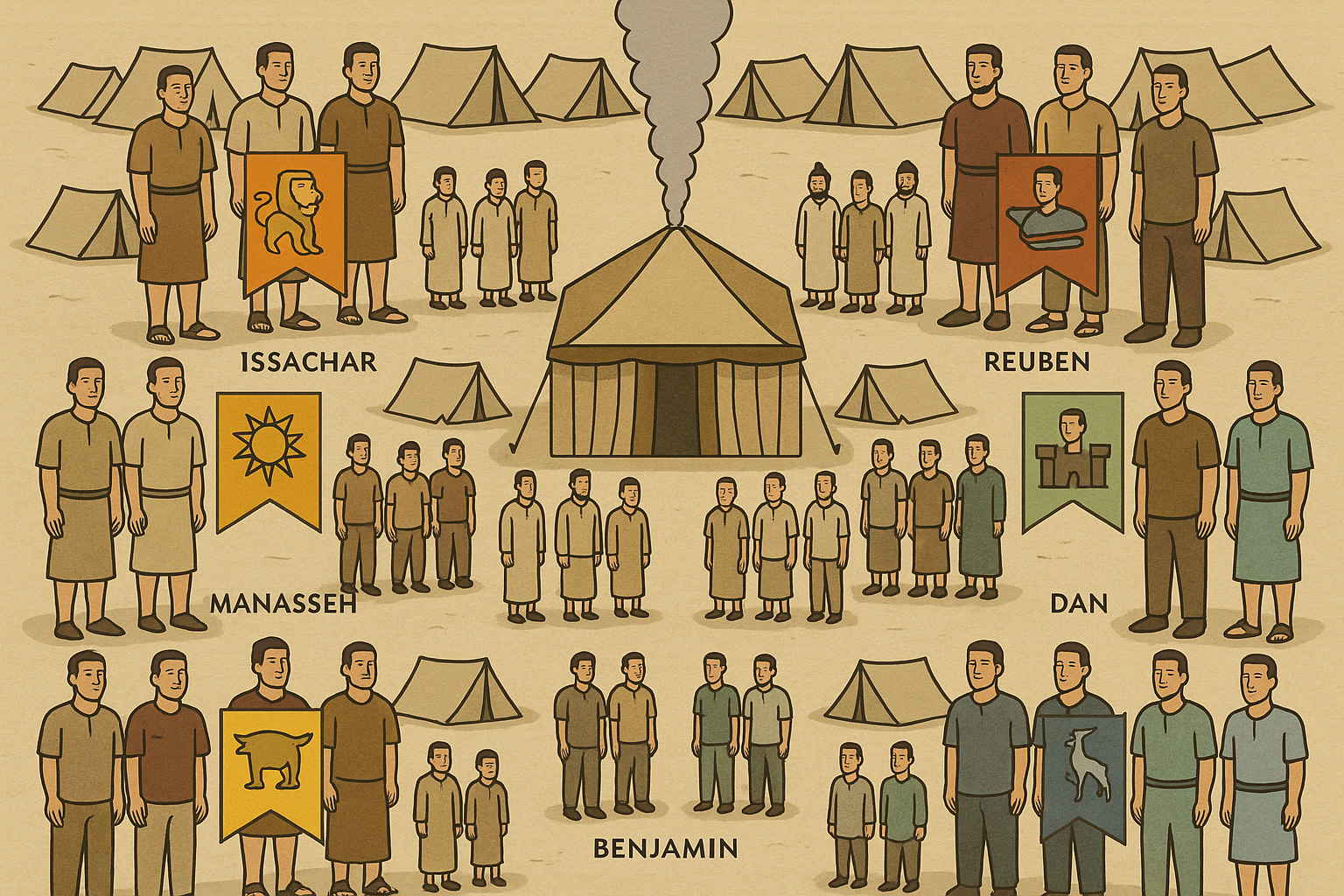
“Every man of the children of Israel shall pitch by his own standard, with the ensign of their father’s house: far off about the tabernacle of the congregation shall they pitch.” — Numbers 2:2.
The KJV therefore explicitly identifies several elements of the arrangement:
- Individual tribes had their own standards.
- There were ensigns associated with their fathers’ houses.
- The tribes had assigned camping positions.
- The tabernacle of the congregation stood in relation to the entire arrangement.
Scripture does not describe the colors, pictures, animals, or designs appearing on those standards in Numbers 2. Traditional reconstructions of such emblems should therefore not be presented as though Numbers itself states them.
East — The camp of Judah
On the east side was the standard of the camp of Judah, accompanied by Issachar and Zebulun.
Their totals were:
- Judah — 74,600
- Issachar — 54,400
- Zebulun — 57,400
- Total — 186,400
Numbers 2:9 says:
“They shall first set forth.”
Judah therefore held the first position in the stated marching order.
This chapter does not explain why Judah was given that position. Later Scripture certainly gives Judah extraordinary significance, including the royal and Messianic line, but Numbers 2 itself does not state that this was the reason for Judah’s eastern or leading position. It is safest to leave the reason where Scripture leaves it.
South — The camp of Reuben
On the south side were:
- Reuben — 46,500
- Simeon — 59,300
- Gad — 45,650
- Total — 151,450
Numbers 2:16 says:
“and they shall set forth in the second rank.”
The Levites and the tabernacle in the midst
After the first two groups, Scripture says:
“Then the tabernacle of the congregation shall set forward with the camp of the Levites in the midst of the camp” — Numbers 2:17.
This is a central fact in the chapter. Israel’s marching arrangement was not merely a column of fighting men. The tabernacle and Levites occupied an expressly appointed position “in the midst of the camp.”
Exodus 25:8 gives the theological significance of the sanctuary:
“And let them make me a sanctuary; that I may dwell among them.”
Therefore, it is scripturally warranted to connect the central place of the tabernacle with God’s declared purpose to dwell among Israel. We should not, however, invent symbolic meanings for every geographical detail that Scripture itself does not give.
West — The camp of Ephraim
On the west side were:
- Ephraim — 40,500
- Manasseh — 32,200
- Benjamin — 35,400
- Total — 108,100
Numbers 2:24 says:
“And they shall go forward in the third rank.”
Joseph’s two sons, Ephraim and Manasseh, thus appear as distinct tribal divisions in the census arrangement.
North — The camp of Dan
On the north side were:
- Dan — 62,700
- Asher — 41,500
- Naphtali — 53,400
- Total — 157,600
Numbers 2:31 says:
“They shall go hindmost with their standards.”
Dan’s camp therefore occupied the final stated position in the marching arrangement.
The total remains 603,550
Numbers 2:32 repeats the total:
“six hundred thousand and three thousand and five hundred and fifty.”
The Levites again were excluded:
“But the Levites were not numbered among the children of Israel; as the LORD commanded Moses.” — Numbers 2:33.
Finally:
“And the children of Israel did according to all that the LORD commanded Moses: so they pitched by their standards, and so they set forward, every one after their families, according to the house of their fathers.” — Numbers 2:34.
Numbers 1 ends with obedience, and Numbers 2 ends with obedience.
That repetition deserves attention.
Key People and Places
The LORD
The LORD is the One issuing the commands throughout both chapters. The organization of Israel originates in divine revelation, not simply in Moses’ administrative judgment.
Moses
Moses receives the LORD’s instructions and carries them out. He participates directly in the census and organization of the tribes.
Aaron
Aaron serves alongside Moses in numbering Israel and receiving God’s directions.
The tribal heads
Twelve named representatives assist Moses and Aaron. They are described as:
“the renowned of the congregation, princes of the tribes of their fathers, heads of thousands in Israel.” — Numbers 1:16.
Their authority is therefore stated directly in the text.
The children of Israel
Israel is presented as an identifiable covenant nation composed of tribes, families, fathers’ houses, and numbered men.
This passage concerns national Israel, not the New Testament church. The distinction should be maintained rather than treating Israel’s tribal camp as an allegory of the church.
The Levites
The Levites are separated from the military census and appointed to tabernacle service.
Their distinct responsibility illustrates a plain biblical principle: God determines the duties associated with His service.
Wilderness of Sinai
Numbers 1:1 explicitly places these events:
“in the wilderness of Sinai.”
The passage does not say merely “at Mount Sinai” in this verse; its stated geographical designation is the wilderness of Sinai.
The tabernacle of the congregation / tabernacle of testimony
The tabernacle occupies the central place in Israel’s encampment and is specifically entrusted to the Levites.
Main Doctrinal or Spiritual Themes
1. God Is a God of Order
Numbers 1–2 contains careful numbering, defined qualifications, assigned responsibilities, appointed leaders, established camping locations, and a fixed marching sequence.
Nothing in these chapters suggests disorder or improvisation.
The New Testament likewise declares:
“For God is not the author of confusion, but of peace” — 1 Corinthians 14:33.
And:
“Let all things be done decently and in order.” — 1 Corinthians 14:40.
The church is not commanded to imitate Israel’s tribal arrangement, but God’s character has not changed. Biblical service should not glorify confusion.
2. Obedience Must Be Governed by God’s Word
Numbers 1:54 says:
“And the children of Israel did according to all that the LORD commanded Moses, so did they.”
Numbers 2:34 repeats essentially the same truth.
The emphasis is not merely that they accomplished the desired result. They did it according to what God commanded.
That principle remains vital. Good intentions do not give believers authority to alter what God has plainly revealed.
Jesus said:
“If ye love me, keep my commandments.” — John 14:15.
3. God’s Holiness Requires Separation and Boundaries
The Levites were appointed to tabernacle responsibilities, while the other tribes had different duties.
Numbers 1:53 expressly connects the Levites’ position with preventing wrath upon the congregation.
This teaches that matters relating to God’s holiness cannot be treated casually. God Himself determined who could perform particular functions.
A sound application is not that New Testament pastors are Levitical priests—they are not—but that God’s work must be conducted according to God’s qualifications and instructions rather than human presumption.
4. God Assigns Different Responsibilities
The fighting men were numbered for one purpose; the Levites were separated for another.
Neither assignment was created by personal preference.
This does not establish New Testament spiritual gifts by itself, but it agrees with the later principle:
“But now hath God set the members every one of them in the body, as it hath pleased him.” — 1 Corinthians 12:18.
Believers should not despise another person’s biblical responsibility or envy a calling God has given someone else.
5. The LORD Dwelling Among Israel Is Central
The tabernacle was positioned:
“in the midst of the camp” — Numbers 2:17.
And God had already said concerning the sanctuary:
“that I may dwell among them.” — Exodus 25:8.
The safest conclusion is exactly what Scripture establishes: God designed Israel’s camp around the sanctuary associated with His dwelling among them.
It is reasonable devotionally to say that believers should give God first place, but Numbers 2 should not be turned into an elaborate allegory in which every direction and tribal position receives a hidden spiritual meaning.
6. Israel Remains Distinct as Israel
These chapters repeatedly speak of:
- tribes,
- fathers’ houses,
- tribal leaders,
- tribal standards,
- the children of Israel,
- and the tribe of Levi.
Nothing in the passage suggests that these distinctions are figurative descriptions of the church.
A dispensational reading accepts the plain sense: this is literal Israel in the wilderness.
God’s program for Israel must not be absorbed into or confused with His program for the New Testament church.
7. Readiness for Conflict
The census repeatedly identifies those:
“able to go forth to war.”
This is explicitly a military qualification.
The passage therefore presents Israel as an organized nation possessing men numbered for warfare. Scripture does not say in Numbers 1 that every individual numbered was spiritually faithful; the qualification stated here concerns age, sex, tribal identity, and ability to go to war.
For believers today, spiritual warfare is of a different nature:
“For we wrestle not against flesh and blood” — Ephesians 6:12.
The legitimate application is therefore readiness for the spiritual conflict God actually assigns to the church, not the transfer of Israel’s military commission to Christians.
Practical Applications or Lessons
Obey what God actually said
The repeated conclusion of both chapters is obedience to God’s command.
The believer should therefore ask not merely, “Does this seem useful?” but, “What hath God said?”
“But be ye doers of the word, and not hearers only” — James 1:22.
Do God’s work God’s way
Moses did not invent the census qualifications. The tribal leaders did not choose their own positions. The Levites did not redesign their calling.
God determined the order.
Christian ministry likewise must remain subordinate to Scripture rather than pragmatism, tradition, popularity, or personal preference.
Respect biblical distinctions
Israel had tribes. Levi had a distinct calling. The tabernacle had restricted responsibilities.
Believers should learn not to erase distinctions that Scripture itself makes—whether between Israel and the church, pastor and congregation, man and woman, or differing areas of service.
At the same time, we should not manufacture distinctions Scripture does not make.
Faithfulness matters more than prominence
Judah marched first. Dan marched last. Levi remained in the midst with the tabernacle.
Scripture does not describe the last position as dishonorable or the first position as proof of superior personal spirituality.
The proper lesson is to be faithful in whatever place God assigns.
“Moreover it is required in stewards, that a man be found faithful.” — 1 Corinthians 4:2.
God’s holiness must never be treated casually
The warning surrounding the tabernacle reminds the reader that nearness to sacred things did not give a person liberty to disregard God’s commands.
This principle remains serious for preaching, worship, church leadership, and Christian living.
“But as he which hath called you is holy, so be ye holy in all manner of conversation.” — 1 Peter 1:15.
Numbers matter because people matter to God
Numbers 1 contains thousands of people, but the census is organized by tribe, family, fathers’ house, and even individual names.
We should not overstate what this proves about God’s personal relationship with every numbered individual; the chapter does not directly address that subject. It does show, however, that God’s command involved careful and specific accounting rather than a vague estimate.
Spiritual order should accompany spiritual zeal
Israel was not simply told to move. They were told where to pitch, when to move, and in what sequence.
Zeal without biblical direction is not presented as a virtue.
“And Samuel said, Hath the LORD as great delight in burnt offerings and sacrifices, as in obeying the voice of the LORD? Behold, to obey is better than sacrifice” — 1 Samuel 15:22.
Overall Message of Numbers 1–2
Numbers 1–2 shows the redeemed nation of Israel ordered under the direct command of the LORD.
God numbers the men able to go forth to war. He appoints leaders. He separates the Levites for tabernacle responsibility. He determines where each tribe camps and in what order each division moves. Most importantly, the tabernacle of the congregation occupies its appointed place “in the midst of the camp.”
The two chapters repeatedly stress one decisive standard:
“as the LORD commanded Moses.”
The great practical lesson is therefore not merely organization. It is ordered obedience to revealed truth.
Biblical order without obedience is empty formalism. Zeal without biblical order can become presumption. Numbers 1–2 presents both responsibility and order as governed by the spoken command of God.
For the Christian, the particulars of Israel’s census and camp are not church ordinances, but the underlying principle remains sound: believe God’s Word, respect God’s distinctions, fulfill the responsibility God gives, and do His work according to His revealed will.
How useful was this post?
Click on a star to rate it!
Average rating 0 / 5. Vote count: 0
No votes so far! Be the first to rate this post.
We are sorry that this post was not useful for you!
Let us improve this post!
Tell us how we can improve this post?
Comments are closed