Exodus 20–22 records the LORD giving commandments and judgments to Israel after bringing them out of Egypt. The order is important: God had already delivered Israel from Egyptian bondage before these laws were given. Exodus 20:2 begins, “I am the LORD thy God, which have brought thee out of the land of Egypt, out of the house of bondage.” The law therefore did not bring Israel out of Egypt; it instructed a people whom God had already delivered concerning worship, personal conduct, justice, property, family responsibilities, and holiness.
These chapters must also be kept in their proper dispensational setting. They are commandments and judgments given to Israel. They reveal the unchanging holiness and righteousness of God, but the Church is not national Israel and is not placed under Israel’s Mosaic civil covenant. Nothing in these chapters teaches salvation by law-keeping. Scripture elsewhere states plainly, “Therefore by the deeds of the law there shall no flesh be justified in his sight” (Romans 3:20).
Chapter Summaries
 Exodus 20 — The Ten Commandments, the Fear of God, and the Altar
The chapter opens with God Himself speaking:
“And God spake all these words, saying, I am the LORD thy God, which have brought thee out of the land of Egypt, out of the house of bondage.”
— Exodus 20:1–2
The commandments that follow establish Israel’s obligations toward God and toward other people.
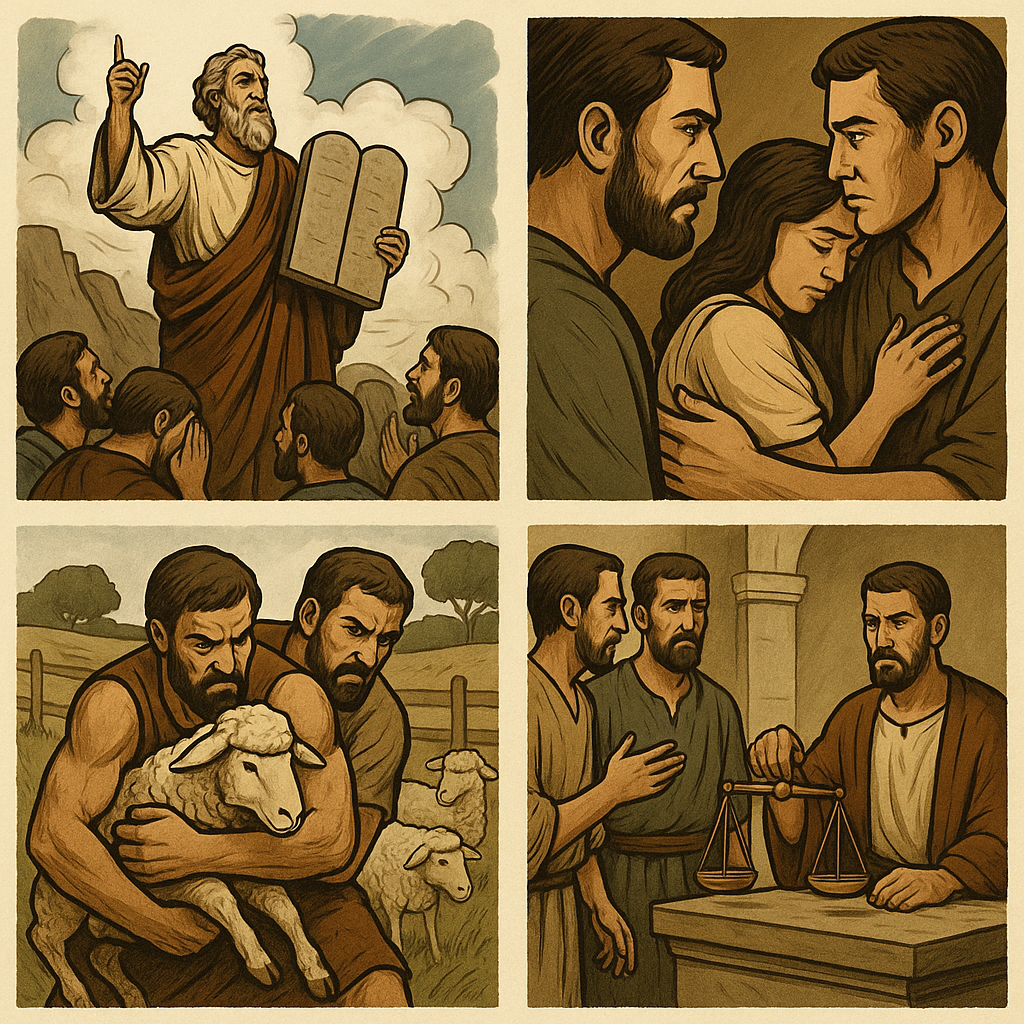
The first commands concern man’s relationship to God. Israel was to have “no other gods before me” (v. 3). They were forbidden to make or worship graven images (vv. 4–6), forbidden to take “the name of the LORD thy God in vain” (v. 7), and commanded to remember the sabbath day and keep it holy (vv. 8–11).
The latter commands deal especially with man’s conduct toward others: honoring father and mother, not killing, not committing adultery, not stealing, not bearing false witness, and not coveting (vv. 12–17).
The tenth commandment is particularly important because it shows that God’s standard reaches beyond outward conduct to coveting:
“Thou shalt not covet thy neighbour’s house, thou shalt not covet thy neighbour’s wife…”
— Exodus 20:17
The chapter therefore does not present righteousness as merely external conformity.
Israel’s fear at the mountain
The people saw “the thunderings, and the lightnings, and the noise of the trumpet, and the mountain smoking” and “removed, and stood afar off” (v. 18).
They asked Moses to speak with them rather than God, saying:
“Speak thou with us, and we will hear: but let not God speak with us, lest we die.”
— Exodus 20:19
Moses answered:
“Fear not: for God is come to prove you, and that his fear may be before your faces, that ye sin not.”
— Exodus 20:20
The wording is worth noticing. Moses says both “Fear not” and that God’s “fear may be before your faces.” The text itself therefore distinguishes their terror from the godly fear intended to restrain sin.
Instructions concerning worship
Verses 22–26 return to the subject of worship. God reminds them:
“Ye have seen that I have talked with you from heaven.”
They were forbidden to make gods of silver or gold. An altar of earth could be made, or an altar of stone, but if stone was used:
“thou shalt not build it of hewn stone: for if thou lift up thy tool upon it, thou hast polluted it.”
— Exodus 20:25
They were also forbidden to ascend the altar by steps in a manner that would expose nakedness (v. 26).
A sound practical principle may be drawn from this: God determines how He is to be approached. Human ingenuity cannot improve upon what God commands.
The Sabbath in its textual setting
The command is explicitly the seventh day:
“But the seventh day is the sabbath of the LORD thy God.”
— Exodus 20:10
Later in Exodus, God explicitly identifies the sabbath as “a sign between me and you throughout your generations” when speaking to Israel (Exodus 31:13).
Scripture does not call the first day of the week “the sabbath” in Exodus 20–22. The Church and Israel should therefore not be confused when interpreting this command.
Exodus 21 — Judgments Concerning Servants, Life, Injury, and Responsibility
Exodus 21 begins:
“Now these are the judgments which thou shalt set before them.”
— Exodus 21:1
This establishes the judicial nature of much that follows. These are not merely private suggestions; they are judgments governing Israel’s society.
Hebrew servants — verses 2–11
The chapter first regulates the Hebrew servant. A Hebrew servant was to serve six years and:
“in the seventh he shall go out free for nothing.”
— Exodus 21:2
Verses 3–6 give additional conditions concerning his family situation. If the servant declared:
“I love my master, my wife, and my children; I will not go out free”
he was brought “unto the judges,” then to the door or doorpost, his ear was bored through with an awl, “and he shall serve him for ever” (vv. 5–6).
Verses 7–11 deal separately with a daughter sold as a maidservant and specify obligations regarding her treatment, food, raiment, and duty of marriage.
It is important not to impose modern categories on every detail of the passage. The text describes a particular legal institution operating under Israel’s law. Scripture explicitly regulates it and establishes protections and obligations within it.
Murder, accidental death, and other capital offenses
Verse 12 states:
“He that smiteth a man, so that he die, shall be surely put to death.”
But verses 13–14 immediately distinguish between a death that was not deliberately planned and deliberate murder.
Concerning one who “lie not in wait”, provision is made for a place of refuge. By contrast:
“But if a man come presumptuously upon his neighbour, to slay him with guile; thou shalt take him from mine altar, that he may die.”
— Exodus 21:14
This context is significant when reading “Thou shalt not kill” in Exodus 20:13. Chapter 21 demonstrates that the law itself distinguishes deliberate murder from other circumstances in which death occurs.
Other offenses carrying the death penalty include striking father or mother (v. 15), stealing a man (v. 16), and cursing father or mother (v. 17).
Exodus 21:16 is especially explicit concerning man-stealing:
“And he that stealeth a man, and selleth him, or if he be found in his hand, he shall surely be put to death.”
Bodily injury and restitution
Verses 18–27 establish responsibility when one person injures another.
Where injury causes loss of time, the offender must “pay for the loss of his time, and shall cause him to be thoroughly healed” (v. 19).
Verses 20–21 address the striking of servants. Verses 26–27 additionally establish that if a master destroys a servant’s eye or knocks out a servant’s tooth, the servant must be released:
“he shall let him go free for his eye’s sake.”
and:
“he shall let him go free for his tooth’s sake.”
“Eye for eye” and proportional justice
In the setting of these judicial laws, verses 23–25 state:
“And if any mischief follow, then thou shalt give life for life, Eye for eye, tooth for tooth, hand for hand, foot for foot, Burning for burning, wound for wound, stripe for stripe.”
Because Exodus 21:1 explicitly calls these “judgments,” the passage concerns judicial justice. The principle is proportion: punishment is not to exceed the wrong committed.
It is therefore improper to turn “eye for eye” into permission for uncontrolled personal vengeance.
Responsibility for dangerous animals and property
Verses 28–36 deal principally with oxen that injure people or other animals.
A crucial distinction is made when an ox was already known to be dangerous:
“But if the ox were wont to push with his horn in time past, and it hath been testified to his owner, and he hath not kept him in…”
— Exodus 21:29
The owner could therefore bear greater responsibility when a known danger was negligently left unrestrained.
The chapter also deals with an uncovered pit and the resulting responsibility when an animal falls into it (vv. 33–34).
The biblical principle is plain: a person can be accountable not only for what he intentionally does but also for dangers under his control that he knowingly fails to address.
Exodus 22 — Restitution, Property, Moral Purity, Compassion, and Holiness
Exodus 22 continues the judgments and applies God’s righteousness to theft, property damage, lending, sexual misconduct, false worship, treatment of the vulnerable, and daily holiness.
Theft and restitution — verses 1–4
A man stealing an ox or sheep and killing or selling it owed restitution greater than the original value:
“he shall restore five oxen for an ox, and four sheep for a sheep.”
— Exodus 22:1
If the stolen animal was found alive in his possession, he was to “restore double” (v. 4).
The law did not treat repentance as merely feeling sorry. Where property loss occurred, restitution was required.
Damage to another man’s property — verses 5–6
If a man allowed his beast to feed in another man’s field or vineyard, he owed restitution from “the best of his own field, and of the best of his own vineyard” (v. 5).
Likewise, if fire spread and destroyed another person’s property:
“he that kindled the fire shall surely make restitution.”
— Exodus 22:6
Personal carelessness could therefore carry financial responsibility.
Entrusted and borrowed property — verses 7–15
The law addresses money or goods delivered to a neighbor for safekeeping, disputes over ownership, animals entrusted to another, and borrowed property.
Several cases were to come “unto the judges” (vv. 8–9).
This reinforces that Israel’s judicial law required evidence and judgment rather than mere personal accusation.
Sexual morality — verses 16–17
If a man enticed an unmarried maid and lay with her, he incurred definite obligations concerning marriage and dowry. If her father refused to give her to him, the man still owed according to “the dowry of virgins.”
The text does not treat sexual conduct as morally insignificant or purely private.
Witchcraft, bestiality, and idolatry — verses 18–20
Three commands follow with severe penalties:
“Thou shalt not suffer a witch to live.” — verse 18
“Whosoever lieth with a beast shall surely be put to death.” — verse 19
“He that sacrificeth unto any god, save unto the LORD only, he shall be utterly destroyed.” — verse 20
These statements belong explicitly to Israel’s civil law and demonstrate the seriousness with which God regarded occult practice, sexual perversion, and idolatry under that covenant.
A dispensational distinction must be maintained here. The Church has not been constituted as national Israel and has not been given authority to administer Israel’s Mosaic civil penalties. That distinction does not make the sins themselves righteous.
The stranger, widow, and fatherless — verses 21–24
God specifically commands:
“Thou shalt neither vex a stranger, nor oppress him.”
— Exodus 22:21
Israel was reminded:
“for ye were strangers in the land of Egypt.”
Regarding widows and fatherless children:
“Ye shall not afflict any widow, or fatherless child.”
— Exodus 22:22
God then declares that if they cry unto Him:
“I will surely hear their cry.”
— Exodus 22:23
God’s holiness is therefore seen not only in punishing idolatry and immorality but also in His concern for those vulnerable to oppression.
Lending to the poor — verses 25–27
When lending to “any of my people that is poor by thee,” Israel was forbidden to act as a usurer toward him.
If a neighbor’s garment was taken as a pledge, it had to be returned before sunset because it might be his only covering.
God concludes:
“and it shall come to pass, when he crieth unto me, that I will hear; for I am gracious.”
— Exodus 22:27
The explicit reason given is God’s own gracious character.
Reverence, firstfruits, and holiness — verses 28–31
Verse 28 commands:
“Thou shalt not revile the gods, nor curse the ruler of thy people.”
The verse’s KJV wording should be allowed to stand without forcing a more specific identification upon the word “gods” than this passage itself supplies.
Israel was also commanded concerning firstfruits and firstborn (vv. 29–30).
The chapter closes:
“And ye shall be holy men unto me.”
— Exodus 22:31
They were therefore forbidden to eat flesh torn by beasts in the field.
The final verse gives a fitting summary of much of chapters 20–22: God required a people separated unto Himself.
Key People and Places
The LORD God
The central Person throughout the passage. He speaks His commandments, establishes Israel’s judgments, demands exclusive worship, defends the oppressed, and repeatedly reveals His holiness and justice.
He identifies Himself in Exodus 20:2 as the One “which have brought thee out of the land of Egypt, out of the house of bondage.”
Moses
Moses stands between the fearful people and the manifestation of God in Exodus 20:18–21. The people ask Moses to speak with them, and Moses explains that God’s manifestation is connected with proving them and placing His fear before them.
The Children of Israel
They are the people directly addressed by this covenant legislation. The laws concerning servants, judges, property, rulers, worship, strangers, and firstborn presuppose Israel as an organized people living under God’s revealed judgments.
Judges
They appear explicitly in Exodus 21:6 and Exodus 22:8–9. Certain disputes were to be brought before them rather than settled by uncontrolled private retaliation.
Egypt
Egypt is mentioned in Exodus 20:2 as “the house of bondage” from which God brought Israel, and again in Exodus 22:21 when Israel is reminded that they themselves had been strangers there.
The Mount
Exodus 20:18 describes “the mountain smoking.” The immediately preceding KJV context identifies this mountain as “mount Sinai” (Exodus 19:11, 18, 20). Thus identifying the setting as Mount Sinai is explicit from the surrounding text, not a geographical guess.
Heaven
God says in Exodus 20:22:
“Ye have seen that I have talked with you from heaven.”
His authority is therefore presented as divine, not as legislation invented by Moses.
Main Doctrinal or Spiritual Themes
1. God Alone Is Worthy of Worship
The foundation is:
“Thou shalt have no other gods before me.”
— Exodus 20:3
Exodus 20:4–6 forbids idolatry, and Exodus 22:20 again condemns sacrificing to another god. Biblical worship demands exclusiveness.
There is no biblical room here for religious syncretism—the combination of the worship of the LORD with the worship of false gods.
2. God’s Holiness Governs Every Area of Life
The law moves from worship to parents, marriage, life, property, speech, servants, animals, money, sexuality, lending, rulers, and treatment of strangers.
Biblical holiness is therefore not limited to religious ceremonies.
The climactic statement is:
“And ye shall be holy men unto me.”
— Exodus 22:31
3. God’s Law Reveals Sin but Does Not Justify the Sinner
Exodus 20 even addresses coveting. The law reaches beyond merely visible behavior.
The New Testament explains the doctrinal purpose plainly:
“Therefore by the deeds of the law there shall no flesh be justified in his sight: for by the law is the knowledge of sin.”
— Romans 3:20
Salvation is not obtained by keeping the Ten Commandments. A sinner is justified by faith apart from the works of the law.
4. Redemption Precedes the Giving of These Laws in the Exodus Narrative
God does not begin Exodus 20 by telling Israel how to escape Egypt. He says:
“I am the LORD thy God, which have brought thee out of the land of Egypt.”
That sequence is explicit.
It should not be turned into an assertion that Israel’s national deliverance from Egypt and New Testament justification are identical events; Scripture does not say that. But the passage certainly gives no basis for teaching that Israel earned its escape from Egypt by subsequently keeping the commandments given at Sinai.
5. God Requires Justice, Not Unrestrained Revenge
The repeated requirements of restitution and the judicial setting of “eye for eye” demonstrate measured justice.
Punishment and restitution correspond to the wrong committed. Personal anger is not given unlimited authority.
6. Human Life Is Sacred
Murder receives the most serious treatment. Exodus 21 also carefully distinguishes deliberate killing “with guile” from a death where the offender “lie not in wait.”
The same chapter condemns man-stealing with death (21:16).
Human life cannot be treated merely as property or convenience.
7. Sin Creates Real Obligations Toward Those Harmed
The repeated phrase and principle of restitution are striking.
A thief might have to restore double, fourfold, or fivefold. One whose carelessness destroyed property had to “surely make restitution.”
Biblical repentance should therefore never be used as an excuse to avoid making right what can rightly be restored.
8. God Defends Those Vulnerable to Oppression
The stranger, widow, fatherless child, and poor man receive explicit protection.
God says concerning their cry:
“I will surely hear their cry.”
And concerning the poor man’s garment:
“when he crieth unto me, that I will hear; for I am gracious.”
Justice and compassion are not competing attributes in God.
9. God’s People Must Be Separated From Idolatry and Moral Perversion
Witchcraft, bestiality, and sacrifice to false gods are condemned without qualification in Exodus 22:18–20.
The civil penalties belong to Israel under the Mosaic covenant. The moral seriousness of the practices should not therefore be minimized.
10. Israel and the Church Must Remain Distinct
These chapters contain laws for Hebrew servants, civil judges, national penalties, restitution schedules, sabbath observance, firstborn requirements, and other commands given within Israel’s covenant administration.
The Church should learn from the righteousness, holiness, justice, and moral truth revealed here without pretending that it has become national Israel.
That distinction is especially necessary when interpreting Israel’s civil penalties.
Practical Applications or Lessons
Put God First Without Rival
“Thou shalt have no other gods before me” remains a searching statement concerning the believer’s devotion. Nothing should be knowingly permitted to rival obedience to God.
Guard Worship From Human Invention
God specified how Israel was to approach Him even in the construction of an altar. The practical lesson is that sincerity alone does not authorize whatever form of worship man chooses.
God’s Word must govern God’s people.
Treat God’s Name Reverently
“Thou shalt not take the name of the LORD thy God in vain.”
The name of God should never become careless speech, profanity, manipulation, or empty religious language.
Honor Parents
God explicitly commands:
“Honour thy father and thy mother.”
A culture that despises parental authority moves contrary to the plain commandment of God.
Guard Both Conduct and Desire
The prohibition against adultery addresses conduct; the prohibition against coveting one’s neighbor’s wife reaches inward.
Sin should therefore be resisted before wrongful desire produces wrongful action.
Do Not Confuse Forgiveness With Avoiding Restitution
If you have wrongfully taken or damaged what belongs to another person, seeking forgiveness does not automatically remove every practical responsibility.
Exodus repeatedly teaches making restitution when restitution is possible.
Take Responsibility for Known Dangers
The owner of an ox known to be dangerous could not ignore that knowledge without consequences.
A sound application is that believers should not knowingly leave preventable dangers where others may be harmed and then claim innocence because they did not personally intend the injury.
Protect Rather Than Exploit the Vulnerable
God’s words concerning the stranger, widow, fatherless, and poor should search the conscience.
Strength, wealth, position, age, or authority should never become an opportunity to exploit someone weaker.
Practice Compassion in Financial Dealings
Exodus 22 does not permit a poor man’s desperation to become an opportunity for heartless gain.
A Christian should therefore examine not only whether a financial action is technically permissible, but whether it is merciful and upright.
Take Sexual Purity Seriously
Exodus 22 treats sexual wrongdoing as something carrying real responsibility and consequences.
Modern society may attempt to separate sexual behavior from moral accountability, but Scripture does not.
Reject the Occult and False Worship
Exodus 22:18–20 leaves no room to regard witchcraft or idolatry as harmless spiritual alternatives.
Believers should maintain clear separation from occult practice and every form of worship directed away from the true God.
Cultivate the Fear of God
Moses said that God’s fear was to be before Israel’s faces “that ye sin not.”
Biblical fear of God therefore has a practical relationship to holiness. A person who takes God seriously will take sin seriously.
Overall Message of Exodus 20–22
Exodus 20–22 reveals a holy God establishing His righteous standard among the nation He brought out of Egypt. His authority governs worship, family, human life, property, sexuality, justice, money, treatment of the weak, and everyday responsibility.
Exodus 20 gives the foundational commandments. Exodus 21 begins the detailed “judgments” applying divine justice to real disputes and injuries. Exodus 22 continues those judgments and closes by calling Israel to holiness:
“And ye shall be holy men unto me.”
— Exodus 22:31
For the Christian, these chapters should produce neither legalism nor disregard for God’s holiness. The law cannot justify a sinner, but it unmistakably reveals the righteousness of the God who gave it. Salvation is by grace through faith, apart from works; and the saved believer should desire to walk in holiness because he belongs to the Lord.
Comments are closed