
Exodus 23–25 moves from the LORD’s civil and ceremonial commands for Israel, to the solemn confirmation of the covenant at Sinai, and then to God’s instructions concerning the sanctuary and its furnishings. The order is significant in the text: Israel hears the words of the LORD, agrees to obey them, the covenant is confirmed with blood, Moses ascends the mount, and God begins revealing how a sanctuary is to be made so that He may dwell among His people.
These chapters belong directly to Israel under the Mosaic covenant. They contain enduring truths concerning God’s holiness, justice, worship, obedience, and approach to God, but the church is not Israel and is not placed under the Sinai covenant.
Chapter Summaries
 Exodus 23 — Justice, Separation, Worship, and God’s Promise to Lead Israel
The first part of Exodus 23 continues the judgments and commands connected with Israel’s covenant responsibilities.
God requires truth and impartial justice:
“Thou shalt not raise a false report: put not thine hand with the wicked to be an unrighteous witness.”
— Exodus 23:1
Israel was forbidden to follow a majority into wrongdoing:
“Thou shalt not follow a multitude to do evil…”
— Exodus 23:2
That principle is morally important. Truth is not determined by popularity. A multitude can be wrong, and God’s people are responsible to obey what God has said rather than follow prevailing opinion.
God also prohibited partiality. Exodus 23:3 says:
“Neither shalt thou countenance a poor man in his cause.”
Later, verse 6 adds:
“Thou shalt not wrest the judgment of thy poor in his cause.”
Taken together, Scripture forbids corrupt judgment in either direction. Poverty was neither grounds for favoritism nor an excuse for oppression.
Verses 4–5 command Israel to act rightly even toward an enemy:
“If thou meet thine enemy’s ox or his ass going astray, thou shalt surely bring it back to him again.”
Personal hostility was not to cancel moral responsibility.
God further commanded:
“Keep thee far from a false matter…”
— Exodus 23:7
And:
“And thou shalt take no gift: for the gift blindeth the wise, and perverteth the words of the righteous.”
— Exodus 23:8
Here “gift” is plainly connected with corrupt judgment—a bribe that distorts justice.
The Sabbath year and Sabbath day
Israel was commanded to sow and gather from the land for six years and allow it to rest in the seventh:
“But the seventh year thou shalt let it rest and lie still…”
— Exodus 23:11
Likewise:
“Six days thou shalt do thy work, and on the seventh day thou shalt rest…”
— Exodus 23:12
These commands were given to Israel within the Mosaic covenant. They should not be confused with New Testament church ordinances. Nevertheless, they reveal God’s concern for obedience, order, mercy, and recognition that man is dependent upon Him.
Separation from false gods
God says:
“And in all things that I have said unto you be circumspect: and make no mention of the name of other gods, neither let it be heard out of thy mouth.”
— Exodus 23:13
This is an uncompromising command against idolatrous accommodation. Israel was to belong distinctly to Jehovah.
The three annual feasts
Verse 14 says:
“Three times thou shalt keep a feast unto me in the year.”
The three named observances are:
- The feast of unleavened bread — Exodus 23:15.
- The feast of harvest, the firstfruits of thy labours — Exodus 23:16.
- The feast of ingathering, which is in the end of the year — Exodus 23:16.
Verse 17 states:
“Three times in the year all thy males shall appear before the Lord GOD.”
These feasts belonged to Israel’s covenant worship. They should not be transferred wholesale to the New Testament church.
The angel sent before Israel
A major transition occurs in verse 20:
“Behold, I send an Angel before thee, to keep thee in the way, and to bring thee into the place which I have prepared.”
God commands:
“Beware of him, and obey his voice, provoke him not; for he will not pardon your transgressions: for my name is in him.”
— Exodus 23:21
The wording gives this Angel extraordinary divine authority and says, “my name is in him.”
A conservative Christian interpretation may identify this Angel with a preincarnate manifestation of Christ. However, Exodus 23 itself does not explicitly say, “This Angel is Christ.” Therefore that identification should be presented as an interpretation drawn from comparison with other Scriptures, not as wording explicitly stated in the chapter.
The explicit truth is that God promised supernatural guidance and demanded obedience to the Angel whom He sent.
Israel and the inhabitants of Canaan
God commanded complete religious separation:
“Thou shalt not bow down to their gods, nor serve them, nor do after their works…”
— Exodus 23:24
And:
“Thou shalt make no covenant with them, nor with their gods.”
— Exodus 23:32
The danger is expressly stated:
“They shall not dwell in thy land, lest they make thee sin against me…”
— Exodus 23:33
This is not merely a cultural separation. The stated reason is spiritual: their idolatry would become a snare to Israel.
God also promised that Israel’s conquest would occur progressively:
“I will not drive them out from before thee in one year…”
— Exodus 23:29
And:
“By little and little I will drive them out from before thee…”
— Exodus 23:30
The reason is explicitly given: an immediate depopulation would leave the land desolate and allow wild beasts to multiply.
Exodus 24 — The Covenant Confirmed with Blood
Chapter 24 records a solemn confirmation of the covenant between the LORD and Israel.
God tells Moses:
“Come up unto the LORD, thou, and Aaron, Nadab, and Abihu, and seventy of the elders of Israel…”
— Exodus 24:1
Moses alone was instructed to come near unto the LORD in the manner specified in verse 2.
Israel agrees to the words of the LORD
Moses tells the people:
“all the words of the LORD, and all the judgments…”
— Exodus 24:3
The people answer:
“All the words which the LORD hath said will we do.”
Moses then writes:
“all the words of the LORD…”
— Exodus 24:4
This emphasizes that Israel’s covenant obligation rested upon revealed words, not human religious opinion.
The blood of the covenant
Moses builds an altar and twelve pillars:
“according to the twelve tribes of Israel.”
— Exodus 24:4
Young men offer burnt offerings and peace offerings.
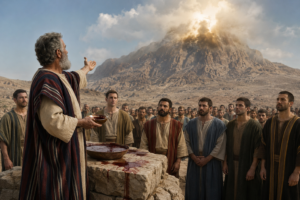
Moses then takes half the blood and puts it in basons and sprinkles half on the altar.
He reads:
“the book of the covenant in the audience of the people…”
— Exodus 24:7
Again the people answer:
“All that the LORD hath said will we do, and be obedient.”
Then:
“Moses took the blood, and sprinkled it on the people, and said, Behold the blood of the covenant…”
— Exodus 24:8
The text makes blood central to the formal covenant ceremony.
This provides important biblical background for the broader doctrine that sinful man does not approach a holy God on his own terms. Hebrews later makes extensive use of this covenant-and-blood background when explaining the superior sacrifice of Christ.
Care must be taken not to confuse the Mosaic covenant with the New Testament. Israel’s covenant at Sinai and salvation by grace through faith are not the same subject. No sinner was ever justified before God by personal merit or by perfect law-keeping.
Moses, Aaron, Nadab, Abihu, and the seventy elders
Exodus 24:9–10 states:
“Then went up Moses, and Aaron, Nadab, and Abihu, and seventy of the elders of Israel:
And they saw the God of Israel…”
The verse further describes:
“there was under his feet as it were a paved work of a sapphire stone, and as it were the body of heaven in his clearness.”
We should remain within the text. Scripture explicitly says “they saw the God of Israel.” It also specifically describes what was “under his feet.”
Exactly how this appearance relates to God’s otherwise unseen glory should be understood in harmony with the rest of Scripture rather than by speculation. Exodus 33:20 later says:
“Thou canst not see my face: for there shall no man see me, and live.”
Therefore we should not claim that Exodus 24 teaches they comprehended God’s unveiled divine essence. Scripture does not say that.
Verse 11 says:
“And upon the nobles of the children of Israel he laid not his hand: also they saw God, and did eat and drink.”
The scene demonstrates both the holiness of God’s presence and the extraordinary privilege granted to these representatives of Israel.
Moses enters the cloud
God calls Moses further up the mountain to receive:
“tables of stone, and a law, and commandments which I have written…”
— Exodus 24:12
Moses tells the elders:
“Tarry ye here for us, until we come again unto you…”
— Exodus 24:14
Joshua accompanies Moses part of the way in the narrative.
The glory of the LORD then abides upon Mount Sinai:
“And the cloud covered it six days: and the seventh day he called unto Moses out of the midst of the cloud.”
— Exodus 24:16
To Israel:
“the sight of the glory of the LORD was like devouring fire on the top of the mount.”
— Exodus 24:17
Finally:
“Moses was in the mount forty days and forty nights.”
— Exodus 24:18
The chapter ends with Moses in the presence of God, preparing for the detailed instructions beginning in chapter 25.
Exodus 25 — The Sanctuary, Ark, Table, and Candlestick
Exodus 25 begins a new major section of Exodus: God’s instructions concerning the sanctuary.
The willing offering
The LORD tells Moses:
“Speak unto the children of Israel, that they bring me an offering: of every man that giveth it willingly with his heart ye shall take my offering.”
— Exodus 25:2
The text specifically emphasizes willingness.
Materials listed include gold, silver, brass, fabrics, skins, wood, oil, spices, and precious stones.
God then states the purpose:
“And let them make me a sanctuary; that I may dwell among them.”
— Exodus 25:8
That statement is central to the chapter.
The sanctuary was not conceived by human imagination. God supplied the pattern:
“According to all that I shew thee, after the pattern of the tabernacle…”
— Exodus 25:9
Biblical worship is therefore governed by divine revelation rather than human invention.
The Ark
The first piece of furniture described is the ark.
It was to be made of:
“shittim wood…”
— Exodus 25:10
and overlaid:
“with pure gold, within and without…”
— Exodus 25:11
Rings and staves were provided for carrying it.
God commands:
“And thou shalt put into the ark the testimony which I shall give thee.”
— Exodus 25:16
The mercy seat
Upon the ark was to be:
“a mercy seat of pure gold…”
— Exodus 25:17
Two cherubims of gold were made at its ends.
Verse 20 says:
“the cherubims shall stretch forth their wings on high, covering the mercy seat with their wings…”
Their faces were directed:
“toward the mercy seat.”
God then says:
“And there I will meet with thee, and I will commune with thee from above the mercy seat…”
— Exodus 25:22
The explicit focus is God’s appointed place of meeting with Moses and communication to Israel.
The mercy-seat imagery becomes doctrinally important in later Scripture in connection with atonement and approach to God. But the tabernacle itself must first be understood literally as the sanctuary God commanded Israel to construct.
The Table of Shewbread
The table was likewise made of shittim wood and overlaid with pure gold.
God commands:
“And thou shalt set upon the table shewbread before me alway.”
— Exodus 25:30
The table, its vessels, and the continual bread belonged to Israel’s prescribed sanctuary worship.
One should avoid inventing meanings for every measurement, material, or construction detail unless Scripture itself supplies that interpretation. There are legitimate doctrinal correspondences elsewhere in Scripture, but imagination must never replace exposition.
The Candlestick
The chapter concludes with instructions for:
“a candlestick of pure gold…”
— Exodus 25:31
It was not simply assembled from separate ornamental pieces in an arbitrary fashion:
“of beaten work shall the candlestick be made…”
Its branches, bowls, knops, flowers, and lamps were all specified by God.
Verse 37 says:
“And thou shalt make the seven lamps thereof: and they shall light the lamps thereof, that they may give light over against it.”
Again the chapter closes by emphasizing God’s pattern:
“And look that thou make them after their pattern, which was shewed thee in the mount.”
— Exodus 25:40
The tabernacle was therefore not an exercise in religious creativity. Moses was to follow divine instruction.
Key People and Places
- The LORD / God of Israel — The covenant-giving God who commands Israel, promises to lead them, confirms His covenant, reveals His glory, and gives Moses the pattern for the sanctuary.
- Moses — Mediator of the Sinai covenant in these chapters; he speaks God’s words to Israel, records them, applies the covenant blood, and ascends Mount Sinai.
- Aaron — Brother of Moses; one of those commanded to ascend with Moses in Exodus 24:1.
- Nadab and Abihu — Sons of Aaron named among those who ascend in Exodus 24:1, 9.
- Joshua — Called Moses’ minister in Exodus 24:13 and accompanies Moses as he rises toward the mount.
- Seventy elders of Israel — Representatives of Israel who ascend and are said to have “saw the God of Israel.”
- The Angel — Sent by God before Israel in Exodus 23:20. God says, “my name is in him.” Identification with the preincarnate Christ may be suggested by comparison with other Scriptures, but Exodus 23 does not explicitly name Him as Christ.
- Children of Israel — The covenant nation directly addressed by these laws and instructions.
- Mount Sinai — The mountain where God’s glory appears, Moses enters the cloud, and the sanctuary pattern is revealed. Exodus 24 explicitly calls the location “the mount”; earlier context identifies Sinai.
- Canaan / the promised territory — The land into which God promises to bring Israel, occupied by nations named in Exodus 23.
- Amorites, Hittites, Perizzites, Canaanites, Hivites, and Jebusites — Peoples whom God states He will cut off before Israel.
- The sanctuary/tabernacle — The divinely patterned dwelling place God orders Israel to construct: “that I may dwell among them.”
Main Doctrinal or Spiritual Themes
1. God Is Perfectly Just
Exodus 23 condemns false reports, corrupt witnesses, majority-driven wrongdoing, partial judgment, false accusations, and bribery.
God’s righteousness is not flexible according to social pressure.
“Thou shalt not follow a multitude to do evil…”
— Exodus 23:2
Biblical truth is determined by God’s Word, not by consensus.
2. God’s People Are Called to Separation from Idolatry
Israel was expressly forbidden to serve the gods of the nations.
“Thou shalt not bow down to their gods, nor serve them…”
— Exodus 23:24
Separation in this passage is first of all separation from false worship and spiritual corruption.
For the church, the Mosaic command itself is not transferred as covenant legislation, but the New Testament likewise teaches believers to reject idolatry and spiritual compromise.
3. Obedience Matters
Repeatedly Israel is commanded to hear and obey.
“All that the LORD hath said will we do, and be obedient.”
— Exodus 24:7
Their promise also exposes an important biblical reality developed throughout the remainder of Scripture: man desperately needs God’s mercy because human promises of obedience do not make sinful human nature righteous.
This does not teach that salvation was ever earned by obeying Moses’ law. Scripture consistently establishes the need for faith and divine grace.
4. A Holy God Establishes the Terms of Approach to Himself
Israel did not design its own altar, covenant ceremony, sanctuary, ark, mercy seat, table, or candlestick.
God prescribed them.
“According to all that I shew thee…”
— Exodus 25:9
True worship must submit to God’s revelation.
5. Blood Is Central to Covenant Relationship
Exodus 24 repeatedly emphasizes covenant blood:
“Behold the blood of the covenant…”
— Exodus 24:8
Blood does not appear accidentally in biblical theology. Later Scripture reveals fully that remission of sins requires the shedding of blood and that Christ’s sacrifice is perfect and final.
The animal sacrifices themselves could not save a sinner by works. Their place in Israel’s worship pointed forward within God’s larger redemptive revelation.
6. God Desires to Dwell Among His People
One of the most important statements in these chapters is:
“And let them make me a sanctuary; that I may dwell among them.”
— Exodus 25:8
The God who descended upon the fearful mountain also provided an ordered sanctuary among Israel.
This displays both transcendence and nearness: God is infinitely holy, yet He graciously establishes the manner in which He will dwell among His covenant people.
7. Mercy Occupies a Central Place
Atop the ark containing the testimony was the mercy seat.
God says:
“And there I will meet with thee…”
— Exodus 25:22
The placement is significant in the actual sanctuary arrangement described by God. We should not invent symbolism beyond Scripture, but later biblical revelation clearly connects atonement, blood, mercy, and access to God.
8. Israel and the Church Must Remain Distinct
Exodus 23–25 concerns Israel under the Mosaic covenant.
The agricultural Sabbaths, annual feasts, conquest commands, Sinai covenant ceremony, and tabernacle instructions were given to Israel.
The New Testament church is not spiritual Israel replacing national Israel. God’s moral character revealed in these chapters remains unchanged, and Christians may learn deeply from them, but sound interpretation distinguishes Israel’s covenant obligations from church doctrine and practice.
9. God’s Work Must Be Done According to God’s Word
The chapter twice stresses the pattern shown to Moses.
“And look that thou make them after their pattern, which was shewed thee in the mount.”
— Exodus 25:40
Sincerity did not authorize Moses to modify God’s pattern.
That principle has strong practical application: religious enthusiasm never gives man authority to alter what God has spoken.
Practical Applications or Lessons
Stand for truth even when the majority goes another direction.
“Thou shalt not follow a multitude to do evil…”
— Exodus 23:2
Popularity is no substitute for Scripture. A believer should ask, “What hath God said?” rather than, “What does everyone else accept?”
Be completely honest in judgment and speech.
False reports, false accusations, partiality, and bribery are all condemned in Exodus 23. God’s people should be dependable in testimony, business dealings, church matters, and personal relationships.
Do right even toward an enemy.
Returning an enemy’s wandering animal was commanded by God. Personal dislike never gives a believer permission to abandon righteousness.
Guard against spiritual compromise.
God warned Israel that false worship would become:
“a snare unto thee.”
— Exodus 23:33
Sin that is tolerated rarely remains harmless. What begins as accommodation can become participation.
Give willingly to the Lord’s work.
Exodus 25:2 emphasizes:
“every man that giveth it willingly with his heart…”
Although Christians are not financing Israel’s tabernacle, willing giving remains a sound devotional principle. Giving should arise from a heart responding to God rather than mere external pressure.
Approach God on His terms, not ours.
Israel could not redesign the sanctuary according to preference.
Modern believers likewise have no authority to redesign biblical doctrine, salvation, worship, or holiness to make them more acceptable to the culture.
Never confuse obedience with the basis of salvation.
Israel solemnly promised obedience in Exodus 24. Yet the larger testimony of Scripture demonstrates man’s need for grace.
Salvation is not obtained by law-keeping, religious ceremonies, personal surrender as meritorious works, sacraments, or moral reform.
Salvation is by God’s grace through faith. Under the New Testament revelation, the finished work is Christ’s alone:
“For by grace are ye saved through faith; and that not of yourselves: it is the gift of God:
Not of works, lest any man should boast.”
— Ephesians 2:8–9
Remember that holiness and mercy are not opposites.
The God whose glory appeared:
“like devouring fire on the top of the mount”
is also the God who said concerning the mercy seat:
“there I will meet with thee.”
God does not abandon holiness in order to show mercy. Biblical mercy operates consistently with His holiness and righteousness.
Handle biblical types with restraint.
The ark, mercy seat, bread, candlestick, sanctuary, sacrifices, and priestly system have important connections to later biblical revelation. However, every color, board, number, measurement, and material should not automatically be assigned a hidden spiritual meaning.
Where Scripture gives an interpretation, we may confidently teach it. Where Scripture does not explicitly interpret a detail, restraint is safer than imagination.
That is conservative Bible interpretation: believing everything God said while refusing to add what He did not say.
Overall Flow of Exodus 23–25
The three chapters form a clear progression:
Exodus 23: God commands Israel concerning justice, worship, separation, feasts, and their coming entrance into the land.
Exodus 24: Israel formally assents to God’s covenant; the covenant is confirmed with blood; Moses ascends into God’s presence.
Exodus 25: From the mount, God begins giving Moses the pattern for the sanctuary where He will dwell among Israel.
The central message is unmistakable: the holy God who redeemed Israel also had the right to govern Israel, define Israel’s worship, establish the terms of covenant fellowship, and determine exactly how His sanctuary was to be constructed.
For the Christian, these chapters reinforce reverence for God’s Word, separation from false worship, integrity in conduct, dependence upon blood atonement, willing service, and submission to God’s revealed pattern—while maintaining the biblical distinction between Israel under the Mosaic covenant and the New Testament church.
Comments are closed