Exodus 17–19 records Israel’s journey from Rephidim to Mount Sinai. The three chapters move from God’s provision and warfare, to ordered leadership, and finally to Israel’s solemn encounter with the holiness of God at Sinai.
The passage repeatedly shows that Israel is dependent upon the LORD. He provides water where there is none, gives victory over Amalek, establishes order among the people, and brings the nation to Himself at Sinai. At the same time, Israel is warned that the God who graciously delivered them from Egypt is holy and must be approached according to His command.
The immediate people addressed at Sinai are explicitly “the house of Jacob” and “the children of Israel” (Exodus 19:3). The passage should therefore be understood first in its literal historical setting concerning Israel rather than being redefined as though Israel and the New Testament Church were the same body.
Chapter Summaries
 Exodus 17 — Water from the Rock and War with Amalek
Israel at Rephidim
Israel journeys from the wilderness of Sin and camps at Rephidim:
“And all the congregation of the children of Israel journeyed from the wilderness of Sin, after their journeys, according to the commandment of the LORD, and pitched in Rephidim: and there was no water for the people to drink.”
— Exodus 17:1
Their need is genuine: there is no water. Their sinful response, however, is contention and unbelief.
They chide with Moses:
“Give us water that we may drink.”
Moses answers:
“Why chide ye with me? wherefore do ye tempt the LORD?”
— Exodus 17:2
The people become so angry that Moses tells the LORD:
“What shall I do unto this people? they be almost ready to stone me.”
— Exodus 17:4
God does not abandon them. He commands Moses to take the elders of Israel and the rod with which he had struck the river.
The LORD says:
“Behold, I will stand before thee there upon the rock in Horeb; and thou shalt smite the rock, and there shall come water out of it, that the people may drink.”
— Exodus 17:6
Moses obeys, and God provides water.
Massah and Meribah
Moses names the place Massah and Meribah because of Israel’s contention and because they tempted the LORD, saying:
“Is the LORD among us, or not?”
— Exodus 17:7
Their question is especially serious because they had already witnessed God’s mighty works in Egypt, at the Red Sea, and in His provision during their journey.
The Rock and Christ
The historical event involved a real people, a real wilderness, a real rock, and real water. Yet the New Testament gives an additional inspired identification concerning Israel’s spiritual provision:
“and that Rock was Christ.”
— 1 Corinthians 10:4
That connection is therefore not speculative allegory; it is explicitly supplied by Scripture.
Christ is the true source of spiritual life. As Israel could not manufacture water in the wilderness, sinful man cannot provide his own salvation.
Amalek attacks Israel
Immediately afterward:
“Then came Amalek, and fought with Israel in Rephidim.”
— Exodus 17:8
Joshua now appears prominently in the narrative. Moses tells him:
“Choose us out men, and go out, fight with Amalek.”
— Exodus 17:9
Joshua fights below while Moses stands on the hill with the rod of God in his hand.
When Moses holds up his hand, Israel prevails; when he lets down his hand, Amalek prevails.
Moses eventually grows weary:
“But Moses’ hands were heavy; and they took a stone, and put it under him, and he sat thereon; and Aaron and Hur stayed up his hands…”
— Exodus 17:12
Joshua then defeats Amalek.
The text does not explicitly state that Moses’ raised hands were an act of prayer. Their position may suggest dependence upon God and is often associated devotionally with intercession, but the KJV itself simply records the connection between Moses’ upheld hands and Israel’s success.
God declares continuing judgment upon Amalek
The LORD commands Moses to record the event:
“Write this for a memorial in a book, and rehearse it in the ears of Joshua…”
— Exodus 17:14
Moses builds an altar:
“And Moses built an altar, and called the name of it Jehovahnissi.”
— Exodus 17:15
Jehovahnissi is connected directly with the LORD as Israel’s banner.
God further declares:
“the LORD will have war with Amalek from generation to generation.”
— Exodus 17:16
Earlier Scripture names an Amalek among the descendants of Esau in Genesis 36:12. Exodus 17 itself, however, does not pause to give a genealogy of the attacking people, so no additional genealogical conclusions need to be imposed upon this chapter.
Exodus 18 — Jethro, Moses, and Ordered Leadership
Jethro comes to Moses
Jethro is explicitly identified as:
“the priest of Midian, Moses’ father in law”
— Exodus 18:1
Having heard what God had done for Moses and Israel, Jethro comes into the wilderness.
He brings Zipporah, Moses’ wife:
“after he had sent her back”
— Exodus 18:2
Scripture does not explicitly state in this chapter when or why Moses had sent her back, so it would go beyond the text to construct a detailed explanation.
Jethro also brings Moses’ two sons.
Gershom
His name recalled Moses’ earlier condition:
“I have been an alien in a strange land.”
— Exodus 18:3
Eliezer
His name testified to God’s help:
“The God of my father was mine help, and delivered me from the sword of Pharaoh.”
— Exodus 18:4
These names served as reminders of Moses’ pilgrimage and God’s preservation.
Moses recounts God’s works
Moses tells Jethro:
“all that the LORD had done unto Pharaoh and to the Egyptians for Israel’s sake”
— Exodus 18:8
Jethro rejoices and blesses the LORD.
He says:
“Now I know that the LORD is greater than all gods: for in the thing wherein they dealt proudly he was above them.”
— Exodus 18:11
The statement is explicit. Scripture records Jethro’s confession concerning the greatness of the LORD.
It would be stronger than the text to construct a detailed doctrine of Jethro’s personal conversion from this verse alone. The chapter tells us what Jethro confessed and what he did; it does not give a complete account of his spiritual history.
Jethro then offers:
“a burnt offering and sacrifices for God”
— Exodus 18:12
Aaron and the elders of Israel join him in eating bread before God.
Moses judges the people
The following day Moses sits:
“to judge the people: and the people stood by Moses from the morning unto the evening.”
— Exodus 18:13
Jethro sees the burden and says plainly:
“The thing that thou doest is not good.”
— Exodus 18:17
He warns:
“Thou wilt surely wear away…”
— Exodus 18:18
Moses was attempting to personally handle matters that could be distributed among qualified men.
Jethro advises Moses to remain responsible for the matters specifically belonging to his position before God:
“Be thou for the people to God-ward…”
— Exodus 18:19
Moses must also:
“teach them ordinances and laws, and shalt shew them the way wherein they must walk, and the work that they must do.”
— Exodus 18:20
Qualifications for subordinate rulers
Jethro’s qualifications are strikingly moral:
“able men, such as fear God, men of truth, hating covetousness”
— Exodus 18:21
They are to serve as rulers of:
- thousands,
- hundreds,
- fifties,
- tens.
They would judge smaller matters, while difficult cases would still come to Moses.
Importantly, Jethro does not present his counsel as independent of divine authority. He says:
“If thou shalt do this thing, and God command thee so…”
— Exodus 18:23
That qualification is significant. Human wisdom must remain subject to God’s command.
Moses hearkens to Jethro and institutes the arrangement.
Exodus 19 — Israel Comes to Mount Sinai
Exodus 19 marks a major transition in the book.
Israel has been delivered from Egypt and brought through the wilderness. Now God brings them to Sinai.
Arrival in the wilderness of Sinai
The chapter gives a chronological marker:
“In the third month, when the children of Israel were gone forth out of the land of Egypt, the same day came they into the wilderness of Sinai.”
— Exodus 19:1
They depart from Rephidim and camp:
“before the mount.”
— Exodus 19:2
Moses goes up unto God.
God reminds Israel of His grace
Before giving Israel covenant responsibilities, God reminds them of what He has already done:
“Ye have seen what I did unto the Egyptians, and how I bare you on eagles’ wings, and brought you unto myself.”
— Exodus 19:4
Notice the order.
God did not say that Israel had delivered itself from Egypt through obedience to the law. God had already acted mightily on their behalf.
Then comes responsibility.
The covenant proposal
God says:
“Now therefore, if ye will obey my voice indeed, and keep my covenant…”
— Exodus 19:5
The “if” should not be ignored. The statement concerning their covenant obedience is conditional.
God continues:
“then ye shall be a peculiar treasure unto me above all people: for all the earth is mine:”
— Exodus 19:5
And:
“And ye shall be unto me a kingdom of priests, and an holy nation.”
— Exodus 19:6
Israel, not the Church, is being addressed
The identity of the recipients is explicitly established in verse 3:
“Thus shalt thou say to the house of Jacob, and tell the children of Israel”
— Exodus 19:3
Therefore Exodus 19 should first be interpreted literally as God’s covenant dealings with Israel.
The Church does not replace Israel in this passage.
This also must not be turned into salvation by works. Exodus 19 concerns Israel’s covenant position and responsibility before God. Individual justification before God is not earned through keeping the law. Scripture elsewhere states plainly:
“But to him that worketh not, but believeth on him that justifieth the ungodly, his faith is counted for righteousness.”
— Romans 4:5
Salvation remains by grace through faith, apart from works.
Israel agrees to obey
Moses presents God’s words to the elders.
The people answer:
“All that the LORD hath spoken we will do.”
— Exodus 19:8
Moses returns their words to the LORD.
This is a solemn commitment.
Preparation to meet God
God tells Moses that He will come:
“in a thick cloud”
— Exodus 19:9
The people are commanded to sanctify themselves and wash their clothes.
God says:
“And be ready against the third day: for the third day the LORD will come down in the sight of all the people upon mount Sinai.”
— Exodus 19:11
Strict boundaries are placed around the mountain.
The warning is severe:
“whosoever toucheth the mount shall be surely put to death”
— Exodus 19:12
This emphasizes the holiness of God and the danger of approaching Him contrary to His command.
The LORD descends upon Sinai
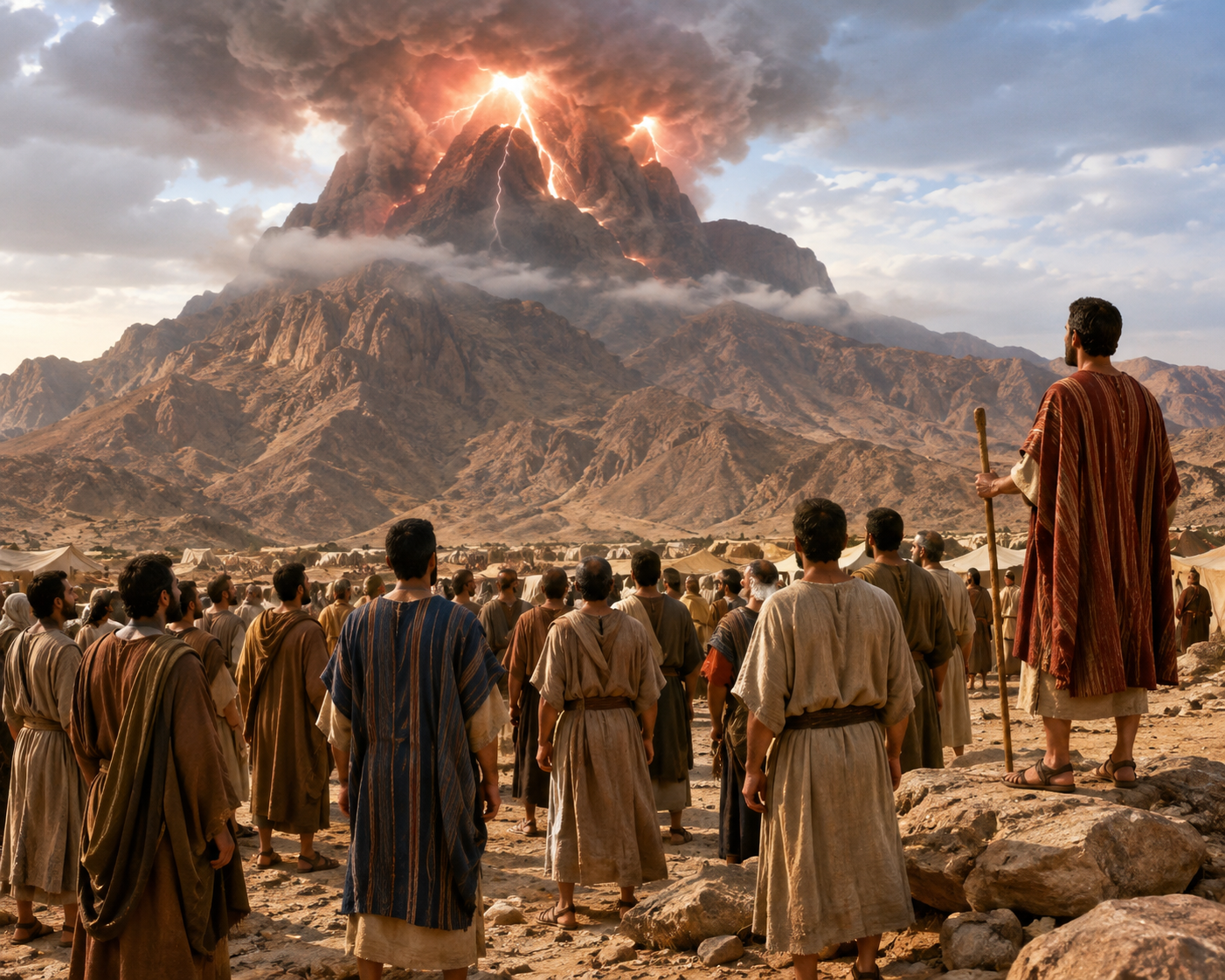
On the third day there are:
“thunders and lightnings, and a thick cloud upon the mount, and the voice of the trumpet exceeding loud”
— Exodus 19:16
The people tremble.
Moses brings them out:
“to meet with God”
— Exodus 19:17
Then:
“mount Sinai was altogether on a smoke, because the LORD descended upon it in fire”
— Exodus 19:18
The smoke ascends:
“as the smoke of a furnace”
and:
“the whole mount quaked greatly.”
The trumpet becomes increasingly loud.
“Moses spake, and God answered him by a voice.”
— Exodus 19:19
The scene is not symbolic fantasy. The KJV presents it as a historical manifestation of God’s presence before Israel.
A final warning concerning God’s holiness
Even after boundaries have been established, God again warns Moses:
“Go down, charge the people, lest they break through unto the LORD to gaze, and many of them perish.”
— Exodus 19:21
The priests are likewise warned:
“let the priests also, which come near to the LORD, sanctify themselves”
— Exodus 19:22
Neither curiosity, position, nor religious office gives a person permission to disregard God’s holiness.
Moses finally descends and speaks to the people.
The chapter ends with Israel standing before a holy God, prepared for the giving of His law in Exodus 20.
Key People and Places
- Moses — God’s appointed leader of Israel. In these chapters he strikes the rock according to God’s command, stands during the battle with Amalek, judges disputes, receives Jethro’s counsel, and repeatedly ascends and descends Sinai at God’s direction.
- Joshua — Commanded by Moses to select men and fight Amalek. Exodus 17:13 says, “Joshua discomfited Amalek and his people with the edge of the sword.”
- Aaron — Assists Moses during the battle by helping support his hands. He later participates with Jethro and Israel’s elders before God and is specifically permitted to accompany Moses in connection with Sinai in Exodus 19:24.
- Hur — Helps Aaron uphold Moses’ hands during the battle with Amalek. Exodus 17 gives his action but does not supply further biographical information about him.
- Jethro — Moses’ father-in-law and “the priest of Midian.” He hears of God’s mighty works, rejoices, blesses the LORD, sacrifices to God, and gives Moses counsel regarding judicial administration.
- Zipporah — Moses’ wife, brought to Moses by Jethro in Exodus 18.
- Gershom — Moses’ son whose name is connected with Moses saying, “I have been an alien in a strange land.”
- Eliezer — Moses’ son whose name is connected with Moses’ testimony that “The God of my father was mine help.”
- Amalek — The people who attack Israel at Rephidim. God declares continuing warfare against Amalek.
- Children of Israel — The nation God delivered from Egypt and brought to Sinai. They are the explicit recipients of the Sinai covenant statements in Exodus 19.
- Wilderness of Sin — The region from which Israel travels before arriving at Rephidim.
- Rephidim — The location where Israel lacks water and where Amalek attacks.
- Horeb — The location identified with the rock from which God supplies water in Exodus 17:6.
- Midian — Associated with Jethro, whom Scripture calls “the priest of Midian.”
- Wilderness of Sinai — The wilderness into which Israel comes in the third month after departing Egypt.
- Mount Sinai — The mountain upon which the LORD descends in fire and from which He speaks to Moses.
Main Doctrinal or Spiritual Themes
1. God alone is the true provider
Israel has no water at Rephidim, but God provides it from a rock.
The answer to Israel’s need does not come from human ingenuity but from God’s intervention.
For the believer, this teaches dependence upon God rather than unbelieving panic.
2. Christ is the spiritual Rock
The identification is explicitly inspired:
“and that Rock was Christ.”
— 1 Corinthians 10:4
Therefore the lesson is greater than physical provision alone. Spiritual life ultimately comes through Christ.
The rock of Exodus 17 should not be turned into unlimited allegory, but where the New Testament explicitly identifies Christ, we may confidently follow Scripture.
3. Murmuring can reveal unbelief
Israel’s great question was:
“Is the LORD among us, or not?”
Their immediate circumstances caused them to question what God’s previous works had already demonstrated.
Difficult circumstances do not cancel God’s faithfulness.
4. Victory belongs ultimately to God
Joshua truly fights. His soldiers truly use swords. Moses truly stands on the hill.
Yet the unusual relationship between Moses’ hands and the battle demonstrates that military ability alone does not explain Israel’s victory.
Human responsibility and divine dependence appear together.
5. God’s servants need the help of others
“Moses’ hands were heavy.”
The Bible does not disguise his physical limitation.
Aaron and Hur assist him.
Faithful service does not require pretending that one person can carry every burden alone.
6. Spiritual leadership requires character
Jethro does not merely recommend capable administrators. He requires:
“able men, such as fear God, men of truth, hating covetousness”
Biblical usefulness is inseparable from character.
Competence without truth and godliness is insufficient.
7. Delegation does not eliminate responsibility
Moses gives lesser judgments to qualified men, but he retains the weightier matters and his responsibility to teach God’s way.
Delegation is not abdication.
A pastor, parent, teacher, or leader may share work without surrendering the responsibility God has specifically placed upon him.
8. God’s grace precedes Israel’s covenant responsibility
Before saying:
“if ye will obey my voice indeed”
God says:
“I bare you on eagles’ wings, and brought you unto myself.”
Deliverance from Egypt had already occurred.
Israel’s obedience at Sinai was therefore not the means by which they originally escaped Pharaoh.
9. Israel and the Church must remain distinct
Exodus 19 explicitly identifies those addressed as:
“the house of Jacob”
and:
“the children of Israel.”
Those expressions should be allowed to mean what they say.
God’s later dealings with the Church do not erase His literal dealings with Israel or transfer every national promise without distinction.
10. God is holy
Perhaps the dominant truth of Exodus 19 is the awesome holiness of God.
Boundaries are established.
The people must sanctify themselves.
Unauthorized approach brings judgment.
Fire, smoke, thunder, lightning, trumpet, and the shaking mountain emphasize that the LORD is not to be treated casually.
“the whole mount quaked greatly.”
Man does not determine the terms upon which he approaches God.
God does.
11. Privilege brings responsibility
Israel is offered extraordinary covenant privilege:
“a peculiar treasure”
“a kingdom of priests”
“an holy nation”
But that privilege carries the responsibility to:
“obey my voice indeed, and keep my covenant.”
Biblical privilege never gives permission for carelessness toward God.
Practical Applications or Lessons
Remember God’s previous faithfulness when present circumstances are difficult. Israel’s thirst was real, but questioning whether the LORD was among them ignored what He had already done. A believer should bring genuine needs to God without allowing hardship to erase confidence in His character.
Do not confuse need with permission to murmur. Exodus 17 does not condemn Israel for needing water. Their fault appears in their contentious and unbelieving response. Legitimate need can still be handled in an ungodly manner.
Depend upon God while fulfilling your responsibility. Joshua had to fight, but the battle was not won by the sword alone. Biblical faith is not laziness, nor is faithful labor independence from God.
Support those carrying legitimate burdens. Aaron and Hur saw Moses’ weakness and helped him. There are times when faithful servants need assistance rather than criticism.
Do not attempt to do alone what can biblically be entrusted to qualified people. Moses was wearing himself away. Wise leadership recognizes both personal responsibility and legitimate delegation.
Choose leaders by character, not ability alone. “Fear God,” “men of truth,” and “hating covetousness” are moral qualifications. God’s work should never treat integrity as optional.
Keep human counsel under divine authority. Jethro wisely added, “and God command thee so.” Good advice never outranks the Word of God.
Take commitments to God seriously. Israel declared, “All that the LORD hath spoken we will do.” Words spoken before God are not light matters.
Approach God reverently. Exodus 19 destroys any idea that familiarity with religious things justifies casualness toward the LORD. God is loving and gracious, but He remains infinitely holy.
Accept God’s boundaries. Israel was forbidden to cross the limits around Sinai. There is a continuing moral principle: God’s commands are not arbitrary suggestions. Faith honors the boundaries God establishes.
Never turn obedience into a means of earning salvation. Israel’s covenant obligations at Sinai must not be confused with justification. Salvation is received through faith, not purchased by religious works.
Keep Christ central. Israel needed water, and God supplied it. The New Testament expressly says, “that Rock was Christ.” The deepest need of every sinner is not merely improved circumstances but the saving grace found in Jesus Christ.
Overall Emphasis
Exodus 17–19 takes Israel from need, through conflict and ordered leadership, to the foot of holy Mount Sinai.
In chapter 17, God demonstrates that He provides and He gives victory.
In chapter 18, Scripture demonstrates the value of godly order, qualified leadership, and shared responsibility.
In chapter 19, God makes unmistakably clear that the nation He delivered belongs to Him and must recognize His holiness, His covenant authority, and His right to command obedience.
The same LORD who graciously says,
“I bare you on eagles’ wings, and brought you unto myself”
also commands His people to prepare themselves before His holy presence.
Grace does not make holiness unnecessary. God’s goodness should produce reverence, gratitude, faith, and obedient living
Comments are closed