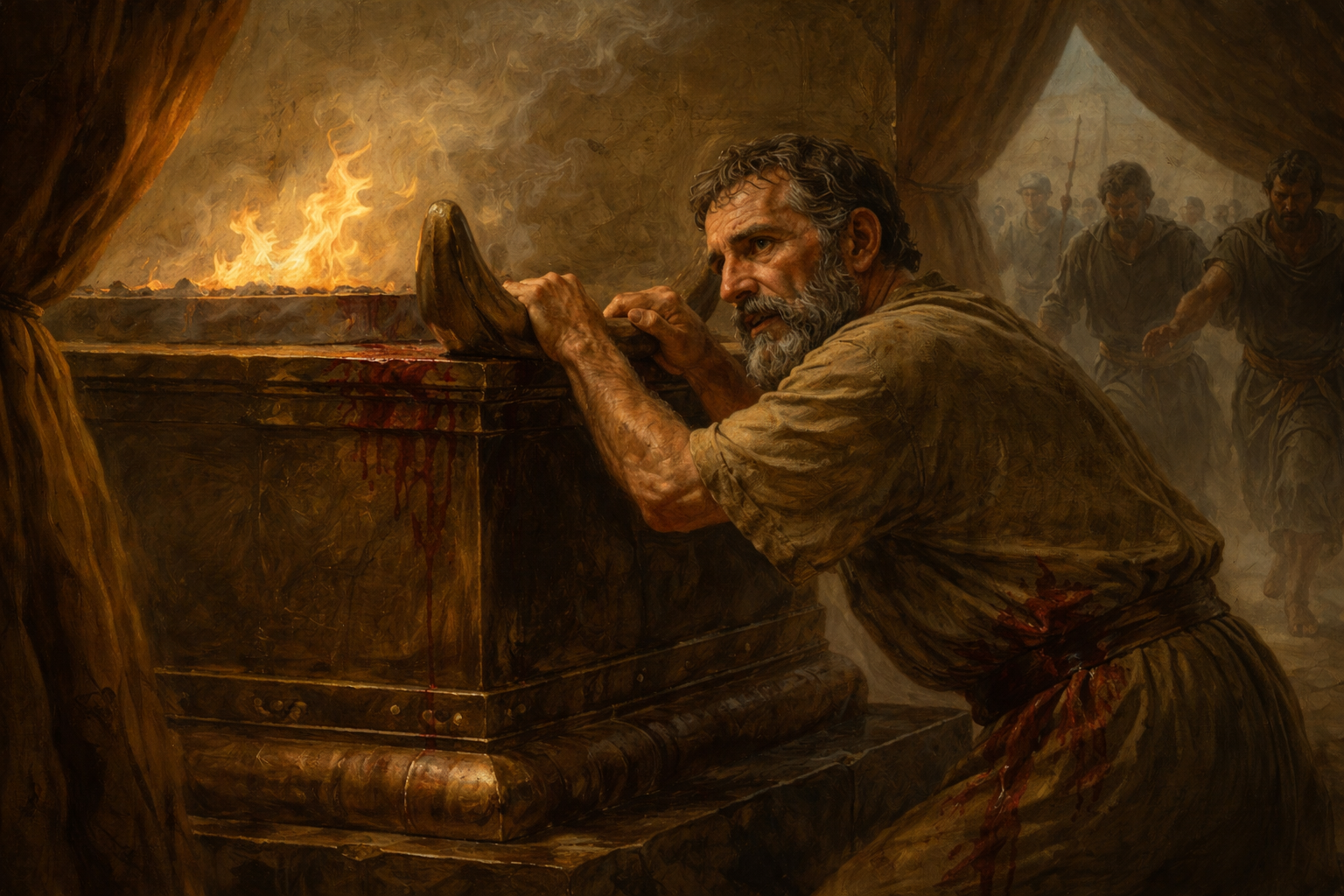
1. What Were the “Horns of the Altar”?
The altar of burnt offering had four horns on its corners (see Exodus 27:2). These horns symbolized:
-
God’s power
-
God’s mercy
-
A place of appeal to divine justice
To grasp the horns was to make a public appeal for mercy before God.
2. What Did Grabbing the Horns Mean Spiritually?
When someone grabbed the horns of the altar, they were essentially saying:
“I place myself under God’s mercy and judgment.”
It was:
-
A confession of danger
-
An acknowledgment of guilt
-
A plea for protection from immediate death
Think of it as the Old Testament equivalent of running into a sanctuary and throwing yourself before the Judge.
3. Why Was Adonijah Spared (1 Kings 1:50–53)?
Adonijah had sinned by trying to take the throne unlawfully, but he had not committed capital murder. When he fled to the altar:
-
Solomon showed conditional mercy
-
He was spared as long as he proved himself a worthy man
This shows:
-
Mercy is available for political sin
-
Repentance can delay judgment
-
But mercy does not cancel accountability
Later, when Adonijah plotted again, judgment followed.
4. Why Was Joab Executed at the Altar (1 Kings 2:28–34)?
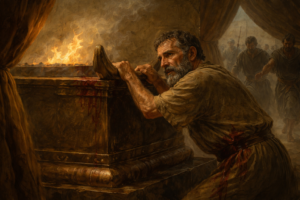 Joab also fled to the altar—but unlike Adonijah:
-
He was guilty of cold-blooded murder
-
He had killed Abner and Amasa unjustly
-
He had long resisted righteous authority
God’s law was clear:
“If a man come presumptuously upon his neighbour, to slay him with guile; thou shalt take him from mine altar, that he may die.” (Exodus 21:14 KJV)
So Joab was executed at the altar itself—because:
? The altar protects the repentant
? The altar does not shield unrepentant murderers
5. The Doctrinal Significance
This teaches several powerful truths:
-
God’s mercy has boundaries
-
Sacred places do not override divine justice
-
Religious acts cannot cover hardened, unrepented sin
-
True repentance matters more than religious symbolism
The altar is not a magical escape hatch. It is a place of:
-
Mercy for the humble
-
Judgment for the defiant
6. Gospel Connection (Without Allegory or Compromise)
In the New Testament age:
-
We do not flee to a physical altar
-
We flee to Christ Himself
-
But the same truth holds:
Mercy is for the repentant
Judgment is for the defiant
Joab wanted protection without repentance.
Adonijah received mercy with a warning.
Simple Summary
| Person | Action | Outcome | Why |
|---|---|---|---|
| Adonijah | Grabbed altar horns | Spared temporarily | Political rebellion, not murder |
| Joab | Grabbed altar horns | Executed | Guilty of cold-blooded murder |
Comments are closed