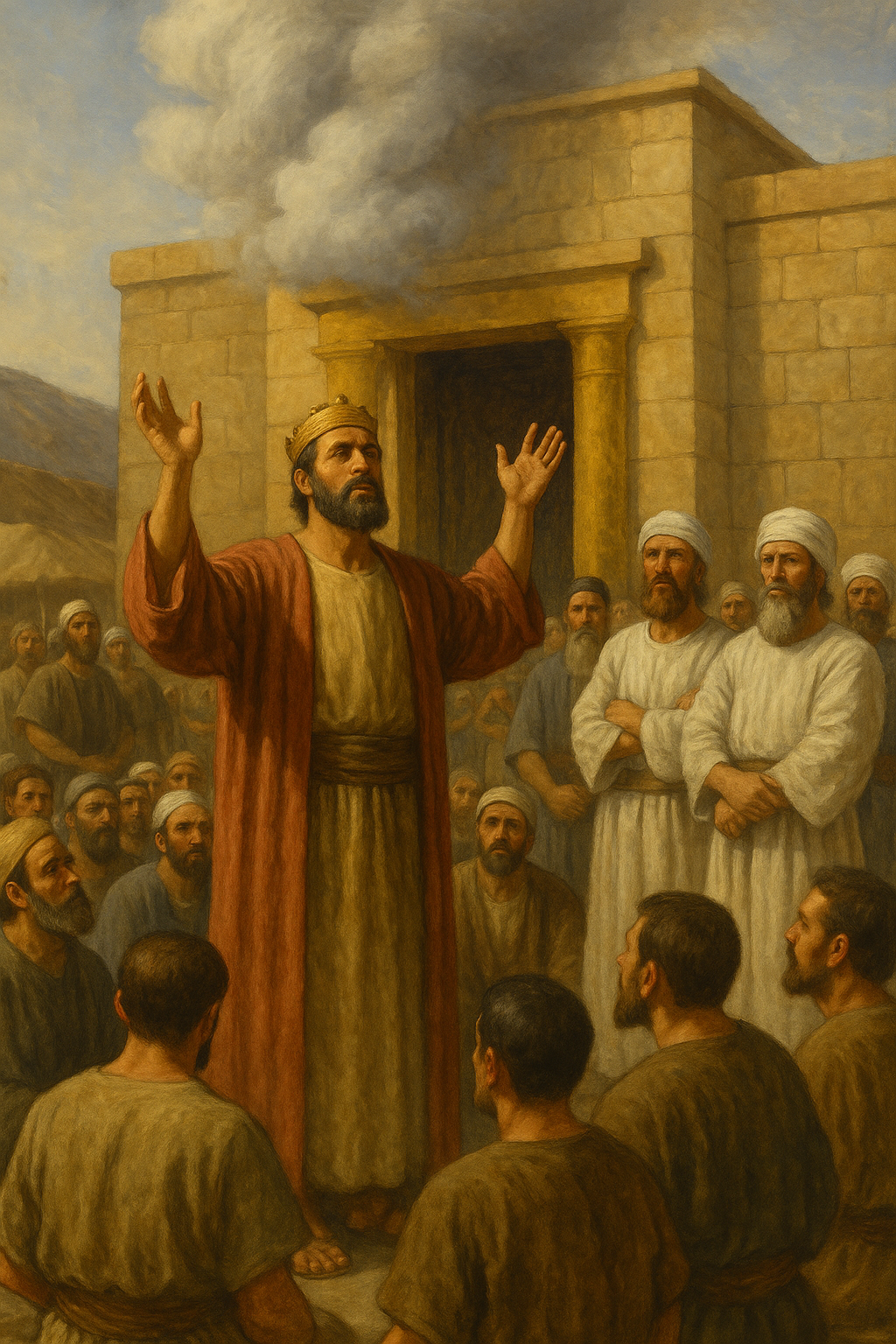
On the day Israel dedicates the temple, Solomon prays for people who may one day be far from it. He remembers the stranger who will hear of the LORD in a distant country and the Israelite who may call upon God from captivity. Both are included in a prayer offered before the altar in Jerusalem. The house bears the LORD’s name, and the One to whom Solomon prays hears in heaven (1 Kings 8:22, 27-30, 41-50).
Chapter Summaries
The ark is brought into the most holy place (1 Kings 8:1-11)
 Solomon calls Israel’s elders, tribal leaders, and heads of families to Jerusalem. The men of Israel assemble at the feast in Ethanim, the seventh month. The priests take up the ark from the city of David, which is Zion. The priests and Levites also bring up the tabernacle of the congregation and its holy vessels. Before the ark, Solomon and the assembled people offer more sheep and oxen than can be counted.
The priests place the ark in the oracle, the most holy place, beneath the wings of the cherubims. Scripture identifies precisely what the ark contains at this dedication: the two tables of stone that Moses placed there at Horeb. When the priests come out of the holy place, a cloud fills the house. The priests cannot stand to minister because the glory of the LORD has filled it. A similar event is recorded when the glory of the LORD filled the tabernacle and Moses could not enter it (1 Kings 8:6-11, Exodus 40:34-35).
Solomon remembers the LORD’s word to David (1 Kings 8:12-21)
Solomon speaks of the house he has built, then turns to bless the congregation. With all Israel standing, he recounts a conversation between the LORD and his father. David had wanted to build a house for the LORD’s name. God commended that desire and told David that his son would build the house. Solomon now sits on David’s throne, the house is built, and the ark has a place within it. Solomon gives the LORD the praise for bringing His word to pass (1 Kings 8:14-21).
Solomon asks the LORD to hear in heaven (1 Kings 8:22-30)
Solomon stands before the altar and spreads his hands toward heaven. The parallel account also records that he kneels on a brasen scaffold before the congregation (2 Chronicles 6:12-13). He begins by praising the God of Israel, who keeps covenant and mercy. He then asks God to fulfill His word concerning David’s throne, including the condition that David’s descendants take heed to their way and walk before Him (1 Kings 8:22-26).
Solomon asks, “But will God indeed dwell on the earth?” (1 Kings 8:27). Even heaven cannot contain Him. Yet the LORD has put His name on this house, and Solomon asks Him to attend to prayers offered toward it. His plea reaches beyond the desire to be heard. He asks God to forgive (1 Kings 8:27-30).
Seven petitions for those who will need the LORD (1 Kings 8:31-53)
The last petition recalls Israel’s deliverance from Egypt. Solomon appeals to the LORD on the ground that these are His people, whom He brought out and separated to be His inheritance (1 Kings 8:51-53).
A blessing for Israel and a charge to obey (1 Kings 8:54-61)
Solomon rises from his knees and blesses the congregation with a loud voice. He praises the LORD for giving Israel the rest He promised through Moses. Then he asks for something the people will need when they leave the assembly: that God would incline their hearts to walk in His ways. Solomon also addresses the people directly, charging them to keep the LORD’s commandments. His desire extends to the whole earth, that all people may know that the LORD alone is God (1 Kings 8:54-61).
The people dedicate the house and depart with joy (1 Kings 8:62-66)
Solomon offers 22,000 oxen and 120,000 sheep as peace offerings. He hallows the middle of the court because the brasen altar is too small to receive all the offerings. The assembly extends from the entering in of Hamath to the river of Egypt. First Kings records fourteen days, and 2 Chronicles 7:9 distinguishes seven days for the dedication of the altar and seven days for the feast. When Solomon dismisses the people, they bless the king and return to their tents rejoicing in the goodness the LORD has shown to David and Israel (1 Kings 8:62-66).
Key People and Places
Main Doctrinal or Spiritual Themes
God keeps His word. Solomon points to a promise with a fulfillment the congregation can see. God had said that David’s son would build the house, and the people are standing before it. When Solomon gives thanks for Israel’s rest, he again identifies what God promised and through whom He spoke. His confidence in prayer rests on the character of the God who gave His word (1 Kings 8:17-26, 56).
God knows what human judgment cannot reach. One petition concerns an oath sworn publicly before the altar. Another concerns a burden known within a person’s own heart. Solomon brings both before the LORD. God can judge the dispute righteously, and He knows the heart of the individual praying in the midst of a national calamity (1 Kings 8:31-32, 37-40).
Repentance includes an honest acknowledgment of sin. In the captivity petition, the people acknowledge their wickedness, turn to the LORD with all their heart and soul, and ask for mercy. Solomon can pray for them even in an enemy’s land because their distance from Jerusalem places them within reach of the God who hears in heaven (1 Kings 8:46-50).
Israel’s separation to God stands alongside His concern for the nations. Solomon calls Israel the LORD’s inheritance. He also asks God to hear a foreigner who comes for His name’s sake. The reason Solomon gives is that people throughout the earth might know and fear the LORD. Both truths belong to the same prayer (1 Kings 8:41-43, 51-53, 60).
Practical Applications or Lessons
- Ask what God would teach you while you are asking for relief. In the petition for rain, Solomon asks God to teach His people the good way to walk. When a difficulty leads you to prayer, give attention to what Scripture already directs you to do (1 Kings 8:35-36, James 1:22).
- Be specific when confessing sin. Solomon describes captives who acknowledge their own wrongdoing. Bring your own sin honestly before the Lord. First John 1:9 directs believers to confess their sins and speaks plainly of God’s faithfulness to forgive and cleanse (1 Kings 8:46-50).
- Come to God with confidence through Jesus Christ. Solomon prayed before Israel’s altar. Hebrews tells believers why they may draw near to God today: Jesus Christ offered Himself once for all, and His blood gives them access. Salvation is God’s gift, received by grace through faith (Hebrews 10:10-14, 19-22, Ephesians 2:8-9).
- Remember the person hearing about the Lord for the first time. Solomon made room in his public prayer for someone from another country who had heard of God’s name. Pray for those hearing the Gospel in their own language, and be ready to explain that Christ died for our sins, was buried, and rose again (1 Kings 8:41-43, 1 Corinthians 15:1-4).
- Carry Sunday’s worship into the week’s decisions. Solomon’s charge concerns how the people will walk after the gathering ends. When you thank the Lord publicly for His goodness, consider where obedience is called for at home, at work, or in your dealings with a neighbor (1 Kings 8:57-61, 66).
Supporting study. Matthew Henry connects Solomon’s thanksgiving for a promise fulfilled with his confidence in asking God to keep His word. John MacArthur discusses the temple’s purpose as a place of prayer in his treatment of 1 Kings 8:27-30. Adrian Rogers draws attention to the LORD’s commendation of David’s desire in 1 Kings 8:17-18. Jack Hyles preached from 1 Kings 8:54-61 on the dependability of God’s Word.
Tags
1 Kings 8, King James Bible, Solomon, David, Moses, Israel, Jerusalem, Zion, Mount Moriah, Horeb, Egypt, Hamath, Ark of the Covenant, Solomon’s Temple, Temple Dedication, Prayer of Dedication, Repentance, Forgiveness, God’s Faithfulness
Comments are closed