Solomon Builds the Temple: God’s Holiness and Obedience in 1 Kings 6-7
 First Kings 6-7 records the construction of the house of the LORD, Solomon’s royal buildings, and the furnishings prepared for temple service. These chapters describe costly materials, careful workmanship, and the completion of an extensive undertaking. Within those construction details, God speaks directly to Solomon about obedience.
The central spiritual lesson rests in that divine instruction: building a magnificent house for the LORD did not replace walking in His commandments. God’s people needed His presence, and Solomon remained accountable to His Word.
Chapter Summaries
1 Kings 6: The Construction of the House of the LORD
The foundation and structure – 1 Kings 6:1-10
Construction began in the fourth year of Solomon’s reign, during Zif, the second month. Scripture places this beginning in “the four hundred and eightieth year” after Israel came out of Egypt (1 Kings 6:1). The text connects this building project with the history of the people God had delivered.
The house measured sixty cubits long, twenty cubits wide, and thirty cubits high. A porch extended across its front, and chambers were built around the walls. These surrounding chambers had three levels, with winding stairs providing access between levels (1 Kings 6:2-8).
The stones were prepared before being brought to the building:
“There was neither hammer nor axe nor any tool of iron heard in the house, while it was in building.” – 1 Kings 6:7
This verse specifically describes the absence of those tool sounds at the house during construction. It does not say that every part of the building site was completely silent. The practical lesson is that preparation matters: work performed beforehand contributed to the orderly construction of the house.
God’s word concerning obedience – 1 Kings 6:11-14
During the building, the word of the LORD came to Solomon:
“If thou wilt walk in my statutes, and execute my judgments, and keep all my commandments to walk in them; then will I perform my word with thee, which I spake unto David thy father.” – 1 Kings 6:12
God continued:
“And I will dwell among the children of Israel, and will not forsake my people Israel.” – 1 Kings 6:13
The command concerns Solomon’s conduct, not simply his construction work. The king must walk in God’s statutes, execute His judgments, and keep His commandments.
These verses address God’s dealings with Solomon and Israel. They should not be turned into a teaching that sinners earn salvation by obedience. The New Testament expressly teaches salvation by grace through faith, apart from works, while also teaching that believers are created in Christ Jesus unto good works (Ephesians 2:8-10).
The interior and the most holy place – 1 Kings 6:15-22
The interior walls were covered with cedar, and the floor with fir. The cedar was carved with knops and open flowers, and no stone was visible within the cedar-covered interior (1 Kings 6:15-18).
The inner sanctuary is called “the oracle” and “the most holy place” (1 Kings 6:16). Solomon prepared it “to set there the ark of the covenant of the LORD” (1 Kings 6:19). This describes the room’s intended purpose; the actual bringing in of the ark is recorded in 1 Kings 8:6.
The oracle measured twenty cubits in length, breadth, and height. Solomon overlaid it with pure gold. Gold also covered the interior of the house and the altar by the oracle (1 Kings 6:20-22).
The distinction between the temple room and the most holy place establishes that the building contained separate sacred spaces. The account should be understood according to those stated arrangements without assigning an unstated spiritual meaning to every measurement or material.
The cherubims, carvings, doors, and court – 1 Kings 6:23-36
Within the oracle, Solomon made two cherubims of olive wood, each ten cubits high, and overlaid them with gold. Their outstretched wings reached the opposing walls and touched one another in the middle of the room (1 Kings 6:23-28).
The walls and doors bore carvings of cherubims, palm trees, and open flowers. The floors were overlaid with gold. Olive wood was used for the doors of the oracle, while the temple entrance had olive wood posts and folding doors of fir (1 Kings 6:29-35).
These details describe the temple’s workmanship. The chapter does not authorize worship of the carved figures. God’s prohibition against bowing down to images remains explicit in Exodus 20:4-5.
The inner court was constructed with three rows of hewed stone and a row of cedar beams (1 Kings 6:36).
The completion of the house – 1 Kings 6:37-38
The foundation was laid in Solomon’s fourth year, in Zif. The house was finished in his eleventh year, in Bul, the eighth month. Scripture summarizes the undertaking: “So was he seven years in building it” (1 Kings 6:38).
The chapter closes with the house completed throughout its parts and according to its specified form.
1 Kings 7: Solomon’s Buildings and the Temple Furnishings
The royal buildings – 1 Kings 7:1-12
Solomon spent thirteen years building his own house. The account also describes the house of the forest of Lebanon, a porch of pillars, a porch of judgment containing the throne, his dwelling, and a house for Pharaoh’s daughter, whom he had married.
The house of the forest of Lebanon measured one hundred cubits long, fifty cubits wide, and thirty cubits high. Cedar pillars and beams were prominent features. The porch of judgment provided a place where Solomon could judge (1 Kings 7:2-7).
The buildings used costly hewed stones and cedar, including great foundation stones measuring eight and ten cubits (1 Kings 7:9-12).
The temple took seven years, while Solomon’s own house took thirteen. Those numbers alone do not establish his motives or prove which project he valued more. Scripture does not explicitly explain the difference in construction time.
Likewise, the name “house of the forest of Lebanon” should not be treated as proof that the building stood in Lebanon. First Kings 10:17 places Solomon’s gold shields in that house, and 2 Chronicles 9:16 connects the corresponding building with Jerusalem.
Hiram the craftsman – 1 Kings 7:13-14
Solomon brought Hiram from Tyre to perform the brass work. He is described as a widow’s son of the tribe of Naphtali, whose father was a man of Tyre and a worker in brass.
Hiram possessed “wisdom, and understanding, and cunning to work all works in brass” (1 Kings 7:14). Here, “cunning” describes skill in craftsmanship.
This craftsman should be distinguished from Hiram king of Tyre, whose dealings with Solomon appear in 1 Kings 5:1-12. The text presents the worker through his parentage and trade rather than identifying him as the king.
The pillars Jachin and Boaz – 1 Kings 7:15-22
Hiram cast two brass pillars, each eighteen cubits high. Their tops, called chapiters, were decorated with networks, chain work, pomegranates, and lily work.
The pillars were erected in the temple porch. The right pillar was named Jachin, and the left pillar Boaz (1 Kings 7:21).
The passage records their construction, placement, and names. It does not explain a separate doctrinal meaning for each decorative feature.
The molten sea – 1 Kings 7:23-26
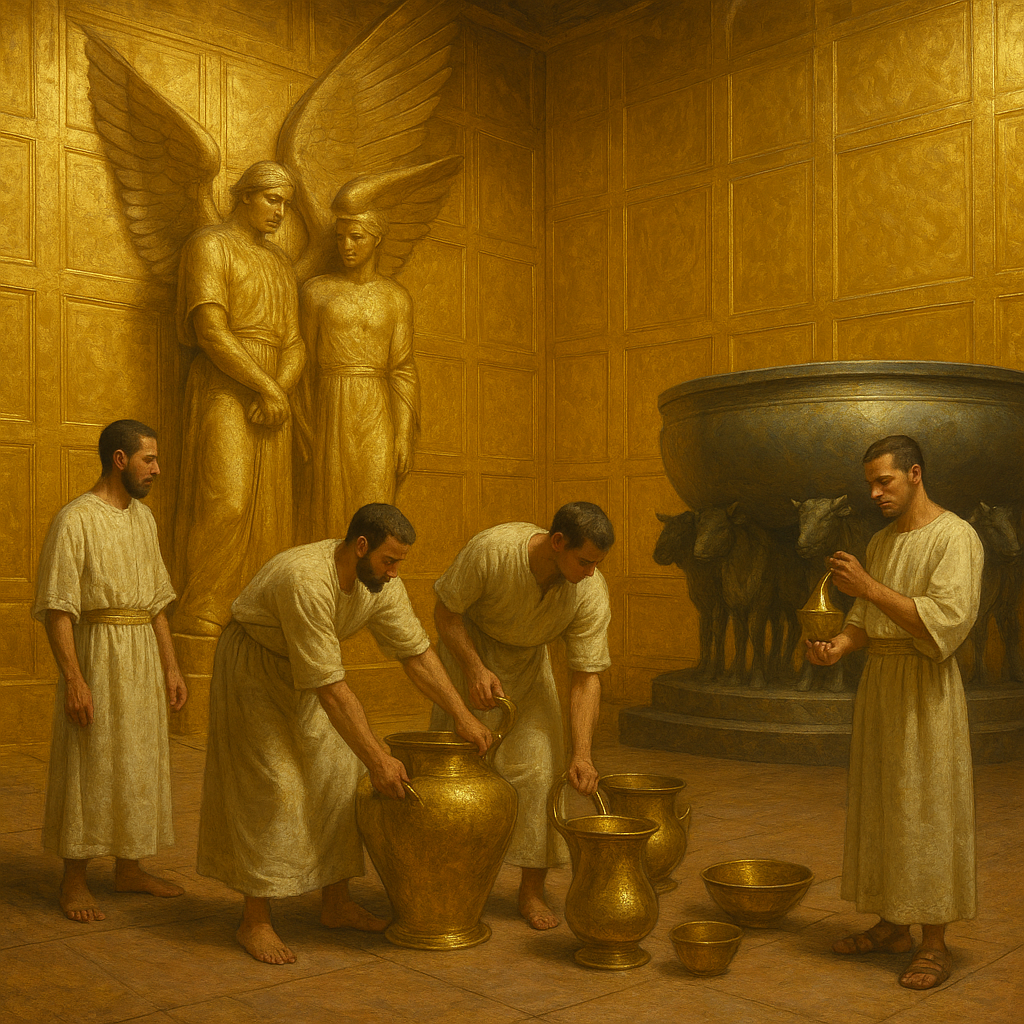
Hiram made a large round vessel called “a molten sea.” It measured ten cubits across and five cubits high, with a circumference stated as thirty cubits.
The sea rested upon twelve oxen, arranged in groups of three facing north, west, south, and east. Its brim resembled a cup’s brim with flowers of lilies, and 1 Kings 7:26 states that it contained two thousand baths.
Second Chronicles 4:6 explicitly identifies its use: “the sea was for the priests to wash in.” Its purpose therefore belongs to the cleansing arrangements of temple service.
The bases and lavers – 1 Kings 7:27-39
Ten brass bases supported ten brass lavers. The bases had wheels and were decorated with lions, oxen, cherubims, and palm trees. Each laver contained forty baths.
Five bases stood on the right side of the house and five on the left. The sea was placed on the right side, eastward toward the south (1 Kings 7:39).
Second Chronicles 4:6 explains that the lavers were used to wash things offered for the burnt offering. Scripture distinguishes their purpose from the priests’ washing in the sea.
The completed vessels and dedicated treasures – 1 Kings 7:40-51
The chapter summarizes Hiram’s brass work, including the pillars, sea, bases, lavers, and utensils. The castings were made in the plain of Jordan, in clay ground between Succoth and Zarthan. The brass vessels were so numerous that their total weight was not determined (1 Kings 7:40-47).
The golden furnishings included the altar, the table for the shewbread, ten candlesticks, and various utensils. Even the hinges associated with the sanctuary doors were gold (1 Kings 7:48-50).
Finally, Solomon brought in the silver, gold, and vessels David had dedicated and placed them among the treasures of the house of the LORD. The chapter ends with the work completed (1 Kings 7:51).
Key People and Places
- Solomon: King of Israel who built the temple, constructed the royal buildings, and arranged for the furnishings described in these chapters.
- The LORD: Gave Solomon direct instruction concerning obedience and promised to dwell among the children of Israel (1 Kings 6:11-13).
- David: Solomon’s father, to whom God had spoken, and whose dedicated treasures Solomon brought into the house (1 Kings 6:12; 7:51).
- Hiram the craftsman: Skilled worker brought from Tyre to perform the brass work (1 Kings 7:13-14).
- Pharaoh’s daughter: Solomon’s wife, for whom he built a house (1 Kings 7:8).
- Israel: The people among whom God promised to dwell (1 Kings 6:13).
- Egypt: The land from which Israel had departed; that departure provides the chronological reference in 1 Kings 6:1.
- Jerusalem: The temple’s location, explicitly identified in the parallel account in 2 Chronicles 3:1.
- Tyre: The place from which Solomon brought Hiram the craftsman (1 Kings 7:13).
- The oracle: The temple’s most holy place, prepared to receive the ark of the covenant (1 Kings 6:16-20).
- The plain of Jordan, Succoth, and Zarthan: Geographic references identifying the area where the brass furnishings were cast (1 Kings 7:46).
Main Doctrinal or Spiritual Themes
Obedience Must Accompany Religious Service
God’s message interrupts the construction account to address Solomon’s walk. The building project did not remove his responsibility to obey God’s commandments (1 Kings 6:11-13).
The same moral principle applies to believers: visible service must be accompanied by submission to Scripture. Jesus connects love for Him with keeping His commandments (John 14:15).
God’s Presence Is Greater Than a Building’s Splendor
God promised, “I will dwell among the children of Israel” (1 Kings 6:13). The value of His presence exceeds the value of the gold, cedar, and stone.
The temple did not contain or limit God. Solomon explicitly acknowledged this at its dedication: “Behold, the heaven and heaven of heavens cannot contain thee; how much less this house that I have builded?” (1 Kings 8:27).
Holiness and Cleansing Matter in Approaching God
The most holy place and the provisions for washing belong to the temple’s sacred arrangements (1 Kings 6:16; 2 Chronicles 4:6).
For Christians, cleansing from sin rests upon Christ’s blood. Hebrews 9:11-14 explains the superiority of His redemptive work over the former ceremonial arrangements. The temple’s washing vessels should not be treated as teaching salvation through baptism or outward washing.
Skilled Work Has a Place in Serving the LORD
Hiram’s wisdom, understanding, and craftsmanship receive specific attention (1 Kings 7:14). His contribution consisted of demanding practical work.
A sound application is that believers should perform their responsibilities carefully and wholeheartedly: “Whatsoever ye do, do it heartily, as to the Lord” (Colossians 3:23).
Scripture Governs Our Understanding of Sacred Things
These chapters provide extensive details without explaining a spiritual symbol behind every feature. Responsible interpretation receives what God states and avoids presenting imaginative symbolism as doctrine.
The New Testament identifies Christ’s body as the temple in John 2:19-21. That explicit connection gives believers firm ground for understanding His supremacy without inventing meanings for every temple ornament.
Practical Applications or Lessons
- Examine your obedience alongside your activity. Teaching, giving, building, and organizing are valuable responsibilities. God’s instruction to Solomon reminds us to consider whether our daily conduct agrees with His Word (1 Kings 6:12).
- Prepare carefully for the work entrusted to you. The stones were made ready before they reached the house (1 Kings 6:7). As a practical application, preparation deserves attention in preaching, teaching, maintenance, and administration.
- Use practical abilities faithfully. Hiram’s skilled labor contributed to the completed furnishings. Believers can apply Colossians 3:23 to technical, mechanical, artistic, and administrative responsibilities as well as public ministry.
- Pursue inward cleansing. The washing arrangements had defined purposes in temple service. For believers today, confession and cleansing are addressed directly in 1 John 1:9. Outward religious order should accompany an honest walk before God.
- Respect what others have dedicated to the LORD. Solomon brought David’s dedicated treasures into the house (1 Kings 7:51). A fitting application is to handle entrusted ministry resources honestly and for their intended purposes.
- Avoid judging motives from incomplete evidence. The differing construction times do not reveal everything about Solomon’s priorities. First Corinthians 4:5 warns against premature judgment and identifies the Lord as the One who reveals the counsels of hearts.
- Follow worthwhile work through to completion. Both chapters record completed work (1 Kings 6:38; 7:51). Their example provides a practical encouragement to persevere in responsibilities God has given us.
- Keep your confidence in the Lord. Buildings and equipment can support ministry, but they cannot provide salvation or spiritual life. Salvation is through Jesus Christ, and fruitful Christian service depends upon abiding in Him (Acts 4:12; John 15:5).
Comments are closed