 The book of Psalms contains fifteen psalms grouped together under a distinctive heading: “A Song of degrees.” These are Psalms 120 through 134, commonly known as the Psalms of Ascent, Songs of Degrees, or Pilgrim Psalms.
Psalm 120 begins the collection:
“In my distress I cried unto the LORD, and he heard me.”
— Psalm 120:1
Psalm 134 concludes it with worship in the house of God:
“Behold, bless ye the LORD, all ye servants of the LORD, which by night stand in the house of the LORD.”
— Psalm 134:1
Taken together, these fifteen psalms present a remarkable spiritual journey. They begin with a pilgrim distressed in a hostile world and end with the pilgrim standing in the sanctuary, blessing the Lord.
What Does “A Song of Degrees” Mean?
Each of Psalms 120–134 bears the heading “A Song of degrees,” with the exception that several identify David or Solomon as the author.
The precise historical origin of the title is not stated directly in Scripture. The Hebrew idea behind “degrees” carries the thought of steps, ascents, or going upward.
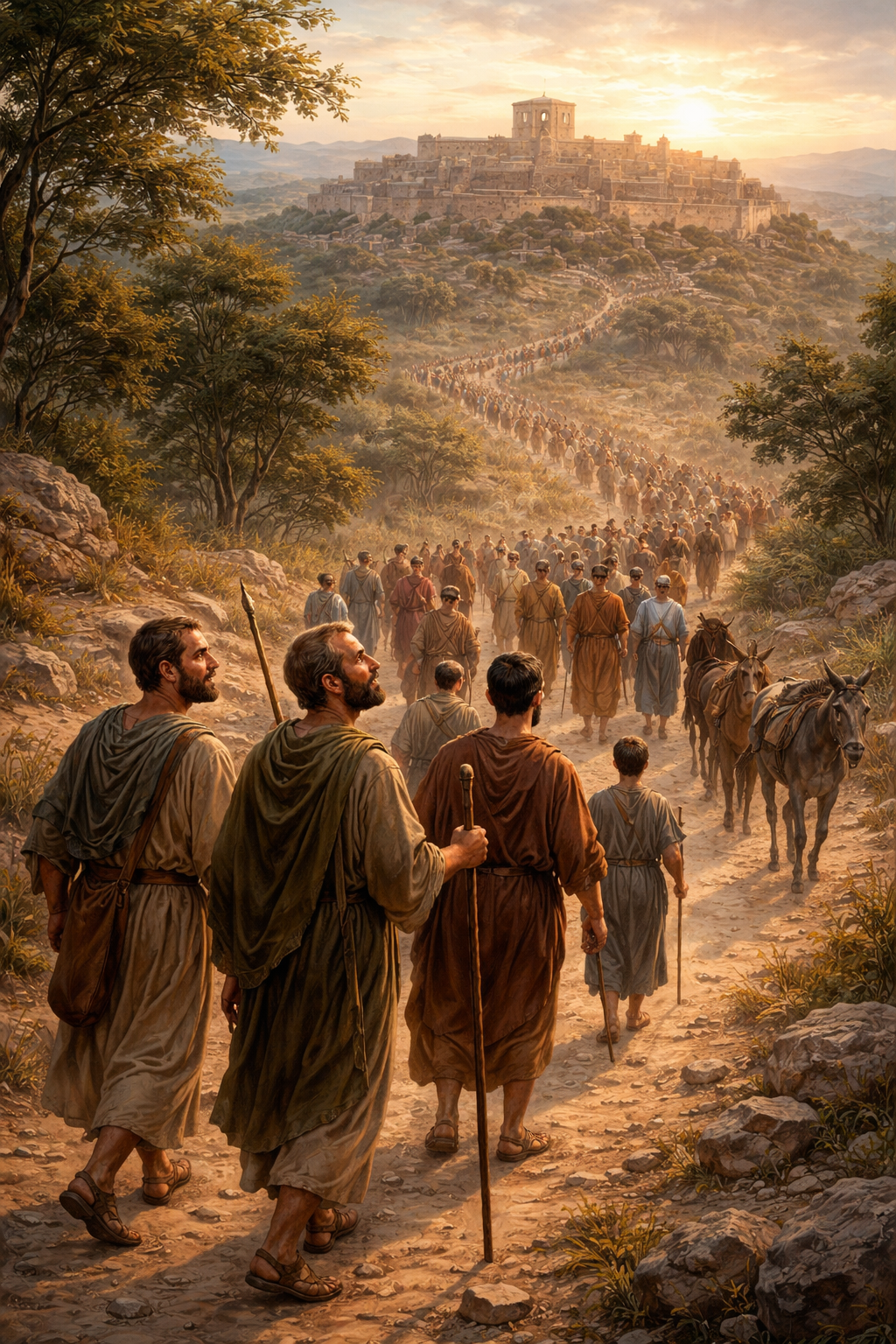
A widely held explanation is that these psalms were associated with Israelite pilgrims traveling up to Jerusalem for the appointed feasts. Jerusalem sits in the hill country, and Scripture regularly speaks of people “going up” to Jerusalem.
The law required Israelite males to appear before the Lord three times each year:
“Three times in a year shall all thy males appear before the LORD thy God in the place which he shall choose; in the feast of unleavened bread, and in the feast of weeks, and in the feast of tabernacles.”
— Deuteronomy 16:16
As families and groups traveled toward Jerusalem, these psalms would have been especially fitting expressions of prayer, faith, anticipation, fellowship, and worship.
Whether every detail of their ancient use can be established or not, their spiritual message is unmistakable: God’s people are travelers, and the journey should continually lead us upward toward Him.
Psalm 120 — Crying to God in Distress
The journey begins far from the sanctuary.
“In my distress I cried unto the LORD, and he heard me.”
— Psalm 120:1
The psalmist finds himself surrounded by lying lips, deceit, strife, and people who have no desire for peace.
“I am for peace: but when I speak, they are for war.”
— Psalm 120:7
This is an appropriate starting point for the pilgrim journey. The believer lives in a world that is hostile toward God. There comes a realization that this world cannot satisfy the soul.
The first movement upward begins when a person cries unto the Lord.
Psalm 121 — Looking to the Lord for Help
Now the pilgrim lifts his eyes.
“I will lift up mine eyes unto the hills, from whence cometh my help.”
— Psalm 121:1
The next verse makes clear where that help originates:
“My help cometh from the LORD, which made heaven and earth.”
— Psalm 121:2
The believer’s confidence is not ultimately in mountains, armies, governments, possessions, or human ability. Our help comes from the Creator Himself.
Six times in this short psalm the Lord is described as the One who keeps or preserves His people.
“The LORD shall preserve thy going out and thy coming in from this time forth, and even for evermore.”
— Psalm 121:8
The God who saved us is able to keep us throughout the journey.
Psalm 122 — Rejoicing in the House of God
David writes:
“I was glad when they said unto me, Let us go into the house of the LORD.”
— Psalm 122:1
The pilgrim has moved from distress, to dependence upon God, to joyful anticipation of worship.
Jerusalem held a special place in Israel because God had chosen it in connection with His earthly worship and the house of the Lord.
The believer today should likewise rejoice in the privilege of gathering with God’s people. Hebrews 10:25 warns Christians against:
“Not forsaking the assembling of ourselves together, as the manner of some is…”
Worship should never be merely an obligation. There should be gladness in meeting with God’s people around the Word of God.
Psalm 123 — Looking to the Master
The pilgrim again lifts his eyes:
“Unto thee lift I up mine eyes, O thou that dwellest in the heavens.”
— Psalm 123:1
The picture is that of servants watching the hand of their master.
“So our eyes wait upon the LORD our God, until that he have mercy upon us.”
— Psalm 123:2
The Christian life requires continual dependence upon God. We look to Him for direction, provision, mercy, strength, and correction.
Spiritual progress is impossible when our eyes are continually fixed upon ourselves.
Psalm 124 — Remembering the Lord’s Deliverance
Psalm 124 looks backward.
“If it had not been the LORD who was on our side…”
— Psalm 124:1
Israel could remember enemies, dangers, and overwhelming circumstances from which God had delivered them.
The believer can do the same.
How many times could we say:
“If it had not been the LORD…”
God protected us when we did not see the danger. He provided when we did not know how the need would be met. He answered prayers we had nearly forgotten.
The psalm concludes:
“Our help is in the name of the LORD, who made heaven and earth.”
— Psalm 124:8
Psalm 125 — Security in the Lord
“They that trust in the LORD shall be as mount Zion, which cannot be removed, but abideth for ever.”
— Psalm 125:1
The mountains surrounding Jerusalem provided the psalmist with a powerful illustration:
“As the mountains are round about Jerusalem, so the LORD is round about his people from henceforth even for ever.”
— Psalm 125:2
God’s people are secure because their security rests in Him.
Circumstances change. Nations rise and fall. Human strength disappears. But the Lord remains.
Psalm 126 — Joy After Sorrow
This psalm celebrates restoration.
“The LORD hath done great things for us; whereof we are glad.”
— Psalm 126:3
Yet one of its best-known passages concerns sowing and reaping:
“They that sow in tears shall reap in joy.”
— Psalm 126:5
Then comes the precious promise:
“He that goeth forth and weepeth, bearing precious seed, shall doubtless come again with rejoicing, bringing his sheaves with him.”
— Psalm 126:6
The principle applies powerfully to Christian service and soul winning. God’s servant faithfully carries the precious seed of His Word. There may be tears, sacrifice, disappointment, and long seasons without visible results.
But God’s Word is never wasted.
Our responsibility is to keep sowing.
Psalm 127 — Depending Upon God
Solomon writes:
“Except the LORD build the house, they labour in vain that build it…”
— Psalm 127:1
Human effort without God’s blessing ultimately accomplishes nothing of eternal value.
We can make plans. We can organize ministries. We can build buildings. We can develop programs. But spiritual fruit comes from God.
The same psalm reminds us:
“Lo, children are an heritage of the LORD…”
— Psalm 127:3
Home, family, work, and ministry must all be surrendered to the Lord.
Psalm 128 — The Blessing of Fearing the Lord
“Blessed is every one that feareth the LORD; that walketh in his ways.”
— Psalm 128:1
The fear of the Lord is not a terrified attempt to hide from God. It is reverence for Him that produces obedience.
Notice the connection:
Fearing the Lord leads to walking in His ways.
Biblical faith always affects conduct.
The psalm then describes blessing upon labor, marriage, family, and future generations.
Godliness begins in the heart but reaches into the home.
Psalm 129 — Afflicted, Yet Not Defeated
Israel had suffered greatly:
“Many a time have they afflicted me from my youth: yet they have not prevailed against me.”
— Psalm 129:2
God’s people have never been strangers to opposition.
Yet persecution does not mean God has abandoned His people.
The enemies of God’s truth may appear powerful for a season, but their victory is never final.
God remains faithful.
Psalm 130 — Waiting for Redemption
Psalm 130 begins from the depths:
“Out of the depths have I cried unto thee, O LORD.”
— Psalm 130:1
Then comes a profound statement concerning sin:
“If thou, LORD, shouldest mark iniquities, O Lord, who shall stand?”
— Psalm 130:3
The answer is obvious: no sinner could stand before a perfectly holy God on the basis of his own righteousness.
But the next verse provides hope:
“But there is forgiveness with thee, that thou mayest be feared.”
— Psalm 130:4
Our hope is in God’s mercy.
The psalmist waits upon the Lord and His Word:
“I wait for the LORD, my soul doth wait, and in his word do I hope.”
— Psalm 130:5
Faith rests upon what God has said.
Psalm 131 — The Quieted Soul
David presents the picture of a humble and contented heart:
“Surely I have behaved and quieted myself, as a child that is weaned of his mother…”
— Psalm 131:2
The mature believer learns that he does not need an explanation for everything God permits.
There are mysteries we cannot solve and circumstances we cannot understand.
Faith says, God knows, God is good, and I can trust Him.
David concludes:
“Let Israel hope in the LORD from henceforth and for ever.”
— Psalm 131:3
Psalm 132 — Remembering God’s Covenant
Psalm 132 recalls David’s desire to prepare a dwelling place associated with the worship of God and emphasizes God’s covenant promises.
The psalm points repeatedly toward God’s chosen king and His purposes for Zion.
“The LORD hath sworn in truth unto David; he will not turn from it…”
— Psalm 132:11
Ultimately the promises concerning David’s throne find their fulfillment in the Lord Jesus Christ, the promised Son of David and Israel’s Messiah.
God always keeps His Word.
Psalm 133 — The Blessing of Unity
Few passages describe godly unity more beautifully:
“Behold, how good and how pleasant it is for brethren to dwell together in unity!”
— Psalm 133:1
Biblical unity is precious.
It does not mean compromising truth for the sake of outward agreement. True spiritual unity exists when God’s people walk together in obedience to Him.
The pilgrims who had traveled from different places now stood together as worshippers of the same Lord.
So it should be among believers.
Personal pride, jealousy, bitterness, and unnecessary division damage the testimony of God’s people.
Where truth and righteousness are honored, brethren should rejoice to labor together.
Psalm 134 — Blessing the Lord
The journey ends in worship.
“Behold, bless ye the LORD, all ye servants of the LORD, which by night stand in the house of the LORD.”
— Psalm 134:1
Then comes the invitation:
“Lift up your hands in the sanctuary, and bless the LORD.”
— Psalm 134:2
The pilgrims began in Psalm 120 surrounded by trouble.
They end in Psalm 134 standing in the sanctuary praising God.
That progression is significant.
The Christian life should continually draw our hearts away from the distractions of this world and toward the worship of the Lord.
The Spiritual Progression of the Psalms of Ascent
Viewed together, these fifteen psalms form a beautiful progression:
Psalm 120 — Distress: I cry unto the Lord.
Psalm 121 — Dependence: My help comes from the Lord.
Psalm 122 — Worship: I am glad to go to the house of the Lord.
Psalm 123 — Submission: My eyes wait upon the Lord.
Psalm 124 — Deliverance: The Lord has been on our side.
Psalm 125 — Security: Those who trust the Lord cannot ultimately be moved.
Psalm 126 — Restoration: Those who sow in tears shall reap in joy.
Psalm 127 — Dependence: Without the Lord, our labor is vain.
Psalm 128 — Obedience: Blessed is everyone who fears the Lord.
Psalm 129 — Endurance: Affliction has not destroyed God’s people.
Psalm 130 — Forgiveness: There is forgiveness with the Lord.
Psalm 131 — Humility: The soul rests quietly in God.
Psalm 132 — Promise: God remembers His covenant.
Psalm 133 — Fellowship: Brethren dwell together in unity.
Psalm 134 — Worship: Bless the Lord.
The direction throughout the collection is upward.
Christians Are Pilgrims Too
The Psalms of Ascent belonged particularly to Israel and should first be understood in their biblical setting. Nevertheless, the pilgrim theme has an obvious application to believers today.
Peter writes:
“Dearly beloved, I beseech you as strangers and pilgrims…”
— 1 Peter 2:11
This world is not the Christian’s final home.
We are traveling.
There will be difficult valleys, steep climbs, dangerous paths, weariness, opposition, and tears. Yet the believer does not travel alone.
The same Lord who watched over Israel watches over His children.
The same God who heard the distressed pilgrim in Psalm 120 is still the God of Psalm 121:
“The LORD shall preserve thy going out and thy coming in from this time forth, and even for evermore.”
Keep Looking Up
One of the great lessons of the Psalms of Ascent is simple:
Keep looking to the Lord.
When distressed — cry unto Him.
When afraid — trust Him.
When weary — wait upon Him.
When delivered — thank Him.
When blessed — praise Him.
When surrounded by God’s people — worship Him.
When the road becomes difficult — keep climbing.
The Christian journey does not end with the troubles of Psalm 120.
For the child of God, the road ultimately leads home.
And until that day, we can say with the pilgrims of old:
“Our help is in the name of the LORD, who made heaven and earth.”
— Psalm 124:8
Comments are closed