Ruth: Faith, Providence, Redemption, and the Line of David
 The book of Ruth is a brief but deeply significant record set “in the days when the judges ruled” (Ruth 1:1). Against the troubled national background described in Judges, Ruth focuses upon one family, one faithful Moabitess, one godly man in Bethlehem, and the providential working of God through ordinary events.
The human writer of Ruth is not identified in the KJV. Samuel has traditionally been suggested as the writer, but Scripture does not explicitly say who wrote the book. The events themselves occurred during the period of the judges, and the book closes by tracing the family line to David (Ruth 4:17-22).
Ruth begins with famine, departure, bereavement, and bitterness. It ends with provision, redemption, marriage, a child, and the genealogy of David. Throughout the book, the LORD works through decisions, relationships, labor, obedience, kindness, and lawful responsibilities rather than through spectacular signs or recorded miracles. The one direct statement concerning conception says that “the LORD gave her conception” (Ruth 4:13).
The book therefore gives a powerful biblical picture of God’s providential care without requiring us to claim that Scripture explains the divine purpose behind every individual event.
Chapter Summaries
Ruth 1 – Loss in Moab and Ruth’s Decision to Follow Naomi
Ruth opens during the period of the judges with a famine in the land (Ruth 1:1). Elimelech, Naomi, and their two sons, Mahlon and Chilion, leave Bethlehemjudah and sojourn in the country of Moab (Ruth 1:1-2).
Elimelech dies in Moab (Ruth 1:3). Mahlon and Chilion marry women of Moab named Ruth and Orpah, and the family remains there about ten years (Ruth 1:4). Mahlon and Chilion also die, leaving Naomi without her husband and sons (Ruth 1:5). Ruth 4:10 later explicitly identifies Ruth as the wife of Mahlon.
Scripture records the family’s move to Moab, but it does not explicitly state that Elimelech’s death or the deaths of his sons were divine punishment for moving there. Some commentators have drawn that conclusion, but the KJV does not state it. Conservative interpretation should therefore stop where the text stops.
Naomi hears in Moab that “the LORD had visited his people in giving them bread” and begins the journey back to Judah (Ruth 1:6-7). Ruth and Orpah initially travel with her.
Naomi urges both women to return to their mothers’ homes and asks the LORD to deal kindly with them (Ruth 1:8-13). After much weeping, Orpah returns, while Ruth refuses to leave Naomi (Ruth 1:14-18).
Ruth makes one of Scripture’s clearest declarations of personal loyalty and religious identification. She commits herself to Naomi’s people and declares, “thy people shall be my people, and thy God my God” (Ruth 1:16).
The text therefore explicitly establishes Ruth’s allegiance to Naomi, Israel, and Naomi’s God. This provides strong evidence of genuine faith in the LORD. Scripture does not, however, describe a separate conversion experience or tell us exactly when Ruth first came to believe.
Naomi and Ruth arrive in Bethlehem, where their arrival causes considerable attention among the people of the city (Ruth 1:19). Naomi tells them not to call her Naomi, but Mara, because she says the Almighty has dealt very bitterly with her (Ruth 1:20).
Naomi further says that she went out full and that the LORD brought her home again empty (Ruth 1:21). These words record Naomi’s own understanding and grief. The narrative does not give a separate inspired explanation for every loss she experienced. Her sorrow is real, but the remainder of the book shows that her story is not finished.
The chapter closes with Naomi and Ruth arriving in Bethlehem at the beginning of barley harvest (Ruth 1:22). What begins with famine is already moving toward harvest.
Ruth 2 – Ruth Gleans in the Field of Boaz
Ruth 2 introduces Boaz, a relative of Elimelech. He is described as a mighty man of wealth (Ruth 2:1).
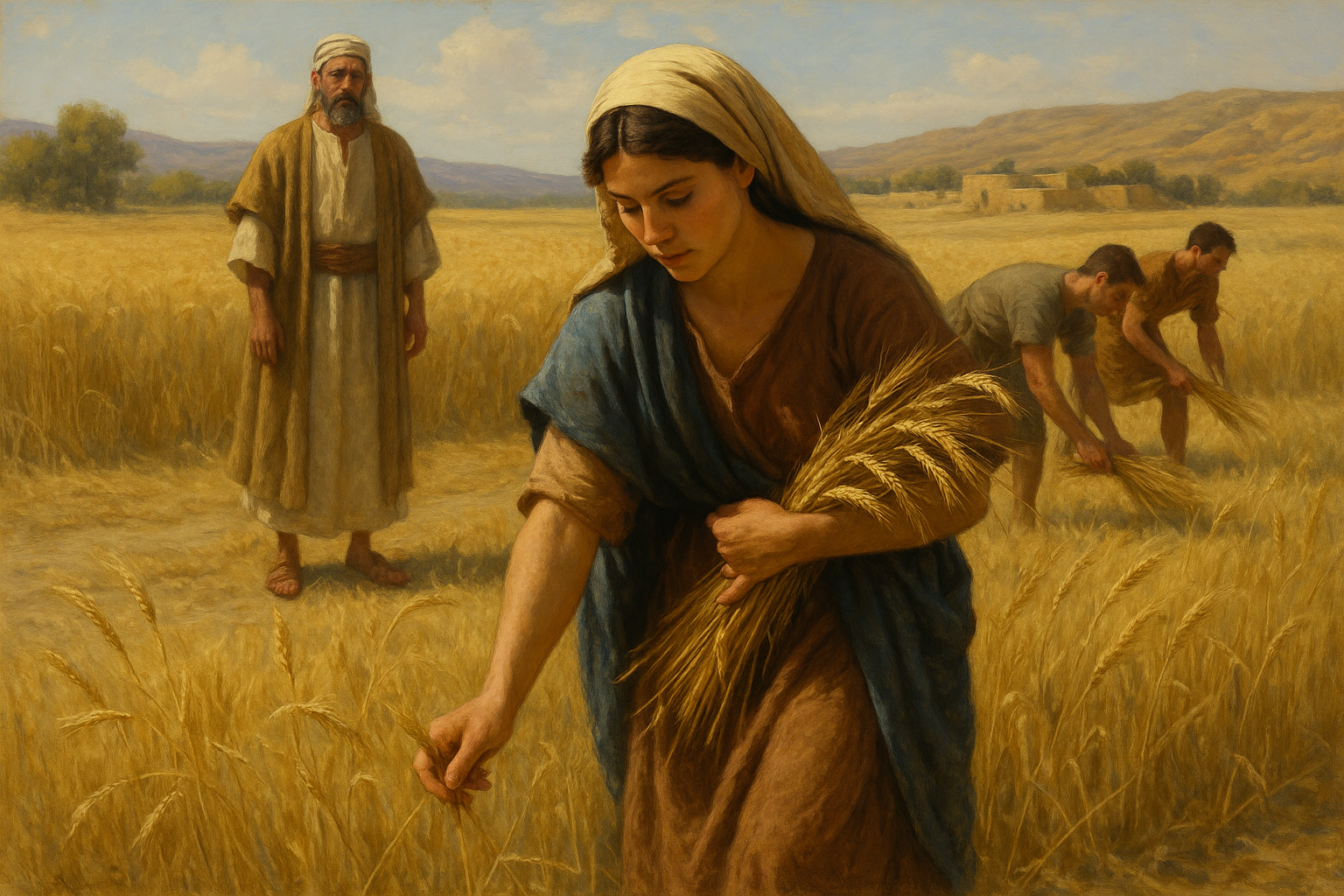
Ruth asks Naomi for permission to go into the fields and glean after someone in whose sight she might find grace (Ruth 2:2). Her action fits the provision God had made in the law for the poor and the stranger to glean from the harvest (Leviticus 19:9-10; Deuteronomy 24:19-22).
Ruth goes out to glean, and Ruth 2:3 says that her “hap” was to come to the portion of the field belonging to Boaz. From Ruth’s immediate human viewpoint, she arrived there without arranging the encounter. As the story unfolds, the circumstances may properly be understood as displaying divine providence, although the verse does not describe a miraculous direction of her steps.
Boaz comes from Bethlehem and notices Ruth (Ruth 2:4-5). His servant explains that she is the Moabitish woman who returned with Naomi and reports her diligent work in the field (Ruth 2:6-7).
Boaz tells Ruth to remain in his field, stay near his maidens, and drink from the water drawn by his young men (Ruth 2:8-9). He also commands the young men not to touch her.
Ruth is astonished by his favor and asks why she has found grace in his eyes when she is a stranger (Ruth 2:10).
Boaz explains that he has heard of Ruth’s kindness toward Naomi and of how she left her own family and homeland to live among a people she had not previously known (Ruth 2:11). He asks the LORD to reward her and speaks of the God of Israel “under whose wings thou art come to trust” (Ruth 2:12).
That statement gives important spiritual insight into Ruth’s decision. She has not merely changed geographical locations. Boaz describes her as having come to trust under the protection of the LORD God of Israel.
Boaz continues to show Ruth favor. He allows her to eat with his workers and orders his young men to let her glean even among the sheaves. He further commands them to drop some grain deliberately for her to gather (Ruth 2:14-16).
Ruth works until evening, beats out what she has gleaned, and carries the grain home to Naomi, along with food left from her meal (Ruth 2:17-18).
When Naomi learns that Ruth has gleaned in the field of Boaz, she blesses the LORD and identifies Boaz as one of their near kinsmen (Ruth 2:19-20).
Ruth continues gleaning with the maidens of Boaz through both barley harvest and wheat harvest while living with Naomi (Ruth 2:21-23).
The chapter emphasizes honest labor, humility, kindness, protection, generosity, and God’s provision through ordinary means. Ruth works diligently, Boaz acts generously, and Naomi recognizes the significance of their family relationship.
Ruth 3 – Ruth Appeals to Boaz as a Near Kinsman
Naomi now seeks “rest” for Ruth and tells her that Boaz is their kinsman (Ruth 3:1-2). She knows that Boaz will be winnowing barley at the threshingfloor that night.
Naomi instructs Ruth to wash, anoint herself, put on her raiment, go to the threshingfloor, wait until Boaz has finished eating and drinking, observe where he lies down, uncover his feet, and lie down there (Ruth 3:3-4).
Ruth answers, “All that thou sayest unto me I will do” (Ruth 3:5).
Ruth follows Naomi’s instructions. At midnight Boaz is startled and discovers a woman lying at his feet (Ruth 3:6-8). When he asks who she is, Ruth identifies herself and asks him to spread his skirt over her because he is a near kinsman (Ruth 3:9).
The meaning is clarified by Boaz’s response. He treats Ruth’s request as a matter involving his responsibility as a kinsman. He blesses her, commends her kindness, and says that all the city knows she is a virtuous woman (Ruth 3:10-11).
Nothing in the KJV states that sexual activity occurred between Ruth and Boaz at the threshingfloor. The text presents Ruth appealing to Boaz concerning his position as a near kinsman, and Boaz responds by seeking to handle the matter lawfully and honorably.
Boaz then reveals an important complication: although he is indeed a near kinsman, there is another kinsman nearer than he is (Ruth 3:12).
Boaz refuses to bypass the nearer man’s right. He promises that if the nearer kinsman will perform the part of a kinsman, he may do so; but if he will not, Boaz promises before the LORD that he will perform it (Ruth 3:13).
Ruth remains until morning and leaves before people can easily recognize one another (Ruth 3:14). Boaz gives her six measures of barley to take back (Ruth 3:15).
When Ruth returns, Naomi listens to what happened and then expresses confidence that Boaz will not rest until the matter is settled that day (Ruth 3:16-18).
Boaz’s conduct demonstrates both willingness and integrity. He desires to help Ruth, but he will not ignore the lawful claim of the nearer kinsman.
Ruth 4 – Redemption, Marriage, Obed, and the Line of David
Boaz goes to the city gate, where legal and public business could be conducted, and sits down (Ruth 4:1). The nearer kinsman passes by, and Boaz calls him aside. Boaz also gathers ten elders of the city as witnesses (Ruth 4:2).
Boaz explains that Naomi is connected with a parcel of land belonging to Elimelech and gives the nearer kinsman the first opportunity to redeem it (Ruth 4:3-4).
At first the man agrees.
Boaz then explains that the transaction also involves Ruth the Moabitess, the wife of the dead, in order “to raise up the name of the dead upon his inheritance” (Ruth 4:5).
The nearer kinsman then declines, saying that he cannot redeem it for himself lest he mar his own inheritance. He tells Boaz to redeem it (Ruth 4:6).
Ruth 4:7 explains the custom used to confirm such a transaction: a man removed his shoe and gave it to his neighbor as testimony concerning the agreement.
The nearer kinsman therefore tells Boaz to buy it and removes his shoe (Ruth 4:8).
Boaz publicly declares before the elders and the people that he has purchased what belonged to Elimelech, Chilion, and Mahlon. He also declares that he has purchased Ruth the Moabitess, Mahlon’s wife, to be his wife, with the purpose of preserving the name of the dead in connection with his inheritance (Ruth 4:9-10).
The people and elders respond as witnesses and pronounce a blessing upon Ruth and Boaz (Ruth 4:11-12).
Boaz takes Ruth as his wife. Ruth 4:13 specifically states that the LORD gives her conception, and she bears a son.
The women then speak to Naomi concerning what the LORD has done and concerning the child who will be a restorer of her life and a nourisher of her old age (Ruth 4:14-15). They also praise Ruth’s love for Naomi (Ruth 4:15).
Naomi takes the child, lays him in her bosom, and becomes nurse unto him (Ruth 4:16). The women of the neighborhood call his name Obed (Ruth 4:17).
The importance of the child extends far beyond that household:
Obed is the father of Jesse, and Jesse is the father of David (Ruth 4:17).
The book then closes with a genealogy beginning with Pharez and ending with David (Ruth 4:18-22).
The New Testament carries the genealogy still further. Matthew 1:5 specifically names Ruth in the ancestry of David, and Matthew’s genealogy ultimately leads to Jesus Christ (Matthew 1:5-16).
Ruth therefore occupies a definite place in the biblical history that leads to Israel’s king David and, through that line, to the earthly genealogy of Jesus Christ.
Key People and Places
Ruth
A Moabitish woman who had been married to Mahlon (Ruth 4:10). After his death, she remains with Naomi, identifies herself with Naomi’s people and God, returns with her to Bethlehem, labors faithfully as a gleaner, is called a virtuous woman by Boaz, marries Boaz, and becomes the mother of Obed (Ruth 1:16-18; 2:2-23; 3:11; 4:10-17).
Naomi
The wife of Elimelech and mother of Mahlon and Chilion. She experiences the deaths of her husband and sons in Moab and returns to Bethlehem in deep grief (Ruth 1:2-5, 19-21). She guides Ruth concerning Boaz and eventually holds Ruth’s son Obed in her bosom (Ruth 3:1-5; 4:16-17).
Boaz
A relative of Elimelech and a mighty man of wealth (Ruth 2:1). He treats Ruth with generosity and protection, recognizes her trust in the LORD, honors the right of the nearer kinsman, redeems the property interests publicly, and marries Ruth (Ruth 2:8-16; 3:10-13; 4:1-13).
Elimelech
Naomi’s husband and an Ephrathite of Bethlehemjudah. He travels with his family into Moab during the famine and dies there (Ruth 1:1-3).
Mahlon
One of Elimelech and Naomi’s sons and the husband of Ruth (Ruth 1:2-5; 4:10). His family name and inheritance become part of the matter addressed by Boaz.
Chilion
The other son of Elimelech and Naomi. He also marries in Moab and dies there (Ruth 1:2-5).
Orpah
One of Naomi’s Moabitish daughters-in-law. She initially begins the return journey with Naomi but ultimately returns to her people (Ruth 1:4, 8-15).
The Nearer Kinsman
An unnamed relative who has a prior claim before Boaz (Ruth 3:12; 4:1-6). He declines to redeem the inheritance when Boaz presents the full matter to him.
Obed
The son born to Boaz and Ruth. He becomes the father of Jesse and grandfather of David (Ruth 4:13-17).
Jesse
The son of Obed and father of David (Ruth 4:17, 22).
David
The final person named in the genealogy of Ruth (Ruth 4:17-22). The conclusion demonstrates the book’s direct connection to the family line of Israel’s later king.
Bethlehemjudah
The home of Elimelech and Naomi and the principal setting after Naomi and Ruth return from Moab (Ruth 1:1-2, 19, 22). It is also the location associated with Boaz and the events leading to Ruth’s marriage.
Moab
The country to which Elimelech’s family travels during the famine and the homeland of Ruth and Orpah (Ruth 1:1-6).
The Field of Boaz
The place where Ruth gleans and first comes under the special protection and generosity of Boaz (Ruth 2:3-23).
The Threshingfloor
The location where Ruth appeals to Boaz concerning his position as a near kinsman (Ruth 3:2-13).
The City Gate
The place where Boaz brings the redemption matter before the nearer kinsman and ten elders, securing public witnesses to the transaction (Ruth 4:1-12).
Main Doctrinal or Spiritual Themes
1. God’s Providence in Ordinary Life
Ruth contains no series of spectacular miracles. Instead, God’s hand is seen amid famine and harvest, travel and labor, meetings and family obligations, sorrow and restoration.
The text explicitly says that the LORD had visited His people by giving them bread (Ruth 1:6), Boaz recognizes Ruth as one who has trusted under the LORD’s wings (Ruth 2:12), and the LORD gives Ruth conception (Ruth 4:13).
At the same time, Scripture does not explain the divine reason for every painful event in the book. That restraint is important. Biblical faith trusts God’s sovereignty without pretending to know what God has not revealed.
2. Faith That Identifies With the True God
Ruth’s declaration in Ruth 1:16 is more than affection for Naomi. She identifies herself with Naomi’s people and Naomi’s God.
Boaz later describes Ruth as having come to trust under the wings of the LORD God of Israel (Ruth 2:12).
Her subsequent life is consistent with that confession. Scripture records no return by Ruth to the gods of Moab.
3. Grace Toward the Stranger
Ruth repeatedly recognizes that she is a foreigner and does not presume upon the kindness of others (Ruth 2:10, 13).
Yet she finds grace in the eyes of Boaz.
God’s law had already made provision for the stranger, poor, fatherless, and widow through gleaning (Leviticus 19:9-10; Deuteronomy 24:19-22). Boaz obeys the spirit of that provision generously.
Ruth’s nationality does not prevent her from trusting the LORD or from occupying an honored place in the lineage leading to David and ultimately to Jesus Christ (Matthew 1:5-16).
4. Redemption and the Kinsman
Redemption is central to Ruth 3-4.
Boaz is explicitly a near kinsman, but another relative has a nearer claim (Ruth 3:12). Boaz therefore handles the matter openly and lawfully, allowing the nearer man to decide first (Ruth 4:1-8).
When that man declines, Boaz redeems the relevant inheritance and takes Ruth as his wife (Ruth 4:9-13).
The transaction has background in Old Testament principles concerning family property, inheritance, and preserving a deceased man’s name (Leviticus 25:25; Deuteronomy 25:5-10). Ruth 4 itself explains precisely what Boaz undertakes, so conclusions should be governed by the wording of that chapter rather than by reconstructed customs.
Boaz is frequently presented in Christian teaching as a picture of Christ the Redeemer. This may be a useful illustration because Boaz is a kinsman who willingly performs a work of redemption. However, Scripture does not explicitly call Boaz a prophetic type of Christ. The certain doctrine of Christ’s redemption should therefore be established from passages that directly teach it, such as Ephesians 1:7, Titus 2:14, and 1 Peter 1:18-19.
5. Godly Character Matters
Ruth’s character is demonstrated through repeated conduct rather than merely through words.
She remains with Naomi (Ruth 1:16-18), works diligently (Ruth 2:2, 7, 17), cares for Naomi (Ruth 2:18), obeys Naomi’s instructions (Ruth 3:5-6), and develops a public reputation that leads Boaz to call her a virtuous woman (Ruth 3:11).
Boaz likewise demonstrates generosity, concern for Ruth’s safety, respect for God’s name, and careful observance of the nearer kinsman’s right (Ruth 2:4, 8-16; 3:12-13; 4:1-10).
Neither person’s good works are presented as earning salvation. Rather, their conduct demonstrates honorable character and faithfulness.
6. Honest Labor and Personal Responsibility
Ruth does not remain idle while waiting for circumstances to improve. She asks to glean and works throughout the day (Ruth 2:2, 7, 17).
Boaz helps her generously, but his generosity does not remove her opportunity to work.
The book therefore presents a healthy combination of compassion and responsibility: those with resources show generosity, and those able to labor work faithfully.
7. Kindness Within the Family
Kindness is repeatedly emphasized.
Naomi remembers the kindness Ruth and Orpah showed toward the dead and toward her (Ruth 1:8). Ruth sacrifices greatly to remain with Naomi (Ruth 1:16-18). Boaz provides for and protects Ruth (Ruth 2:8-16). Ruth shares her provision with Naomi (Ruth 2:18). Boaz later commends Ruth’s kindness (Ruth 3:10).
Godliness is demonstrated in the treatment of people close to us, especially when there is no earthly advantage in showing kindness.
8. Integrity in Relationships
Ruth 3 could easily be misrepresented if separated from Ruth 4.
Boaz acknowledges Ruth’s request but refuses to disregard the rights of the nearer kinsman (Ruth 3:12-13). He then handles the matter publicly before elders and witnesses (Ruth 4:1-12).
His desire does not become an excuse to abandon proper conduct.
The lesson is straightforward: doing the right thing includes doing it the right way.
9. God Can Bring Hope Out of Deep Sorrow
Naomi returns to Bethlehem describing herself as bitter and empty (Ruth 1:20-21). The book does not minimize her losses.
Yet Ruth 4 presents a radically different scene. Ruth is married, Obed is born, Naomi holds the child, and the women bless the LORD (Ruth 4:13-17).
The lesson is not that every earthly sorrow will be reversed in the same manner. Scripture makes no such promise. Ruth demonstrates, however, that present grief does not exhaust what God may yet accomplish.
10. Ruth’s Place in the Messianic Line
Ruth itself ends with David (Ruth 4:17-22).
Matthew then explicitly includes Ruth in the genealogy that leads to Jesus Christ (Matthew 1:5-16).
This is not speculation or typology. It is a direct statement of Scripture.
A Moabitish woman who trusted the God of Israel became the great-grandmother of David and is explicitly named in the earthly genealogy of Jesus Christ.
Practical Applications or Lessons
Trust God When You Cannot See the Whole Story
Ruth begins with circumstances that appear almost entirely dark. Naomi has lost her husband and both sons. She returns home grieving deeply.
Nothing in Ruth 1 tells Naomi how Ruth 4 will end.
Believers likewise are called to trust God without demanding advance knowledge of everything He is doing. We know what God has revealed. We should not pretend to know what He has kept hidden.
Make a Definite Commitment to the Lord
Ruth refuses to treat allegiance to God as a temporary convenience. Her identification with Naomi’s God accompanies a willingness to leave her homeland and live among God’s people (Ruth 1:16-18).
Biblical faith is not merely admiration from a distance. The believer belongs to the Lord.
Do the Work God Has Put Before You
Ruth does not know what the future holds when she enters the field in Ruth 2.
She simply goes to work.
Faith in God’s providence is never an excuse for laziness. Ruth trusts God and gleans. Boaz trusts God and conducts his responsibilities faithfully.
Believers should pray, trust God, and faithfully perform today’s duty.
Treat People With Grace
Boaz possesses authority and resources. Ruth does not.
He uses his position to protect, provide for, and encourage her rather than to exploit her (Ruth 2:8-16).
Those whom God has given authority, possessions, influence, or opportunity should use them honorably and compassionately.
Guard Your Testimony
Boaz and Ruth are both careful concerning their conduct and reputation.
Boaz can say that the city knows Ruth to be a virtuous woman (Ruth 3:11). Boaz himself refuses to bypass the nearer kinsman’s legitimate claim (Ruth 3:12-13).
A good testimony is built through repeated godly choices.
Never Use a Desired Outcome to Justify Wrong Methods
Boaz wants to act as kinsman, yet another man has the prior right.
Boaz does not manipulate the process. He brings the matter before witnesses and allows the nearer man to choose (Ruth 4:1-10).
A desirable goal does not make an improper method right.
Show Faithfulness to Family
Ruth could have left Naomi. Instead, she stays with her, works for their support, and shares what she receives.
Biblical Christianity should be visible in the way believers treat parents, spouses, children, relatives, widows, and others God has placed within their responsibilities.
Do Not Confuse God’s Silence With God’s Absence
Much of Ruth contains no direct divine speech.
Yet the LORD is not absent from the story.
His name is honored, His law provides for the needy, people pray for His blessing, Ruth trusts beneath His wings, and He ultimately gives Ruth conception.
God does not have to explain every movement of His providence for Him to remain sovereign.
Remember That Grace Reaches Beyond Human Boundaries
Ruth is repeatedly called a Moabitess, yet she comes to trust the LORD God of Israel.
Her nationality is never hidden. Neither does it prevent her from being received among God’s people or included in the line of David.
The New Testament ultimately records that “there is no difference” concerning the universal problem of sin and the availability of salvation through faith in Christ (Romans 3:22-23; Romans 10:12-13).
Redemption Comes at a Cost
Boaz assumes real obligations when he redeems the inheritance and takes Ruth as his wife (Ruth 4:9-10).
This provides a fitting illustration, though not an explicitly declared type, of the far greater truth of redemption in Jesus Christ.
Christian redemption is not merely deliverance from difficulty. Christ “gave himself for us, that he might redeem us from all iniquity” (Titus 2:14). The believer is redeemed by the precious blood of Christ (1 Peter 1:18-19).
God Often Works Through Ordinary Faithfulness
Ruth contains fields, harvests, meals, family discussions, legal proceedings, marriage, and childbirth.
There is nothing insignificant about ordinary obedience when it is placed in God’s hands.
Ruth could not have known while gathering leftover grain that her name would one day appear in the genealogy of Jesus Christ.
The believer’s responsibility is not to manufacture greatness. It is to be faithful to God in whatever responsibility He has given.
Conclusion
Ruth moves from famine to harvest, from bereavement to family, from uncertainty to redemption, and from an unknown Moabitish widow to the genealogy of David.
Its greatness lies partly in its simplicity.
Ruth trusts the God of Israel.
Naomi returns to Bethlehem despite her grief.
Ruth works faithfully.
Boaz behaves generously and honorably.
A lawful redemption is completed.
A son is born.
And that son becomes the grandfather of David.
Behind those ordinary events stands the providence of God.
The book of Ruth reminds believers that God sees faithfulness that may appear unnoticed, that His purposes are larger than our present circumstances, that righteous conduct matters, and that redemption occupies a central place in His revealed plan.
Most importantly, the Bible itself eventually carries Ruth’s family line beyond David to Jesus Christ (Matthew 1:5-16), the One in whom believers have eternal redemption (Hebrews 9:12).
Comments are closed