 Numbers 27–30 records Israel’s preparation for life beyond Moses’ leadership. The section addresses inheritance within Israel, the appointment of Joshua, the regular offerings Israel was to bring before the LORD, the observance of appointed feasts, and the binding nature of vows made unto God.
A strong thread runs through all four chapters: God orders His people deliberately. Property, leadership, worship, sacrifice, holy days, and personal promises were not to be governed merely by preference. Israel was to live under the revealed word of the LORD.
Chapter Summaries
Numbers 27 — Inheritance and the Appointment of Joshua
The Daughters of Zelophehad — Numbers 27:1–11
The chapter opens with five women:
- Mahlah
- Noah
- Hoglah
- Milcah
- Tirzah
They were daughters of Zelophehad, of the tribe of Manasseh.
They came before Moses, Eleazar the priest, the princes, and the congregation at the door of the tabernacle and explained that their father had died in the wilderness.
They said:
“Our father died in the wilderness, and he was not in the company of them that gathered themselves together against the LORD in the company of Korah; but died in his own sin, and had no sons.”
— Numbers 27:3
The wording must be kept exactly within what Scripture states. The text says Zelophehad “died in his own sin.” It does not identify that particular sin.
His daughters asked:
“Why should the name of our father be done away from among his family, because he hath no son?”
— Numbers 27:4
Moses did not simply decide the matter himself.
“And Moses brought their cause before the LORD.”
— Numbers 27:5
That is an important feature of the passage. When Moses faced a matter requiring divine judgment, he sought the LORD’s answer.
The LORD declared:
“The daughters of Zelophehad speak right.”
— Numbers 27:7
They were therefore to receive an inheritance among their father’s brethren.
God then established a broader order of inheritance:
- If a man died without a son, the inheritance passed to his daughter.
- If he had no daughter, it passed to his brethren.
- If he had no brethren, it passed to his father’s brethren.
- If none of these existed, it passed to the nearest kinsman of his family.
This became:
“a statute of judgment unto the children of Israel”
— Numbers 27:11
The passage demonstrates that God cared about the orderly preservation of inheritance within Israel.
It would go beyond the text to import modern civil or political theories into the passage. Its immediate subject is the inheritance structure God gave Israel.
Moses Is Told He Will Die — Numbers 27:12–14
The LORD told Moses:
“Get thee up into this mount Abarim, and see the land which I have given unto the children of Israel.”
— Numbers 27:12
After viewing the land, Moses would:
“be gathered unto thy people”
— Numbers 27:13
The reason is expressly stated:
“For ye rebelled against my commandment in the desert of Zin, in the strife of the congregation, to sanctify me at the water before their eyes.”
— Numbers 27:14
This refers directly to the events recorded in Numbers 20.
Moses was God’s servant, but his position did not exempt him from divine discipline.
God’s holiness does not change according to a man’s usefulness, years of service, or position.
Moses Requests a Successor — Numbers 27:15–17
Moses immediately showed concern for the people.
He prayed:
“Let the LORD, the God of the spirits of all flesh, set a man over the congregation”
— Numbers 27:16
His concern was that Israel should not become:
“as sheep which have no shepherd.”
— Numbers 27:17
That statement reveals Moses’ pastoral concern for the congregation.
He did not ask that his personal reputation be preserved. He asked that God’s people have leadership.
There is an obvious pastoral principle here: God’s people need faithful spiritual leadership.
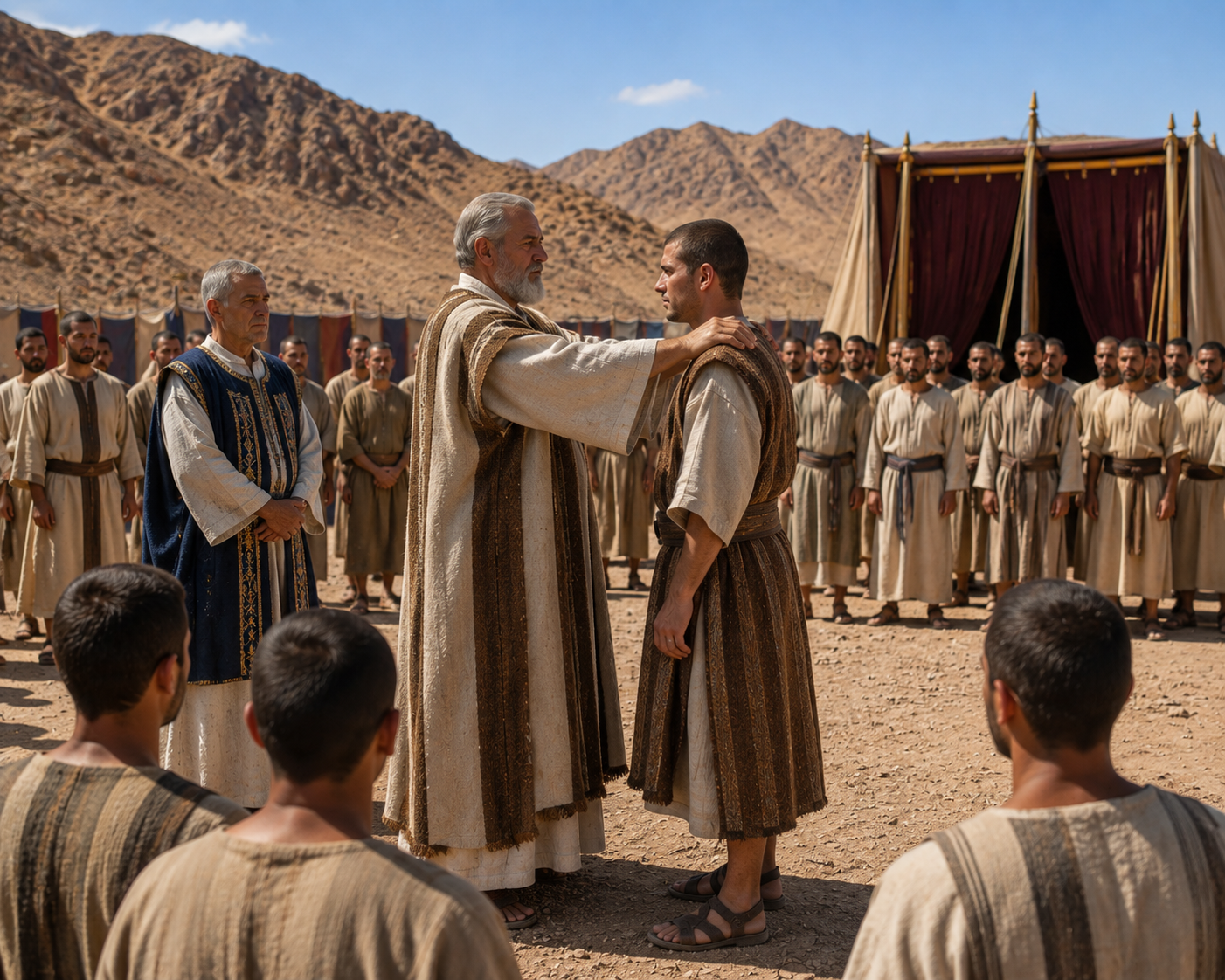
Joshua Is Appointed — Numbers 27:18–23
The LORD answered:
“Take thee Joshua the son of Nun, a man in whom is the spirit, and lay thine hand upon him.”
— Numbers 27:18
Joshua was to stand before:
- Eleazar the priest,
- the congregation.
Moses was commanded:
“thou shalt put some of thine honour upon him”
— Numbers 27:20
Notice the exact wording: “some of thine honour.”
Joshua was given responsibility and authority, but Scripture does not say that Joshua simply became another Moses in every respect.
Joshua would also inquire through Eleazar:
“after the judgment of Urim before the LORD”
— Numbers 27:21
Moses obeyed exactly as commanded:
“And Moses did as the LORD commanded him.”
— Numbers 27:22
He laid his hands upon Joshua and gave him a charge.
This is an orderly transfer of leadership under divine direction.
Numbers 28 — The Daily, Sabbath, Monthly, and Feast Offerings
Numbers 28 begins:
“Command the children of Israel, and say unto them, My offering, and my bread for my sacrifices made by fire, for a sweet savour unto me, shall ye observe to offer unto me in their due season.”
— Numbers 28:2
The repeated emphasis is that worship was to be offered as God commanded and at God’s appointed time.
The Daily Offering — Numbers 28:3–8
Israel was to offer:
“two lambs of the first year without spot day by day, for a continual burnt offering.”
— Numbers 28:3
One was offered in the morning and the other:
“at even.”
— Numbers 28:4
Meal and drink offerings accompanied the sacrifices.
The repeated morning and evening offering established a continual pattern of worship before the LORD.
For the Christian, these sacrifices are not church ordinances and should not be reproduced. They belonged to the law given to Israel.
Nevertheless, the spiritual lesson that God deserves regular, faithful devotion remains entirely consistent with the New Testament.
The Sabbath Offering — Numbers 28:9–10
On the Sabbath day additional lambs were offered.
The text says:
“This is the burnt offering of every sabbath, beside the continual burnt offering.”
— Numbers 28:10
The Sabbath offering did not eliminate the daily offering; it was additional.
God’s appointed worship was ordered rather than improvised.
The Beginning of the Months — Numbers 28:11–15
At the beginning of each month, additional sacrifices were commanded.
These included:
- bullocks,
- a ram,
- lambs,
- meal offerings,
- drink offerings,
- a kid of the goats for a sin offering.
The repeated phrase:
“beside the continual burnt offering”
shows that special observances did not replace Israel’s regular obligations.
Passover and Unleavened Bread — Numbers 28:16–25
The Passover was observed:
“in the fourteenth day of the first month”
— Numbers 28:16
Then:
“in the fifteenth day of this month is the feast”
— Numbers 28:17
Unleavened bread was eaten seven days.
The first and seventh days were holy convocations, with no servile work.
Special offerings were commanded throughout the feast.
Passover looked back to Israel’s deliverance from Egypt.
In New Testament doctrine, Christ is expressly connected with Passover:
“For even Christ our passover is sacrificed for us.”
— 1 Corinthians 5:7
That connection is explicit in Scripture.
The Old Testament Passover did not itself save anyone by ritual performance. Salvation has always depended upon God’s grace received by faith; the sacrifices and ordinances functioned within God’s covenant dealings with Israel and pointed to truths ultimately fulfilled in Christ.
The Day of Firstfruits — Numbers 28:26–31
At the time of:
“the day of the firstfruits”
Israel brought a new meat offering unto the LORD.
This involved another holy convocation and specified sacrifices.
Again the passage emphasizes exact obedience:
“Ye shall offer them beside the continual burnt offering, and his meat offering.”
— Numbers 28:31
God determined how He was to be approached.
Numbers 29 — Seventh-Month Feasts and Their Offerings
Numbers 29 continues the instructions concerning Israel’s appointed worship.
The chapter concentrates especially upon the seventh month.
The First Day of the Seventh Month — Numbers 29:1–6
Israel was commanded:
“In the seventh month, on the first day of the month, ye shall have an holy convocation; ye shall do no servile work: it is a day of blowing the trumpets unto you.”
— Numbers 29:1
Specified burnt offerings and a sin offering accompanied the day.
It was:
“according unto their manner, for a sweet savour, a sacrifice made by fire unto the LORD.”
— Numbers 29:6
The trumpet day was not merely cultural celebration. It was a divinely appointed religious observance.
The Day of Atonement — Numbers 29:7–11
On the tenth day:
“ye shall afflict your souls: ye shall not do any work therein.”
— Numbers 29:7
Additional sacrifices were commanded.
Verse 11 refers specifically to:
“the sin offering of atonement”
along with the continual burnt offering and its accompanying offerings.
The fuller instructions concerning the Day of Atonement are given in Leviticus 16.
The sacrifices of the law could not accomplish the complete and final removal of sin that Christ accomplished.
Hebrews teaches:
“For it is not possible that the blood of bulls and of goats should take away sins.”
— Hebrews 10:4
Christ’s sacrifice is final and sufficient:
“But this man, after he had offered one sacrifice for sins for ever, sat down on the right hand of God.”
— Hebrews 10:12
The Feast Beginning on the Fifteenth Day — Numbers 29:12–38
Beginning on the fifteenth day of the seventh month, Israel observed a seven-day feast, followed by a solemn assembly on the eighth day.
The offerings were extensive.
The number of bullocks decreased through the days:
- Day 1 — thirteen
- Day 2 — twelve
- Day 3 — eleven
- Day 4 — ten
- Day 5 — nine
- Day 6 — eight
- Day 7 — seven
The text clearly records this decreasing sequence.
It would be speculative to assign a symbolic theological meaning to the descending number unless another Scripture explicitly provides one. Numbers 29 itself does not explain why the number decreases each day.
The safe conclusion is simply that God prescribed the offerings in this precise order.
Israel’s Required and Voluntary Offerings — Numbers 29:39–40
The chapter concludes:
“These things ye shall do unto the LORD in your set feasts, beside your vows, and your freewill offerings…”
— Numbers 29:39
Israel therefore had both:
- prescribed offerings,
- voluntary offerings.
But even voluntary worship was not independent of God’s revealed requirements.
Moses communicated:
“unto the children of Israel according to all that the LORD commanded Moses.”
— Numbers 29:40
Numbers 30 — Vows Made Unto the LORD
Numbers 30 concerns vows and binding commitments.
Moses spoke:
“unto the heads of the tribes concerning the children of Israel”
— Numbers 30:1
The fundamental rule appears immediately:
“If a man vow a vow unto the LORD, or swear an oath to bind his soul with a bond; he shall not break his word, he shall do according to all that proceedeth out of his mouth.”
— Numbers 30:2
Words spoken before God matter.
A vow was not to be made lightly and then discarded when inconvenient.
A Young Woman in Her Father’s House — Numbers 30:3–5
If a woman in her youth, while living in her father’s house, made a vow, her father could respond.
If he heard it and:
“hold his peace at her”
her vows stood.
If her father disallowed her vow on the day he heard it:
“the LORD shall forgive her”
— Numbers 30:5
because her father had disallowed it.
The chapter gives the legal framework without inviting speculation about motives or family circumstances.
A Married Woman — Numbers 30:6–8
If a woman had made a vow and then had a husband, the husband could either allow the vow to stand by silence or disallow it when he heard it.
If he disallowed it:
“the LORD shall forgive her.”
— Numbers 30:8
Again, the passage describes Israel’s legal structure concerning vows within the household.
A Widow or Divorced Woman — Numbers 30:9
The text states plainly:
“But every vow of a widow, and of her that is divorced, wherewith they have bound their souls, shall stand against her.”
— Numbers 30:9
No paternal or marital authority is described in this verse as canceling her vow.
A Wife’s Vow and Her Husband — Numbers 30:10–15
If a husband heard his wife’s vow and remained silent, her vows stood.
If he disallowed them when he heard them, they did not stand.
But verse 15 adds an important warning:
“But if he shall any ways make them void after that he hath heard them; then he shall bear her iniquity.”
The chapter therefore recognizes both authority and responsibility.
Authority before God never means freedom from accountability to God.
Summary of the Vow Laws — Numbers 30:16
The chapter ends:
“These are the statutes, which the LORD commanded Moses, between a man and his wife, between the father and his daughter, being yet in her youth in her father’s house.”
The verse defines the immediate legal setting.
Applications to Christians should therefore be drawn as moral principles and not as though the Mosaic civil structure were directly imposed upon the local New Testament church.
Key People and Places
Moses
The servant of the LORD who brought the inheritance question before God, received notice concerning his approaching death, requested leadership for Israel, appointed Joshua, and communicated God’s commands concerning worship and vows.
Numbers 27 especially shows Moses thinking about Israel’s future after his own departure.
Joshua the Son of Nun
Chosen by the LORD to lead the congregation.
God described him as:
“a man in whom is the spirit”
— Numbers 27:18
He was publicly commissioned before Eleazar and the congregation.
Eleazar the Priest
Son of Aaron and the serving high priest during this period.
Joshua was to stand before Eleazar, and Eleazar would inquire:
“after the judgment of Urim before the LORD.”
— Numbers 27:21
Zelophehad
A man of the tribe of Manasseh who died in the wilderness.
Scripture specifically says:
“he was not in the company of them that gathered themselves together against the LORD in the company of Korah; but died in his own sin.”
— Numbers 27:3
The specific sin is not identified.
Mahlah, Noah, Hoglah, Milcah, and Tirzah
The five daughters of Zelophehad.
They appealed for their father’s inheritance, and God declared:
“The daughters of Zelophehad speak right.”
— Numbers 27:7
Mount Abarim
The location Moses was told to ascend in order to see the land God had given Israel.
Numbers 27 names “this mount Abarim.”
The text in this chapter does not give every geographical detail concerning Moses’ later ascent, so no additional identification is necessary to understand the passage.
The Land Given to Israel
Moses was permitted to see:
“the land which I have given unto the children of Israel.”
— Numbers 27:12
Israel’s possession of the land rested upon God’s promise.
The Tabernacle
The daughters of Zelophehad presented their case:
“by the door of the tabernacle of the congregation”
— Numbers 27:2
The offerings of chapters 28–29 belonged to Israel’s divinely regulated worship associated with the sanctuary.
Main Doctrinal or Spiritual Themes
1. God’s Word Governs Difficult Questions
When the inheritance issue arose:
“Moses brought their cause before the LORD.”
— Numbers 27:5
That is a model of submission to divine revelation.
The Christian’s first question should not merely be, “What seems reasonable?” but:
What hath God said?
Human experience matters, but Scripture has final authority.
2. God Is Just
The LORD heard the case of Zelophehad’s daughters and declared:
“The daughters of Zelophehad speak right.”
God established a righteous judgment for the situation.
Biblical justice is determined by God’s character and His revealed word, not by cultural fashion.
3. Sin Has Consequences
Moses was God’s servant, yet the LORD reminded him:
“ye rebelled against my commandment”
— Numbers 27:14
Moses was forgiven as a servant of God, but forgiveness did not remove every earthly consequence of his actions.
The passage therefore warns believers against treating obedience lightly.
4. God’s Work Continues Beyond One Servant
Moses’ ministry was coming to an end, but God’s purpose for Israel was not.
Joshua was appointed.
This gives an important ministry perspective:
God buries His servants, but His work continues.
No pastor, missionary, teacher, or church worker is indispensable.
Faithfulness includes preparing others to carry responsibility.
5. God’s People Need Shepherding
Moses asked God to provide a leader:
“that the congregation of the LORD be not as sheep which have no shepherd.”
— Numbers 27:17
Biblical leadership involves responsibility for people, not merely authority over them.
The shepherd imagery emphasizes guidance, protection, direction, and care.
6. Leadership Should Be Recognized and Ordered
Joshua’s appointment was not secretive.
He was presented:
“before Eleazar the priest, and before all the congregation”
— Numbers 27:19
There was an orderly and public transfer of responsibility.
For the New Testament church, pastoral qualifications and church order are given in passages such as 1 Timothy 3, Titus 1, and Acts 14:23.
Numbers 27 should not be used to erase the distinctions between Israel’s national leadership and New Testament church offices, but the principle of orderly leadership remains sound.
7. God Determines Acceptable Worship
Numbers 28–29 repeatedly specifies:
- what was to be offered,
- when it was to be offered,
- how much was to be offered,
- and the occasion for which it was offered.
Israel was not invited to invent its own worship.
That principle remains important.
Jesus said:
“God is a Spirit: and they that worship him must worship him in spirit and in truth.”
— John 4:24
Sincerity does not replace truth.
8. Worship Was Regular as Well as Special
Israel had:
- daily offerings,
- Sabbath offerings,
- monthly offerings,
- yearly feast offerings.
Special occasions did not replace daily obedience.
That principle is highly applicable to Christians.
A revival meeting, conference, anniversary, missions meeting, or Sunday service cannot substitute for daily fellowship with God.
9. Sacrifice Points Forward to Christ
The continual blood sacrifices demonstrate the seriousness of sin.
Hebrews explains that these sacrifices could not finally remove sin:
“For it is not possible that the blood of bulls and of goats should take away sins.”
— Hebrews 10:4
Christ accomplished what animal sacrifice never could accomplish:
“For by one offering he hath perfected for ever them that are sanctified.”
— Hebrews 10:14
The believer therefore does not approach God through repeated animal sacrifice but through the finished work of Jesus Christ.
10. God’s Appointed Times Matter
Repeatedly Numbers 28–29 speaks of offerings:
“in their due season”
and of:
“your set feasts.”
God ordered Israel’s calendar around worship and remembrance.
Time itself belonged to God.
For Christians, the application is straightforward: our schedules should reflect that God has first claim upon our lives.
11. God’s Holiness Requires Atonement
The Day of Atonement stands prominently in Numbers 29.
Sin could not simply be ignored.
The New Testament reveals the complete answer in Christ:
“without shedding of blood is no remission.”
— Hebrews 9:22
and:
“the blood of Jesus Christ his Son cleanseth us from all sin.”
— 1 John 1:7
12. God Takes Our Words Seriously
Numbers 30:2 is unmistakable:
“he shall not break his word.”
Promises made before God are not casual speech.
Ecclesiastes gives a similar warning:
“When thou vowest a vow unto God, defer not to pay it.”
— Ecclesiastes 5:4
Christians should therefore be slow to make dramatic promises and determined to keep righteous commitments once made.
13. Authority Carries Accountability
Numbers 30 gives fathers and husbands defined authority concerning certain vows.
But the chapter also assigns responsibility to the one exercising that authority.
Numbers 30:15 says:
“then he shall bear her iniquity.”
Biblical authority is never permission for selfish domination.
Everyone entrusted with authority remains accountable to God.
Practical Applications or Lessons
1. Take Difficult Questions to the Lord
Moses did not pretend to know what God had not yet revealed concerning Zelophehad’s daughters.
“Moses brought their cause before the LORD.”
There is wisdom in saying:
“I need to see what the Bible says.”
A Christian should never feel pressured to manufacture certainty where Scripture has not spoken.
2. Do Not Go Beyond Scripture
Numbers 27 provides a useful example of textual restraint.
We know:
- Zelophehad died in the wilderness.
- He was not part of Korah’s rebellion.
- He died “in his own sin.”
- He had no sons.
We do not know from this passage what his particular sin was.
Sound Bible interpretation is often demonstrated as much by what we refuse to invent as by what we explain.
3. Prepare Others to Continue the Work
Moses could have focused upon his coming death.
Instead, he asked:
“Let the LORD… set a man over the congregation.”
Every mature Christian worker should think about continuation.
A pastor should train men.
A missionary should disciple believers.
A teacher should develop other teachers.
An experienced Christian should help younger Christians learn how to serve.
A ministry that depends entirely upon one personality is unnecessarily vulnerable.
4. Enter Leadership Under God’s Direction
Joshua did not seize Moses’ position.
God chose him.
Moses presented him.
Eleazar and the congregation witnessed it.
There is a substantial difference between being called to serve and merely wanting prominence.
Christian service should be motivated by obedience, not ambition.
5. God’s Work Needs Shepherds, Not Merely Administrators
Moses feared Israel becoming:
“as sheep which have no shepherd.”
Churches need more than organization.
They need men who:
- know the Word,
- love the flock,
- preach truth,
- warn against error,
- lead by example,
- care for souls.
Biblical ministry involves people, not merely programs.
6. Faithfulness Should Be Daily
The continual burnt offering came morning and evening.
The Christian does not imitate the sacrifice, but the pattern challenges us.
Spiritual life should not consist of occasional intense moments surrounded by long stretches of neglect.
There should be regular:
- prayer,
- Scripture reading,
- thanksgiving,
- confession,
- service,
- worship.
7. Special Meetings Never Replace Daily Christianity
Israel had special feast days, but the continual offering remained.
Likewise:
- revival meetings do not replace daily prayer,
- Sunday preaching does not replace personal Bible reading,
- missions conferences do not replace witnessing,
- church attendance does not replace personal holiness.
Special seasons are valuable, but faithful Christianity is lived every day.
8. Worship God His Way
Numbers 28–29 repeatedly demonstrates that God gave exact instructions.
Modern worship must likewise remain governed by Scripture.
The important question is not merely:
“Do people like it?”
The greater question is:
“Does it honor God according to His Word?”
9. Remember the Cost of Sin
The sheer repetition of sacrifices in Numbers 28–29 is sobering.
Day after day, month after month, feast after feast, blood was shed.
Sin is not trivial.
The sacrifices point us toward the enormous significance of Christ’s once-for-all offering.
Calvary should never become commonplace in the believer’s mind.
10. Do Not Make Rash Promises to God
A person under emotional pressure may say:
“Lord, if You do this, I will do that.”
Numbers 30 warns that words directed toward God carry weight.
It is wiser to say:
“If the Lord will, we shall live, and do this, or that.”
— James 4:15
Serve God because His Word commands it, not because you have tried to bargain with Him.
11. Keep Your Word
Numbers 30:2 establishes a moral principle that extends well beyond ceremonial law:
“he shall not break his word.”
Christians ought to be people whose speech can be trusted.
Jesus said:
“But let your communication be, Yea, yea; Nay, nay.”
— Matthew 5:37
A Christian’s ordinary word should be dependable enough that elaborate oath-making is unnecessary.
12. Authority Must Never Become Arbitrary
Numbers 30 gave genuine authority within the household structure, but it also placed responsibility upon the one exercising that authority.
Christian husbands in particular must remember:
“Husbands, love your wives, even as Christ also loved the church, and gave himself for it.”
— Ephesians 5:25
Biblical headship is sacrificial and accountable to Christ.
13. Experience Does Not Remove the Need for Obedience
Moses had served God for decades.
He had:
- confronted Pharaoh,
- led Israel from Egypt,
- crossed the Red Sea,
- received the law,
- endured rebellion,
- interceded repeatedly for Israel.
Yet God still held him accountable for his rebellion at the waters of Meribah.
Past usefulness does not grant present permission to disobey.
No Christian reaches a level of service at which obedience becomes optional.
14. Finish Well and Think Beyond Yourself
Numbers 27 shows Moses near the end of his ministry, yet concerned about who would lead after him.
That is a powerful lesson for seasoned believers.
The question should not merely be:
“What have I accomplished?”
It should also be:
“Whom have I helped prepare to serve after me?”
Paul expressed the same principle to Timothy:
“And the things that thou hast heard of me among many witnesses, the same commit thou to faithful men, who shall be able to teach others also.”
— 2 Timothy 2:2
Overall Message of Numbers 27–30
Numbers 27–30 presents a God who brings order to every area of His people’s life.
He governs:
- inheritance,
- leadership,
- succession,
- worship,
- sacrifice,
- sacred times,
- personal commitments.
Israel was not left to invent its relationship with God.
Neither are we.
Numbers 27 says, in effect:
Seek God’s judgment and prepare faithful leadership.
Numbers 28 says:
Worship God faithfully and continually.
Numbers 29 says:
Honor God’s appointed worship and remember the seriousness of sin and atonement.
Numbers 30 says:
Mean what you say before God.
For the Christian, all of this points us toward a life of reverence, faithfulness, biblical order, careful speech, and submission to God’s revealed Word.
Above all, the many sacrifices of Numbers remind us of the superiority and sufficiency of Christ:
“Neither by the blood of goats and calves, but by his own blood he entered in once into the holy place, having obtained eternal redemption for us.”
— Hebrews 9:12
The believer does not live beneath a continual system of animal sacrifice.
Jesus Christ has finished the work of redemption.
Our response should therefore be one of grateful obedience:
“I beseech you therefore, brethren, by the mercies of God, that ye present your bodies a living sacrifice, holy, acceptable unto God, which is your reasonable service.”
— Romans 12:1
Comments are closed