 Numbers 15–17 follows the judgment of Numbers 14, where the unbelieving generation was sentenced to wander in the wilderness. These chapters emphasize that although God judges rebellion severely, His purposes and promises concerning Israel remain sure. Numbers 15 looks forward to Israel’s life in the land; Numbers 16 records a direct rebellion against God’s appointed order; and Numbers 17 gives God’s unmistakable confirmation of Aaron’s priesthood.
The central lesson running through all three chapters is that God is holy, His Word must be obeyed, and men do not have the right to approach or serve God according to their own choosing.
Chapter Summaries
Numbers 15 — Offerings, Sin, the Sabbath Breaker, and the Fringes
1. God speaks concerning Israel’s future life in the land — Numbers 15:1–21
The chapter opens:
“When ye be come into the land of your habitations, which I give unto you…”
— Numbers 15:2
This statement is especially significant after the judgment pronounced in Numbers 14. God had condemned the unbelieving generation to die in the wilderness, yet He still speaks of Israel entering the land which He gives them.
The passage establishes regulations concerning offerings made by fire, including burnt offerings, sacrifices, freewill offerings, solemn feasts, and accompanying meat and drink offerings.
The repeated expression concerning these offerings is:
“a sweet savour unto the LORD”
— Numbers 15:3, 7, 10, 13, 14
The offerings were not to be improvised. God prescribed what was to be offered and how it was to be presented.
The stranger under the same ordinance
Numbers 15:14–16 specifically includes the stranger who sojourned with Israel:
“One ordinance shall be both for you of the congregation, and also for the stranger that sojourneth with you…”
— Numbers 15:15
And:
“One law and one manner shall be for you, and for the stranger that sojourneth with you.”
— Numbers 15:16
This does not erase the biblical distinction between Israel and the nations. In this context, it explicitly means that a stranger dwelling among Israel and participating in these prescribed offerings was subject to the same divine regulations.
The first of the dough
When Israel entered the land and ate its bread, they were commanded to offer:
“a cake of the first of your dough for an heave offering”
— Numbers 15:20
The first portion belonged to the LORD, reminding Israel that their provision ultimately came from Him.
2. Sins committed through ignorance — Numbers 15:22–29
The LORD then gives instruction concerning failures committed ignorantly.
Provision is made both for:
- the congregation as a whole, and
- an individual person.
Concerning the congregation, the text says:
“it shall be forgiven them; for it is ignorance”
— Numbers 15:25
Concerning an individual:
“And the priest shall make an atonement for the soul that sinneth ignorantly…”
— Numbers 15:28
The passage teaches that ignorance did not make wrongdoing cease to be wrongdoing. Atonement was still required under the Mosaic system.
At the same time, God distinguished between sin committed ignorantly and deliberate defiance.
3. The presumptuous sinner — Numbers 15:30–31
A solemn contrast follows:
“But the soul that doeth ought presumptuously… the same reproacheth the LORD; and that soul shall be cut off from among his people.”
— Numbers 15:30
The reason is plainly stated:
“Because he hath despised the word of the LORD, and hath broken his commandment…”
— Numbers 15:31
The issue is not merely the outward act. God identifies the heart of presumptuous rebellion as despising His Word.
This gives an important doctrinal principle: deliberate rebellion against revealed truth is exceedingly serious because it amounts to treating God’s authority with contempt.
This passage concerns Israel under the Mosaic covenant and its civil and ceremonial administration. It should not be confused with the New Testament doctrine of salvation by grace through faith. Salvation is not obtained or maintained by Mosaic lawkeeping.
4. The man gathering sticks on the sabbath — Numbers 15:32–36
While Israel was in the wilderness, a man was found gathering sticks on the sabbath day.
He was brought before Moses and Aaron and the congregation.
The text says:
“they put him in ward, because it was not declared what should be done to him.”
— Numbers 15:34
They did not invent a punishment. They waited for the LORD’s command.
Then:
“And the LORD said unto Moses, The man shall be surely put to death…”
— Numbers 15:35
The congregation brought him outside the camp and stoned him, exactly as the LORD commanded Moses.
The KJV does not explicitly state the man’s motive for gathering the sticks. Therefore, it should not be asserted that he was doing so for a particular purpose beyond what the text says.
What Scripture does establish is that his action violated the sabbath commandment, and God Himself pronounced the judgment.
5. Fringes and the ribband of blue — Numbers 15:37–41
The LORD commanded the children of Israel to make fringes in the borders of their garments and place:
“a ribband of blue”
— Numbers 15:38
The purpose is explicitly stated:
“that ye may look upon it, and remember all the commandments of the LORD, and do them”
— Numbers 15:39
They were warned against following:
“after your own heart and your own eyes”
— Numbers 15:39
Instead:
“That ye may remember, and do all my commandments, and be holy unto your God.”
— Numbers 15:40
The chapter closes by grounding their obedience in God’s redemption of Israel from Egypt:
“I am the LORD your God, which brought you out of the land of Egypt…”
— Numbers 15:41
God had redeemed them, and they therefore belonged to Him.
Numbers 16 — The Rebellion of Korah, Dathan, and Abiram
1. The rebellion begins — Numbers 16:1–3
Korah, a Levite, joined with Dathan and Abiram, sons of Eliab, and On, the son of Peleth. They were joined by:
“two hundred and fifty princes of the assembly, famous in the congregation, men of renown”
— Numbers 16:2
Their accusation against Moses and Aaron was:
“Ye take too much upon you, seeing all the congregation are holy…”
— Numbers 16:3
They challenged the authority and position God had given Moses and Aaron.
Moses’ immediate response is striking:
“And when Moses heard it, he fell upon his face”
— Numbers 16:4
He did not simply defend himself politically. He placed the matter before God.
2. God would show whom He had chosen — Numbers 16:4–11
Moses answered:
“Even to morrow the LORD will shew who are his, and who is holy…”
— Numbers 16:5
Korah and his company were commanded to take censers and offer incense before the LORD.
Moses also rebuked Korah for failing to appreciate the privilege already given to the Levites:
“Seemeth it but a small thing unto you, that the God of Israel hath separated you from the congregation of Israel…”
— Numbers 16:9
Korah had already been separated for Levitical service, but he and his company:
“seek ye the priesthood also?”
— Numbers 16:10
Their rebellion was ultimately directed beyond Moses and Aaron:
“what is Aaron, that ye murmur against him?”
— Numbers 16:11
God had established the priesthood. Rejecting His appointed order was therefore rebellion against God.
3. Dathan and Abiram refuse Moses’ summons — Numbers 16:12–14
Dathan and Abiram answered:
“We will not come up”
— Numbers 16:12
They accused Moses of bringing them:
“out of a land that floweth with milk and honey, to kill us in the wilderness”
— Numbers 16:13
This description of Egypt as “a land that floweth with milk and honey” was their own statement; Scripture is recording their accusation, not endorsing their characterization of Egypt.
They also blamed Moses because they had not entered the promised land.
Yet Numbers 14 had already established that Israel’s wilderness judgment came because of the congregation’s unbelief and rebellion against the LORD.
4. The confrontation at the tabernacle — Numbers 16:15–22
Korah gathered the congregation against Moses and Aaron:
“unto the door of the tabernacle of the congregation”
— Numbers 16:19
Then:
“the glory of the LORD appeared unto all the congregation.”
— Numbers 16:19
God warned Moses and Aaron:
“Separate yourselves from among this congregation, that I may consume them in a moment.”
— Numbers 16:21
Moses and Aaron again fell upon their faces and interceded.
They prayed:
“O God, the God of the spirits of all flesh, shall one man sin, and wilt thou be wroth with all the congregation?”
— Numbers 16:22
Their response shows the seriousness with which they regarded both God’s holiness and the lives of the people.
5. Dathan, Abiram, and their households judged — Numbers 16:23–34
The congregation was commanded:
“Depart, I pray you, from the tents of these wicked men…”
— Numbers 16:26
Moses declared that an extraordinary judgment would prove that the LORD had sent him.
The ground then:
“clave asunder that was under them”
— Numbers 16:31
And:
“the earth opened her mouth, and swallowed them up…”
— Numbers 16:32
The surrounding Israelites fled at their cry.
This was presented by Moses as a divine sign confirming that these men had:
“provoked the LORD”
— Numbers 16:30
6. The 250 men and their censers — Numbers 16:35–40
The 250 men offering incense were consumed by fire from the LORD.
Their brass censers were afterward made into broad plates for a covering of the altar:
“to be a memorial unto the children of Israel”
— Numbers 16:40
Its purpose was expressly preventative:
“that no stranger, which is not of the seed of Aaron, come near to offer incense before the LORD”
— Numbers 16:40
God had restricted this priestly service to Aaron’s line.
Religious sincerity, prominence, or popular support could not replace divine appointment.
7. The congregation murmurs again — Numbers 16:41–50
The very next day:
“all the congregation of the children of Israel murmured against Moses and against Aaron”
— Numbers 16:41
They charged:
“Ye have killed the people of the LORD.”
But the previous verses had explicitly identified the judgments as acts of the LORD.
God’s wrath then went out against the congregation, and a plague began.
Moses told Aaron:
“Take a censer, and put fire therein from off the altar, and put on incense…”
— Numbers 16:46
Aaron obeyed.
The remarkable statement follows:
“And he stood between the dead and the living; and the plague was stayed.”
— Numbers 16:48
The number who died in the plague was:
“fourteen thousand and seven hundred, beside them that died about the matter of Korah.”
— Numbers 16:49
Aaron’s intercession here belongs specifically to his God-appointed priestly ministry under the Mosaic covenant.
It also illustrates the broader biblical truth that sinful man cannot casually approach a holy God apart from the means God Himself appoints.
Numbers 17 — Aaron’s Rod That Budded
1. Twelve rods placed before the LORD — Numbers 17:1–7
After the rebellion concerning the priesthood, God gave an unmistakable confirmation of His choice.
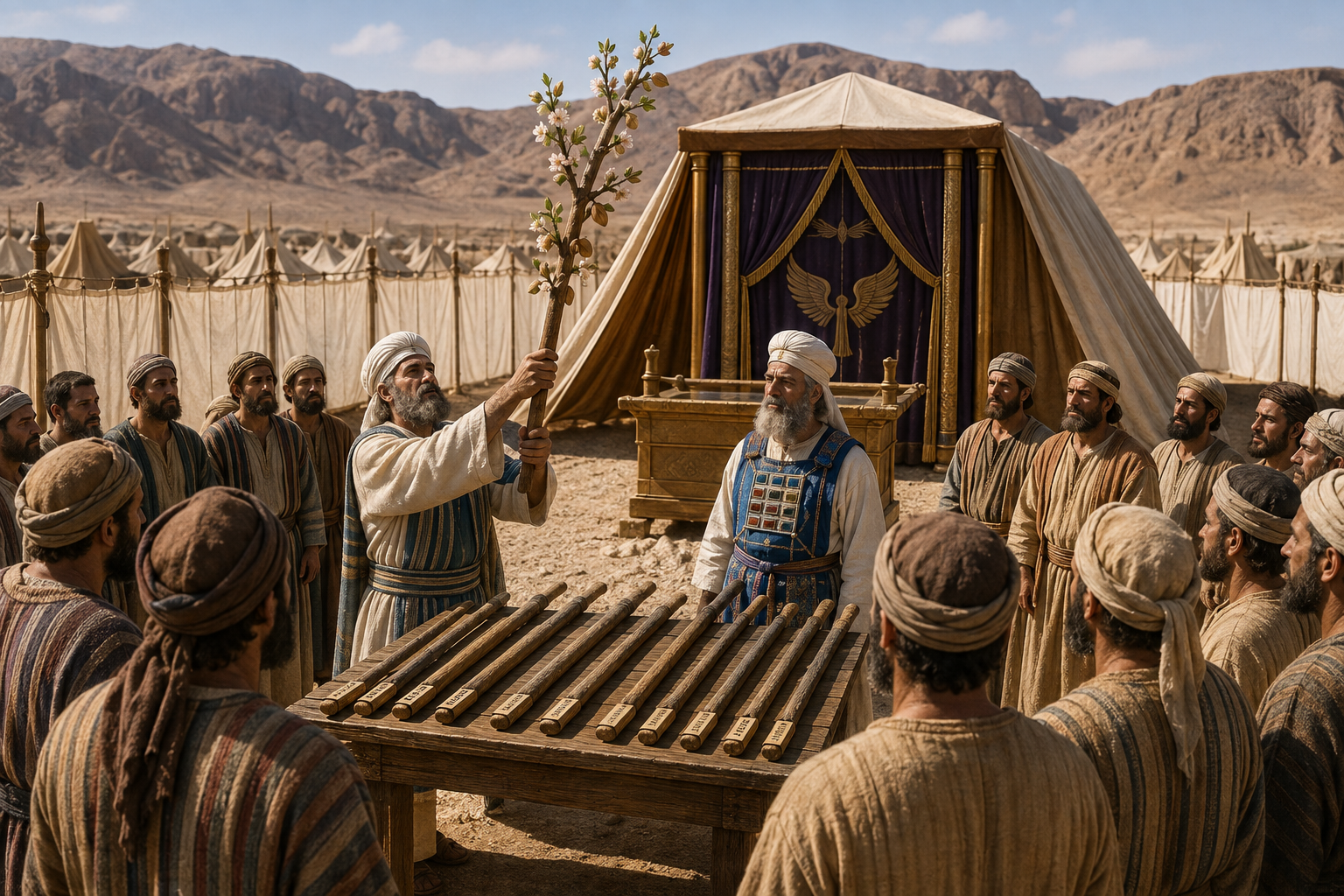
Each tribal leader was to provide a rod.
God commanded:
“write thou every man’s name upon his rod.”
— Numbers 17:2
On Levi’s rod:
“thou shalt write Aaron’s name”
— Numbers 17:3
The rods were placed:
“in the tabernacle of the congregation before the testimony”
— Numbers 17:4
God then declared:
“the man’s rod, whom I shall choose, shall blossom”
— Numbers 17:5
The purpose was:
“I will make to cease from me the murmurings of the children of Israel…”
— Numbers 17:5
The issue was therefore settled by God’s choice rather than human vote, ambition, or status.
2. Aaron’s rod buds, blossoms, and bears almonds — Numbers 17:8–9
The following day Moses entered the tabernacle.
Aaron’s rod:
“was budded, and brought forth buds, and bloomed blossoms, and yielded almonds.”
— Numbers 17:8
The text presents a dead wooden rod producing buds, blossoms, and mature almonds as God’s supernatural sign identifying Aaron.
Moses then brought the rods before Israel, and each man received his own rod.
Only Aaron’s had produced this sign.
3. Aaron’s rod kept as a testimony — Numbers 17:10–11
The LORD commanded:
“Bring Aaron’s rod again before the testimony, to be kept for a token against the rebels”
— Numbers 17:10
The purpose was again stated:
“thou shalt quite take away their murmurings from me, that they die not.”
God’s warning and God’s sign were acts of judgment, but they were also intended to restrain further rebellion and death.
Moses obeyed:
“as the LORD commanded him, so did he.”
— Numbers 17:11
That simple statement is one of the great patterns throughout Scripture: God commands; His servant obeys.
4. Israel’s fearful response — Numbers 17:12–13
The chapter concludes with the children of Israel saying:
“Behold, we die, we perish, we all perish.”
— Numbers 17:12
And:
“Whosoever cometh any thing near unto the tabernacle of the LORD shall die: shall we be consumed with dying?”
— Numbers 17:13
The people had witnessed repeatedly that God’s presence and service were not to be treated casually.
Their words express fear of approaching the tabernacle improperly. Chapter 18 continues by explaining more fully the responsibilities of Aaron, his sons, and the Levites concerning the sanctuary.
Key People and Places
Moses
God’s appointed leader of Israel. In Numbers 16 he repeatedly falls upon his face before the LORD and intercedes for the people rather than merely defending his own position.
Aaron
Brother of Moses and God’s appointed high priest. Numbers 16 confirms his priestly ministry through the censer and intercession during the plague; Numbers 17 confirms God’s choice of Aaron through the rod that budded.
Korah
A son of Izhar, of the family of Kohath, of the tribe of Levi (Numbers 16:1). He led a rebellion challenging the position given to Moses and Aaron.
Dathan and Abiram
Sons of Eliab, associated with Korah’s rebellion. They refused Moses’ summons and openly accused him before receiving divine judgment.
On
The son of Peleth, named in Numbers 16:1 among the original group. Scripture does not explicitly describe his later actions in the chapter, so no further conclusion should be made about him.
The 250 princes
They are explicitly described as:
“princes of the assembly, famous in the congregation, men of renown”
— Numbers 16:2
Their prominence did not protect them when they opposed God’s established order.
Eleazar
Aaron’s son. He was commanded to gather the censers from the burning and make them into plates for the altar as a memorial (Numbers 16:36–40).
The children of Israel
The covenant nation addressed throughout all three chapters. They receive commandments, witness judgments, and repeatedly see God’s appointed order confirmed.
The wilderness
Numbers 15:32 explicitly states that Israel was in the wilderness when the sabbath violation occurred. The immediate narrative remains within Israel’s wilderness journey.
The tabernacle of the congregation
The central place of divine service and manifestation in Numbers 16–17. God’s glory appears there, the censers are presented there, and the tribal rods are placed there before the LORD.
The promised land
Numbers 15 repeatedly anticipates:
“the land of your habitations, which I give unto you”
— Numbers 15:2
God’s judgment upon the rebellious generation did not cancel His declared purpose concerning Israel and the land.
Egypt
Mentioned in Numbers 15:41 as the place from which God brought Israel out:
“I am the LORD your God, which brought you out of the land of Egypt.”
Main Doctrinal or Spiritual Themes
1. God’s Holiness
Numbers 15–17 consistently teaches that God is holy and determines the conditions under which Israel worships and serves Him.
Men cannot redefine holiness according to sincerity, popularity, or personal opinion.
“that ye may remember, and do all my commandments, and be holy unto your God.”
— Numbers 15:40
Biblical holiness requires separation unto God and submission to His Word.
2. The Authority of God’s Word
Numbers 15:31 identifies presumptuous rebellion in very strong terms:
“he hath despised the word of the LORD.”
The issue behind much of Numbers 15–17 is whether God’s revealed Word will govern man’s actions.
The conservative Baptist principle is straightforward: Scripture is the authority, not religious tradition, personal experience, human scholarship, majority opinion, or cultural preference.
3. God Determines the Manner of Worship
Korah’s fundamental error was not that he lacked religious interest. His company was actively attempting to offer incense.
The problem was that God had not authorized them to exercise Aaron’s priesthood.
Numbers 16:40 specifically establishes the lesson:
“that no stranger, which is not of the seed of Aaron, come near to offer incense before the LORD.”
Religious activity does not become acceptable simply because it is sincere.
God decides how He is to be approached.
4. Rebellion Against God’s Order Is Rebellion Against God
Korah presented his challenge as opposition to Moses and Aaron, but Moses said:
“therefore both thou and all thy company are gathered together against the LORD”
— Numbers 16:11
This does not mean that every human leader is beyond question or correction. Moses’ authority in this passage was specifically established by God.
The lesson must therefore be stated carefully: when God has clearly spoken, resistance to His Word is resistance to God Himself.
5. Spiritual Privilege Does Not Excuse Pride
Korah was already a Levite.
Moses asked:
“Seemeth it but a small thing unto you, that the God of Israel hath separated you…?”
— Numbers 16:9
Rather than valuing the service God had given him, Korah sought the priesthood also.
A believer should guard against despising the place of service God has given while coveting another person’s position or recognition.
6. God Makes a Difference Between Ignorance and Presumption
Numbers 15 clearly distinguishes sins committed ignorantly from deliberate defiance.
That distinction does not mean ignorant sin was harmless; atonement was still required.
But presumptuous rebellion is described as despising God’s Word.
The passage demonstrates that God perfectly understands both actions and the heart behind them.
7. Redemption Should Produce Obedience
Numbers 15 ends:
“I am the LORD your God, which brought you out of the land of Egypt, to be your God…”
— Numbers 15:41
God’s redemption of Israel formed the basis for their covenant obedience.
For the Christian, obedience likewise does not purchase salvation. The New Testament teaches salvation by grace through faith apart from works. Good works follow salvation; they do not produce justification.
8. God’s Chosen Priesthood Was Not Self-Appointed
Numbers 17 removes all legitimate uncertainty concerning Aaron:
“the man’s rod, whom I shall choose, shall blossom.”
— Numbers 17:5
Aaron’s rod blossomed.
Thus the text explicitly presents Aaron’s priesthood as the result of God’s choice, not Aaron’s ambition.
Within its dispensational setting, this concerns Israel’s Levitical priesthood under the Mosaic covenant. It should not be used to establish an earthly sacerdotal priesthood over the New Testament church.
9. Intercession and the Necessity of God’s Appointed Mediatorial Provision
Aaron:
“stood between the dead and the living; and the plague was stayed.”
— Numbers 16:48
Within the immediate context, this was Aaron performing the priestly action Moses commanded during a specific judgment upon Israel.
It also fits the broader scriptural truth that sinful men require God’s appointed provision for access to Him.
The Old Testament priesthood was temporary and belonged to Israel’s Mosaic economy. The believer today approaches God through Jesus Christ, the one Mediator:
“For there is one God, and one mediator between God and men, the man Christ Jesus;”
— 1 Timothy 2:5
10. God’s Purposes for Israel Remain Distinct
Numbers 15 begins after severe national judgment but still speaks of:
“the land of your habitations, which I give unto you.”
God’s dealings with Israel in these chapters should not be allegorized into the Church.
Israel is Israel. The Levitical priesthood is the Levitical priesthood. The promised land is the land God promised Israel.
Sound dispensational interpretation preserves those distinctions while recognizing moral and spiritual principles that remain profitable for believers.
Practical Applications or Lessons
1. Take God’s Word Seriously
The clearest description of presumptuous sin in Numbers 15 is:
“he hath despised the word of the LORD.”
A Christian should never cultivate an attitude that says, in effect, “I know what God said, but I will decide for myself.”
Faith honors God’s Word.
2. Do Not Substitute Sincerity for Obedience
Korah and the 250 men were participating in religious activity, but God had not authorized their action.
Being sincere does not make disobedience acceptable.
The proper question is not merely, “Do I mean well?” but, “What saith the scripture?” (Romans 4:3).
3. Beware of Envy in Christian Service
Korah had real responsibilities as a Levite, yet Moses asked why he sought:
“the priesthood also?”
Coveting another man’s ministry, office, influence, or recognition can destroy gratitude for the work God has actually placed before us.
“Moreover it is required in stewards, that a man be found faithful.”
— 1 Corinthians 4:2
4. Separate From Open Rebellion Against God
Before judgment fell, Moses commanded:
“Depart, I pray you, from the tents of these wicked men…”
— Numbers 16:26
The direct command belonged to that particular historical judgment. Nevertheless, Scripture repeatedly teaches believers not to participate in rebellion or fellowship with ungodly works.
Biblical separation is not personal pride. It is loyalty to God and His truth.
5. Popularity Does Not Determine Truth
The rebellion included:
“two hundred and fifty princes… men of renown.”
Later, much of the congregation murmured against Moses and Aaron.
A position does not become true because influential men support it or because a majority accepts it.
Truth rests upon what God has spoken.
6. Remember God’s Past Deliverance
The fringes were designed so Israel would:
“remember all the commandments of the LORD, and do them.”
God knows man’s tendency to forget.
Believers should deliberately remember God’s Word, His salvation, His faithfulness, answered prayer, and past provision. Forgetfulness easily leads to carelessness.
7. Do Not Follow Your Own Heart as the Final Authority
Numbers 15:39 warns Israel:
“that ye seek not after your own heart and your own eyes.”
The modern idea that a person should simply “follow his heart” is contrary to this biblical principle.
The heart is not the Christian’s final authority. God’s Word is.
8. Leadership Is Stewardship, Not Self-Exaltation
Moses did not respond to Korah’s challenge by boasting.
Twice in the chapter we see him falling on his face before God.
Godly leadership recognizes dependence upon God rather than relying upon position, personality, or reputation.
9. Murmuring Is Spiritually Dangerous
Murmuring appears repeatedly in Israel’s wilderness history.
Numbers 16 shows that even after unmistakable judgment, the congregation murmured again the following day.
Repeated exposure to God’s truth does not automatically produce obedience. A heart determined to resist God can reinterpret even His clearest dealings.
Believers should therefore deal quickly with bitterness, complaining, unbelief, and rebellion.
10. Godly Service Must Be Done God’s Way
The contrast between Korah and Moses is instructive.
Korah attempted to obtain what God had not given him.
Moses repeatedly did:
“as the LORD commanded him”
— Numbers 17:11
The safest place for any servant of God is simple obedience to the written Word.
Overall Message of Numbers 15–17
Numbers 15–17 moves from commandment, to rebellion, to divine confirmation.
Numbers 15: God gives His Word and calls Israel to remember and obey it.
Numbers 16: Men challenge God’s order and discover that religious rebellion remains rebellion.
Numbers 17: God settles the dispute Himself by causing Aaron’s rod to bud, blossom, and bear almonds.
The great contrast is therefore between man’s self-will and God’s revealed will.
Korah says, in effect, that men may determine their own standing.
God answers:
“the man whom the LORD doth choose, he shall be holy”
— Numbers 16:7
And then He proves His choice in Numbers 17.
The conservative Baptist conclusion is clear: God’s Word, not man’s opinion, establishes truth. God’s holiness demands reverence. God’s service requires obedience. Salvation is by grace through faith, but those whom God has saved should willingly submit themselves to His revealed Word.
How useful was this post?
Click on a star to rate it!
Average rating 0 / 5. Vote count: 0
No votes so far! Be the first to rate this post.
We are sorry that this post was not useful for you!
Let us improve this post!
Tell us how we can improve this post?
Comments are closed