Nahum means “comfort” or “consolation,” and that fits the message: God’s judgment on Nineveh was terror to Assyria, but comfort to Judah.
Nahum prophesies against Nineveh, the capital of Assyria. About a century earlier, Jonah had preached to Nineveh, and the city repented for a time. By Nahum’s day, Nineveh had returned to cruelty, pride, idolatry, violence, and oppression. God announces that Assyria’s power will be broken and that Judah will no longer be afflicted by her.
Chapter Summaries
Nahum 1 — The LORD’s Jealousy, Wrath, and Goodness
 Nahum begins with “The burden of Nineveh” and identifies the prophet as “Nahum the Elkoshite” (Nahum 1:1). The word “burden” points to a heavy prophetic message of judgment.
The chapter opens by declaring the character of God:
“God is jealous, and the LORD revengeth; the LORD revengeth, and is furious…”
“The LORD is slow to anger, and great in power, and will not at all acquit the wicked…”
“The LORD is good, a strong hold in the day of trouble; and he knoweth them that trust in him.”
This is not sinful rage. It is holy justice. God’s jealousy is His rightful zeal for His glory, His people, and His covenant truth. He is “slow to anger,” but His patience must never be mistaken for weakness. He will not “acquit the wicked.”
The chapter describes God’s power over creation: the sea, rivers, mountains, hills, and earth tremble before Him. This shows that Nineveh’s military strength is nothing compared to the LORD.
The Lord promises that although He has afflicted Judah, He will break Assyria’s yoke:
“For now will I break his yoke from off thee, and will burst thy bonds in sunder.”
Nahum 1 closes with hope for Judah:
“Behold upon the mountains the feet of him that bringeth good tidings, that publisheth peace!”
For Judah, the fall of Nineveh means relief, deliverance, and renewed worship.
Main flow of Nahum 1: God is holy, patient, powerful, just, and good. He will judge Nineveh and comfort those who trust in Him.
Nahum 2 — The Siege and Fall of Nineveh
Nahum 2 describes the coming attack on Nineveh in vivid detail. The chapter opens:
“He that dasheth in pieces is come up before thy face…”
Nineveh is told to prepare herself, but the warning carries a sense of certainty. Human preparation cannot stop divine judgment.
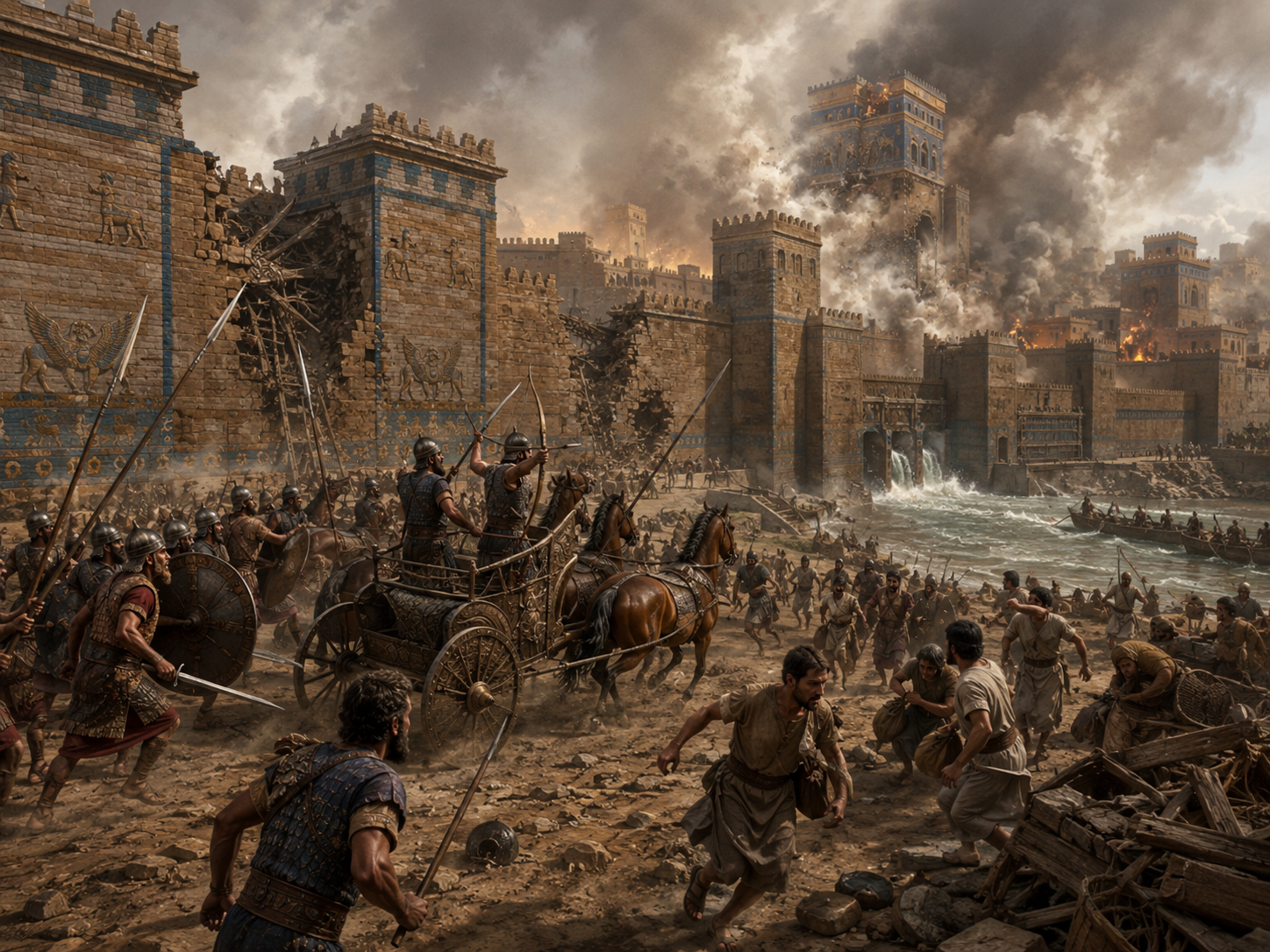
The invading army is pictured with shields, scarlet garments, flashing chariots, and military force. The city is thrown into confusion. Gates are opened. The palace is dissolved. The people flee.
Nahum 2:6 says:
“The gates of the rivers shall be opened, and the palace shall be dissolved.”
Historically, Nineveh was located near the Tigris River and was protected by water systems and walls. The prophecy pictures the city’s defenses failing under God’s providential judgment.
Nineveh had been like a lion’s den, devouring nations and carrying away spoil:
“Where is the dwelling of the lions, and the feedingplace of the young lions…?”
Assyria was known for brutality. The lion imagery fits Nineveh’s predatory violence. But now the hunter becomes the hunted.
The LORD declares:
“Behold, I am against thee, saith the LORD of hosts…”
That is the most terrible position any nation, city, church, family, or soul can be in: to have God Himself opposed to them.
Main flow of Nahum 2: Nineveh’s fall is described as certain, violent, humiliating, and divinely appointed. The cruel empire that plundered others will itself be plundered.
Nahum 3 — The Shame, Sin, and Final Ruin of Nineveh
Nahum 3 begins:
“Woe to the bloody city! it is all full of lies and robbery; the prey departeth not.”
This chapter gives the moral reasons for Nineveh’s destruction. The city is condemned for bloodshed, deceit, robbery, idolatrous seduction, pride, and cruelty.
Nineveh is pictured as a corrupt, seductive city that led nations astray:
“Because of the multitude of the whoredoms of the wellfavoured harlot…”
This language points to spiritual and political corruption. Assyria used power, intimidation, false promises, alliances, and idolatrous influence to dominate other nations.
God says again:
“Behold, I am against thee, saith the LORD of hosts…”
Nineveh’s shame will be exposed. The city that humiliated others will be humiliated.
Nahum compares Nineveh to No, or No-amon, a great Egyptian city associated with Thebes:
“Art thou better than populous No…?”
The point is direct: if mighty No fell, Nineveh should not imagine herself untouchable.
The chapter describes Nineveh’s leaders as weak, her gates as vulnerable, her merchants as fleeing, and her shepherds as sleeping. Her wound is incurable:
“There is no healing of thy bruise; thy wound is grievous…”
The book ends with the nations clapping their hands over Nineveh’s fall because her wickedness had touched so many:
“for upon whom hath not thy wickedness passed continually?”
Main flow of Nahum 3: Nineveh’s ruin is deserved. Her violence, lies, idolatry, and oppression have reached the point of final judgment.
Key People and Places
Nahum
Nahum is the prophet through whom God gives this message. He is called “the Elkoshite” in Nahum 1:1. The text does not give many personal details about him. His message is focused almost entirely on God’s judgment against Nineveh and comfort for Judah.
Nineveh
Nineveh was the capital city of Assyria. It represents cruelty, pride, violence, idolatry, and worldly power. Jonah had preached there earlier, and the city had repented temporarily. By Nahum’s time, Nineveh had returned to wickedness and was marked for destruction.
Assyria
Assyria was the empire that oppressed Israel and threatened Judah. It was known for military strength and extreme cruelty. In Nahum, Assyria’s power is shown to be temporary and subject to God’s rule.
Judah
Judah is not the main object of judgment in this book but is the recipient of comfort. God promises to break Assyria’s yoke and restore peace to His afflicted people.
No / No-amon
Mentioned in Nahum 3:8, this refers to a powerful Egyptian city, commonly associated with Thebes. Nahum uses its fall as an example: if that great city could fall, Nineveh could fall too.
The LORD of Hosts
This title emphasizes God as the sovereign Commander of heaven’s armies. When He says, “Behold, I am against thee,” Nineveh’s doom is sealed.
Main Doctrinal or Spiritual Themes
1. God’s Holiness and Justice
Nahum strongly teaches that God does not overlook sin forever.
“The LORD… will not at all acquit the wicked.”
This is foundational biblical truth. God is loving and patient, but He is also holy. His mercy never cancels His justice.
2. God’s Patience Is Not Permission
Nineveh had received mercy in Jonah’s day. But later generations returned to wickedness. The delay of judgment did not mean judgment would never come.
A sinner, church, or nation should never confuse God’s longsuffering with approval.
3. God Is Good to Those Who Trust Him
Nahum 1:7 is one of the great comfort verses of the Old Testament:
“The LORD is good, a strong hold in the day of trouble; and he knoweth them that trust in him.”
This verse balances the whole book. The same God who judges Nineveh shelters His people.
4. No Nation Is Above God
Assyria seemed unstoppable. Nineveh seemed secure. But God brought it down.
The Bible repeatedly teaches that kings, empires, armies, economies, and cities are all under the authority of God.
5. Violence and Pride Bring Judgment
Nineveh is called a “bloody city.” Her cruelty came back upon her own head. This is a solemn reminder that God sees oppression, injustice, abuse, robbery, and bloodshed.
6. False Security Will Fail
Nineveh trusted in walls, rivers, soldiers, wealth, merchants, and reputation. None of those could save her when God rose in judgment.
7. God Comforts His Afflicted People
The fall of Nineveh was not merely destruction for Assyria; it was deliverance for Judah. God knows how to judge the wicked and relieve the oppressed.
Practical Applications or Lessons
1. Do Not Mistake God’s Patience for Weakness
Because judgment does not always come immediately, men often think they have escaped it. Nahum reminds us that God’s timing is not carelessness. He is “slow to anger,” but He is still “great in power.”
2. Make Sure God Is Your Refuge, Not Your Enemy
Nahum shows two sides clearly: to the trusting soul, God is “a strong hold in the day of trouble”; to the proud and wicked, He says, “I am against thee.”
The most important question is not whether life is hard, but whether a man is right with God.
3. National Sin Matters
Nineveh was judged for public, widespread wickedness. A nation’s cruelty, lies, corruption, violence, and idolatry matter before God. The Lord rules over nations, not just individuals.
4. Pride Always Falls
Nineveh thought she was untouchable. Her walls, wealth, soldiers, and terror tactics could not protect her. Pride may look strong for a season, but it is brittle before God.
5. God Sees the Oppressed
Judah had suffered under Assyrian pressure, but God had not forgotten. Believers can take comfort that God knows every burden, every affliction, and every injustice.
6. Religious History Is Not Enough
Nineveh had once repented under Jonah’s preaching. But a past revival did not save a later generation that returned to sin. Every generation must respond rightly to God.
7. Sin Eventually Becomes Shame
Nineveh had gloried in violence and conquest. In Nahum 3, God exposes her shame. Sin often advertises itself as power, pleasure, or freedom, but it ends in disgrace.
8. The Only Safe Stronghold Is the LORD
Nineveh had strong walls. Judah had a strong God. Walls fell. God remained.
The believer’s confidence must not be in money, health, politics, weapons, reputation, or human ability, but in the Lord Himself.
Conservative Baptist Emphasis
Nahum is a book of divine judgment and divine comfort. It upholds the holiness of God, the certainty of judgment, the danger of national wickedness, and the security of those who trust the Lord. It gives no room for a soft view of sin or a sentimental view of God. The LORD is good, but He is not permissive. He is patient, but He is not passive. He is merciful, but He is not unjust.
The book also points forward in principle to the final judgment of all wickedness. Every proud system that exalts itself against God will fall. Every sinner needs refuge in the Lord. Every believer can rest in this truth:
“The LORD is good, a strong hold in the day of trouble; and he knoweth them that trust in him.
Comments are closed