Chapter Summaries
Micah 1 — The Lord Comes Down in Judgment
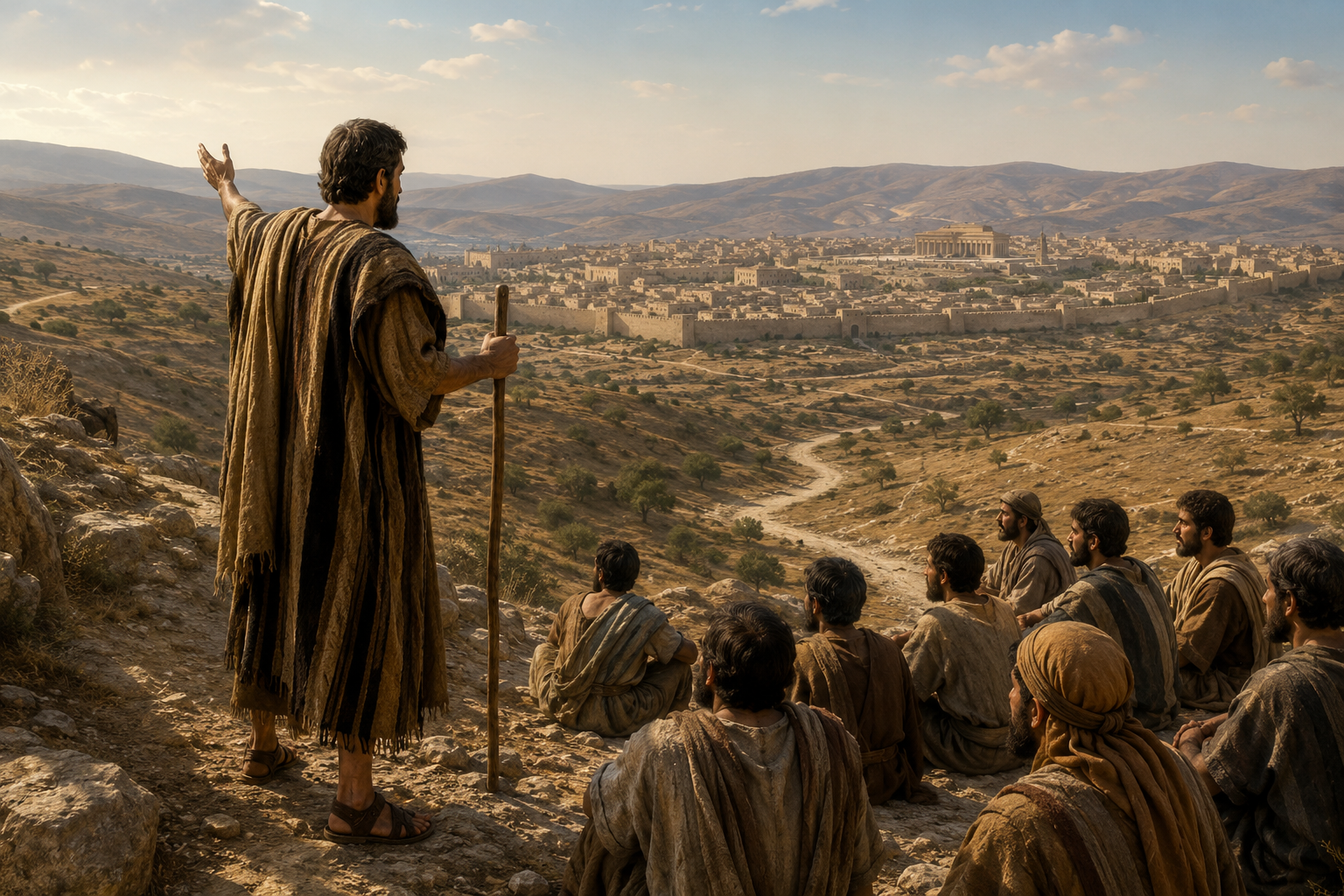
 Micah opens by identifying himself as “Micah the Morasthite” and dating his ministry during the reigns of Jotham, Ahaz, and Hezekiah, kings of Judah. His message concerns “Samaria and Jerusalem” (Micah 1:1), meaning both the northern kingdom of Israel and the southern kingdom of Judah are under divine examination.
The chapter begins with a courtroom-like summons:
“Hear, all ye people; hearken, O earth, and all that therein is” (Micah 1:2).
God Himself is the witness against His people. The Lord is pictured as coming down from His place, treading upon the high places of the earth. The imagery is fearful and majestic: mountains melt, valleys are cleft, and the earth reacts before the holiness of God. This is not the weak god of man’s imagination, but the living God who judges sin.
The cause of judgment is plainly stated:
“For the transgression of Jacob is all this, and for the sins of the house of Israel” (Micah 1:5).
Samaria, the capital of the northern kingdom, is singled out for judgment because of idolatry and rebellion. The Lord declares:
“I will make Samaria as an heap of the field” (Micah 1:6).
Her graven images and idols would be broken. The sin that Israel trusted in would become her shame.
Micah then mourns deeply. He says:
“Therefore I will wail and howl, I will go stripped and naked” (Micah 1:8).
This is not cold preaching. Micah declares judgment with tears. He is not a man delighting in doom, but a preacher burdened over sin and its consequences.
The wound is described as incurable:
“For her wound is incurable; for it is come unto Judah; he is come unto the gate of my people, even to Jerusalem” (Micah 1:9).
Judah is warned that the judgment which struck Samaria would reach even to Jerusalem’s gate. The chapter then includes a series of place names, many likely involving wordplay in Hebrew, showing that judgment would roll through the towns of Judah. The people are told to mourn because captivity is coming.
The chapter ends with a sober command:
“Make thee bald, and poll thee for thy delicate children; enlarge thy baldness as the eagle; for they are gone into captivity from thee” (Micah 1:16).
The grief is not abstract. Sin will affect families, cities, children, worship, and national life.
Micah 2 — Woe to Oppressors and False Prophets
Micah 2 turns from national judgment to personal and social sin. The chapter opens:
“Woe to them that devise iniquity, and work evil upon their beds!” (Micah 2:1).
These were not people who fell suddenly into sin. They planned it. They lay awake plotting wickedness, and when morning came, they performed it because it was in the power of their hand.
Their sin included covetousness and oppression:
“And they covet fields, and take them by violence; and houses, and take them away” (Micah 2:2).
This was a violation of God’s law and a direct attack on the inheritance and homes of others. The wealthy and powerful were abusing the weak. They were using position, money, and influence to take what did not belong to them.
Because they devised evil, God declares that He also is devising judgment:
“Behold, against this family do I devise an evil” (Micah 2:3).
Here “evil” means calamity or judgment, not moral wickedness in God. The Lord is holy and cannot sin. The point is that the disaster coming upon them is not accidental; it is divine judgment.
The people did not want preaching that exposed sin. They said:
“Prophesy ye not” (Micah 2:6).
This is one of the great marks of rebellion: people want religious speech, but not rebuke; comfort, but not conviction; blessing, but not obedience.
Micah exposes false prophets who told the people what they wanted to hear. He says:
“If a man walking in the spirit and falsehood do lie, saying, I will prophesy unto thee of wine and of strong drink; he shall even be the prophet of this people” (Micah 2:11).
In other words, a preacher who justified appetite, pleasure, and worldliness would be popular among a carnal people. That is still true. When men reject truth, they prefer voices that baptize their desires.
Yet the chapter does not end without hope. God promises a future gathering:
“I will surely assemble, O Jacob, all of thee; I will surely gather the remnant of Israel” (Micah 2:12).
The Lord speaks of a remnant. Judgment is real, but God’s covenant mercy is not exhausted. He will gather His people like sheep. The chapter closes with the picture of the Lord leading them:
“And their king shall pass before them, and the LORD on the head of them” (Micah 2:13).
This points forward to restoration under the rule of God, and ultimately harmonizes with the messianic hope fulfilled in the Lord Jesus Christ, the true Shepherd and King.
Micah 3 — Corrupt Leaders, False Prophets, and Coming Destruction
Micah 3 addresses the rulers, princes, prophets, and priests. The leadership of the nation had become corrupt. Micah asks:
“Is it not for you to know judgment?” (Micah 3:1).
Those who were supposed to uphold justice hated good and loved evil. The language is graphic and severe, picturing leaders as those who tear the skin and flesh from the people. This shows the cruelty of corrupt leadership. They were not shepherding the flock; they were devouring it.
Because they ignored God’s law and oppressed others, God would ignore their cries:
“Then shall they cry unto the LORD, but he will not hear them” (Micah 3:4).
That is a fearful truth. There comes a point when those who refuse God’s voice may find heaven silent in the day of calamity.
Micah then turns to false prophets:
“Thus saith the LORD concerning the prophets that make my people err” (Micah 3:5).
These prophets preached according to payment. If someone fed them, they cried peace; if not, they prepared war against him. Their ministry was not governed by truth but by personal gain.
God’s judgment on false prophets would be spiritual darkness:
“Therefore night shall be unto you, that ye shall not have a vision” (Micah 3:6).
They claimed light, but God would expose them as blind guides. They claimed revelation, but God would leave them without an answer.
Micah contrasts himself with these false prophets:
“But truly I am full of power by the spirit of the LORD, and of judgment, and of might” (Micah 3:8).
This is one of the key statements in the book. Micah’s authority did not come from popularity, position, or money. It came from the Spirit of the Lord. His calling was:
“to declare unto Jacob his transgression, and to Israel his sin” (Micah 3:8).
That is faithful preaching. It does not merely entertain, flatter, or manage public opinion. It declares sin plainly and calls people back to God.
The final section condemns rulers, priests, and prophets together:
“The heads thereof judge for reward, and the priests thereof teach for hire, and the prophets thereof divine for money” (Micah 3:11).
Yet they still claimed religious security:
“Is not the LORD among us? none evil can come upon us” (Micah 3:11).
This is presumption. They assumed God’s presence while ignoring God’s holiness. They wanted the temple, the rituals, and the national identity without repentance and obedience.
Therefore Micah gives one of the strongest warnings in the book:
“Therefore shall Zion for your sake be plowed as a field, and Jerusalem shall become heaps” (Micah 3:12).
This prophecy was remembered later in Jeremiah 26:18, showing its seriousness and historical importance. The city that presumed upon privilege would face devastation because of sin.
Micah 4 — The Latter-Day Glory of Zion and the Coming Kingdom
Micah 4 opens with a dramatic shift from judgment to hope:
“But in the last days it shall come to pass, that the mountain of the house of the LORD shall be established” (Micah 4:1).
After the warning that Zion would be plowed like a field, God reveals that Zion’s future is not finished. The same place that would be humbled under judgment will one day be exalted by divine purpose.
The nations will flow unto it, saying:
“Come, and let us go up to the mountain of the LORD” (Micah 4:2).
This is a future picture of Gentile nations seeking the Lord’s instruction. The law will go forth from Zion, and the word of the Lord from Jerusalem. From a conservative Baptist and premillennial perspective, this fits naturally with the future earthly reign of Christ, when the Messiah rules in righteousness.
The result will be peace under divine government:
“They shall beat their swords into plowshares, and their spears into pruninghooks” (Micah 4:3).
This is not peace brought by human diplomacy, the United Nations, education, or social progress. It is peace brought by the righteous rule of the Lord. Men cannot create lasting peace while remaining rebels against God. True peace comes when the Prince of Peace reigns.
Micah adds:
“But they shall sit every man under his vine and under his fig tree; and none shall make them afraid” (Micah 4:4).
This describes security, prosperity, and rest under God’s rule. The verse ends:
“for the mouth of the LORD of hosts hath spoken it.”
That is the certainty of prophecy. God’s word is enough.
Micah then contrasts the nations with the faithful:
“For all people will walk every one in the name of his god, and we will walk in the name of the LORD our God for ever and ever” (Micah 4:5).
The believer’s path is not determined by the direction of the crowd. Even when nations follow false gods, God’s people must walk in the name of the Lord.
The chapter continues with God gathering the lame, the outcast, and the afflicted:
“I will assemble her that halteth, and I will gather her that is driven out” (Micah 4:6).
This is a beautiful picture of grace. God does not merely gather the strong and impressive. He gathers the broken, wounded, scattered, and chastened remnant.
The kingdom promise follows:
“And the LORD shall reign over them in mount Zion from henceforth, even for ever” (Micah 4:7).
Micah then speaks of Zion’s travail. Jerusalem would experience pain, exile, and captivity:
“For now shalt thou go forth out of the city, and thou shalt dwell in the field, and thou shalt go even to Babylon” (Micah 4:10).
This is remarkable because Babylon was not yet the dominant world power in Micah’s day as it later became. Yet the prophecy points ahead to Judah’s Babylonian captivity. Still, judgment would not be the end:
“there shalt thou be delivered; there the LORD shall redeem thee from the hand of thine enemies” (Micah 4:10).
The chapter closes with nations gathered against Zion, but they do not understand God’s plan:
“But they know not the thoughts of the LORD, neither understand they his counsel” (Micah 4:12).
The enemies think they are gathering for victory, but God is gathering them for judgment. Zion is pictured as threshing the nations, and their gain is consecrated unto the Lord.
Micah 4 therefore moves from judgment to kingdom hope: Zion humbled, Zion restored, Zion ruled by the Lord, and Zion victorious by God’s power.
Key People and Places
Micah the Morasthite
Micah was a prophet from Moresheth, likely a small town in Judah. He was not presented as a priest, court official, or wealthy man. His preaching shows the burden of a country prophet who saw the sins of cities, rulers, priests, prophets, and common people. He preached during the days of Jotham, Ahaz, and Hezekiah.
Jotham, Ahaz, and Hezekiah
These were kings of Judah during Micah’s ministry. Their reigns place Micah in the eighth century B.C., around the same general era as Isaiah. Ahaz was a wicked king; Hezekiah was a reforming king. Micah ministered during a spiritually dangerous and politically unstable period.
Samaria
Samaria was the capital of the northern kingdom of Israel. In Micah 1, it represents the idolatry and rebellion of Israel. God declares that Samaria would become “as an heap of the field” because of her sin.
Jerusalem
Jerusalem was the capital of Judah and the location of the temple. Micah warns that Jerusalem herself would not be spared simply because of religious privilege. In Micah 3:12, Jerusalem is warned that she would become heaps. Yet in Micah 4, Jerusalem/Zion becomes the center of future kingdom blessing.
Zion
Zion refers to Jerusalem, especially in its covenant and prophetic significance. In Micah 3, Zion faces judgment because of corrupt leadership. In Micah 4, Zion is exalted in the last days as the place from which the word of the Lord goes forth.
Jacob and Israel
These names are used to refer to God’s covenant people. Sometimes they refer broadly to the whole nation, and sometimes the context distinguishes the northern and southern kingdoms. Their privilege did not excuse their sin.
The Heads, Princes, Priests, and Prophets
Micah strongly rebukes the leadership classes. The civil rulers judged for reward, priests taught for hire, and prophets divined for money. Their corruption brought great guilt upon the nation.
Babylon
Micah 4:10 mentions Babylon as the place of future captivity. This anticipates Judah’s later exile and shows that God knew and declared the future before it came to pass.
Moresheth, Gath, Aphrah, Saphir, Zaanan, Bethezel, Maroth, Lachish, Moresheth-gath, Achzib, Mareshah, and Adullam
These towns in Micah 1 represent the spread of judgment through Judah. The list shows that God’s judgment was not merely theoretical. Real communities, families, and cities would feel the consequences of national sin.
Main Doctrinal or Spiritual Themes
1. The Holiness of God
Micah begins with God coming down in judgment. Mountains melt and valleys are cleft before Him. This reveals that God is not indifferent to sin. His holiness demands judgment against rebellion.
2. Sin Brings Consequences
Micah does not treat sin lightly. Idolatry, oppression, covetousness, corrupt leadership, false preaching, and religious presumption all bring judgment. Sin may be excused by men, but it is never overlooked by God.
3. Religious Privilege Does Not Replace Obedience
Jerusalem had the temple, priests, sacrifices, and history. Yet Micah warned that Jerusalem could become heaps. A people may have religious heritage and still be under judgment if they reject God’s word.
4. False Prophets Tell People What They Want to Hear
Micah exposes prophets who preach peace for personal gain. They are willing to flatter sin if it benefits them. This is a continuing danger in every generation. A preacher’s first duty is not to be liked, but to be faithful to God.
5. True Preaching Declares Sin Plainly
Micah says he is full of power by the Spirit of the Lord “to declare unto Jacob his transgression, and to Israel his sin” (Micah 3:8). Biblical preaching must include doctrine, warning, rebuke, repentance, and hope.
6. God Cares About Justice and Righteous Dealing
The oppression in Micah 2 shows that God sees how people treat one another. Coveting fields, taking houses, abusing the weak, and corrupting judgment are spiritual issues. A man cannot claim to love God while knowingly defrauding others.
7. God Preserves a Remnant
Even in judgment, God promises to gather His people. The remnant theme shows both God’s holiness and His mercy. Not all who belong outwardly to the nation are faithful, but God always preserves those who are His.
8. The Future Kingdom Belongs to the Lord
Micah 4 gives a glorious kingdom vision. The Lord will reign from Zion. The nations will be taught His ways. War will cease under His authority. This is not man-made utopia but divine rule.
9. Christ Is the True King and Shepherd
Micah 2:13 speaks of the king passing before them and the Lord at the head of them. Micah 4 speaks of the Lord reigning in Zion. These truths point forward to the Messiah, the Lord Jesus Christ, who is Prophet, Priest, King, and Shepherd.
10. God’s Word Is Certain
Micah’s prophecies include judgment, captivity, restoration, and future glory. The phrase “for the mouth of the LORD of hosts hath spoken it” reminds us that God’s word stands above human opinion, politics, and circumstances.
Practical Applications or Lessons
1. Do Not Mistake God’s Patience for Approval
Israel and Judah had time to repent, but they used that time to continue in sin. God may delay judgment, but delay is mercy, not permission.
2. Sin Planned in Private Will Be Judged Openly
Micah 2 condemns those who “devise iniquity” on their beds. God sees not only public actions but private planning. The believer must guard the imagination, motives, and secret thoughts.
3. Covetousness Is Dangerous
The people wanted fields and houses that belonged to others. Covetousness is not harmless desire. It can lead to theft, oppression, bitterness, debt, dishonesty, and broken relationships.
4. Beware of Preaching That Never Confronts Sin
Micah’s generation wanted prophets who would say pleasant things. A faithful church must not demand soft preaching that avoids conviction. Loving preaching tells the truth.
5. Leaders Are Accountable to God
Civil leaders, religious leaders, and spiritual teachers are all accountable. Authority is not a license to exploit. God judges rulers who abuse power, preachers who corrupt truth, and priests who serve for hire.
6. Do Not Trust in Religious Identity Without Repentance
The people said, “Is not the LORD among us?” while continuing in sin. Church attendance, Baptist heritage, Bible knowledge, ministry activity, and conservative language cannot replace a clean heart and obedient life.
7. Godly Sorrow Should Accompany Godly Warning
Micah wailed over coming judgment. He was not harsh for the sake of harshness. A believer should stand firmly for truth, but with tears, compassion, and a burden for souls.
8. God Can Restore What Judgment Has Broken
Micah 4 shows that Zion’s destruction was not the final word. God gathers the lame, the outcast, and the afflicted. The Lord is able to restore broken lives, broken homes, broken churches, and broken nations when there is repentance and faith.
9. The World Cannot Produce Lasting Peace Apart from Christ
Micah 4’s peace comes when the Lord judges among many people and reigns. Human systems cannot cure the sin nature. Lasting peace requires the righteous rule of God.
10. Walk With God Even When the Nations Walk After Idols
Micah 4:5 says that all people may walk in the name of their gods, “and we will walk in the name of the LORD our God for ever and ever.” The believer must not measure faithfulness by majority opinion. The right path is obedience to the Lord.
11. God’s People Should Look Beyond Present Trouble to Future Glory
Micah 1–3 are heavy with judgment, but Micah 4 lifts the eyes to God’s future kingdom. Believers should face sin honestly, but not hopelessly. God’s final purpose is not defeat, but righteous rule, restoration, and glory.
12. The Word of the Lord Must Be the Final Authority
Micah’s message was not popular, but it was true. In every age, God’s people must stand on what the Lord has spoken, not on what the culture approves, what leaders prefer, or what false prophets promise.
Summary Thought
Micah 1–4 moves from judgment to hope. God exposes the sin of Samaria and Jerusalem, condemns oppression and corrupt leadership, rebukes false prophets, and warns that even Zion can be plowed as a field. Yet the same Lord promises to gather His remnant, restore Zion, teach the nations, and reign in righteousness.
The great lesson is this: God is holy, sin is serious, false religion is deadly, but the Lord is merciful to the remnant and faithful to His promises.
Comments are closed