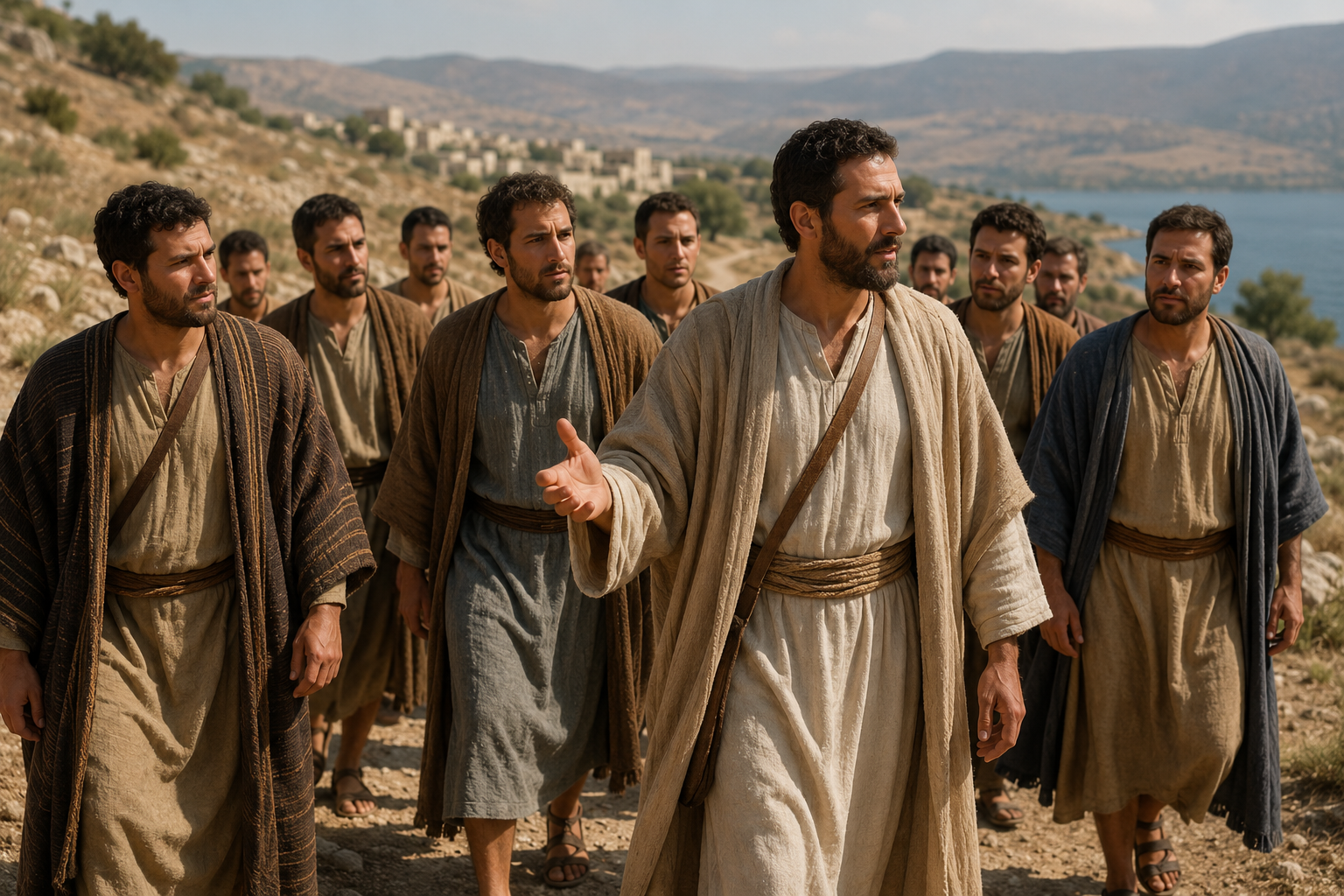
 Matthew 8–10 moves from the Lord Jesus Christ’s authoritative teaching to His authoritative works and then to His delegation of authority to the twelve apostles. Matthew 8 especially demonstrates Christ’s power over disease, devils, nature, and circumstances. Matthew 9 emphasizes His authority to forgive sins, His compassion toward sinners and sufferers, and the spiritual need of the multitudes. Matthew 10 records the naming and commissioning of the twelve, their specifically Israel-directed ministry, and Christ’s instructions concerning service, opposition, fear, loyalty, and reward.
Throughout these chapters, Jesus is presented not merely as another teacher, but as the Son of God, the Son of man, the promised Son of David, and the One possessing divine authority.
Chapter Summaries
Matthew 8 — The Authority of the King
Matthew 8 follows the Sermon on the Mount. Matthew 7:28–29 says the people were astonished because Christ taught “as one having authority, and not as the scribes.” Matthew 8 then demonstrates that authority through His works.
The cleansing of the leper — Matthew 8:1–4
After Jesus came down from the mountain, “great multitudes followed him.” A leper worshipped Him and said:
“Lord, if thou wilt, thou canst make me clean.” — Matthew 8:2
Jesus answered:
“I will; be thou clean.”
The man was immediately cleansed.
Several truths are explicit in the text. The leper believed Christ was able to cleanse him, but submitted the matter to Christ’s will. Jesus willingly touched a man suffering from leprosy and healed him immediately.
Christ then commanded him to show himself to the priest and “offer the gift that Moses commanded, for a testimony unto them.”
This occurred under the Mosaic order before the cross. Jesus did not instruct the man to disregard Moses’ command. The cleansing was supernatural, but the man was still directed to obey what Moses had commanded concerning the priestly examination and offering.
A devotional lesson is evident: biblical faith recognizes both Christ’s ability and Christ’s will. Faith does not dictate terms to God.
The centurion’s servant — Matthew 8:5–13
At Capernaum, a centurion appealed to Christ concerning his servant, who was “sick of the palsy, grievously tormented.”
The centurion declared that Christ did not need to enter his house. He understood authority and believed Christ could simply speak the word.
Jesus said:
“Verily I say unto you, I have not found so great faith, no, not in Israel.” — Matthew 8:10
Christ then spoke of people coming “from the east and west” and sitting down with Abraham, Isaac, and Jacob in the kingdom of heaven, while “the children of the kingdom” would be cast into outer darkness.
This does not erase the biblical distinction between Israel and the Church. It does demonstrate that physical privilege or ancestry cannot substitute for faith. Being associated outwardly with covenant privilege did not guarantee personal participation in kingdom blessing.
Jesus said to the centurion:
“Go thy way; and as thou hast believed, so be it done unto thee.”
The servant was healed “in the selfsame hour.”
Peter’s wife’s mother — Matthew 8:14–15
Jesus entered Peter’s house and found Peter’s wife’s mother sick with a fever.
The fact that Peter had a wife is explicit in the KJV text because the woman is called “his wife’s mother.”
Jesus:
“touched her hand, and the fever left her: and she arose, and ministered unto them.”
Her restoration was immediate and sufficient for her to resume service.
Many healed and devils cast out — Matthew 8:16–17
That evening many possessed with devils were brought to Christ.
Matthew says:
“he cast out the spirits with his word, and healed all that were sick.”
Matthew then applies Isaiah’s prophecy:
“Himself took our infirmities, and bare our sicknesses.”
The immediate context explicitly connects this statement with Christ’s healing ministry. It demonstrates His messianic compassion and power.
It should not be turned into a promise that every Christian is guaranteed immediate physical healing in the present age. Matthew describes what Christ did there; he does not state that every believer in every age is promised identical physical healing.
The seriousness of following Christ — Matthew 8:18–22
A scribe offered to follow Jesus wherever He went. Christ answered:
“The foxes have holes, and the birds of the air have nests; but the Son of man hath not where to lay his head.”
Another disciple wanted first to bury his father. Jesus answered:
“Follow me; and let the dead bury their dead.”
The passage clearly teaches that following Christ is not something to be approached casually or placed beneath other priorities.
A common interpretation understands the second occurrence of “dead” to refer to people spiritually dead, but Scripture does not explicitly define that expression in this verse. The certain point is that Christ demanded priority rather than postponement.
This concerns discipleship and following Christ. It should not be turned into a doctrine of salvation by works. Eternal salvation remains the gift of God received by faith, not a reward earned by sacrificial discipleship.
Jesus stills the tempest — Matthew 8:23–27
Jesus entered a ship with His disciples. A “great tempest” arose, while Jesus was asleep.
The disciples cried:
“Lord, save us: we perish.”
Jesus rebuked their fear and then:
“rebuked the winds and the sea; and there was a great calm.”
The disciples asked:
“What manner of man is this, that even the winds and the sea obey him!”
The incident demonstrates Christ’s authority over creation itself.
The passage does not merely teach that Jesus can comfort people emotionally during figurative “storms.” A literal storm occurred, and Jesus literally commanded the winds and sea. Devotional applications may legitimately be made from His care and power, but they should not replace the historical event.
The two possessed men in the country of the Gergesenes — Matthew 8:28–34
Matthew specifically records two men possessed with devils.
The devils cried:
“What have we to do with thee, Jesus, thou Son of God? art thou come hither to torment us before the time?”
Several truths are explicit.
The devils recognized Jesus as the Son of God. They knew that judgment awaited them. They knew Christ possessed authority over them.
They requested permission to enter a herd of swine. Jesus said:
“Go.”
The swine then ran violently into the sea and died in the waters.
The people of the city subsequently:
“besought him that he would depart out of their coasts.”
Matthew does not explicitly state every motive behind their request, so speculation concerning their exact inner reasoning should be avoided. The solemn fact is that the presence and power of Christ were demonstrated among them, yet they asked Him to leave.
Matthew 9 — The Authority, Compassion, and Harvest of Christ
Matthew 9 continues demonstrating the authority of Jesus but increasingly emphasizes the spiritual condition of men and Christ’s compassion toward them.
The man sick of the palsy and forgiveness of sins — Matthew 9:1–8
A man sick of the palsy was brought to Jesus.
Matthew says:
“Jesus seeing their faith said unto the sick of the palsy; Son, be of good cheer; thy sins be forgiven thee.”
Certain scribes accused Him inwardly of blasphemy.
Jesus responded by asking whether it was easier to say that the man’s sins were forgiven or to command him to arise and walk. He then declared:
“But that ye may know that the Son of man hath power on earth to forgive sins…”
He commanded the man to arise, take up his bed, and go home.
The healing visibly authenticated the authority that Christ claimed.
Only God can ultimately forgive sins against God. Jesus’ authority to forgive sins is therefore a powerful testimony to His divine identity.
The call of Matthew — Matthew 9:9
Jesus saw:
“a man, named Matthew, sitting at the receipt of custom.”
Jesus said:
“Follow me.”
Matthew:
“arose, and followed him.”
“Receipt of custom” refers to tax collection. The KJV explicitly identifies Matthew by name and occupation in this setting.
Jesus among publicans and sinners — Matthew 9:10–13
Jesus ate with “many publicans and sinners.”
When the Pharisees objected, Jesus replied:
“They that be whole need not a physician, but they that are sick.”
He then said:
“I will have mercy, and not sacrifice: for I am not come to call the righteous, but sinners to repentance.”
Christ did not participate in sin in order to reach sinners. His presence among sinners was redemptive, calling them to repentance.
Biblical repentance must not be turned into a meritorious work by which a sinner earns salvation. Nor does the passage teach that a sinner must reform his entire life before he may come to Christ. Salvation is by grace through faith.
As Ephesians 2:8–9 states:
“For by grace are ye saved through faith; and that not of yourselves: it is the gift of God: Not of works, lest any man should boast.”
The question concerning fasting — Matthew 9:14–17
John’s disciples asked why they and the Pharisees fasted while Christ’s disciples did not.
Jesus compared His presence to that of a bridegroom and said:
“Can the children of the bridechamber mourn, as long as the bridegroom is with them?”
He then used the illustrations of new cloth on an old garment and new wine in old bottles.
The immediate point concerns the changed situation created by Christ’s presence.
The illustrations may suggest the incompatibility of Christ’s work with attempts merely to attach it to old religious forms, but Matthew does not explicitly identify every detail of the cloth and bottles with a complete dispensational system. We should therefore avoid assigning meanings the text itself does not supply.
The ruler’s daughter and the woman with an issue of blood — Matthew 9:18–26
A ruler came and worshipped Christ, saying:
“My daughter is even now dead: but come and lay thy hand upon her, and she shall live.”
Matthew does not name the ruler in this chapter. The KJV parallels in Mark 5:22 and Luke 8:41 identify him as Jairus.
While Jesus went with him, a woman who had suffered an issue of blood for twelve years touched the hem of His garment.
She said within herself:
“If I may but touch his garment, I shall be whole.”
Jesus told her:
“Daughter, be of good comfort; thy faith hath made thee whole.”
She was made whole “from that hour.”
Jesus then came to the ruler’s house, took the girl by the hand, and:
“the maid arose.”
These accounts again combine Christ’s compassion, His response to faith, and His absolute authority over physical affliction and death.
Jack Hyles used Matthew 9:18 as part of his sermon “Behold My Hands,” emphasizing the personal touch seen repeatedly in Christ’s earthly ministry. That is a useful devotional observation, but the authority remains Matthew’s inspired account itself.
Two blind men healed — Matthew 9:27–31
Two blind men followed Jesus crying:
“Thou Son of David, have mercy on us.”
“Son of David” is an important messianic designation.
Jesus asked:
“Believe ye that I am able to do this?”
They answered, “Yea, Lord.”
Jesus touched their eyes and said:
“According to your faith be it unto you.”
Their eyes were opened.
Jesus “straitly charged them” not to make Him known, but they spread His fame through the country. Whatever motives they may have had, their spreading the report did not conform to the command Christ had just given them.
The dumb man possessed with a devil — Matthew 9:32–34
A dumb man possessed with a devil was brought to Jesus. After the devil was cast out, the man spoke.
The multitudes marveled, but the Pharisees said:
“He casteth out devils through the prince of the devils.”
Matthew records the accusation without giving it any legitimacy. Christ’s works were openly manifest, yet His enemies attributed them to evil.
Christ’s compassion and the harvest — Matthew 9:35–38
This closing section provides the spiritual setting for Matthew 10.
Jesus went through cities and villages:
“teaching in their synagogues, and preaching the gospel of the kingdom, and healing every sickness and every disease among the people.”
When He saw the multitudes:
“he was moved with compassion on them, because they fainted, and were scattered abroad, as sheep having no shepherd.”
Then He told His disciples:
“The harvest truly is plenteous, but the labourers are few.”
And:
“Pray ye therefore the Lord of the harvest, that he will send forth labourers into his harvest.”
Matthew 10 immediately records Christ sending the twelve.
The order is instructive: Christ saw, Christ had compassion, Christ commanded them to pray, and then Christ sent laborers.
Matthew 10 — The Commission and Instruction of the Twelve
The twelve apostles named — Matthew 10:1–4
Jesus gave His twelve disciples:
“power against unclean spirits, to cast them out, and to heal all manner of sickness and all manner of disease.”
Matthew names them:
Simon called Peter, Andrew, James the son of Zebedee, John, Philip, Bartholomew, Thomas, Matthew the publican, James the son of Alphaeus, Lebbaeus surnamed Thaddaeus, Simon the Canaanite, and Judas Iscariot.
Matthew adds concerning Judas:
“who also betrayed him.”
The miracles performed by the apostles were not presented as independent powers belonging to them. Christ gave them power.
A specifically Israel-directed commission — Matthew 10:5–8
Jesus explicitly commanded:
“Go not into the way of the Gentiles, and into any city of the Samaritans enter ye not: But go rather to the lost sheep of the house of Israel.”
Their message was:
“The kingdom of heaven is at hand.”
They were also commanded to heal, cleanse lepers, raise the dead, and cast out devils.
This distinction is important dispensationally.
Matthew 10 is not the Church’s universal Great Commission. This mission was explicitly restricted to “the lost sheep of the house of Israel.” After His resurrection Christ would command:
“Go ye therefore, and teach all nations…” — Matthew 28:19
The KJV therefore establishes a real distinction between the restricted mission of Matthew 10 and the later worldwide commission.
This does not mean God lacked concern for Gentiles. Matthew 8 has already shown Christ responding favorably to the centurion’s faith. It means the particular commission of Matthew 10 had a stated Israelite focus.
“Freely ye have received, freely give” — Matthew 10:8–15
The apostles were not to commercialize the supernatural authority Christ had given them.
They were commanded:
“freely ye have received, freely give.”
Christ gave specific instructions concerning money, provisions, lodging, and hospitality during this mission.
When a city rejected their message, they were to shake its dust from their feet.
Jesus warned:
“It shall be more tolerable for the land of Sodom and Gomorrha in the day of judgment, than for that city.”
Greater revelation brings greater accountability.
Sheep among wolves — Matthew 10:16–23
Jesus said:
“Behold, I send you forth as sheep in the midst of wolves: be ye therefore wise as serpents, and harmless as doves.”
Biblical ministry requires both wisdom and innocence. Being “harmless” does not mean being foolish, and being “wise” does not authorize dishonesty.
Christ warned of councils, synagogues, governors, kings, betrayal, hatred, and persecution.
When they were delivered up, He promised:
“For it is not ye that speak, but the Spirit of your Father which speaketh in you.”
The immediate context is testimony under persecution. It should not be misused as an excuse for careless preaching or refusal to study Scripture.
Jesus also said:
“he that endureth to the end shall be saved.”
This statement occurs inside a discourse about hostility and persecution. Matthew 10 does not present it as a complete formula explaining how a sinner receives eternal life. It therefore must not be isolated and made to teach salvation by human endurance.
Clear KJV passages teach salvation by grace through faith apart from works. Matthew 10 concerns faithfulness amid severe opposition.
Christ also says:
“Ye shall not have gone over the cities of Israel, till the Son of man be come.”
The wording is explicit; the complete chronology intended by “till the Son of man be come” is not fully explained within Matthew 10 itself. A dispensational interpretation may see a prophetic reach beyond the apostles’ immediate journey and toward God’s continuing prophetic dealings with Israel, but that conclusion should be identified as interpretation rather than something Matthew explicitly spells out in this verse.
The servant and his master — Matthew 10:24–25
Jesus said:
“The disciple is not above his master, nor the servant above his lord.”
If Christ was opposed and slandered, His servants should not assume faithful service will always bring public approval.
Christian faithfulness is not measured by popularity.
Fear God rather than men — Matthew 10:26–33
Christ repeatedly tells them not to fear men.
He says:
“Fear not them which kill the body, but are not able to kill the soul.”
Instead:
“fear him which is able to destroy both soul and body in hell.”
Jesus then reminds them that sparrows are under the Father’s knowledge and that:
“the very hairs of your head are all numbered.”
The doctrine is balanced beautifully: God is to be feared reverently, yet His servants may also rest in His meticulous care.
Christ then declares:
“Whosoever therefore shall confess me before men, him will I confess also before my Father which is in heaven.”
Loyalty to Christ must not be surrendered because of human opposition.
Christ, division, and supreme loyalty — Matthew 10:34–39
Jesus said:
“Think not that I am come to send peace on earth: I came not to send peace, but a sword.”
The following verses explain the nature of that “sword”: allegiance to Christ can divide even members of the same household.
This does not teach that Christians should be violent. The immediate verses speak of relational division arising because Christ must be loved above father, mother, son, or daughter.
Jesus says:
“He that loveth father or mother more than me is not worthy of me.”
And:
“he that taketh not his cross, and followeth after me, is not worthy of me.”
Taking up the cross concerns costly discipleship and allegiance. It is not a meritorious work by which eternal salvation is purchased.
Receiving Christ’s messengers and reward — Matthew 10:40–42
Jesus concludes:
“He that receiveth you receiveth me, and he that receiveth me receiveth him that sent me.”
He then speaks of rewards for receiving a prophet, a righteous man, or even giving:
“a cup of cold water only in the name of a disciple.”
Faithful service may appear small in human estimation, but nothing done rightly for Christ escapes His notice.
Key People and Places
Jesus Christ
The central Person throughout all three chapters. He exercises authority over sickness, devils, nature, sin, death, His disciples, and the terms of their mission. He is called the Son of man, Son of God, and Son of David in these chapters.
The leper
A man cleansed immediately by Christ in Matthew 8:1–4. His confidence in Christ’s ability was joined with submission to Christ’s will.
The centurion
An officer whose servant was grievously sick. Jesus commended his exceptional faith.
Peter
One of Christ’s disciples. Matthew 8 explicitly refers to Peter’s house and Peter’s wife’s mother.
Peter’s wife’s mother
Healed immediately of a fever, after which she ministered unto them.
The two men possessed with devils
Encountered in the country of the Gergesenes. The devils possessing them recognized Jesus as the Son of God.
Matthew
Found “sitting at the receipt of custom.” Jesus called him, and he arose and followed Christ.
Publicans and sinners
People with whom Jesus ate, prompting criticism from the Pharisees. Christ explained His mission using the illustration of a physician attending the sick.
Pharisees
Religious opponents who criticized Christ for receiving sinners and later accused Him of casting out devils “through the prince of the devils.”
John’s disciples
They questioned Jesus concerning fasting.
The ruler
A father whose daughter had died. Matthew does not name him in chapter 9; Mark 5:22 and Luke 8:41 identify him as Jairus.
The woman with an issue of blood
She had suffered twelve years and was made whole after coming to Christ in faith.
The two blind men
They addressed Jesus as “Son of David” and were healed.
The Twelve Apostles
Simon Peter, Andrew, James the son of Zebedee, John, Philip, Bartholomew, Thomas, Matthew, James the son of Alphaeus, Lebbaeus surnamed Thaddaeus, Simon the Canaanite, and Judas Iscariot.
Judas Iscariot
Explicitly identified by Matthew as the apostle “who also betrayed him.”
Capernaum
The city entered by Jesus in Matthew 8:5, where the centurion appealed to Him.
The country of the Gergesenes
The location named in the KJV in Matthew 8:28 for the encounter with the two men possessed with devils.
Israel
Central to Matthew 10. The twelve were explicitly sent to “the lost sheep of the house of Israel.”
Samaritans
The twelve were instructed during this particular mission not to enter their cities.
Gentiles
The twelve were initially commanded not to enter “the way of the Gentiles,” although Jesus foretold that His servants would eventually be brought before rulers and Gentiles for a testimony.
Sodom and Gomorrha
Used by Christ as examples when describing the seriousness of rejecting the testimony delivered by His commissioned messengers.
Main Doctrinal or Spiritual Themes
1. The absolute authority of Jesus Christ
Matthew 8–9 systematically displays Christ’s authority.
He commands disease, and disease departs. He commands devils, and they obey. He rebukes winds and sea, and there is calm. He forgives sins. He raises the dead. He gives supernatural authority to His apostles.
The proper response is not merely admiration of Jesus as a moral teacher, but recognition of His divine authority.
2. The deity of Christ
The devils themselves call Him:
“Jesus, thou Son of God.”
He possesses authority to forgive sins, exercises authority over creation, and claims supreme loyalty above the nearest human relationships.
These chapters harmonize with the broader KJV testimony that Jesus Christ is God manifest in the flesh.
3. Faith in Christ
Faith appears repeatedly.
The leper trusted Christ’s ability. The centurion believed Christ’s word was sufficient. The woman with the issue of blood came believing. The blind men believed He was able to heal them.
Biblical faith is directed toward Christ, not toward faith itself.
The lesson is not, “Believe strongly enough and anything you desire must happen.” The object of faith is the Lord Jesus Christ, who remains sovereign.
4. Christ’s compassion
Matthew 9:36 is particularly important:
“But when he saw the multitudes, he was moved with compassion on them…”
Christ did not look upon people merely as crowds. He saw them as “sheep having no shepherd.”
Sound fundamentalism should never become cold fundamentalism. Separation from error, doctrinal conviction, and strong preaching must coexist with genuine compassion for souls.
5. The seriousness of sin
Christ’s healing of the palsied man deliberately brings the issue of forgiveness to the forefront.
Man’s greatest problem is not ultimately disease, poverty, political oppression, or physical suffering. Those matters are real, but sin requires forgiveness.
Christ came to call:
“sinners to repentance.”
6. Salvation and discipleship must not be confused
Matthew 8 and Matthew 10 contain demanding statements about following Christ, suffering, taking up the cross, losing one’s life, and placing Christ above family relationships.
These are serious discipleship passages.
They should not be turned into a doctrine saying sinners purchase eternal life by surrender, suffering, cross-bearing, perseverance, or works.
The KJV explicitly declares:
“Not by works of righteousness which we have done, but according to his mercy he saved us…” — Titus 3:5
Salvation is by grace through faith. Faithful discipleship concerns the saved believer’s obedience, loyalty, service, suffering, and reward.
7. Israel and the Church must remain distinct
Matthew 10 gives unusually clear evidence for maintaining this distinction.
Jesus said:
“Go rather to the lost sheep of the house of Israel.”
That mission had a restriction which the later Great Commission does not have.
The plain text therefore does not support replacing Israel with the Church. God’s program concerning Israel must be allowed to remain what Scripture says it is, while the Church receives its own commission in the proper biblical setting.
8. The kingdom message in its historical setting
The twelve preached:
“The kingdom of heaven is at hand.”
That proclamation occurred before Christ’s crucifixion and resurrection and was specifically directed to Israel in this commission.
The historical setting should therefore be preserved. It should not simply be assumed that every instruction in Matthew 10 is identical in every detail to the Church’s later worldwide ministry.
9. Christ has authority over devils
Matthew repeatedly presents devils as real personal evil beings, not symbols of psychological problems or primitive explanations for disease.
They speak. They recognize Christ. They request permission. Christ commands them.
The grammatical-historical reading requires accepting the account as an actual supernatural encounter.
10. Judgment is real
Christ speaks plainly concerning judgment, outer darkness, Sodom and Gomorrha, and hell.
Matthew 10:28 warns:
“fear him which is able to destroy both soul and body in hell.”
Biblical preaching must include God’s love and compassion without removing His holiness and judgment.
11. Opposition is part of faithful service
Christ did not promise His apostles universal admiration.
He warned them concerning hatred, betrayal, persecution, councils, rulers, and divided families.
Faithfulness to Christ must therefore be measured by obedience to Scripture rather than popular acceptance.
12. God’s care for His servants
The same Christ who warns of persecution also says:
“the very hairs of your head are all numbered.”
The believer can therefore hold two truths together: serving Christ can be costly, and the Father never loses sight of His servants.
13. The need for laborers
Matthew 9 ends with one of Scripture’s clearest missionary burdens:
“The harvest truly is plenteous, but the labourers are few.”
The shortage is not in the harvest but in the laborers.
The response commanded by Christ is:
“Pray ye therefore the Lord of the harvest, that he will send forth labourers into his harvest.”
Practical Applications or Lessons
Trust Christ’s ability while submitting to His will
The leper did not doubt Christ’s power:
“thou canst make me clean.”
Yet he also said:
“if thou wilt.”
Biblical prayer combines confidence in God’s power with submission to God’s will.
Take Christ at His word
The centurion understood that Christ did not need physical proximity to exercise authority.
Believers likewise should trust what God has actually said rather than demanding visible confirmation before believing Him.
Serve after receiving God’s mercy
Peter’s wife’s mother arose and “ministered unto them” after Christ healed her.
Grace received should produce grateful service.
Do not reduce literal miracles to metaphors
The storm was real. The sicknesses were real. The devils were real. The dead girl was really raised.
Applications may be drawn from these accounts, but the historical events should remain primary.
Following Christ deserves first place
Matthew 8 shows that discipleship is not casual.
Christ has rightful priority over comfort, convenience, reputation, and competing loyalties.
Bring sinners to Christ rather than avoiding them self-righteously
Jesus was criticized for eating with publicans and sinners.
Biblical separation does not mean refusing to evangelize sinful people. Christ remained holy while deliberately reaching sinners with truth.
The believer must neither participate in sin nor become too self-righteous to reach sinners.
Remember that man’s deepest need is forgiveness
Christ dealt with the palsied man’s sins before demonstrating His authority through physical healing.
Churches must certainly show compassion toward physical needs, but they must never substitute humanitarian activity for the gospel.
Pray for laborers—and be willing to become one
Matthew 9:38 is followed immediately by Matthew 10, where Christ sends the twelve.
A believer praying for laborers should also be willing for God to use him.
Give freely what God has entrusted to you
Christ told the apostles:
“freely ye have received, freely give.”
Spiritual ministry should never become a scheme for exploiting people.
Combine wisdom with harmlessness
Christ did not say to choose between being shrewd and being innocent.
He commanded:
“wise as serpents, and harmless as doves.”
A Christian should neither be gullible nor deceitful.
Expect opposition without becoming fearful
Christ prepared His servants for rejection before He sent them.
Opposition does not automatically mean a ministry is outside God’s will, just as popularity does not automatically mean it has God’s approval.
Fear God more than men
Human beings can harm the body, but God is the ultimate Judge.
Fear of man produces compromise. Proper fear of God produces faithfulness.
Keep Christ above every earthly relationship
Family relationships are ordained by God and should be honored, but no human relationship may take precedence over obedience to Christ.
Jesus said:
“He that loveth father or mother more than me is not worthy of me.”
Do not confuse the cost of discipleship with the price of salvation
Christ calls His disciples to costly loyalty, but eternal life is not purchased by carrying a cross, enduring persecution, or sacrificing possessions.
Christ paid the price of redemption. The believer serves because he has been saved, not in order to earn salvation.
Never underestimate small acts of service
Christ closes Matthew 10 by mentioning something as ordinary as:
“a cup of cold water.”
Faithfulness is measured by God, not merely by the apparent size or visibility of the ministry.
Overall Message of Matthew 8–10
Matthew 8–10 presents the authority of the King, the compassion of the Savior, and the calling of His servants.
In Matthew 8, Jesus demonstrates authority over sickness, nature, and devils.
In Matthew 9, He demonstrates authority to forgive sins, responds to faith, raises the dead, shows mercy toward sinners, and looks upon the multitudes with compassion.
In Matthew 10, He delegates authority to the twelve and sends them on a specifically Israel-directed mission while preparing them for rejection, persecution, sacrifice, and reward.
The progression is significant:
Christ possesses the power.
Christ sees the need.
Christ has compassion.
Christ commands prayer.
Christ sends laborers.
The chapters call the believer to trust Christ’s authority, believe His Word, care about sinners, pray for laborers, maintain doctrinal discernment, remain faithful under opposition, and give Jesus Christ supreme loyalty.
At the same time, careful interpretation requires keeping the historical setting intact. The miracles are literal. The devils are real. Israel remains Israel. The restricted commission of Matthew 10 should not be confused with the later universal commission of the Church. Discipleship should not be confused with justification. And interpretations should never be made more certain than the KJV text itself permits.
Comments are closed