
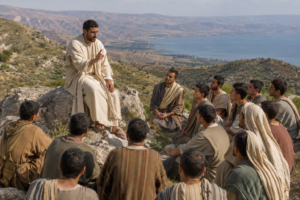
 Matthew 5–7 records the teaching commonly called the Sermon on the Mount. The KJV text itself gives the setting plainly:
“And seeing the multitudes, he went up into a mountain: and when he was set, his disciples came unto him: And he opened his mouth, and taught them…” — Matthew 5:1–2
The disciples are specifically said to come unto Him, while the multitudes are also present and hear His teaching, as Matthew 7:28 says, “the people were astonished at his doctrine.” Scripture does not identify the particular mountain, so it should not be stated as certain which modern location it was.
The discourse emphasizes the righteousness, heart condition, worship, relationships, priorities, discernment, and obedience fitting those who hear Christ. In Matthew’s context, the “kingdom of heaven” is prominent. A dispensational reading should neither confuse Israel with the Church nor dismiss the Sermon as irrelevant to believers today. Much of its moral teaching expresses truths concerning holiness, honesty, prayer, faith, love, separation from hypocrisy, and obedience that are confirmed elsewhere in the New Testament.
It is also essential not to turn Matthew 5–7 into a system of salvation by human merit. Scripture is clear elsewhere:
“Knowing that a man is not justified by the works of the law, but by the faith of Jesus Christ…” — Galatians 2:16
The Sermon exposes the insufficiency of outward religion and presses the hearer toward genuine righteousness before God.
Chapter Summaries
Matthew 5 — The Character and Righteousness Christ Requires
The setting — Matthew 5:1–2
Jesus sees the multitudes, goes “up into a mountain,” sits down, and His disciples come unto Him. He then begins teaching.
His posture as the authoritative Teacher is unmistakable throughout the chapter. Again and again He declares:
“But I say unto you…”
The people later recognize something distinctive about His authority:
“For he taught them as one having authority, and not as the scribes.” — Matthew 7:29
The Beatitudes — Matthew 5:3–12
Christ begins with a series of statements identifying those whom He calls “blessed.”
Among them are:
- “the poor in spirit”
- “they that mourn”
- “the meek”
- those who “hunger and thirst after righteousness”
- “the merciful”
- “the pure in heart”
- “the peacemakers”
- those “persecuted for righteousness’ sake”
The blessings include comfort, mercy, seeing God, being called the children of God, and possessing the kingdom of heaven.
These verses should not be treated as a ladder of works by which a sinner earns salvation. The text describes spiritual qualities and divine blessings; it does not say that performing a prescribed number of these qualities merits justification.
Christ also prepares His followers for opposition:
“Blessed are ye, when men shall revile you, and persecute you… for my sake.” — Matthew 5:11
Thus faithfulness to Christ does not guarantee acceptance by the world.
Salt and light — Matthew 5:13–16
Jesus tells His disciples:
“Ye are the salt of the earth…”
and:
“Ye are the light of the world.”
The believer’s life is not meant to be hidden or indistinguishable from the surrounding world.
Christ says:
“Let your light so shine before men, that they may see your good works, and glorify your Father which is in heaven.” — Matthew 5:16
The purpose is not self-glory. Good works are to direct glory toward God.
Christ and the law — Matthew 5:17–20
Jesus makes a crucial statement:
“Think not that I am come to destroy the law, or the prophets: I am not come to destroy, but to fulfil.” — Matthew 5:17
He does not treat the Old Testament as mistaken, disposable, or inferior revelation. He affirms its authority and fulfills that to which it pointed.
Jesus then warns:
“Except your righteousness shall exceed the righteousness of the scribes and Pharisees, ye shall in no case enter into the kingdom of heaven.” — Matthew 5:20
The verse does not say that salvation is obtained by accumulating more religious works than the Pharisees. The remainder of the chapter demonstrates that God’s standard reaches beyond merely outward conduct into the heart, motives, desires, speech, and relationships.
This agrees with the broader biblical doctrine that justification cannot come through law-keeping. Rather than making self-righteousness achievable, Christ’s teaching exposes its inadequacy.
Murder and anger — Matthew 5:21–26
Jesus moves beyond the external crime of murder to sinful anger and contempt.
He therefore emphasizes reconciliation:
“First be reconciled to thy brother, and then come and offer thy gift.” — Matthew 5:24
Religious activity does not excuse unresolved wrongdoing toward another person.
Adultery and the heart — Matthew 5:27–30
Christ declares:
“Whosoever looketh on a woman to lust after her hath committed adultery with her already in his heart.” — Matthew 5:28
This directly establishes that biblical purity concerns more than outward behavior. God sees sinful desire in the heart.
Christ’s severe language concerning the offending eye and hand stresses the seriousness with which sin must be treated. The passage does not command self-mutilation as a means of salvation; its own emphasis is upon dealing decisively with sin rather than cherishing it.
Divorce — Matthew 5:31–32
Jesus addresses the practice of putting away one’s wife and explicitly mentions “saving for the cause of fornication.”
The passage presents marriage as a serious covenantal matter rather than something to be discarded casually. Any broader treatment of divorce and remarriage should account for all directly relevant KJV passages rather than constructing conclusions from this statement alone.
Oaths and truthful speech — Matthew 5:33–37
Christ rejects manipulative or deceptive oath-taking and says:
“But let your communication be, Yea, yea; Nay, nay…” — Matthew 5:37
The spiritual principle is straightforward: God’s people should be truthful enough that their ordinary word can be trusted.
Retaliation — Matthew 5:38–42
Jesus confronts the spirit of personal retaliation:
“But whosoever shall smite thee on thy right cheek, turn to him the other also.” — Matthew 5:39
The immediate emphasis is personal response to injury rather than personal vengeance.
This passage should not be expanded beyond what it says into a denial of every biblical function of civil government, judicial punishment, or legitimate authority.
Love for enemies — Matthew 5:43–48
One of the chapter’s highest demands is:
“Love your enemies, bless them that curse you, do good to them that hate you, and pray for them which despitefully use you, and persecute you.” — Matthew 5:44
Christ’s followers are not merely to love those who love them.
He points to the Father’s goodness:
“For he maketh his sun to rise on the evil and on the good…” — Matthew 5:45
The chapter concludes:
“Be ye therefore perfect, even as your Father which is in heaven is perfect.” — Matthew 5:48
Christ does not lower God’s standard to accommodate man’s sinfulness. God’s own character remains the standard.
Matthew 6 — Worship Before God and Trust in the Father
Matthew 6 turns especially toward motives. Religious actions that appear righteous before men can be corrupted when performed for human praise.
Giving — Matthew 6:1–4
Jesus warns:
“Take heed that ye do not your alms before men, to be seen of them…” — Matthew 6:1
The problem is not that another person can ever know about charitable giving. Christ specifically identifies the corrupt motive: “to be seen of them.”
He condemns religious showmanship.
The repeated principle is:
“Thy Father which seeth in secret himself shall reward thee openly.” — Matthew 6:4
God sees what men cannot.
Prayer — Matthew 6:5–15
Christ condemns hypocritical public display in prayer:
“For they love to pray standing in the synagogues and in the corners of the streets, that they may be seen of men.” — Matthew 6:5
Again, the condemned element is seeking human recognition.
Jesus also warns:
“But when ye pray, use not vain repetitions, as the heathen do…” — Matthew 6:7
Prayer is not a magical formula in which repetition forces God’s response.
The pattern of prayer
Jesus says:
“After this manner therefore pray ye…” — Matthew 6:9
The prayer begins with God:
“Our Father which art in heaven, Hallowed be thy name.”
It then concerns His kingdom and will:
“Thy kingdom come. Thy will be done in earth, as it is in heaven.”
Then come petitions for daily provision, forgiveness, spiritual protection, and deliverance:
“Give us this day our daily bread.”
“And forgive us our debts, as we forgive our debtors.”
“And lead us not into temptation, but deliver us from evil…”
Prayer is therefore God-centered before it becomes need-centered.
Forgiveness — Matthew 6:14–15
Christ stresses the seriousness of an unforgiving spirit.
This passage should not be made to contradict salvation by grace through faith. Rather, it demonstrates that a person asking the Father for mercy while stubbornly withholding mercy from others is acting inconsistently with the character Christ commands.
Fasting — Matthew 6:16–18
As with giving and prayer, Christ rejects religious performance designed to impress observers.
“But thou, when thou fastest, anoint thine head, and wash thy face; That thou appear not unto men to fast…” — Matthew 6:17–18
Fasting is presented as a legitimate religious practice, but not a means of displaying supposed spirituality.
Treasure — Matthew 6:19–21
Jesus contrasts earthly and heavenly treasure:
“Lay not up for yourselves treasures upon earth…”
but:
“Lay up for yourselves treasures in heaven…” — Matthew 6:19–20
Then comes the searching principle:
“For where your treasure is, there will your heart be also.” — Matthew 6:21
Possessions reveal priorities.
The eye — Matthew 6:22–23
Christ speaks of the eye as “the light of the body” and contrasts a single eye with an evil eye.
In the immediate flow, this follows the discussion of treasure and precedes the warning about serving two masters. The context therefore connects one’s spiritual outlook with what commands one’s devotion.
Further explanations beyond that should be stated cautiously rather than made into facts the passage does not expressly define.
God or mammon — Matthew 6:24
Christ’s statement is absolute:
“No man can serve two masters… Ye cannot serve God and mammon.”
Money is not itself declared sinful here. The issue is mastery.
God will not accept divided supreme allegiance.
Trusting the Father — Matthew 6:25–34
Christ tells His disciples:
“Take no thought for your life, what ye shall eat, or what ye shall drink…”
He points to the birds:
“Behold the fowls of the air… your heavenly Father feedeth them.”
He points to the lilies:
“Consider the lilies of the field, how they grow…”
Then Christ identifies the central priority:
“But seek ye first the kingdom of God, and his righteousness; and all these things shall be added unto you.” — Matthew 6:33
The passage does not forbid diligence, labor, stewardship, or prudent preparation. Rather, in its immediate context, it condemns the anxious preoccupation that lives as though the heavenly Father neither knows nor provides.
Christ concludes:
“Sufficient unto the day is the evil thereof.” — Matthew 6:34
The believer should deal faithfully with today’s responsibilities rather than attempting to carry tomorrow’s burdens before tomorrow arrives.
Matthew 7 — Discernment, Prayer, Two Ways, and Final Accountability
Matthew 7 brings the Sermon toward a series of sharp contrasts:
- hypocritical judgment versus righteous self-examination,
- asking God versus unbelieving self-sufficiency,
- the broad way versus the narrow way,
- true prophets versus false prophets,
- genuine submission versus empty profession,
- the rock versus the sand.
Judgment and self-examination — Matthew 7:1–5
Jesus says:
“Judge not, that ye be not judged.” — Matthew 7:1
This verse is sometimes treated as though Christians are forbidden to make any moral judgment whatsoever. The immediate context does not support that conclusion.
Christ describes a man trying to remove a mote from his brother’s eye while ignoring a beam in his own.
He commands:
“First cast out the beam out of thine own eye; and then shalt thou see clearly to cast out the mote out of thy brother’s eye.” — Matthew 7:5
Thus Christ condemns hypocritical judgment, not all discernment.
That conclusion is further required by the same chapter, because Christ soon commands His hearers to identify false prophets “by their fruits.”
Dogs and swine — Matthew 7:6
Jesus says:
“Give not that which is holy unto the dogs, neither cast ye your pearls before swine…”
The verse plainly requires some degree of spiritual discernment concerning how holy things are treated.
Scripture does not explicitly identify every situation to which this statement should be applied, so applications should not be made more dogmatic than the text.
Ask, seek, knock — Matthew 7:7–11
Christ encourages prayer:
“Ask, and it shall be given you; seek, and ye shall find; knock, and it shall be opened unto you…” — Matthew 7:7
He then reasons from earthly fathers to the heavenly Father.
“If ye then, being evil, know how to give good gifts unto your children, how much more shall your Father which is in heaven give good things to them that ask him?” — Matthew 7:11
God is neither reluctant nor indifferent toward His children.
This does not make prayer a method of compelling God to satisfy every human desire. The promise concerns the goodness of the Father, who gives “good things.”
The Golden Rule — Matthew 7:12
Jesus summarizes a vast principle of interpersonal righteousness:
“Therefore all things whatsoever ye would that men should do to you, do ye even so to them…” — Matthew 7:12
He adds:
“for this is the law and the prophets.”
Biblical love is active. It does not merely refrain from harming others; it seeks to treat others rightly.
The two ways — Matthew 7:13–14
Christ describes two gates and two ways.
The broad way:
“wide is the gate, and broad is the way, that leadeth to destruction…”
The narrow way:
“strait is the gate, and narrow is the way, which leadeth unto life…”
Christ emphatically rejects the idea that every religious path ultimately reaches the same destination.
There are two ways, and they end differently.
False prophets — Matthew 7:15–20
Jesus warns:
“Beware of false prophets, which come to you in sheep’s clothing, but inwardly they are ravening wolves.” — Matthew 7:15
Outward religious appearance therefore proves nothing by itself.
Christ says:
“Ye shall know them by their fruits.” — Matthew 7:16
The section repeatedly stresses fruit:
“A good tree cannot bring forth evil fruit, neither can a corrupt tree bring forth good fruit.” — Matthew 7:18
Doctrine and life must be examined rather than religious claims accepted merely because the speaker appears harmless.
False profession — Matthew 7:21–23
This is among the most solemn passages in the Sermon.
“Not every one that saith unto me, Lord, Lord, shall enter into the kingdom of heaven…” — Matthew 7:21
The rejected people appeal to impressive religious works:
“have we not prophesied in thy name? and in thy name have cast out devils? and in thy name done many wonderful works?”
Christ does not answer that their works were insufficiently numerous.
He says:
“I never knew you: depart from me, ye that work iniquity.” — Matthew 7:23
Notice the exact wording: “I never knew you.”
The text does not say, “I knew you once.” Therefore this passage should not be used to teach that these people possessed eternal salvation and subsequently lost it.
Neither should the passage be used to teach salvation by religious works. The very people rejected are appealing to their works.
Their religious profession and remarkable claims cannot substitute for reality before Christ.
The wise and foolish builders — Matthew 7:24–27
Jesus concludes with two men.
The wise man:
“heareth these sayings of mine, and doeth them”
and builds upon a rock.
When rain, floods, and winds come:
“it fell not: for it was founded upon a rock.”
The foolish man:
“heareth these sayings of mine, and doeth them not”
and builds upon sand.
His house falls:
“and great was the fall of it.”
The contrast is between merely hearing Christ and actually responding obediently to His words.
This is not permission to teach justification by works. Rather, Christ exposes the worthlessness of a profession that hears His truth while deliberately refusing it.
The authority of Christ — Matthew 7:28–29
The Sermon ends with the people’s reaction:
“the people were astonished at his doctrine: For he taught them as one having authority, and not as the scribes.”
Christ does not speak as one religious commentator presenting possibilities. He speaks with authority.
That is a major theme running through all three chapters.
Key People and Places
Jesus Christ
The Speaker and central authority throughout Matthew 5–7. He teaches concerning righteousness, the kingdom of heaven, the Father, prayer, judgment, eternal destiny, and obedience to “these sayings of mine.”
The disciples
Matthew 5:1 explicitly says:
“his disciples came unto him.”
They are the immediate group specifically described as approaching Jesus for this teaching.
The multitudes
Matthew 5:1 mentions “the multitudes,” and Matthew 7:28 says:
“the people were astonished at his doctrine.”
Therefore the teaching is given to the disciples with a wider multitude hearing it.
The heavenly Father
Repeatedly mentioned throughout the Sermon. Jesus teaches His disciples to pray:
“Our Father which art in heaven…”
God is presented as seeing secret devotion, rewarding according to His will, knowing needs, providing necessities, and giving good things.
Scribes and Pharisees
Named in Matthew 5:20.
Christ declares that His hearers’ righteousness must exceed theirs. The verse itself does not provide a complete description of every scribe or Pharisee, so claims about their individual motives should not be added beyond what Scripture establishes.
Prophets
The prophets are mentioned both positively and negatively. Earlier prophets suffered persecution (Matthew 5:12), while Matthew 7 warns of “false prophets.”
Publicans
Mentioned in Matthew 5:46 as an example in Christ’s argument concerning loving only those who love us.
The heathen
Mentioned in Matthew 6:7 concerning “vain repetitions” in prayer.
Solomon
Named in Matthew 6:29:
“even Solomon in all his glory was not arrayed like one of these.”
Christ uses Solomon’s glory to emphasize God’s care in clothing the lilies.
Jerusalem
The principal named earthly location within the Sermon itself:
“Jerusalem… is the city of the great King.” — Matthew 5:35
The unnamed mountain
Matthew says Jesus “went up into a mountain.” The KJV gives no name for it in these chapters. Assigning a particular traditional location as certain would go beyond the text.
Heaven
Frequently mentioned as the dwelling of the Father and the location of heavenly treasure.
Hell
Christ explicitly warns of “hell fire” in Matthew 5:22 and speaks again of being “cast into hell” in Matthew 5:29–30. The Sermon therefore includes genuine warnings of divine judgment, not merely instruction for improving earthly life.
Main Doctrinal or Spiritual Themes
1. The absolute holiness of God
The Sermon does not reduce righteousness to outward respectability.
Christ deals with:
- anger,
- contempt,
- lust,
- truthfulness,
- retaliation,
- hatred,
- greed,
- hypocrisy,
- anxiety,
- judgment,
- false profession,
- and disobedience.
The climactic statement of Matthew 5 is:
“Be ye therefore perfect, even as your Father which is in heaven is perfect.”
God, not surrounding culture, is the standard.
2. Heart righteousness rather than mere outward religion
Matthew 5–6 repeatedly exposes the heart.
A person may refrain from murder yet harbor sinful anger.
A person may refrain from outward adultery yet entertain lust.
A person may give, pray, or fast while secretly craving human praise.
Christ therefore attacks the dangerous assumption that outward respectability necessarily equals spiritual righteousness.
3. Christ’s authority
The repeated:
“But I say unto you…”
culminates in Matthew 7:29:
“he taught them as one having authority.”
Jesus Christ speaks with divine authority concerning man’s heart, God’s law, heaven, hell, judgment, prayer, and eternal destiny.
4. Christ fulfills the law and the prophets
Christ explicitly says:
“I am not come to destroy, but to fulfil.”
The Mosaic law cannot justify a sinner, and the Church must not be confused with Israel under the Mosaic covenant. Nevertheless, Christ does not dishonor Old Testament revelation.
The Christian receives a completed revelation in which the law’s purpose and Christ’s fulfillment must be understood in light of the whole KJV Bible.
5. The kingdom of heaven
The phrase occurs repeatedly.
Matthew’s Gospel has a definite kingdom emphasis. Conservative dispensational interpretation should preserve the biblical distinction between Israel and the Church rather than making those terms interchangeable.
At the same time, the spiritual and moral truths Christ teaches—including purity, honesty, prayer, mercy, faith, and obedience—cannot simply be discarded as though Christians have no obligation to them.
6. Salvation is not earned through religious works
Matthew 7:22 is especially important because the rejected people point directly to their religious accomplishments:
“have we not prophesied in thy name?… and in thy name done many wonderful works?”
Yet Christ says:
“I never knew you.”
Their works do not save them.
The biblical doctrine remains:
“For by grace are ye saved through faith; and that not of yourselves: it is the gift of God: Not of works…” — Ephesians 2:8–9
Good works belong in the Christian life, but they must never be substituted for the grace of God in salvation.
7. Genuine faith is not empty profession
Matthew 7 strongly distinguishes reality from appearance:
- sheep’s clothing versus ravening wolves,
- good fruit versus corrupt fruit,
- “Lord, Lord” versus being known by Christ,
- hearing versus doing,
- rock versus sand.
Christianity is more than religious vocabulary.
8. Prayer and dependence upon God
Matthew 6–7 presents prayer as personal dependence upon the heavenly Father.
Believers are commanded to ask, seek, and knock while trusting the Father’s goodness.
Prayer must not become:
- theatrical,
- hypocritical,
- mechanical,
- or vainly repetitive.
9. Separation from hypocrisy
One repeated enemy throughout the Sermon is religious hypocrisy.
“Be not ye therefore like unto them…” — Matthew 6:8
The believer is not to pattern his worship after men whose chief concern is being admired.
Biblical separation begins with refusing to imitate sin and religious falsehood.
10. Heavenly priorities
Christ commands:
“Lay up for yourselves treasures in heaven…”
and:
“seek ye first the kingdom of God, and his righteousness…”
The believer’s life should therefore be governed by eternity rather than material accumulation.
11. God’s fatherly care
The Lord repeatedly points His disciples toward the Father.
He sees what is done secretly.
He knows what His children need.
He feeds the fowls.
He clothes the grass.
He gives good things to those who ask Him.
Faith rests in the character of God rather than in favorable circumstances.
12. Love that exceeds natural affection
Christ asks:
“For if ye love them which love you, what reward have ye?”
Loving friends requires little supernatural distinction.
Christ commands His followers to love enemies, bless those who curse them, do good toward those who hate them, and pray for persecutors.
That does not call evil good. It forbids personal hatred and vengeance.
13. Biblical discernment
“Judge not” cannot mean “discern nothing,” because the same chapter commands:
“Beware of false prophets…”
and:
“Ye shall know them by their fruits.”
Christ condemns hypocritical judgment while requiring spiritual discernment.
14. The reality of final judgment
Matthew 7 leaves no room for universal salvation.
There is:
- a way leading to destruction,
- a way leading to life,
- corrupt trees cast into fire,
- false professors rejected by Christ,
- and a final separation between genuine and false profession.
Eternity is therefore one of the Sermon’s central concerns.
Practical Applications or Lessons
Examine the heart, not merely the outward act
It is possible to avoid a visible scandal while harboring anger, lust, pride, envy, or bitterness. Christ demands holiness inwardly as well as outwardly.
Refuse religious performance
Giving, praying, fasting, preaching, and serving can become spiritually corrupt when the purpose is human applause.
The repeated concern of Matthew 6 is doing spiritual things “to be seen of men.”
Keep your word
Christ says:
“Let your communication be, Yea, yea; Nay, nay.”
A Christian should cultivate such honesty that deception and manipulative promises have no place in his speech.
Seek reconciliation
Christ places great importance upon being reconciled to an offended brother.
Pride should not be permitted to preserve unnecessary division.
Guard the eyes and imagination
Matthew 5:28 makes inward sexual purity a biblical matter.
A believer should therefore refuse to entertain lust merely because no outward act has occurred.
Love enemies without approving their wrongdoing
Christ commands love, blessing, doing good, and prayer toward enemies.
Biblical love does not require calling sin righteousness. It requires refusing hatred, bitterness, and personal vengeance.
Give secretly when possible
Do good because it pleases God, not because it improves reputation.
The Father sees what other people never see.
Develop a genuine prayer life
Prayer should be directed toward God rather than performed for an audience.
Christ teaches reverence for God’s name, submission to God’s will, dependence for daily needs, confession and forgiveness, and prayer for spiritual protection.
Hold possessions loosely
Earthly treasure is temporary.
“For where your treasure is, there will your heart be also.”
A person’s use of money often reveals what he truly values.
Choose your master
Christ leaves no middle ground:
“Ye cannot serve God and mammon.”
Money may be possessed, used, saved, given, and stewarded, but it must never become the believer’s master.
Trust God’s care
The Father knows what His children need.
The answer to anxious preoccupation is not carelessness but reordered priorities:
“seek ye first the kingdom of God, and his righteousness.”
Correct yourself before correcting others
The beam must be addressed before the mote.
Personal repentance gives moral clarity to biblical correction.
Practice discernment
Not everyone using Christian terminology is sound.
Christ explicitly warns:
“Beware of false prophets.”
Doctrine, fruit, and faithfulness to Scripture matter.
Do not confuse religious activity with salvation
Matthew 7:22 describes people claiming extraordinary ministry accomplishments.
Christ’s response is nevertheless:
“I never knew you.”
Church involvement, preaching, religious experiences, supposed miracles, and outward works cannot replace salvation by grace through faith.
Build upon Christ’s words
The Sermon ends not with admiration but with obedience.
The wise man:
“heareth these sayings of mine, and doeth them.”
Bible knowledge that never affects conduct leaves a person in the position of the foolish builder.
Remember that storms reveal foundations
Both houses experience adverse conditions.
The distinction is the foundation.
Following Christ is not a promise that no storms will come. The passage teaches that one’s foundation determines what remains when the testing comes.
Overall Message of Matthew 5–7
Matthew 5–7 presents Jesus Christ as the authoritative King and Teacher, exposing shallow religion and demanding righteousness that reaches the heart.
The Sermon begins with those Christ calls blessed and ends with two houses standing before a storm.
Between those points, the Lord addresses nearly every major area of personal spiritual life: character, influence, Scripture, anger, purity, marriage, speech, retaliation, love, giving, prayer, fasting, possessions, anxiety, judgment, discernment, eternal destiny, and obedience.
The central problem Christ exposes is the tendency of fallen man to substitute appearance for reality:
- outward law-keeping instead of heart holiness,
- religious ceremony instead of communion with God,
- human praise instead of the Father’s approval,
- material security instead of faith,
- hypocritical criticism instead of self-examination,
- profession instead of possession,
- and hearing instead of obeying.
Yet the Sermon is not a ladder by which sinners earn eternal life. Scripture teaches salvation by grace through faith apart from works. Rather, Christ tears away man’s confidence in outward righteousness and declares the character, priorities, and obedience appropriate to those who hear Him.
The final issue is therefore not whether a person admires the Sermon on the Mount, but what he does with the words of Christ:
“Therefore whosoever heareth these sayings of mine, and doeth them, I will liken him unto a wise man, which built his house upon a rock.” — Matthew 7:24
And the final testimony of the multitude emphasizes why His words demand attention:
“For he taught them as one having authority, and not as the scribes.” — Matthew 7:29
How useful was this post?
Click on a star to rate it!
Average rating 0 / 5. Vote count: 0
No votes so far! Be the first to rate this post.
We are sorry that this post was not useful for you!
Let us improve this post!
Tell us how we can improve this post?
Comments are closed