
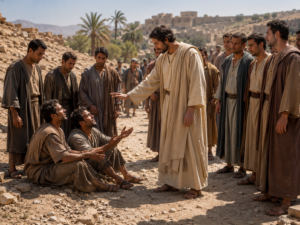
 Matthew 18–20 records the Lord Jesus Christ teaching His disciples about humility, offenses, restoration, forgiveness, marriage, riches, service, reward, His approaching death and resurrection, and compassionate faith. The chapters repeatedly overturn man’s natural ideas of greatness. In Christ’s teaching, greatness is connected with humility and service, while discipleship requires submission to God’s Word rather than pride, wealth, position, or personal ambition.
Chapter Summaries
Matthew 18 — Humility, Offenses, Restoration, and Forgiveness
Matthew 18 begins with the disciples asking:
“Who is the greatest in the kingdom of heaven?” — Matthew 18:1
Jesus answers by calling a little child unto Him and teaching that entrance into the kingdom and greatness within it cannot be approached through human pride:
“Except ye be converted, and become as little children, ye shall not enter into the kingdom of heaven.” — Matthew 18:3
The emphasis is not that children are sinless, nor that childishness saves. Christ emphasizes humility:
“Whosoever therefore shall humble himself as this little child, the same is greatest in the kingdom of heaven.” — Matthew 18:4
The passage therefore condemns the disciples’ pursuit of rank and establishes humility as characteristic of those who submit themselves to Christ.
Christ next warns seriously against causing believers to stumble. He speaks of offending “one of these little ones which believe in me” (Matthew 18:6). Whatever wider applications may legitimately be made, the text explicitly identifies these “little ones” as those who believe in Him.
Jesus then commands radical seriousness concerning personal sin:
“If thy hand or thy foot offend thee, cut them off, and cast them from thee…” — Matthew 18:8
The language stresses that sin must not be treated casually. Scripture does not command self-mutilation as a means of sanctification; the surrounding teaching emphasizes removing occasions of stumbling rather than tolerating sin.
Matthew 18:10 warns:
“Take heed that ye despise not one of these little ones…”
Christ adds that “their angels do always behold the face of my Father which is in heaven.” Scripture explicitly teaches angelic interest here, but Scripture does not explicitly say that every believer possesses one permanently assigned personal “guardian angel.” That conclusion should not be presented more strongly than the text permits.
Christ then gives the illustration of the wandering sheep:
“Even so it is not the will of your Father which is in heaven, that one of these little ones should perish.” — Matthew 18:14
The emphasis is the Father’s concern for those whom men may consider insignificant.
Dealing with a Sinning Brother
Matthew 18:15–17 provides an orderly procedure when “thy brother shall trespass against thee”:
- Go to him privately.
- If he will not hear, take one or two more.
- If he refuses them, “tell it unto the church.”
- If he refuses to hear the church, he is to be treated “as an heathen man and a publican.”
This passage gives an important biblical foundation for orderly local-church discipline. The purpose begins with restoration:
“If he shall hear thee, thou hast gained thy brother.” — Matthew 18:15
The first objective is not public humiliation but recovering the brother.
Verses 18–20 follow in this same setting. Therefore, although Christ’s promise concerning His presence is precious in every legitimate gathering in His name, its immediate context includes agreement, prayer, authority, and church discipline:
“For where two or three are gathered together in my name, there am I in the midst of them.” — Matthew 18:20
Forgiveness
Peter then asks:
“Lord, how oft shall my brother sin against me, and I forgive him? till seven times?” — Matthew 18:21
Jesus answers:
“I say not unto thee, Until seven times: but, Until seventy times seven.” — Matthew 18:22
Christ is not establishing 490 as the maximum number of allowable acts of forgiveness. The plain force of His answer is that the believer must not cultivate a calculating, limited spirit of mercy.
The parable of the unforgiving servant follows. A servant forgiven an enormous debt refuses mercy to a fellow servant owing him far less.
Its concluding lesson is unmistakable:
“So likewise shall my heavenly Father do also unto you, if ye from your hearts forgive not every one his brother their trespasses.” — Matthew 18:35
This should not be made into salvation by works. Eternal salvation is not earned by forgiving others. Rather, those who have been shown great mercy by God have no biblical justification for harboring a merciless spirit toward others.
Matthew 19 — Marriage, Children, Riches, and the Cost of Discipleship
Matthew 19 opens with Jesus leaving Galilee:
“He departed from Galilee, and came into the coasts of Judaea beyond Jordan.” — Matthew 19:1
Great multitudes follow Him, and He heals them.
Marriage and Divorce
The Pharisees approach Christ “tempting him” and ask:
“Is it lawful for a man to put away his wife for every cause?” — Matthew 19:3
Jesus goes beyond contemporary argument and returns directly to God’s creation order:
“Have ye not read, that he which made them at the beginning made them male and female…” — Matthew 19:4
He continues:
“For this cause shall a man leave father and mother, and shall cleave to his wife: and they twain shall be one flesh?” — Matthew 19:5
Then comes Christ’s direct conclusion:
“What therefore God hath joined together, let not man put asunder.” — Matthew 19:6
Several truths are explicit:
- God created mankind “male and female.”
- Marriage joins a man to “his wife.”
- Husband and wife become “one flesh.”
- God’s intention for marriage is permanence.
- Man is warned against separating what God has joined.
When the Pharisees appeal to Moses, Jesus answers:
“Moses because of the hardness of your hearts suffered you to put away your wives: but from the beginning it was not so.” — Matthew 19:8
Christ explicitly names “fornication” in His statement concerning divorce and remarriage in verse 9. The text therefore does not permit believers to treat divorce as a casual answer to ordinary marital difficulty.
The disciples respond that, under such a standard, “it is not good to marry.” Christ then discusses those who are eunuchs for differing reasons, including those “which have made themselves eunuchs for the kingdom of heaven’s sake” (Matthew 19:12).
In context, this may indicate voluntary remaining unmarried in order to devote oneself to God’s service. The passage does not establish compulsory celibacy for ministers or make celibacy a means of obtaining grace.
Jesus and the Little Children
Children are brought to Jesus:
“that he should put his hands on them, and pray.” — Matthew 19:13
The disciples rebuke those bringing them, but Jesus says:
“Suffer little children, and forbid them not, to come unto me: for of such is the kingdom of heaven.” — Matthew 19:14
Jesus receives rather than despises them.
The Rich Young Man
A man asks:
“Good Master, what good thing shall I do, that I may have eternal life?” — Matthew 19:16
His question is already framed around something he can do.
Jesus directs his attention to God’s commandments. The man claims:
“All these things have I kept from my youth up: what lack I yet?” — Matthew 19:20
Jesus then touches the controlling issue of his heart:
“If thou wilt be perfect, go and sell that thou hast, and give to the poor… and come and follow me.” — Matthew 19:21
The man’s response reveals the problem:
“But when the young man heard that saying, he went away sorrowful: for he had great possessions.” — Matthew 19:22
The text does not teach that selling possessions earns eternal life. Rather, Christ’s command exposes the man’s attachment to his possessions and the insufficiency of his claim to righteousness.
Jesus then says:
“It is easier for a camel to go through the eye of a needle, than for a rich man to enter into the kingdom of God.” — Matthew 19:24
There is no need to invent an alleged small Jerusalem gate called “the eye of the needle.” Scripture does not say such a gate is intended. Christ’s own explanation gives the point:
“With men this is impossible; but with God all things are possible.” — Matthew 19:26
Salvation is impossible by man’s resources. God must save.
Peter then asks:
“Behold, we have forsaken all, and followed thee; what shall we have therefore?” — Matthew 19:27
Jesus promises future reward and closes with the principle:
“But many that are first shall be last; and the last shall be first.” — Matthew 19:30
That statement leads directly into Matthew 20.
Matthew 20 — Reward, Christ’s Coming Sacrifice, Servant Leadership, and Mercy
The Laborers in the Vineyard
Matthew 20 begins:
“For the kingdom of heaven is like unto a man that is an householder…” — Matthew 20:1
The householder hires laborers at different times of day, yet at evening each receives a penny.
Those who worked longer complain, but the householder replies:
“Friend, I do thee no wrong…” — Matthew 20:13
And:
“Is it not lawful for me to do what I will with mine own?” — Matthew 20:15
The parable concludes:
“So the last shall be first, and the first last: for many be called, but few chosen.” — Matthew 20:16
Its immediate context should not be ignored. Matthew 19 ended with Peter asking what the disciples would receive for having forsaken all, followed by Christ’s warning that “many that are first shall be last.”
The parable therefore warns against a mercenary spirit toward service and reward. God is never unjust, and His servants have no ground for envy because He deals generously with another servant.
This is not a picture of sinners earning salvation through labor. Scripture elsewhere plainly teaches salvation as God’s gift rather than a wage earned by human works.
Jesus Foretells His Death and Resurrection
While going toward Jerusalem, Jesus takes the twelve apart and tells them:
“Behold, we go up to Jerusalem; and the Son of man shall be betrayed unto the chief priests and unto the scribes…” — Matthew 20:18
He explicitly foretells:
- His betrayal.
- His condemnation.
- His delivery to the Gentiles.
- Mockery.
- Scourging.
- Crucifixion.
- His resurrection “the third day.”
These events are not presented as an unexpected defeat. Jesus knows beforehand what awaits Him.
Ambition Among the Disciples
The mother of Zebedee’s children approaches Jesus asking that her two sons receive privileged positions:
“Grant that these my two sons may sit, the one on thy right hand, and the other on the left, in thy kingdom.” — Matthew 20:21
Jesus tells them that such positions are determined by the Father. The other ten disciples become indignant.
Christ then contrasts worldly leadership with leadership among His followers:
“But it shall not be so among you…” — Matthew 20:26
Instead:
“Whosoever will be chief among you, let him be your servant.” — Matthew 20:27
Jesus Himself is the supreme example:
“Even as the Son of man came not to be ministered unto, but to minister…” — Matthew 20:28
Then comes one of the clearest statements concerning the purpose of His death:
“and to give his life a ransom for many.” — Matthew 20:28
Christ’s death is purposeful and sacrificial. He gives His life as a ransom. The verse strongly supports the biblical truth of substitution: Christ gives Himself on behalf of others.
Two Blind Men Near Jericho
As Jesus departs from Jericho, two blind men hear that He is passing by and cry:
“Have mercy on us, O Lord, thou son of David.” — Matthew 20:30
The multitude tells them to be quiet, but:
“they cried the more, saying, Have mercy on us, O Lord, thou son of David.” — Matthew 20:31
Jesus stops and asks what they desire.
They answer:
“Lord, that our eyes may be opened.” — Matthew 20:33
Then:
“Jesus had compassion on them, and touched their eyes: and immediately their eyes received sight, and they followed him.” — Matthew 20:34
The chapter closes with Christ’s compassion, power, and the response of those who received His mercy: “they followed him.”
Key People and Places
Jesus Christ
The central Person throughout all three chapters. He teaches with authority concerning humility, holiness, forgiveness, marriage, eternal life, service, reward, His coming death, and His resurrection. Matthew 20:28 presents Him as the Son of man who gives “his life a ransom for many.”
The Twelve Disciples
They receive much of the instruction. Their repeated concern with greatness and position provides the setting for Christ’s teaching concerning humility and servant leadership.
Peter
He asks how often a brother must be forgiven in Matthew 18:21 and asks what the disciples will receive after forsaking all in Matthew 19:27.
A Little Child
Jesus places a child among the disciples in Matthew 18 as an object lesson concerning humility.
The Pharisees
They question Jesus concerning divorce in Matthew 19:3, explicitly “tempting him.”
The Rich Young Man
The KJV text calls him a “young man” in Matthew 19:20 and states that “he had great possessions” in verse 22. He comes asking what good thing he can do to have eternal life but departs sorrowfully after Christ confronts his attachment to possessions.
The Mother of Zebedee’s Children
She asks for distinguished positions for her sons in Christ’s kingdom.
The Two Sons of Zebedee
The parallel identification of these sons as James and John is supplied elsewhere in the Gospel record; Matthew 20 itself refers to them as “the two sons of Zebedee.”
Two Blind Men
They appeal to Jesus as “Lord” and “thou son of David” near Jericho. Christ has compassion upon them and restores their sight.
Galilee
Matthew 19:1 explicitly states that Jesus “departed from Galilee.”
Judaea Beyond Jordan
Matthew 19:1 says Jesus came “into the coasts of Judaea beyond Jordan.”
Jerusalem
Jesus announces that He and the disciples are going up to Jerusalem, where His betrayal, condemnation, crucifixion, and resurrection will occur.
Jericho
Matthew 20:29 explicitly places Jesus and the disciples departing from Jericho before the healing of the two blind men.
Main Doctrinal or Spiritual Themes
1. Biblical Greatness Requires Humility
The disciples ask about being greatest; Jesus points them toward humility.
“Whosoever therefore shall humble himself as this little child, the same is greatest in the kingdom of heaven.” — Matthew 18:4
Christian greatness is not self-exaltation.
2. Sin and Offenses Must Be Taken Seriously
Matthew 18 contains severe warnings about causing others to stumble and about tolerating occasions of sin in one’s own life.
Grace is never permission to make peace with sin.
3. God Values the Individual
Christ’s teaching concerning the wandering sheep emphasizes the Father’s concern for “one of these little ones.”
No believer should be despised merely because he appears insignificant to men.
4. Church Discipline Must Be Orderly and Redemptive
Matthew 18:15–17 gives a deliberate progression rather than encouraging gossip, factions, or immediate public exposure.
The stated initial goal is:
“thou hast gained thy brother.”
Biblical discipline aims at truth, purity, and restoration.
5. Forgiven People Should Be Forgiving People
The forgiven servant receives enormous mercy but refuses mercy to another.
The believer should remember the magnitude of God’s mercy when dealing with offenses committed against him.
6. Marriage Is Established by God
Jesus grounds marriage in creation itself:
“he which made them at the beginning made them male and female.” — Matthew 19:4
Marriage is therefore not merely a human social arrangement. Christ recognizes God’s creation of male and female and the joining of husband and wife as one flesh.
7. Eternal Life Cannot Be Earned by Human Merit
The rich young man approaches eternal life in terms of:
“what good thing shall I do”
The encounter exposes the inadequacy of human righteousness and culminates in Christ’s declaration:
“With men this is impossible; but with God all things are possible.” — Matthew 19:26
This harmonizes with the broader biblical doctrine that salvation is by God’s grace through faith, not earned by works.
8. Wealth Can Become a Spiritual Master
The rich young man “went away sorrowful: for he had great possessions.”
The KJV does not say that possession of wealth itself condemned him. The narrative does clearly show that his possessions stood directly in the path of obeying Christ’s command to him.
9. God Is Sovereign in Reward
The laborers in the vineyard are warned against comparing their treatment with God’s generosity toward others.
“Is thine eye evil, because I am good?” — Matthew 20:15
Service must not become a bargaining arrangement in which the servant believes God owes him superiority over another.
10. Christ Knew and Willingly Faced the Cross
Before reaching Jerusalem, Jesus explicitly foretells His suffering, crucifixion, and resurrection.
He was not overtaken by events beyond His knowledge.
11. Christ’s Death Is a Ransom
Matthew 20:28 is foundational:
“the Son of man came not to be ministered unto, but to minister, and to give his life a ransom for many.”
The cross is central to Christ’s mission.
12. Leadership Among Believers Is Service
Worldly rulers seek authority over others. Christ says:
“But it shall not be so among you.”
Biblical leadership is not the pursuit of prestige but the willingness to minister.
13. Christ Is Compassionate Toward Those Who Cry to Him
The blind men are opposed by the crowd, but they continue crying for mercy. Jesus stops.
“So Jesus had compassion on them…” — Matthew 20:34
His authority never makes Him indifferent to human need.
Practical Applications or Lessons
- Choose humility rather than position. The repeated competition among the disciples shows how easily even Christ’s followers can desire recognition. Christ repeatedly directs them toward humility and service.
- Never deliberately become a stumbling block to another believer. Matthew 18 treats offenses as serious matters before God.
- Deal with personal offenses biblically. Begin privately rather than spreading the matter among uninvolved people.
- Seek restoration before retaliation. “Thou hast gained thy brother” should govern the believer’s approach to conflict.
- Forgive from the heart. Forgiveness is not merely courteous speech while bitterness remains deliberately cherished.
- Honor God’s design for marriage. Christ directs the question of marriage back to creation rather than changing human customs.
- Do not measure spirituality by possessions. A man can possess much materially and still lack what matters eternally.
- Never confuse salvation with human achievement. “With men this is impossible.” Man cannot save himself.
- Serve without comparing yourself with others. The vineyard laborers became dissatisfied when they compared their reward with another man’s.
- Do not turn Christian service into a search for status. James and John sought high places; Christ directed His disciples toward servanthood.
- Keep the cross central. Jesus came “to give his life a ransom for many.” Biblical Christianity cannot be separated from Christ’s sacrificial death.
- Believe Christ concerning His resurrection. In advance of Jerusalem, He plainly said, “the third day he shall rise again.”
- Cry to the Lord for mercy despite opposition. The blind men “cried the more,” and Christ heard them.
- Follow Christ after receiving His mercy. The final words of Matthew 20 concerning the healed men are simple and significant: “they followed him.”
Overall Flow of Matthew 18–20
These three chapters progressively confront pride, unforgiveness, hardness of heart, self-righteousness, love of possessions, envy, and ambition.
The disciples begin by asking, Who is greatest?
Christ answers through three chapters by showing them what greatness actually looks like:
Humble yourself.
Care for the little one.
Seek the wandering one.
Restore the offending brother.
Forgive from the heart.
Honor God’s order.
Do not trust riches.
Serve without envy.
Seek no throne above your brethren.
Follow the Son of man, who came “to minister, and to give his life a ransom for many.”
The climactic principle is Matthew 20:26–28: greatness in Christ’s kingdom is measured not by how many serve a man, but by whether he is willing to serve others in the spirit of his Lord.
Comments are closed