 Matthew 1–4 introduces Jesus Christ as the promised Messiah, the Son of David, the Son of Abraham, the virgin-born Saviour, the King of the Jews, the beloved Son of God, the victor over Satan, and the One who begins openly preaching the kingdom of heaven. These chapters move from His genealogy and birth, through His early childhood, to the ministry of John the Baptist, Christ’s baptism and temptation, and the opening of His public ministry in Galilee.
The text repeatedly emphasizes fulfillment of Old Testament prophecy. Matthew does not present Jesus as an accidental religious figure arising out of first-century circumstances. He presents Him as the One whose coming stands within God’s revealed purpose and promises.
Chapter Summaries
Matthew 1 — The Genealogy and Virgin Birth of Jesus Christ
Matthew begins:
“The book of the generation of Jesus Christ, the son of David, the son of Abraham.” — Matthew 1:1
Those two descriptions immediately place Jesus within two major lines of Old Testament promise: Abraham and David.
God promised Abraham that “in thee shall all families of the earth be blessed” (Genesis 12:3), and He promised David concerning his throne and kingdom (2 Samuel 7:12–16). Matthew explicitly presents Jesus Christ as “the son of David” and “the son of Abraham.”
The genealogy
Matthew traces the genealogy from Abraham through David, the kings of Judah, the Babylonian captivity, and finally to Joseph.
Matthew 1:16 is worded very carefully:
“And Jacob begat Joseph the husband of Mary, of whom was born Jesus, who is called Christ.”
Matthew does not say Joseph begat Jesus. Joseph is identified as “the husband of Mary,” and Jesus is born of Mary.
Matthew 1:17 summarizes the genealogy in three groups of fourteen generations:
“So all the generations from Abraham to David are fourteen generations; and from David until the carrying away into Babylon are fourteen generations; and from the carrying away into Babylon unto Christ are fourteen generations.”
The genealogy explicitly establishes Jesus’ connection with Abraham and David. It is commonly described as presenting Christ’s legal or royal connection through Joseph. That may be a reasonable description of Matthew’s purpose, but Matthew does not explicitly use the expression “legal genealogy,” so it should not be stated as though those exact words appear in Scripture.
The genealogy also contains such names as Thamar, Rachab, Ruth, and “her that had been the wife of Urias.” Their inclusion is explicit. A devotional lesson may properly be drawn from this: God’s purpose was not dependent upon the perfection of the human beings appearing in the genealogy.
The virgin conception
Matthew then gives unmistakable testimony concerning Christ’s supernatural conception:
“When as his mother Mary was espoused to Joseph, before they came together, she was found with child of the Holy Ghost.” — Matthew 1:18
This is explicit. Jesus was conceived before Mary and Joseph “came together,” and the child was “of the Holy Ghost.”
Joseph is called “a just man” in Matthew 1:19. Before the angel explained the situation, Joseph intended to “put her away privily.”
The angel then told him:
“Joseph, thou son of David, fear not to take unto thee Mary thy wife: for that which is conceived in her is of the Holy Ghost.” — Matthew 1:20
Joseph was commanded to name the child JESUS:
“And she shall bring forth a son, and thou shalt call his name JESUS: for he shall save his people from their sins.” — Matthew 1:21
The central problem Christ came to address was sin. Israel’s political difficulties were real, but the angel specifically declared that Christ would “save his people from their sins.”
Matthew then applies Isaiah’s prophecy:
“Behold, a virgin shall be with child, and shall bring forth a son, and they shall call his name Emmanuel, which being interpreted is, God with us.” — Matthew 1:23
This supports the biblical doctrine of Christ’s deity. The child born of Mary is Emmanuel—“God with us.” Compare John 1:1, 14 and 1 Timothy 3:16.
Joseph obeyed:
“Then Joseph being raised from sleep did as the angel of the Lord had bidden him.” — Matthew 1:24
His response illustrates straightforward obedience to revealed truth.
Matthew 2 — The King of the Jews, the Wise Men, Herod, Egypt, and Nazareth
Matthew 2 opens after Jesus had been born in Bethlehem:
“Now when Jesus was born in Bethlehem of Judaea in the days of Herod the king, behold, there came wise men from the east to Jerusalem.” — Matthew 2:1
Several common traditions go beyond the text.
Explicitly stated: they were “wise men.”
Scripture does not explicitly say: that they were kings.
Scripture does not explicitly say: that there were three of them.
There were three kinds of gifts—gold, frankincense, and myrrh—but the number of gifts does not establish the number of wise men.
Their country is also unidentified. Matthew says only that they came “from the east.”
They asked:
“Where is he that is born King of the Jews?” — Matthew 2:2
Jesus did not merely become King through human advancement. Matthew’s wording is striking: He was “born King of the Jews.”
Herod was troubled, and “all Jerusalem with him” (Matthew 2:3). The chief priests and scribes identified Bethlehem from the prophetic Scriptures as the place where Christ should be born.
This illustrates an important spiritual warning: possessing biblical information is not the same as responding rightly to biblical truth. The religious leaders could identify Bethlehem, while the wise men traveled to seek Christ.
The star and the house
The wise men followed the star and:
“When they saw the star, they rejoiced with exceeding great joy.” — Matthew 2:10
Then:
“And when they were come into the house, they saw the young child with Mary his mother…” — Matthew 2:11
The text says “house” and “young child.” Therefore, the common picture of these wise men necessarily standing beside the manger on the night of Christ’s birth is not explicitly stated by Matthew.
They:
“fell down, and worshipped him”
and presented “gold, and frankincense, and myrrh.”
Matthew records their worship of Christ without rebuke.
Being “warned of God in a dream,” they returned home by another route rather than reporting to Herod.
Flight into Egypt
An angel warned Joseph:
“Arise, and take the young child and his mother, and flee into Egypt…” — Matthew 2:13
Joseph again obeyed immediately.
Matthew connects Christ’s return from Egypt with:
“Out of Egypt have I called my son.” — Matthew 2:15
Matthew explicitly declares this to be fulfillment of what was spoken by the prophet. We should accept Matthew’s inspired application without inventing additional meanings beyond what Scripture establishes.
Herod’s slaughter
Herod ordered the killing of the male children:
“in Bethlehem, and in all the coasts thereof, from two years old and under” — Matthew 2:16
The order was based upon “the time which he had diligently inquired of the wise men.”
It is sometimes asserted from this that Jesus was exactly two years old. Scripture does not explicitly say that. Herod’s chosen age range establishes the extent of his murderous precaution, not Christ’s exact age.
Matthew connects the grief with Jeremiah’s words concerning Rachel weeping for her children.
Return to Israel and Nazareth
After Herod died, the angel told Joseph to return.
Joseph heard that Archelaus reigned in Judaea and “was afraid to go thither.” Being warned of God in a dream, he went into Galilee and lived in Nazareth.
Matthew concludes:
“He shall be called a Nazarene.” — Matthew 2:23
Matthew says this fulfilled what “was spoken by the prophets.” Scripture does not identify one particular Old Testament verse containing that exact sentence. Therefore, attempts to identify a single unquoted verse should not be stated with certainty.
Matthew 3 — John the Baptist, Repentance, and the Baptism of Jesus
Matthew 3 moves to the ministry of John the Baptist:
“In those days came John the Baptist, preaching in the wilderness of Judaea.” — Matthew 3:1
His message was:
“Repent ye: for the kingdom of heaven is at hand.” — Matthew 3:2
Matthew identifies John with the prophecy:
“The voice of one crying in the wilderness, Prepare ye the way of the Lord, make his paths straight.” — Matthew 3:3
John’s clothing and food are specifically described:
“And the same John had his raiment of camel’s hair, and a leathern girdle about his loins; and his meat was locusts and wild honey.” — Matthew 3:4
The text presents John as an uncompromising preacher preparing Israel for the coming Messiah.
Repentance and fruit
People came from Jerusalem, Judaea, and the region around Jordan:
“And were baptized of him in Jordan, confessing their sins.” — Matthew 3:6
When John saw Pharisees and Sadducees, he did not flatter them:
“O generation of vipers, who hath warned you to flee from the wrath to come?” — Matthew 3:7
He demanded:
“Bring forth therefore fruits meet for repentance.” — Matthew 3:8
The fruit did not purchase repentance or salvation. Fruit is the appropriate outward evidence accompanying a genuine inward response to God.
This harmonizes with salvation by grace through faith. Works do not merit justification. Ephesians 2:8–9 plainly says salvation is “by grace…through faith” and “not of works.” Verse 10 then places good works in their proper place—as the result of God’s saving work, not its cause.
John also rejected reliance upon physical ancestry:
“Think not to say within yourselves, We have Abraham to our father…” — Matthew 3:9
Being physically descended from Abraham could not substitute for personal repentance before God.
The Holy Ghost and fire
John said of Christ:
“he shall baptize you with the Holy Ghost, and with fire” — Matthew 3:11
The immediate context must control the meaning. Verse 12 immediately speaks of Christ gathering His wheat but burning the chaff:
“he will burn up the chaff with unquenchable fire.”
Therefore, the “fire” in this immediate context should not be casually turned into a charismatic experience or an emotional blessing. The surrounding verses clearly contain the theme of divine judgment.
Jesus baptized
Jesus came from Galilee to Jordan to be baptized by John.
John objected:
“I have need to be baptized of thee, and comest thou to me?” — Matthew 3:14
Jesus answered:
“Suffer it to be so now: for thus it becometh us to fulfil all righteousness.” — Matthew 3:15
Jesus was not baptized because He needed forgiveness of sins. Scripture elsewhere explicitly declares His sinlessness: He “was in all points tempted like as we are, yet without sin” (Hebrews 4:15).
Christ Himself states the purpose here: “to fulfil all righteousness.”
Consequently, Matthew 3 cannot legitimately be used to teach baptismal regeneration.
The Trinity displayed
After Jesus was baptized:
“the heavens were opened unto him, and he saw the Spirit of God descending like a dove, and lighting upon him.” — Matthew 3:16
Then the Father’s voice declared:
“This is my beloved Son, in whom I am well pleased.” — Matthew 3:17
All three Persons are present distinctly:
- The Son is baptized.
- The Spirit of God descends.
- The Father speaks from heaven.
This is strong biblical testimony to the Trinity.
Notice also the exact wording: the Spirit descended “like a dove.” Matthew does not say the Holy Ghost ceased to be Spirit and literally became a dove.
Matthew 4 — The Temptation, Beginning of Christ’s Preaching, and Calling of Disciples
Matthew 4 opens:
“Then was Jesus led up of the Spirit into the wilderness to be tempted of the devil.” — Matthew 4:1
The devil is presented as a real personal adversary, not merely as a symbol for human evil.
Jesus fasted:
“forty days and forty nights”
and afterward “he was an hungred.”
First temptation — physical appetite
The tempter challenged:
“If thou be the Son of God, command that these stones be made bread.” — Matthew 4:3
Jesus answered from Scripture:
“Man shall not live by bread alone, but by every word that proceedeth out of the mouth of God.” — Matthew 4:4
Christ answered Satan with the written Word of God.
The verse emphasizes “every word.” God’s words, not merely vague religious ideas, are authoritative.
Second temptation — presumption
The devil took Jesus to a pinnacle of the temple and challenged Him to cast Himself down, appealing to Scripture.
Jesus answered:
“Thou shalt not tempt the Lord thy God.” — Matthew 4:7
The lesson is important: quoting Scripture is not enough if Scripture is being misused. Scripture must be understood in harmony with Scripture.
Faith does not mean deliberately creating danger and demanding that God prove Himself.
Third temptation — worship and the kingdoms
The devil showed Christ:
“all the kingdoms of the world, and the glory of them” — Matthew 4:8
and offered them in exchange for worship.
Jesus answered:
“Get thee hence, Satan: for it is written, Thou shalt worship the Lord thy God, and him only shalt thou serve.” — Matthew 4:10
No earthly gain can justify false worship.
The devil then departed, and angels came and ministered unto Christ.
Jesus begins preaching in Galilee
After hearing that John had been cast into prison, Jesus went into Galilee and dwelt in Capernaum.
Matthew again identifies prophetic fulfillment and describes the people as sitting in darkness until:
“the people which sat in darkness saw great light” — Matthew 4:16
Then:
“From that time Jesus began to preach, and to say, Repent: for the kingdom of heaven is at hand.” — Matthew 4:17
This announcement occurs in a distinctly Jewish and Messianic setting. In a conservative dispensational understanding, the kingdom message should be interpreted according to its biblical context and should not be used to erase the distinction between Israel and the Church.
At the same time, repentance must never be redefined as meritorious works. Scripture joins “repentance toward God, and faith toward our Lord Jesus Christ” (Acts 20:21). Salvation remains by grace through faith, apart from human works.
The first disciples called
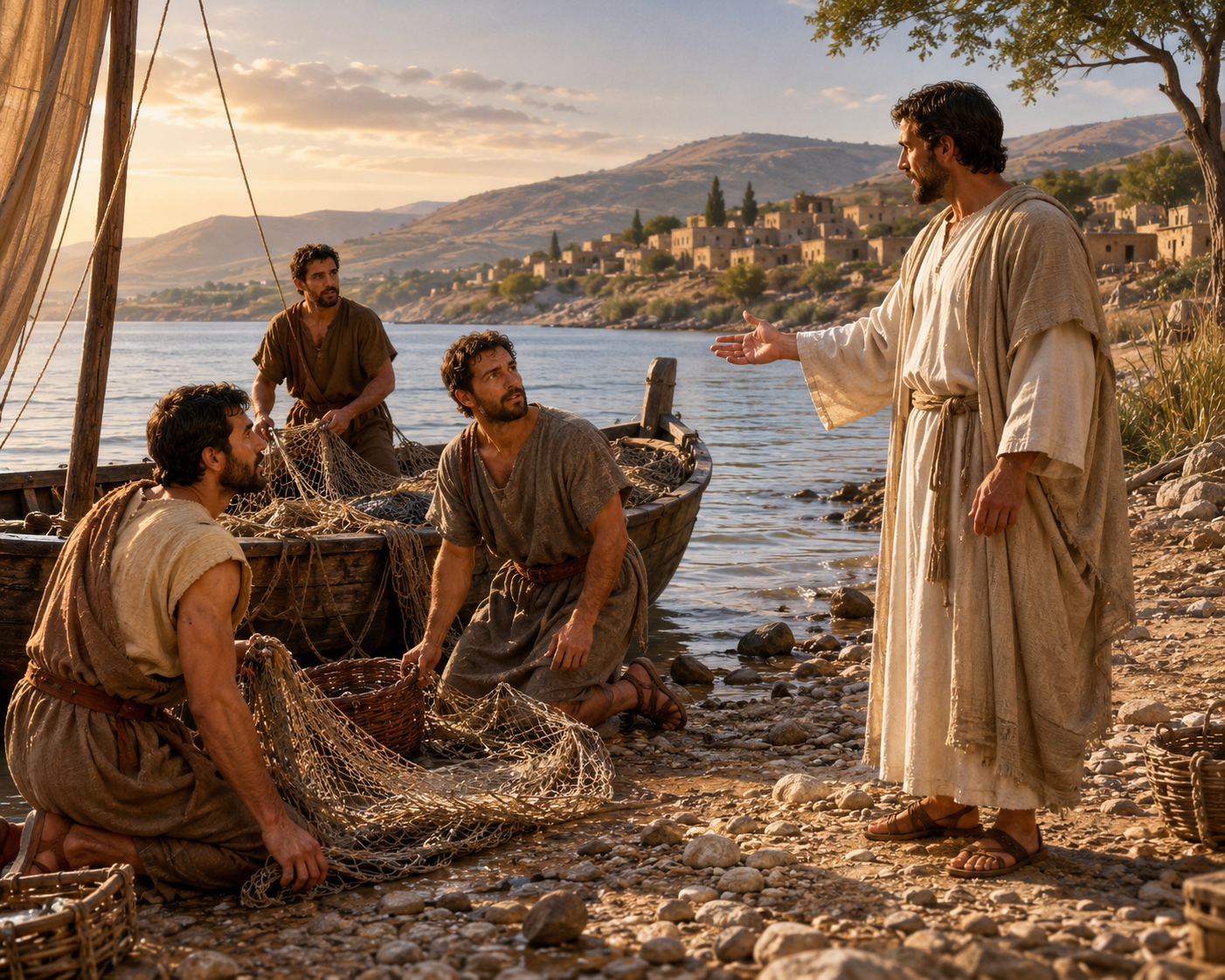
Jesus saw Simon Peter and Andrew casting a net into the sea:
“Follow me, and I will make you fishers of men.” — Matthew 4:19
Their response was immediate:
“And they straightway left their nets, and followed him.” — Matthew 4:20
James and John were then called while with Zebedee their father:
“And they immediately left the ship and their father, and followed him.” — Matthew 4:22
Matthew emphasizes decisive obedience to Christ’s call.
Christ’s Galilean ministry
Matthew summarizes Christ’s ministry under three major activities:
- Teaching in the synagogues.
- Preaching “the gospel of the kingdom.”
- Healing sickness and disease.
His fame spread throughout Syria, and great multitudes followed Him from Galilee, Decapolis, Jerusalem, Judaea, and beyond Jordan.
The miraculous healings are presented as actual works of Christ, not allegories for psychological improvement. They demonstrate His genuine authority and compassion.
Key People and Places
Jesus Christ
The central Person of all four chapters. He is explicitly called the Son of David, Son of Abraham, Christ, JESUS, Emmanuel, King of the Jews, and God’s beloved Son.
Mary
The mother of Jesus. Matthew explicitly teaches that Jesus was conceived in her “of the Holy Ghost” before she and Joseph came together.
Joseph
“The husband of Mary” and “a just man.” He repeatedly obeys divine instruction concerning Mary, Egypt, Israel, and Galilee.
Abraham
The first person named in Matthew’s genealogy after Christ’s title in verse 1. Jesus is explicitly called “the son of Abraham.”
David
Jesus is explicitly called “the son of David,” emphasizing His Messianic relationship to David’s line.
The wise men
Men “from the east” who sought the One “born King of the Jews,” worshipped Him, and gave gifts.
Scripture does not state their number, names, or country.
Herod the king
The ruler who sought to destroy the young Jesus and ordered the slaughter of male children around Bethlehem.
Chief priests and scribes
They correctly identified Bethlehem from Scripture as the prophesied birthplace of the ruler.
Archelaus
Herod’s son, ruling in Judaea when Joseph returned from Egypt.
John the Baptist
The wilderness preacher who prepared the way of the Lord, preached repentance, baptized in Jordan, confronted religious hypocrisy, and baptized Jesus.
Pharisees and Sadducees
Religious groups whom John strongly rebuked and warned concerning coming wrath.
Satan / the devil / the tempter
The personal evil being who directly tempted Jesus in the wilderness.
Simon Peter and Andrew
Brothers called from fishing to follow Christ and become “fishers of men.”
James and John
Sons of Zebedee, called by Christ while working with their father.
Bethlehem of Judaea
The birthplace of Jesus Christ.
Jerusalem
The city to which the wise men first came asking for the King of the Jews.
“The east”
The only geographical description Matthew gives for the wise men’s origin. Their specific homeland is not stated.
Egypt
The place to which Joseph took Jesus and Mary after God’s warning concerning Herod.
Nazareth
The city in Galilee where Joseph settled with Mary and Jesus.
Wilderness of Judaea
The region where John the Baptist preached.
Jordan
The river where John baptized and where Jesus came to be baptized.
Galilee
The principal region in which Matthew 4 describes Christ beginning His public preaching and ministry.
Capernaum
The city by the sea where Jesus dwelt after leaving Nazareth.
Sea of Galilee
The setting for the calling of Peter, Andrew, James, and John.
Syria
The area through which Christ’s fame spread.
Decapolis
One of the regions from which multitudes came to follow Jesus.
Judaea and beyond Jordan
Additional regions represented among the multitudes following Christ.
Main Doctrinal or Spiritual Themes
1. Jesus Christ is the promised Messiah
Matthew intentionally begins with:
“Jesus Christ, the son of David, the son of Abraham.”
The first four chapters repeatedly connect Christ with Old Testament promise and prophecy.
Jesus is not merely a moral teacher. He is the promised Christ.
2. The virgin conception is literal
Matthew 1 leaves no room for reducing the virgin birth to symbolism:
“before they came together, she was found with child of the Holy Ghost.”
The supernatural conception of Christ is presented as historical fact.
3. Jesus Christ is God manifested among men
Matthew applies the name Emmanuel:
“God with us.”
Christ is fully consistent with the KJV’s wider testimony that “the Word was God” and “the Word was made flesh” (John 1:1, 14).
4. Christ came to save from sin
Matthew 1:21 provides one of the clearest statements concerning His mission:
“he shall save his people from their sins.”
Man’s deepest problem is not lack of education, social position, political power, or self-esteem. It is sin.
The answer is not human reformation but the Saviour.
5. Salvation is not obtained through ancestry or religious privilege
John warned:
“Think not to say within yourselves, We have Abraham to our father.”
Physical descent from Abraham could not save anyone.
Likewise, church attendance, a Baptist heritage, baptism, Christian parents, or religious activity cannot substitute for personal faith in Christ.
Salvation is:
“by grace…through faith…not of works” — Ephesians 2:8–9
6. Genuine repentance produces appropriate fruit
John said:
“Bring forth therefore fruits meet for repentance.”
Fruit does not purchase salvation. It is consistent with genuine repentance.
This protects against two opposite errors:
- Works salvation: making changed behavior the means of justification.
- Empty profession: claiming conversion while treating sin and God’s authority as meaningless.
Neither error should be substituted for the plain biblical order.
7. Baptism does not regenerate
Jesus Himself was baptized, though He had no sin requiring cleansing.
He said His baptism was:
“to fulfil all righteousness.”
Therefore Matthew 3 provides no foundation for sacramental or baptismal salvation.
8. The Father, Son, and Holy Ghost are distinct Persons
Matthew 3:16–17 gives a remarkably clear Trinitarian scene.
The Son is in the water.
The Spirit descends.
The Father speaks from heaven.
There is one God, yet the Father, Son, and Holy Ghost are personally distinct.
9. Satan is real
Matthew does not treat Satan as an allegory.
He is called:
- “the devil”
- “the tempter”
- “Satan”
He speaks, tempts, departs, and seeks worship.
Biblical Christianity must not reduce Satan to a symbol for psychological struggle or social evil.
10. Christ defeated temptation by submission to the written Word
Three times Christ answered temptation from Scripture.
Especially significant is:
“Man shall not live by bread alone, but by every word that proceedeth out of the mouth of God.”
The believer needs confidence in the actual words God has given.
Christ did not answer Satan with human philosophy, experience, emotion, or tradition. He answered:
“It is written.”
11. Scripture must interpret Scripture
Satan himself appealed to Scripture in Matthew 4.
Christ’s response demonstrates that an isolated biblical quotation can be wrongly applied.
Sound doctrine requires comparing Scripture with Scripture rather than forcing a verse to support a preconceived teaching.
12. Worship belongs to God alone
Christ declared:
“Thou shalt worship the Lord thy God, and him only shalt thou serve.”
No government, religious institution, spiritual being, possession, ambition, or person may receive the devotion belonging to God.
13. The kingdom announcement must be understood in its biblical setting
Both John and Jesus preached:
“Repent: for the kingdom of heaven is at hand.”
Matthew presents this proclamation within Israel’s Messianic setting.
A conservative dispensational reading maintains the biblical distinction between Israel and the Church rather than treating every promise to Israel as though it were automatically transferred to the Church.
14. Christ possesses divine authority
Matthew 4 portrays Christ exercising authority over:
- Satan’s temptation,
- disciples whom He calls,
- sickness,
- disease,
- and the multitudes who hear His teaching.
His miracles are presented as literal events.
Practical Applications or Lessons
Take God’s Word exactly as written
Matthew’s opening chapters repeatedly reward careful attention to wording.
The wise men are not called kings.
Their number is not stated.
Their homeland is not identified.
Matthew says they entered a house and saw a young child.
Herod’s two-year age range does not establish Christ’s exact age.
The Spirit descended “like a dove.”
Careful Bible study refuses to convert tradition or assumption into inspired fact.
Obey revealed truth promptly
Joseph repeatedly acts upon what God tells him.
Matthew 1:24 says he:
“did as the angel of the Lord had bidden him.”
The wise men obey God’s warning.
Peter and Andrew “straightway” leave their nets.
James and John “immediately” follow Christ.
Knowing God’s will should lead to obedience.
Religious knowledge without obedience is spiritually dangerous
The chief priests and scribes could tell Herod where Christ would be born.
They possessed the correct information concerning Bethlehem.
Yet Matthew records the wise men going to worship Christ.
The practical warning is plain: knowing facts about Scripture is not a substitute for personally responding to its truth.
Never trust religious heritage for salvation
John demolished the argument:
“We have Abraham to our father.”
A person may have godly parents, generations of Baptist heritage, a Christian education, or years of church membership and still need personal salvation through Christ.
Repentance should not be reduced to empty language
John demanded:
“fruits meet for repentance.”
The believer should never preach salvation by works, but neither should repentance be emptied of all moral significance.
Sin is serious because God says it is sin.
Baptism belongs in obedience, not in the place of saving faith
Jesus honored baptism while never presenting baptism as a cure for personal sin.
A conservative Baptist understanding therefore maintains both truths:
Baptism is important obedience.
Baptism does not save.
Do not measure God’s approval by ease
Immediately after the Father’s declaration:
“This is my beloved Son, in whom I am well pleased,”
Matthew records Christ entering the wilderness temptation.
Therefore hardship cannot automatically be interpreted as evidence of God’s displeasure.
The text does not support such reasoning.
Answer temptation with Scripture
Christ’s repeated answer was:
“It is written.”
Believers should know Scripture well enough to recognize both open temptation and distorted uses of biblical language.
Physical need never overrules God’s Word
Christ was genuinely hungry, yet He refused Satan’s proposal.
“Man shall not live by bread alone…”
Legitimate bodily needs do not justify disobedience.
Never test God under the guise of faith
Jesus refused to cast Himself from the temple.
Biblical faith trusts what God has said; it does not manufacture unnecessary danger and demand miraculous deliverance.
No earthly advantage is worth compromised worship
Satan offered the kingdoms and their glory.
Christ answered:
“Thou shalt worship the Lord thy God, and him only shalt thou serve.”
Position, wealth, success, influence, and recognition are never worth spiritual compromise.
Christ calls believers to reach people
Jesus said:
“Follow me, and I will make you fishers of men.”
Following Christ and seeking the salvation of others properly belong together.
Soul-winning must never become a substitute for the gospel itself, but believers should actively carry the gospel to the lost.
Overall Message of Matthew 1–4
Matthew 1–4 establishes the identity and authority of Jesus Christ before the great body of His teaching begins.
He is the Christ.
He is the Son of David.
He is the Son of Abraham.
He is conceived “of the Holy Ghost.”
He is JESUS, who saves from sins.
He is Emmanuel, “God with us.”
He is “born King of the Jews.”
He is God’s beloved Son.
He withstands Satan without sin.
He preaches repentance and the kingdom of heaven.
He calls men to follow Him.
He teaches, preaches, and heals with unmistakable authority.
The proper response is not merely admiration but faith, repentance, worship, obedience, and submission to the written Word of God.
How useful was this post?
Click on a star to rate it!
Average rating 0 / 5. Vote count: 0
No votes so far! Be the first to rate this post.
We are sorry that this post was not useful for you!
Let us improve this post!
Tell us how we can improve this post?
Comments are closed