 Luke 1-2 records the events surrounding the birth of John the Baptist and the birth and early childhood of Jesus Christ. Luke begins by explaining that he had carefully investigated the events he was recording so that Theophilus might “know the certainty of those things” in which he had been instructed (Luke 1:4). The narrative then moves from the temple in Jerusalem, to Nazareth, to the hill country of Juda, to Bethlehem, and finally back to Nazareth.
These chapters emphasize God’s faithfulness to His promises, the miraculous conception and virgin birth of Christ, the deity and humanity of Jesus Christ, His role as Savior, the fulfillment of Old Testament expectation, and the importance of humble faith and obedience.
Chapter Summaries
Luke 1 – The Announcements and Preparations for the Coming of Christ
Luke opens by explaining why he wrote his Gospel. He states that others had already undertaken accounts of the events “which are most surely believed among us” (Luke 1:1). Luke had “perfect understanding of all things from the very first” and wrote an orderly account to Theophilus (Luke 1:3-4).
The narrative then introduces Zacharias and Elisabeth.
Zacharias was a priest “of the course of Abia,” and Elisabeth was “of the daughters of Aaron” (Luke 1:5). Scripture gives them an unusually strong testimony:
“And they were both righteous before God, walking in all the commandments and ordinances of the Lord blameless.” – Luke 1:6
They had no child because Elisabeth was barren, and both were “well stricken in years” (Luke 1:7).
While Zacharias was performing his priestly duties in the temple and burning incense, the angel Gabriel appeared to him.
Gabriel announced that Elisabeth would bear a son named John. John would be a source of joy, would be “great in the sight of the Lord,” would drink neither wine nor strong drink, and would “be filled with the Holy Ghost, even from his mother’s womb” (Luke 1:15).
John’s ministry would prepare Israel for the Lord:
“And many of the children of Israel shall he turn to the Lord their God.” – Luke 1:16
Gabriel further said that John would go before Him “in the spirit and power of Elias” and would “make ready a people prepared for the Lord” (Luke 1:17).
This establishes John as the divinely appointed forerunner of Christ.
Zacharias questioned how he could know that Gabriel’s announcement would come to pass because both he and Elisabeth were elderly. Gabriel identified himself as the angel who stood “in the presence of God” and announced that Zacharias would be unable to speak until the prophecy was fulfilled because he had not believed Gabriel’s words (Luke 1:18-20).
Elisabeth conceived exactly as promised.
She said:
“Thus hath the Lord dealt with me in the days wherein he looked on me, to take away my reproach among men.” – Luke 1:25
Six months into Elisabeth’s pregnancy, Gabriel was sent by God to Nazareth in Galilee.
There he appeared to Mary, a virgin “espoused to a man whose name was Joseph, of the house of David” (Luke 1:27).
Gabriel addressed Mary as one who was “highly favoured” and told her:
“Fear not, Mary: for thou hast found favour with God.” – Luke 1:30
He announced that she would conceive and bear a Son named Jesus.
Gabriel described Him in remarkable terms:
“He shall be great, and shall be called the Son of the Highest: and the Lord God shall give unto him the throne of his father David.” – Luke 1:32
“And he shall reign over the house of Jacob for ever; and of his kingdom there shall be no end.” – Luke 1:33
Mary asked how this could happen because she had not known a man.
The angel answered:
“The Holy Ghost shall come upon thee, and the power of the Highest shall overshadow thee.” – Luke 1:35
Gabriel then declared:
“Therefore also that holy thing which shall be born of thee shall be called the Son of God.” – Luke 1:35
This is one of Scripture’s clearest statements concerning the miraculous conception of Jesus Christ. Luke explicitly teaches that Mary was a virgin and that Christ’s conception occurred through the power of the Holy Ghost, not through a human father.
Gabriel also informed Mary that Elisabeth had conceived in her old age and concluded:
“For with God nothing shall be impossible.” – Luke 1:37
Mary responded in humble submission:
“Behold the handmaid of the Lord; be it unto me according to thy word.” – Luke 1:38
Mary then traveled into the hill country of Juda and entered the house of Zacharias and Elisabeth.
When Elisabeth heard Mary’s greeting, the babe leaped in her womb, and Elisabeth was filled with the Holy Ghost (Luke 1:41).
Elisabeth called Mary “the mother of my Lord” (Luke 1:43).
That statement is significant. The KJV explicitly records Elisabeth referring to the unborn Jesus as “my Lord.” The text therefore presents Christ’s identity and significance before His birth.
Elisabeth also commended Mary’s faith:
“And blessed is she that believed: for there shall be a performance of those things which were told her from the Lord.” – Luke 1:45
Mary responded with a declaration of praise traditionally called the Magnificat, although that title is not part of the biblical text.
Mary said:
“My soul doth magnify the Lord,
And my spirit hath rejoiced in God my Saviour.” – Luke 1:46-47
Mary herself called God “my Saviour.” Scripture does not present Mary as sinless or as a savior. Rather, she rejoiced in God as her Savior.
Her praise emphasizes God’s holiness, mercy, strength, faithfulness, and His concern for the humble.
She also connected what God was doing with His promises to Abraham:
“He hath holpen his servant Israel, in remembrance of his mercy;
As he spake to our fathers, to Abraham, and to his seed for ever.” – Luke 1:54-55
Mary remained with Elisabeth about three months and then returned to her own house (Luke 1:56).
Elisabeth subsequently gave birth to her son.
When the child was circumcised on the eighth day, relatives expected him to be named Zacharias after his father. Elisabeth said his name would be John.
When Zacharias confirmed this by writing, “His name is John,” his ability to speak was immediately restored (Luke 1:63-64).
Zacharias then praised God and was filled with the Holy Ghost.
His prophecy begins:
“Blessed be the Lord God of Israel; for he hath visited and redeemed his people.” – Luke 1:68
He spoke of salvation coming through the house of David and connected God’s actions with His covenant promises.
Speaking of John, Zacharias said:
“And thou, child, shalt be called the prophet of the Highest: for thou shalt go before the face of the Lord to prepare his ways.” – Luke 1:76
John would give:
“Knowledge of salvation unto his people by the remission of their sins.” – Luke 1:77
The chapter concludes:
“And the child grew, and waxed strong in spirit, and was in the deserts till the day of his shewing unto Israel.” – Luke 1:80
Scripture does not provide details concerning John’s experiences during those years beyond what this verse states.
Luke 2 – The Birth, Recognition, and Childhood of Jesus Christ
Luke 2 begins with a decree from Caesar Augustus that “all the world should be taxed” (Luke 2:1).
Joseph traveled:
“Out of the city of Nazareth, into Judaea, unto the city of David, which is called Bethlehem.” – Luke 2:4
Luke explicitly gives the reason:
“Because he was of the house and lineage of David.” – Luke 2:4
Mary traveled with Joseph and was “great with child” (Luke 2:5).
While they were in Bethlehem, the time came for Jesus to be born.
Luke records:
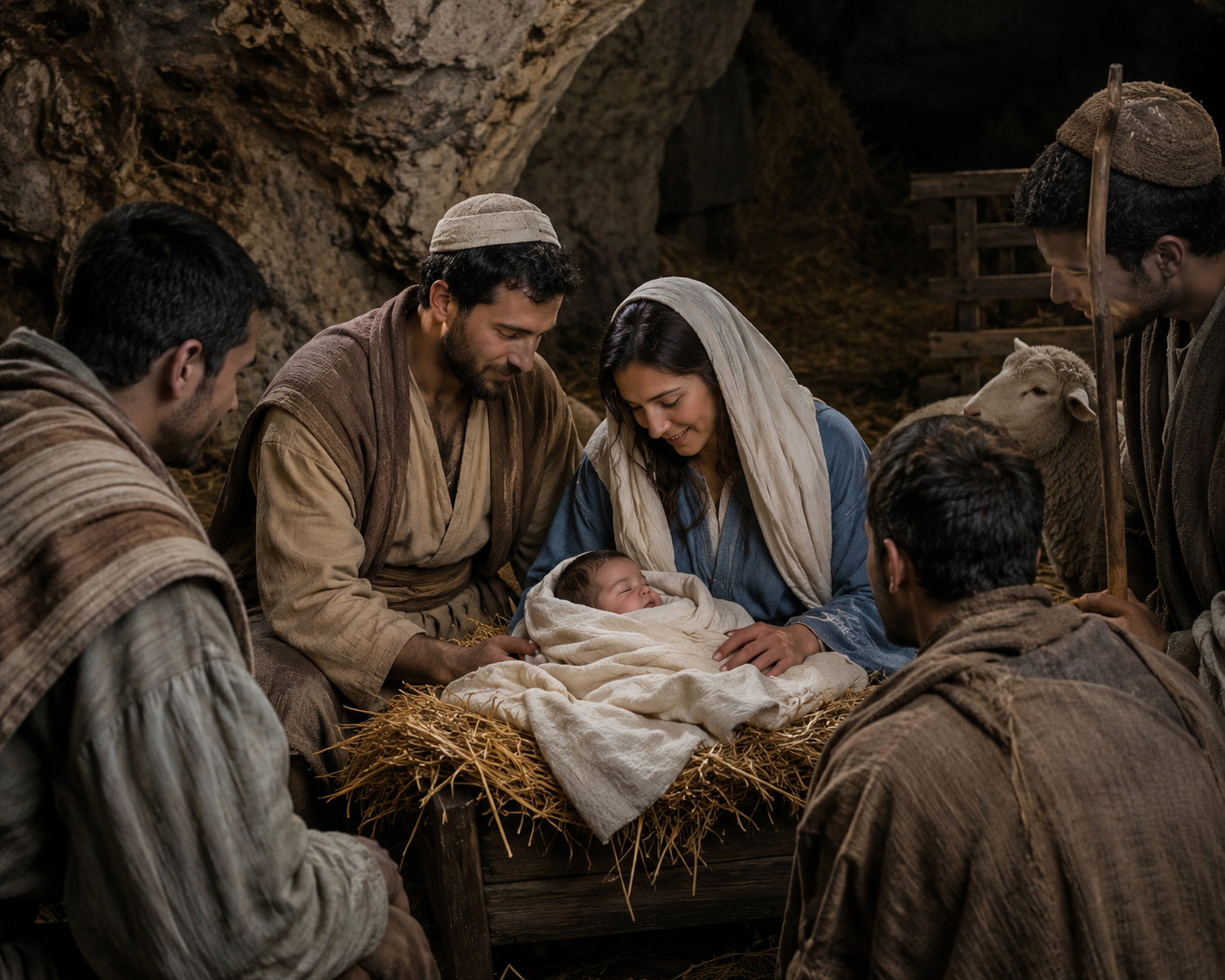
“And she brought forth her firstborn son, and wrapped him in swaddling clothes, and laid him in a manger; because there was no room for them in the inn.” – Luke 2:7
The KJV says that Jesus was laid in a manger because there was no room for them in the inn.
Scripture does not explicitly state that Jesus was born in a wooden stable, nor does Luke describe the exact appearance of the place. The presence of a manger indicates an animal feeding place, but the precise architectural setting is not stated.
Nearby shepherds were “abiding in the field, keeping watch over their flock by night” (Luke 2:8).
An angel of the Lord appeared, and “the glory of the Lord shone round about them.”
The shepherds were afraid, but the angel announced:
“Fear not: for, behold, I bring you good tidings of great joy, which shall be to all people.” – Luke 2:10
The heart of the announcement follows:
“For unto you is born this day in the city of David a Saviour, which is Christ the Lord.” – Luke 2:11
Three titles are joined together:
Saviour.
Christ.
Lord.
Jesus did not merely come to provide an example or a moral philosophy. The angel explicitly called Him “a Saviour.”
Suddenly a multitude of the heavenly host appeared praising God:
“Glory to God in the highest, and on earth peace, good will toward men.” – Luke 2:14
After the angels departed, the shepherds went to Bethlehem.
They found Mary, Joseph, and the baby Jesus lying in a manger.
After seeing Him, they told others what had been revealed concerning the child.
Luke records:
“And all they that heard it wondered at those things which were told them by the shepherds.” – Luke 2:18
Mary responded differently:
“But Mary kept all these things, and pondered them in her heart.” – Luke 2:19
The shepherds returned:
“Glorifying and praising God for all the things that they had heard and seen.” – Luke 2:20
When Jesus was eight days old, He was circumcised and officially given the name Jesus, the name Gabriel had announced before His conception (Luke 2:21).
Mary and Joseph later brought Jesus to Jerusalem in connection with the requirements of the law.
Luke refers specifically to the purification prescribed in the law of Moses and to the presentation of the firstborn male unto the Lord (Luke 2:22-24).
They offered:
“A pair of turtledoves, or two young pigeons.” – Luke 2:24
This offering corresponds with the provision in Leviticus 12:8 for those unable to bring a lamb. This may indicate that Joseph and Mary had limited financial means at that time, although Luke does not explicitly state their economic condition.
In Jerusalem was a man named Simeon.
Luke describes him as:
“Just and devout, waiting for the consolation of Israel: and the Holy Ghost was upon him.” – Luke 2:25
The Holy Ghost had revealed that Simeon would not die before he had seen “the Lord’s Christ” (Luke 2:26).
When Jesus was brought into the temple, Simeon took Him into his arms and blessed God.
He said:
“Lord, now lettest thou thy servant depart in peace, according to thy word:
For mine eyes have seen thy salvation.” – Luke 2:29-30
Simeon did not merely say that he had seen someone who would bring salvation. He said:
“Mine eyes have seen thy salvation.”
He continued:
“A light to lighten the Gentiles, and the glory of thy people Israel.” – Luke 2:32
Thus Luke’s account already points beyond Israel to the Gentiles.
Simeon also told Mary:
“Behold, this child is set for the fall and rising again of many in Israel; and for a sign which shall be spoken against.” – Luke 2:34
He added that a sword would pierce through Mary’s own soul also (Luke 2:35).
Scripture does not explain every detail of that prophecy in Luke 2. It clearly indicates, however, that Christ would be opposed and that Mary’s experience would involve deep sorrow.
Luke then introduces Anna, “a prophetess, the daughter of Phanuel, of the tribe of Aser” (Luke 2:36).
She was advanced in years and served God:
“With fastings and prayers night and day.” – Luke 2:37
She came into the temple at that moment:
“And spake of him to all them that looked for redemption in Jerusalem.” – Luke 2:38
Luke then states that Joseph, Mary, and Jesus returned to Galilee, “to their own city Nazareth” after performing the requirements of the law (Luke 2:39).
Matthew records additional events concerning the wise men and the flight into Egypt. Luke does not include those events in this chapter. Luke 2:39 therefore should be read together with the fuller Gospel record rather than interpreted as denying events recorded elsewhere.
Luke summarizes Jesus’ childhood:
“And the child grew, and waxed strong in spirit, filled with wisdom: and the grace of God was upon him.” – Luke 2:40
Luke then records one event from Jesus’ youth.
When Jesus was twelve years old, His family traveled to Jerusalem for the feast of the passover.
After the feast, Joseph and Mary began the return journey. Jesus remained in Jerusalem, and they did not initially realize He was absent.
After discovering He was missing, they returned to Jerusalem.
After three days they found Him in the temple:
“Sitting in the midst of the doctors, both hearing them, and asking them questions.” – Luke 2:46
Those who heard Him were:
“Astonished at his understanding and answers.” – Luke 2:47
Mary asked why He had dealt with them this way.
Jesus replied:
“How is it that ye sought me? wist ye not that I must be about my Father’s business?” – Luke 2:49
Jesus’ statement distinguishes His relationship with God the Father from His earthly relationship with Joseph.
The text explicitly records Jesus calling God “my Father.”
Joseph and Mary did not understand the saying at the time (Luke 2:50).
Jesus then returned with them to Nazareth:
“And was subject unto them.” – Luke 2:51
This is an important testimony concerning Christ’s earthly obedience within the family.
Luke concludes:
“And Jesus increased in wisdom and stature, and in favour with God and man.” – Luke 2:52
The verse describes His genuine human development. At the same time, Luke has already identified Him as the Son of God, Christ the Lord, and the Savior.
Conservative Baptist theology therefore recognizes both truths affirmed by Scripture: Jesus Christ is fully divine and genuinely human.
Key People and Places
Luke
The human writer of the Gospel. Luke 1:1-4 states that he carefully arranged an account so that Theophilus could know the certainty of the things he had been taught.
Theophilus
The person addressed in Luke 1:3. Luke calls him “most excellent Theophilus.” Scripture does not provide enough information in this passage to identify him further with certainty.
Zacharias
A priest of the course of Abia and husband of Elisabeth. Gabriel announced that he and Elisabeth would have a son named John.
Elisabeth
The wife of Zacharias and a descendant of Aaron. She was barren and advanced in years when God enabled her to conceive John.
Gabriel
The angel who appeared to Zacharias and later to Mary. Gabriel said:
“I am Gabriel, that stand in the presence of God.” – Luke 1:19
John the Baptist
The son of Zacharias and Elisabeth. He was appointed to prepare people for the coming of the Lord.
Luke 1 emphasizes his prophetic mission even before his birth.
Mary
A virgin in Nazareth who was espoused to Joseph. Gabriel announced that she would miraculously conceive Jesus through the power of the Holy Ghost.
Mary described herself as “the handmaid of the Lord” and rejoiced in “God my Saviour.”
Joseph
The man to whom Mary was espoused. Luke states that he was “of the house and lineage of David” (Luke 2:4).
Jesus Christ
The central Person of the entire passage.
Luke 1-2 identifies Him as:
- Jesus.
- Son of the Highest.
- Son of God.
- Lord.
- Savior.
- Christ.
- The Lord’s Christ.
- God’s salvation.
- A light to the Gentiles.
- The glory of Israel.
Simeon
A just and devout man in Jerusalem who was waiting for “the consolation of Israel.” The Holy Ghost revealed that he would see Christ before his death.
Anna
A prophetess, daughter of Phanuel, of the tribe of Aser. She worshiped God with fasting and prayer and spoke about Christ to those looking for redemption in Jerusalem.
Caesar Augustus
The Roman ruler whose decree concerning taxation resulted in Joseph traveling to Bethlehem.
Luke records the decree as the immediate governmental circumstance surrounding the journey.
Nazareth
A city of Galilee where Mary lived and where Jesus was raised.
Jerusalem
The location of the temple and the setting for Zacharias’ priestly service, Jesus’ presentation, Simeon’s prophecy, Anna’s testimony, and the Passover visit when Jesus was twelve years old.
Bethlehem
Called “the city of David” in Luke 2:4. Jesus was born there.
Judaea
The region containing Bethlehem and the hill country where Zacharias and Elisabeth lived.
Galilee
The region containing Nazareth.
The Temple
The place where Zacharias served as priest, where Simeon encountered Jesus, where Anna spoke of Him, and where twelve-year-old Jesus was found among the teachers.
Main Doctrinal or Spiritual Themes
The Absolute Reliability of God’s Word
Luke begins by emphasizing certainty.
Gabriel’s promises concerning John and Jesus were fulfilled exactly as God had declared.
When Zacharias struggled to believe Gabriel’s announcement, Gabriel said:
“Which shall be fulfilled in their season.” – Luke 1:20
God’s Word does not depend upon human circumstances.
Age did not prevent Elisabeth from conceiving according to God’s promise.
Virginity did not prevent the miraculous conception of Christ because:
“For with God nothing shall be impossible.” – Luke 1:37
The Virgin Conception of Jesus Christ
Luke is explicit.
Mary said:
“How shall this be, seeing I know not a man?” – Luke 1:34
Gabriel answered that the Holy Ghost would come upon her and the power of the Highest would overshadow her.
Jesus therefore entered the world through a miraculous conception accomplished by God.
This doctrine is not symbolic or optional within Luke’s account. It is presented as historical fact.
The Deity of Jesus Christ
Luke repeatedly gives Jesus titles and descriptions that reveal His unique divine identity.
Gabriel called Him “the Son of the Highest” and “the Son of God.”
Elisabeth called Him “my Lord.”
The angel told the shepherds that He was:
“Christ the Lord.” – Luke 2:11
At twelve years old Jesus referred to God as:
“My Father.” – Luke 2:49
Taken together, Luke presents Jesus as far more than a teacher or prophet.
The Genuine Humanity of Jesus Christ
Jesus was conceived, born, wrapped in swaddling clothes, laid in a manger, circumcised, presented at the temple, raised within a family, and physically grew.
Luke 2:52 says:
“And Jesus increased in wisdom and stature.”
Christian doctrine must maintain both truths revealed by Scripture: Jesus Christ is God the Son, and He truly became man.
Jesus Christ the Savior
The angel announced:
“Unto you is born this day in the city of David a Saviour.” – Luke 2:11
Simeon declared:
“Mine eyes have seen thy salvation.” – Luke 2:30
Salvation is therefore directly connected to the Person of Jesus Christ.
His very name, Jesus, is associated throughout the New Testament with His saving mission.
Salvation Involves the Forgiveness of Sin
Zacharias said John’s ministry would give:
“Knowledge of salvation unto his people by the remission of their sins.” – Luke 1:77
Biblical salvation cannot be reduced to political, social, or material deliverance.
Humanity’s fundamental problem is sin, and God’s salvation includes the remission of sins.
The Fulfillment of God’s Promises
Both Mary and Zacharias connected the events surrounding Christ’s coming with God’s promises to Abraham and Israel.
God had not forgotten His Word.
Centuries may pass between promise and fulfillment, but God’s promises remain certain.
Christ and the Davidic Throne
Gabriel said:
“The Lord God shall give unto him the throne of his father David.” – Luke 1:32
He continued:
“And he shall reign over the house of Jacob for ever; and of his kingdom there shall be no end.” – Luke 1:33
The text presents Jesus as the promised Davidic King.
The passage does not describe the complete chronology or manner of the fulfillment of every aspect of that kingdom promise. It does explicitly affirm that Christ’s kingdom will have no end.
The Ministry of the Holy Ghost
The Holy Ghost is repeatedly active in Luke 1-2.
John would be filled with the Holy Ghost.
Elisabeth was filled with the Holy Ghost.
Zacharias was filled with the Holy Ghost.
The Holy Ghost was upon Simeon.
The Holy Ghost revealed truth to Simeon and led him into the temple.
Most importantly, the miraculous conception of Jesus was accomplished through the power of the Holy Ghost.
Faith and Unbelief
Zacharias struggled to believe Gabriel’s message and temporarily lost his ability to speak.
Mary responded:
“Be it unto me according to thy word.” – Luke 1:38
Elisabeth said:
“Blessed is she that believed.” – Luke 1:45
The contrast illustrates the importance of believing what God has spoken.
Humility Before God
Mary’s praise repeatedly emphasizes God’s favor toward the humble.
She called herself God’s handmaid.
The circumstances surrounding Christ’s birth were outwardly humble.
The Savior was laid in a manger.
The first recorded public announcement of His birth in Luke was made to shepherds watching their flocks at night.
God’s methods frequently overturn human expectations of greatness.
Obedience
Luke repeatedly records obedience to God’s revealed will.
Mary submitted to God’s announcement.
Zacharias and Elisabeth named their child John as God commanded.
Joseph and Mary complied with the requirements of the law.
The shepherds acted upon the angelic announcement.
Jesus Himself returned to Nazareth with Joseph and Mary and “was subject unto them.”
Worship and Praise
Luke 1-2 is filled with worship.
Mary magnified the Lord.
Zacharias blessed God.
Angels praised God.
Shepherds glorified and praised God.
Simeon blessed God.
Anna gave thanks unto the Lord.
The coming of Christ properly produces worship.
Christ for Both Israel and the Gentiles
Simeon said Jesus would be:
“A light to lighten the Gentiles, and the glory of thy people Israel.” – Luke 2:32
Christ’s mission reaches beyond one nation.
The gospel would ultimately be proclaimed to all nations.
Christ Will Be Opposed
Simeon warned that Jesus would be:
“A sign which shall be spoken against.” – Luke 2:34
The coming of Christ does not produce universal acceptance.
People must respond to Him, and Scripture repeatedly demonstrates that many oppose Him.
God’s Sovereignty Over Human Events
Caesar Augustus issued a decree for governmental reasons.
Luke records that this decree resulted in Joseph traveling from Nazareth to Bethlehem, where Jesus was born.
Micah 5:2 had previously identified Bethlehem in connection with the coming ruler of Israel.
Luke itself does not explicitly state that Caesar understood or intentionally fulfilled prophecy. Scripture gives no indication that he did.
The circumstances may therefore be understood as demonstrating God’s providential rule over human events without attributing motives to Caesar that Scripture does not reveal.
Practical Applications or Lessons
Believe God’s Word Even When Circumstances Appear Impossible
Zacharias and Elisabeth were elderly.
Mary was a virgin.
Yet Gabriel said:
“For with God nothing shall be impossible.” – Luke 1:37
Faith is not confidence that God will do whatever we desire. Biblical faith rests upon what God has actually said.
When God has spoken, His Word is certain.
Do Not Add to What God Has Revealed
Luke gives many specific details concerning Christ’s birth, but it leaves other details unstated.
For example, Luke says that Jesus was placed in a manger, but it does not describe the exact design of the building.
Sound Bible interpretation distinguishes between what Scripture says and what tradition has supplied.
That principle protects believers from turning familiar assumptions into supposed biblical facts.
Respond to God’s Word With Humble Submission
Mary’s response remains a powerful model:
“Behold the handmaid of the Lord; be it unto me according to thy word.” – Luke 1:38
She did not understand every future circumstance.
She simply submitted herself to God’s revealed will.
Believers today should approach Scripture with the same attitude of obedience.
God Can Use Ordinary People
Luke 1-2 focuses upon people who were not presented as powerful political figures.
A priest and his wife.
A young virgin in Nazareth.
A carpenter’s household.
Shepherds.
An elderly worshiper named Simeon.
An elderly prophetess named Anna.
Meanwhile Caesar Augustus appears briefly as part of the historical setting.
God’s greatest work was taking place largely outside the centers of earthly power.
Believers should never assume that usefulness to God depends upon fame, wealth, prominence, or political influence.
Christ Must Remain the Center
John the Baptist was important, but his mission was to prepare people for the Lord.
Mary was greatly favored, but she rejoiced in “God my Saviour.”
The shepherds did not worship Mary, Joseph, or the angels. They glorified God because of what they had seen and heard concerning Christ.
Simeon’s joy centered upon God’s salvation in Jesus.
Luke continually directs attention toward Christ.
Salvation Is Found in Christ
Simeon held Jesus and said:
“Mine eyes have seen thy salvation.” – Luke 2:30
Christianity is not merely a system of morality.
Salvation centers upon a Person.
Jesus Christ came as Savior.
The later Gospel record explains that He would die and rise again, providing salvation through His finished work.
Forgiveness of Sins Is Humanity’s Greatest Need
Zacharias connected salvation with:
“The remission of their sins.” – Luke 1:77
People may have many physical, emotional, financial, and social needs, but the greatest need is reconciliation with God through the forgiveness of sin.
That is why the gospel must remain central to the ministry of the church.
Praise Should Follow Recognition of God’s Work
Nearly every major revelation in Luke 1-2 is followed by worship.
Mary praised.
Zacharias praised.
Angels praised.
Shepherds praised.
Simeon praised.
Anna gave thanks.
Those who understand what God has done in Christ should respond with gratitude and worship.
Parents Should Take Spiritual Responsibilities Seriously
Joseph and Mary repeatedly acted in accordance with God’s law concerning Jesus.
Luke specifically records their observance of circumcision, purification requirements, presentation at the temple, and Passover attendance.
Believing parents today should likewise take seriously the spiritual instruction and example they provide within their homes.
Children Should Learn Obedience
Jesus returned to Nazareth:
“And was subject unto them.” – Luke 2:51
The sinless Son of God willingly lived under earthly parental authority.
His example emphasizes the proper place of obedience and respect within the family.
Spiritual Growth Deserves Attention
Luke twice summarizes Jesus’ development.
Luke 2:40 says:
“And the child grew, and waxed strong in spirit, filled with wisdom.”
Luke 2:52 says:
“And Jesus increased in wisdom and stature, and in favour with God and man.”
These verses specifically describe Jesus and should not be treated as though every detail applies identically to sinful human beings.
Nevertheless, they demonstrate that physical development, wisdom, character, and one’s relationship with God are matters worthy of serious attention.
Waiting on God Is Not Wasted Time
Simeon was “waiting for the consolation of Israel.”
Anna continued in worship, fasting, and prayer.
Neither passage portrays faithful waiting as inactivity.
Biblical waiting can include worship, prayer, obedience, and confident expectation that God will fulfill His Word.
Christ Deserves a Personal Response
People responded differently to Jesus even in these opening chapters.
The shepherds came.
Simeon rejoiced.
Anna gave thanks and spoke about Him.
Others wondered.
Simeon also foretold that Christ would be spoken against.
No person can properly encounter the claims of Christ while treating Him as merely insignificant.
Luke introduces Him as Savior, Christ, Lord, Son of God, and God’s salvation.
The central question ultimately becomes whether a person will believe God’s testimony concerning His Son.
Conclusion
Luke 1-2 opens the Gospel with certainty, prophecy, fulfillment, miraculous intervention, worship, and unmistakable attention upon Jesus Christ.
John the Baptist is introduced as the forerunner who would prepare the way of the Lord.
Jesus is introduced as the virgin-born Son of God, the promised Davidic King, Christ the Lord, the Savior, God’s salvation, the light of the Gentiles, and the glory of Israel.
The circumstances surrounding His birth were humble, but His identity was glorious.
The message of Luke 1-2 is therefore much greater than the familiar story of a child in Bethlehem.
God had kept His promises.
The Savior had come.
As the angel declared:
“For unto you is born this day in the city of David a Saviour, which is Christ the Lord.” – Luke 2:11
Tags
Luke 1, Luke 2, Gospel of Luke, Jesus Christ, birth of Jesus Christ, virgin birth, virgin conception, Mary, Joseph, Zacharias, Elisabeth, John the Baptist, Gabriel, Simeon, Anna, Caesar Augustus, Bethlehem, Nazareth, Jerusalem, Judaea, Galilee, temple, shepherds, Son of God, Son of the Highest, Christ the Lord, Savior, Davidic kingdom, Holy Ghost, salvation, remission of sins, prophecy, faith, obedience, worship, KJV Bible, King James Version, conservative Baptist Bible study
Yoast Meta Description
A KJV-based conservative Baptist overview of Luke 1-2 covering John the Baptist, the virgin birth of Christ, Bethlehem, the shepherds, Simeon, Anna, and key doctrinal lessons.
Comments are closed