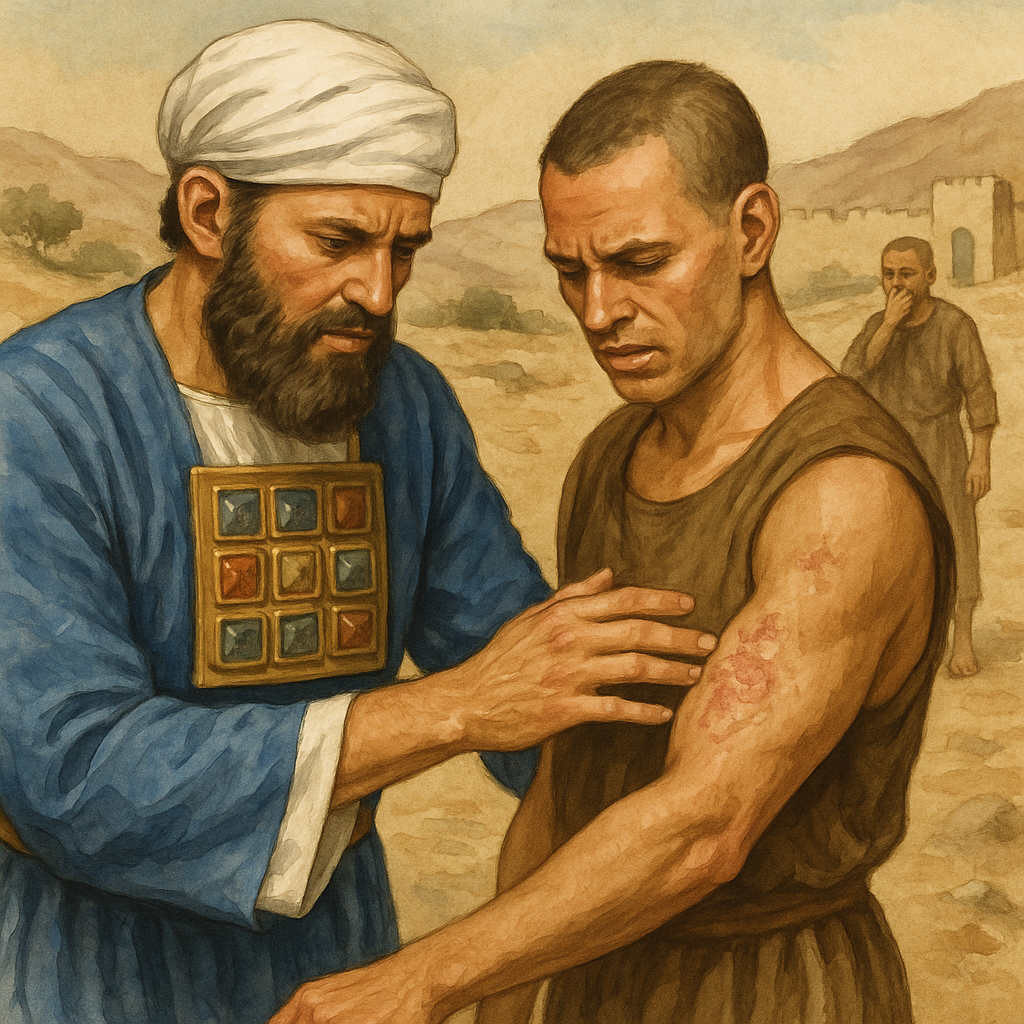
Subject: Regulations concerning leprosy and skin diseases.
This chapter provides detailed instructions given by God to Moses and Aaron regarding how the priests were to diagnose leprosy (a term that included a wide range of serious skin diseases, mildew, and infections). It is the longest chapter in Leviticus, emphasizing the seriousness of purity in Israel’s camp.
1. Examination of Skin Diseases (vv. 1–17)
-
A person with a rising, scab, or bright spot on the skin must come before the priest.
-
The priest examines whether the hair in the spot has turned white, and whether the sore appears deeper than the skin.
-
If unclear, the person is quarantined for seven days, then re-examined.
-
If the disease spreads, he is declared unclean; if it is only a scab and does not spread, he is declared clean.
-
If leprosy covers the whole body, paradoxically the person is declared clean, but if raw flesh appears, he is unclean.
2. Leprosy in Boils and Burns (vv. 18–28)
-
A boil that heals but later shows a white rising or bright spot may be leprosy.
-
Likewise, a burn that becomes a white or reddish spot must be examined.
-
The priest determines clean or unclean depending on whether the sore spreads and the hair turns white.
3. Leprosy in Head, Beard, and Scalp (vv. 29–44)
-
If sores appear in the head or beard area, the priest examines for thin yellow hair.
-
If it spreads, the person is unclean.
-
If it does not spread, the man shaves around it and is quarantined, then re-examined.
4. The Leper’s Condition (vv. 45–46)
-
A leper must wear torn clothes, keep his head bare, cover his upper lip, and cry, “Unclean, unclean.”
-
He must dwell alone, outside the camp.
5. Leprosy in Garments (vv. 47–59)
-
Leprosy could also affect garments of wool, linen, or leather.
-
Greenish or reddish spots indicated uncleanness.
-
The priest quarantined the garment for seven days. If the plague spread, the garment was burned.
-
If it did not spread, it could be washed and quarantined again. If the spot remained, it was burned; if it faded, it was cut out.
-
If the garment was cleansed, it was washed again and declared clean.
? In short, Leviticus 13 emphasizes the holiness of God’s people and the seriousness of uncleanness—requiring separation until cleansing was proven. The priest’s role was crucial in protecting the community from defilement.
Comments are closed