Consecration, Conquest, and the Cost of Disobedience
Trumpets Before the Falling Walls
Joshua 5–7 records a decisive transition in Israel’s entrance into Canaan. The nation is circumcised at Gilgal, keeps the passover, begins eating the produce of the land, and sees the manna cease. Joshua then encounters the captain of the host of the LORD. Chapter 6 records the divinely ordered conquest of Jericho and the deliverance of Rahab. Chapter 7 sharply contrasts Jericho’s victory with Israel’s defeat at Ai because Achan took of the accursed thing.
Together these chapters emphasize that Israel’s victories did not rest upon military strength but upon the presence, command, holiness, and faithfulness of the LORD. They also demonstrate that God’s people cannot treat His explicit commands lightly.
Chapter Summaries
Joshua 5 — Israel Prepared at Gilgal
Joshua 5 opens with the kings of the Amorites and Canaanites hearing what the LORD had done at Jordan:
“their heart melted, neither was there spirit in them any more, because of the children of Israel.” — Joshua 5:1
The fear of Israel among the inhabitants of the land followed the LORD’s miraculous drying of Jordan. The text gives the glory to what “the LORD had dried up the waters of Jordan” rather than to Israelite military power.
The LORD then commanded Joshua:
“Make thee sharp knives, and circumcise again the children of Israel the second time.” — Joshua 5:2
Joshua 5:4–7 explains why. The men who had come out of Egypt had been circumcised, but the generation born during the wilderness journey had not been circumcised. Joshua therefore circumcised them at “the hill of the foreskins.”
This was specifically an act concerning covenant Israel. It should not be converted into a Church ordinance. The New Testament does not place physical circumcision upon believers as a requirement for salvation or standing before God. In Joshua, however, circumcision belonged to Israel’s covenant responsibilities.
Afterward the LORD said:
“This day have I rolled away the reproach of Egypt from off you.” — Joshua 5:9
Therefore the place was called Gilgal. The KJV states the LORD’s declaration but does not further define in this verse every aspect of what “the reproach of Egypt” included. Interpretations should therefore remain subordinate to the words God actually gave.
Israel next kept the passover:
“And the children of Israel encamped in Gilgal, and kept the passover on the fourteenth day of the month at even in the plains of Jericho.” — Joshua 5:10
This is a significant return to explicit covenant obedience before the battles in Canaan proceed. The passover looked back to the LORD’s deliverance of Israel from Egypt. In New Testament doctrine, Scripture explicitly identifies Christ with the passover fulfillment:
“For even Christ our passover is sacrificed for us:” — 1 Corinthians 5:7
Israel then ate “of the old corn of the land” along with unleavened cakes and parched corn. The next day:
“And the manna ceased on the morrow after they had eaten of the old corn of the land; neither had the children of Israel manna any more; but they did eat of the fruit of the land of Canaan that year.” — Joshua 5:12
The forty-year wilderness provision of manna had served its appointed purpose. God had brought Israel into a land where they could eat its produce.
The chapter closes with Joshua near Jericho seeing:
“a man over against him with his sword drawn in his hand” — Joshua 5:13
Joshua asked whether he was for Israel or for Israel’s adversaries. The answer was:
“Nay; but as captain of the host of the LORD am I now come.” — Joshua 5:14
Joshua fell on his face, worshiped, and asked:
“What saith my lord unto his servant?”
The captain commanded:
“Loose thy shoe from off thy foot; for the place whereon thou standest is holy.” — Joshua 5:15
The wording closely parallels the LORD’s command to Moses at the burning bush in Exodus 3:5. This may suggest more than the appearance of an ordinary man, and many conservative interpreters have understood the captain as a divine manifestation, often identifying Him with the preincarnate Christ. Scripture does not explicitly identify the captain as Jesus Christ in Joshua 5, so that identification should not be stated with the same certainty as the actual words of the passage.
What is certain is that Joshua is confronted with the holiness and authority of the LORD’s host immediately before Jericho. The central question is not whether God would submit Himself to Joshua’s plans, but whether Joshua would submit himself to God’s command.
Joshua 6 — The Fall of Jericho
The city of Jericho was shut up because of Israel:
“none went out, and none came in.” — Joshua 6:1
The LORD told Joshua:
“See, I have given into thine hand Jericho, and the king thereof, and the mighty men of valour.” — Joshua 6:2
The victory was announced before Israel carried out the prescribed procedure. Israel was then required to obey God’s instructions exactly.
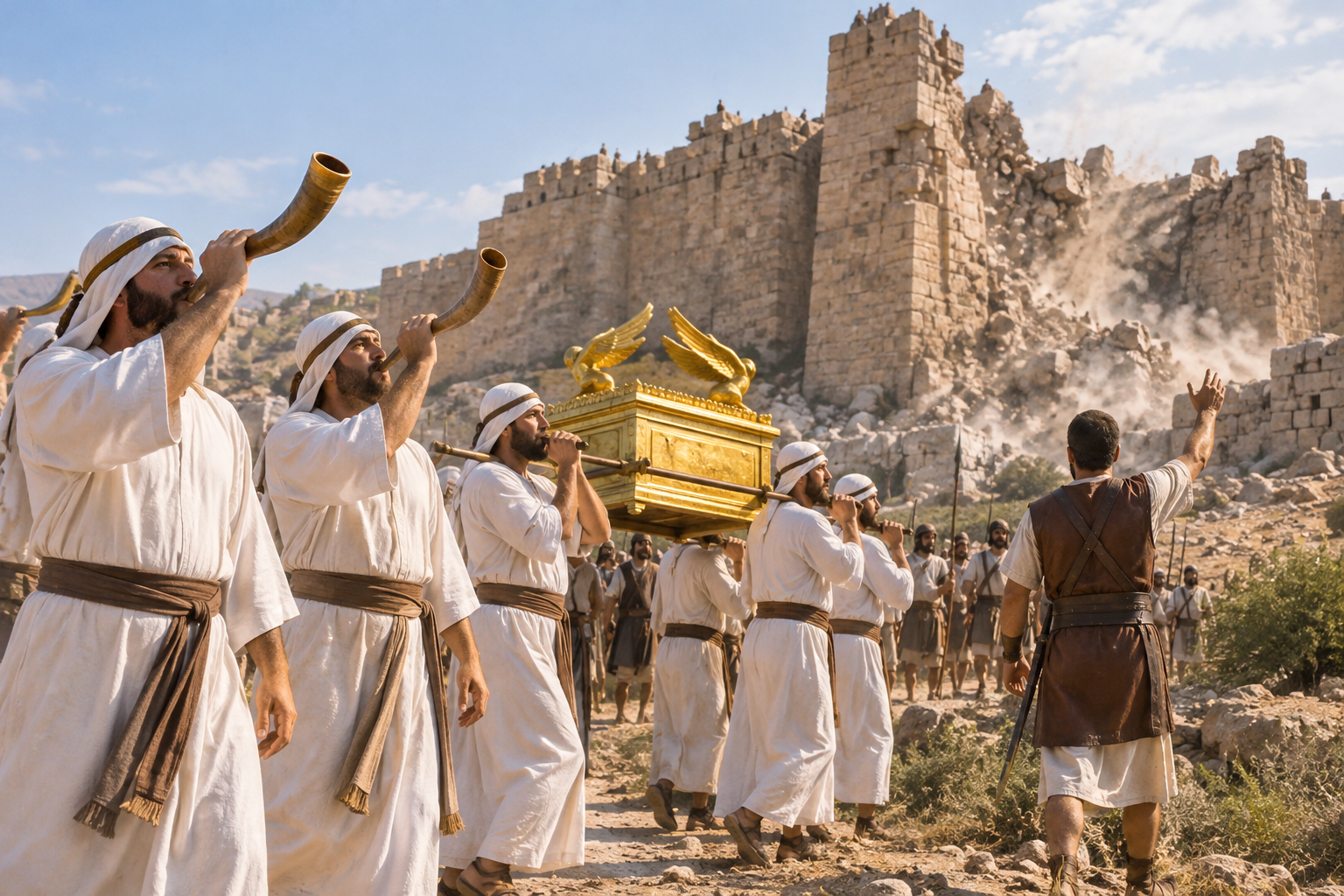
The men of war were to compass the city once each day for six days. Seven priests were to bear seven trumpets of rams’ horns before the ark. On the seventh day Israel was to compass the city seven times. At the appointed trumpet blast Joshua commanded the people to shout.
This was not conventional military strategy. Scripture presents the plan as the LORD’s command. Israel’s responsibility was obedient faith.
Joshua also gave strict instructions concerning the city:
“And the city shall be accursed, even it, and all that are therein, to the LORD: only Rahab the harlot shall live, she and all that are with her in the house, because she hid the messengers that we sent.” — Joshua 6:17
The people were warned not to take of the accursed thing. The silver, gold, vessels of brass, and iron were:
“consecrated unto the LORD: they shall come into the treasury of the LORD.” — Joshua 6:19
When the people shouted:
“the wall fell down flat, so that the people went up into the city, every man straight before him, and they took the city.” — Joshua 6:20
The text attributes the event to the fulfillment of the LORD’s commanded plan. Hebrews 11:30 later expressly says:
“By faith the walls of Jericho fell down, after they were compassed about seven days.”
Rahab and those belonging to her household were brought out according to the promise made by the spies. Joshua 6:25 says:
“And Joshua saved Rahab the harlot alive, and her father’s household, and all that she had.”
Rahab’s deliverance demonstrates that judgment upon Jericho did not prevent mercy toward the one who received Israel’s messengers in faith. Hebrews 11:31 expressly connects her deliverance with faith:
“By faith the harlot Rahab perished not with them that believed not, when she had received the spies with peace.”
Her actions did not purchase salvation by works. Scripture places her in Hebrews 11 among those acting “by faith.” James 2:25 additionally points to her actions as visible evidence accompanying that faith.
Israel burned Jericho and placed its designated valuables into the treasury of the house of the LORD.
Joshua then pronounced a solemn curse concerning rebuilding the city:
“Cursed be the man before the LORD, that riseth up and buildeth this city Jericho: he shall lay the foundation thereof in his firstborn, and in his youngest son shall he set up the gates of it.” — Joshua 6:26
The KJV later explicitly records the fulfillment during the reign of Ahab in 1 Kings 16:34 when Hiel the Bethelite rebuilt Jericho.
The chapter concludes:
“So the LORD was with Joshua; and his fame was noised throughout all the country.” — Joshua 6:27
The emphasis remains upon the LORD being with Joshua.
Joshua 7 — Achan’s Sin and Israel’s Defeat at Ai
The tone changes immediately:
“But the children of Israel committed a trespass in the accursed thing:” — Joshua 7:1
The verse then identifies Achan as the man who took of the accursed thing, and:
“the anger of the LORD was kindled against the children of Israel.”
Joshua sent men to view Ai. They returned recommending that only about two or three thousand men go against it because the inhabitants were few.
About three thousand went up, but:
“they fled before the men of Ai.” — Joshua 7:4
Approximately thirty-six Israelites were smitten. The result was:
“wherefore the hearts of the people melted, and became as water.” — Joshua 7:5
This is a striking reversal from Joshua 5:1. At the beginning of chapter 5 the Canaanites’ hearts melted because of what the LORD had done for Israel. In chapter 7 Israel’s own hearts melted after defeat.
Joshua fell before the ark of the LORD and prayed. The LORD answered directly:
“Get thee up; wherefore liest thou thus upon thy face? Israel hath sinned” — Joshua 7:10–11
The LORD then specified Israel’s offenses:
“they have even taken of the accursed thing, and have also stolen, and dissembled also, and they have put it even among their own stuff.” — Joshua 7:11
God further declared:
“neither will I be with you any more, except ye destroy the accursed from among you.” — Joshua 7:12
Israel’s difficulty at Ai was therefore not fundamentally a matter of troop strength or tactics. The LORD explicitly identified sin as the reason Israel could not stand before its enemies.
God commanded Israel to sanctify themselves and established the process by which the guilty man would be identified.
Achan was eventually taken. Joshua told him:
“My son, give, I pray thee, glory to the LORD God of Israel, and make confession unto him; and tell me now what thou hast done; hide it not from me.” — Joshua 7:19
Achan confessed:
“Indeed I have sinned against the LORD God of Israel, and thus and thus have I done:” — Joshua 7:20
He named what he had taken: a goodly Babylonish garment, two hundred shekels of silver, and a wedge of gold weighing fifty shekels.
His description gives a clear progression in his conduct:
“then I coveted them, and took them; and, behold, they are hid in the earth in the midst of my tent” — Joshua 7:21
Here Scripture itself explicitly gives the sequence: he saw, he coveted, he took, and he hid.
The items were recovered exactly where Achan said they were.
Achan, his sons, daughters, animals, tent, possessions, and the stolen items were brought to the valley of Achor according to Joshua 7:24. Verse 25 then records the severe judgment carried out there, followed by the raising of a great heap of stones.
Because the wording of the passage should control our conclusions, care should be taken in describing details beyond what the verses specifically state concerning each individual member of Achan’s household. What is explicit is that they were brought to the valley and that the passage records stoning, burning, and the erection of the stone heap.
After judgment was executed:
“So the LORD turned from the fierceness of his anger.” — Joshua 7:26
The place was therefore called:
“The valley of Achor, unto this day.”
Key People and Places
- Joshua — Israel’s God-appointed leader. In these chapters he oversees Israel’s circumcision, passover observance, the conquest of Jericho, and the investigation of the sin involving the accursed thing.
- The LORD — The true source of Israel’s direction and victory. He gives Jericho, commands Israel’s actions, exposes hidden sin, and requires holiness.
- Captain of the host of the LORD — The figure who appears to Joshua with a drawn sword in Joshua 5:13–15. Scripture does not explicitly give Him another name in this passage.
- Rahab — The woman of Jericho who had hidden Israel’s spies. She and those in her house were spared according to the promise previously made to her.
- Achan — Son of Carmi, of the tribe of Judah. He explicitly confesses that he coveted and took items from Jericho that Israel had been forbidden to take.
- Gilgal — Israel’s encampment associated in chapter 5 with circumcision, the rolling away of “the reproach of Egypt,” and the observance of the passover.
- Jericho — The fortified Canaanite city delivered into Israel’s hand according to the LORD’s command.
- Ai — The place where Israel initially suffered defeat after the trespass concerning the accursed thing.
- Valley of Achor — The location connected with the judgment recorded at the conclusion of Joshua 7. “Achor” is thereafter associated with this event in the biblical record.
Main Doctrinal or Spiritual Themes
1. God’s presence is more important than human strength
Jericho fell under a plan that could not reasonably be credited to superior human military strategy. Ai, though considered a smaller objective by Israel’s spies, became the scene of defeat when the LORD’s displeasure was upon Israel.
The lesson is plain: numbers do not replace God, and human confidence does not substitute for obedience.
“So the LORD was with Joshua” — Joshua 6:27
That statement explains more than Joshua’s reputation or ability ever could.
2. Obedience must follow God’s Word
At Jericho, Israel was not permitted to improve God’s instructions. They were to march when told, remain silent when told, shout when told, and leave the accursed things alone.
Biblical faith is not merely believing that God exists. Faith takes God at His Word.
Hebrews 11:30 confirms that Jericho’s fall was an act connected with faith:
“By faith the walls of Jericho fell down.”
Faith and obedience are not enemies. Works do not save a sinner, but genuine faith takes seriously what God has said.
3. God is holy
Joshua was told:
“the place whereon thou standest is holy.” — Joshua 5:15
Achan then discovered that the holiness of God was not a ceremonial detail. God meant what He had said concerning Jericho.
Holiness requires that God’s commands be treated as holy rather than optional.
4. Sin may affect more than the individual who commits it
Achan personally confessed:
“I have sinned against the LORD God of Israel.” — Joshua 7:20
Yet the LORD had earlier said:
“Israel hath sinned.” — Joshua 7:11
The text therefore establishes both personal guilt and consequences extending beyond the guilty individual.
This does not mean that the local church today possesses Israel’s civil or judicial authority. Israel under Joshua was a covenant nation operating under commands specifically given by God. Nevertheless, the spiritual principle remains: concealed sin can harm families, churches, testimony, fellowship, and ministry far beyond the person committing it.
5. Covetousness can lead to direct disobedience
Achan’s own words are sufficient:
“I saw… then I coveted them, and took them.” — Joshua 7:21
The passage does not require psychological speculation. Scripture gives the progression itself.
What God had forbidden became desirable to Achan, and desire was allowed to overrule obedience.
6. Hidden sin is not hidden from God
The stolen material was:
“hid in the earth in the midst of my tent.” — Joshua 7:21
It was concealed from human sight but never concealed from the LORD.
A believer may successfully hide conduct from a pastor, spouse, parent, employer, congregation, or friend, but nothing is hidden from God.
7. Confession does not automatically remove every temporal consequence
Achan confessed his sin truthfully after being identified, yet the judgment described by God was still carried out.
This does not teach salvation by works or imply that a sinner earns forgiveness through punishment. It demonstrates that acknowledgment of wrongdoing does not necessarily erase earthly consequences arising from that wrongdoing.
8. God shows mercy in the midst of judgment
Jericho came under divine judgment, yet Rahab was spared according to the promise made to her.
Hebrews 11:31 explicitly says:
“By faith the harlot Rahab perished not with them that believed not.”
God’s holiness and God’s mercy are not contradictory. The same God who judges sin receives the one who believes Him.
9. Israel and the Church must remain distinct
Joshua 5–7 concerns literal Israel entering the literal land promised to that nation. Jericho was a literal city, Joshua was a literal leader, and the conquest was a historical act performed under commands given specifically to Israel.
The Church should draw spiritual and moral instruction from these events, as Scripture permits, without replacing Israel or claiming Israel’s national promises and judicial commands for the Church.
Practical Applications or Lessons
Obey God before expecting His blessing. Israel could not substitute planning, experience, manpower, or past victories for present obedience.
Do not allow yesterday’s victory to create today’s carelessness. Jericho was followed immediately by Ai. A great victory did not make Israel immune to the consequences of sin.
Never treat a clear command of Scripture as insignificant. Achan may have valued the garment, silver, and gold, but God had already spoken concerning those things. Their apparent value could not override God’s prohibition.
Guard against covetousness at the point where Scripture identifies it. Achan said, “I saw… I coveted… and took.” Believers should refuse sinful desire before it becomes sinful action.
Do not confuse religious activity with fellowship with God. Israel was still Israel, Joshua was still Joshua, and the army was still assembled; nevertheless, something was seriously wrong because sin had entered the camp.
Take hidden sin seriously. What is buried “in the midst of my tent” is not buried from God.
Seek God’s will rather than asking Him merely to endorse our plans. Joshua asked the armed figure whether he was “for us, or for our adversaries.” The answer redirected Joshua to the authority of the captain of the LORD’s host.
The believer’s proper posture is not to recruit God to a personal agenda, but to submit the personal agenda to God’s Word.
Remember that victory belongs to the LORD. The walls of Jericho demonstrate that what God promises, He is able to perform. Israel marched and obeyed, but God gave the city.
Remember that God keeps both promises and warnings. Rahab was preserved according to the promise. Jericho fell according to God’s declaration. Achan’s violation of the command brought the consequence God had warned about. Joshua’s curse concerning Jericho was later explicitly fulfilled in 1 Kings 16:34.
Do not turn grace into permission for disobedience. Salvation is by grace through faith apart from works, but the saved believer is never taught to despise God’s commandments. Grace does not make holiness unnecessary.
Keep worship and holiness before service and conquest. Joshua 5 places circumcision, passover, and the encounter on holy ground before the fall of Jericho. While these acts belong to Israel’s historical setting, the order may suggest an enduring practical lesson: communion with God and submission to His Word must never be treated as secondary to visible activity.
Overall Message
Joshua 5–7 moves from consecration at Gilgal, to miraculous victory at Jericho, to humiliating defeat at Ai, and finally to the exposure and judgment of hidden sin.
The central truth is unmistakable: Israel could prevail only as the nation walked under the command and presence of the LORD.
Jericho teaches that seemingly impossible obstacles are no obstacle to God when His people believe and obey Him. Ai teaches that seemingly easy tasks can become impossible when God’s explicit Word is disregarded.
Joshua therefore teaches both confidence and fear: confidence in the faithfulness and power of God, and reverent fear of treating His commands lightly.
“Sanctify yourselves against to morrow.” — Joshua 7:13
The God who gives victory is also the holy God who requires obedience.
Comments are closed