
 Joshua 23–24 records the closing exhortations of Joshua to Israel. The emphasis is not primarily upon Joshua himself, but upon the faithfulness of the LORD, Israel’s obligation to remain separated from idolatry, the holiness of God, covenant responsibility, and the necessity of serving the LORD sincerely.
Joshua repeatedly directs Israel’s attention backward to what God had already done and forward to the consequences of either obedience or apostasy. The final chapters therefore form a solemn conclusion to the book: the God who faithfully fulfilled His promises to Israel must be feared, loved, obeyed, and served.
These chapters concern Israel as a nation living in the land God had given them. They should not be confused with the New Testament doctrine of individual salvation. Israel’s continued enjoyment of covenant blessing in the land involved national obedience. Salvation from sin is never presented in Scripture as being earned by human works.
Chapter Summaries
Joshua 23 — Joshua’s Farewell Warning to Israel
Joshua 23 begins:
“And it came to pass a long time after that the LORD had given rest unto Israel from all their enemies round about, that Joshua waxed old and stricken in age.”
— Joshua 23:1
The KJV explicitly states that a “long time” had passed after the LORD had given Israel rest from their surrounding enemies. Joshua was now “old and stricken in age.”
Joshua called Israel’s leaders:
“And Joshua called for all Israel, and for their elders, and for their heads, and for their judges, and for their officers…”
— Joshua 23:2
He immediately reminded them that their victories had come from God:
“And ye have seen all that the LORD your God hath done unto all these nations because of you; for the LORD your God is he that hath fought for you.”
— Joshua 23:3
This is one of the controlling truths of the chapter. Israel had fought real battles, but Joshua attributed the decisive victory to the LORD.
Joshua also reminded them that he had divided by lot the territories of the nations which remained, together with those already conquered, “from Jordan, with all the nations that I have cut off, even unto the great sea westward” (Joshua 23:4).
He then assured them:
“And the LORD your God, he shall expel them from before you, and drive them from out of your sight; and ye shall possess their land, as the LORD your God hath promised unto you.”
— Joshua 23:5
God’s promise did not eliminate Israel’s responsibility. Joshua therefore commanded:
“Be ye therefore very courageous to keep and to do all that is written in the book of the law of Moses, that ye turn not aside therefrom to the right hand or to the left.”
— Joshua 23:6
Biblical courage here is directly connected with obedience to the written Word of God.
Joshua warned them against religious compromise with the nations that remained:
“That ye come not among these nations, these that remain among you; neither make mention of the name of their gods, nor cause to swear by them, neither serve them, nor bow yourselves unto them:”
— Joshua 23:7
The command is plainly one of separation from idolatry.
The positive counterpart is given immediately:
“But cleave unto the LORD your God, as ye have done unto this day.”
— Joshua 23:8
Joshua reminded them that the LORD had driven out “great nations and strong” and declared:
“One man of you shall chase a thousand: for the LORD your God, he it is that fighteth for you, as he hath promised you.”
— Joshua 23:10
The application Joshua draws is particularly important:
“Take good heed therefore unto yourselves, that ye love the LORD your God.”
— Joshua 23:11
Their obedience was not to be reduced to outward formality. They were commanded to love the LORD.
Joshua then gives one of the strongest warnings in the book. If Israel were to “go back,” associate themselves with the remaining nations, and enter into marriages with them, the LORD would cease driving those nations out before them. They would instead become:
“snares and traps unto you, and scourges in your sides, and thorns in your eyes…”
— Joshua 23:13
The text specifically connects this warning with Israel’s covenant separation from idolatrous nations. It should not be expanded beyond what the passage itself states.
Joshua knew that his death was approaching:
“And, behold, this day I am going the way of all the earth…”
— Joshua 23:14
He then gives a magnificent testimony concerning God’s faithfulness:
“…ye know in all your hearts and in all your souls, that not one thing hath failed of all the good things which the LORD your God spake concerning you; all are come to pass unto you, and not one thing hath failed thereof.”
— Joshua 23:14
This does not mean that every promise God ever made concerning Israel had been exhausted or that no future promises remained. The immediate statement concerns “all the good things” which the LORD had spoken concerning the blessings then under consideration.
Joshua then establishes the other side of covenant faithfulness. Just as God had faithfully brought good upon them, He would faithfully bring the threatened judgment for rebellion:
“Therefore it shall come to pass, that as all good things are come upon you, which the LORD your God promised you; so shall the LORD bring upon you all evil things…”
— Joshua 23:15
The chapter ends with a warning against breaking the covenant, serving other gods, and worshipping them.
The central message of Joshua 23 is therefore clear: The LORD had been completely faithful to Israel; Israel must therefore remain faithful to Him and separate from idolatry.
Joshua 24 — Covenant Renewal at Shechem
Joshua 24 begins:
“And Joshua gathered all the tribes of Israel to Shechem, and called for the elders of Israel, and for their heads, and for their judges, and for their officers; and they presented themselves before God.”
— Joshua 24:1
Shechem becomes the setting for Joshua’s final recorded national address.
Joshua does not begin by praising Israel’s accomplishments. He begins with what God had done.
Speaking the words of the LORD, Joshua traces Israel’s history beginning with Terah:
“Your fathers dwelt on the other side of the flood in old time, even Terah, the father of Abraham, and the father of Nachor: and they served other gods.”
— Joshua 24:2
Here “the flood” refers in the wording of this passage to the region “on the other side of the flood.” The verse itself should govern the interpretation rather than importing unrelated assumptions concerning Noah’s Flood into this expression.
God declared:
“And I took your father Abraham from the other side of the flood, and led him throughout all the land of Canaan…”
— Joshua 24:3
The repeated divine action is striking throughout verses 3–13:
“I took.”
“I gave.”
“I sent.”
“I plagued Egypt.”
“I brought your fathers out of Egypt.”
“I brought you into the land.”
“I delivered them into your hand.”
This emphasis places the glory upon God rather than man.
Joshua recounts Abraham, Isaac, Jacob, Esau, Moses, Aaron, the deliverance from Egypt, the Red Sea, Israel’s wilderness experience, the defeat of the Amorites, Balak and Balaam, the crossing of Jordan, Jericho, and the nations of Canaan.
Concerning Balaam, the LORD says:
“But I would not hearken unto Balaam; therefore he blessed you still: so I delivered you out of his hand.”
— Joshua 24:10
Joshua then reminds Israel:
“And I sent the hornet before you, which drave them out from before you, even the two kings of the Amorites; but not with thy sword, nor with thy bow.”
— Joshua 24:12
The KJV explicitly says that God sent “the hornet.” The passage does not explain the mechanism in greater detail, so speculation about exactly how this occurred should be avoided.
God gave them:
“a land for which ye did not labour, and cities which ye built not…”
— Joshua 24:13
Their inheritance was a gift of divine grace and faithfulness.
Joshua then comes to the great appeal of the chapter:
“Now therefore fear the LORD, and serve him in sincerity and in truth…”
— Joshua 24:14
He also commands:
“…put away the gods which your fathers served on the other side of the flood, and in Egypt; and serve ye the LORD.”
— Joshua 24:14
Then comes one of Joshua’s best-known declarations:
“And if it seem evil unto you to serve the LORD, choose you this day whom ye will serve…”
— Joshua 24:15
Joshua sets before them the alternatives: the gods their fathers had served or the gods of the Amorites.
He then declares:
“…but as for me and my house, we will serve the LORD.”
— Joshua 24:15
This verse clearly expresses Joshua’s settled determination concerning himself and his household. Scripture does not provide additional details here concerning how every member of his household responded individually, so the text should not be made to say more than Joshua actually declares.
The people answered that they would not forsake the LORD, recounting His deliverance from Egypt and His protection throughout their journey.
Joshua then gives a startling response:
“Ye cannot serve the LORD: for he is an holy God; he is a jealous God…”
— Joshua 24:19
This statement must be read with what follows.
Joshua is not teaching that obedience to God is absolutely impossible in every sense, because he immediately continues calling the people to put away strange gods and serve the LORD.
Rather, the immediate context shows that Joshua is confronting superficial confidence. The holy and jealous God cannot be treated casually while His people retain competing gods.
Joshua warns:
“If ye forsake the LORD, and serve strange gods, then he will turn and do you hurt, and consume you, after that he hath done you good.”
— Joshua 24:20
The people again insist:
“Nay; but we will serve the LORD.”
— Joshua 24:21
Joshua therefore makes them witnesses against themselves concerning their declaration.
The people answer:
“We are witnesses.”
— Joshua 24:22
Then Joshua commands:
“Now therefore put away, said he, the strange gods which are among you, and incline your heart unto the LORD God of Israel.”
— Joshua 24:23
This verse is especially important because the KJV explicitly states that “strange gods” were “among” them. Scripture does not specify in this verse precisely which individuals possessed them or in exactly what form they were present, so unnecessary speculation should be avoided.
The people responded:
“The LORD our God will we serve, and his voice will we obey.”
— Joshua 24:24
Joshua then:
“made a covenant with the people that day, and set them a statute and an ordinance in Shechem.”
— Joshua 24:25
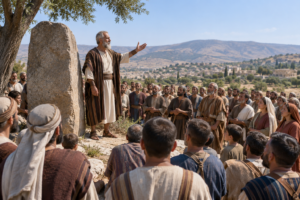
He wrote these words “in the book of the law of God” and set up a great stone:
“under an oak, that was by the sanctuary of the LORD.”
— Joshua 24:26
The KJV calls the location “the sanctuary of the LORD.” The verse itself does not require us to identify more precisely what structure or arrangement is intended beyond the language God provided.
Joshua told the people that the stone would be a witness:
“Behold, this stone shall be a witness unto us; for it hath heard all the words of the LORD which he spake unto us…”
— Joshua 24:27
The language gives the stone a witnessing function as a memorial to the covenant. We should preserve the wording of Scripture without constructing speculative doctrines about an inanimate stone literally possessing human consciousness.
Joshua then dismissed the people:
“So Joshua let the people depart, every man unto his inheritance.”
— Joshua 24:28
The death of Joshua follows:
“And it came to pass after these things, that Joshua the son of Nun, the servant of the LORD, died, being an hundred and ten years old.”
— Joshua 24:29
He was buried:
“in the border of his inheritance in Timnathserah, which is in mount Ephraim, on the north side of the hill of Gaash.”
— Joshua 24:30
Joshua’s spiritual influence is noted:
“And Israel served the LORD all the days of Joshua, and all the days of the elders that overlived Joshua, and which had known all the works of the LORD, that he had done for Israel.”
— Joshua 24:31
The text explicitly connects continued service to the LORD with the generation that personally “had known all the works of the LORD.”
Joseph’s bones, which Israel had brought from Egypt, were buried at Shechem:
“And the bones of Joseph, which the children of Israel brought up out of Egypt, buried they in Shechem…”
— Joshua 24:32
The chapter also records the death of Eleazar:
“And Eleazar the son of Aaron died; and they buried him in a hill that pertained to Phinehas his son, which was given him in mount Ephraim.”
— Joshua 24:33
Thus the book closes with the deaths of Joshua and Eleazar and with Joseph’s burial, emphasizing the passing of a generation while God’s covenant dealings with Israel continue.
Key People and Places
- Joshua — Son of Nun, servant of the LORD, leader of Israel, and the principal speaker in these final chapters. He dies at 110 years of age in Joshua 24:29.
- The LORD God of Israel — The central Person of both chapters. He fought for Israel, fulfilled His promises, delivered them from enemies, gave them the land, and demanded exclusive worship.
- Israel — The covenant nation addressed by Joshua.
- Elders, heads, judges, and officers — Israel’s recognized leaders summoned by Joshua in both chapters.
- Moses — Named in Joshua 23:6 in connection with “the book of the law of Moses” and in Joshua 24 in the historical account of Israel’s deliverance from Egypt.
- Terah — Father of Abraham and Nachor. Joshua 24:2 states that Terah and the fathers in that setting “served other gods.”
- Abraham — Called by God from beyond the flood and brought through Canaan.
- Isaac — Son given to Abraham.
- Jacob — Son of Isaac and father connected with Israel’s descent into Egypt.
- Esau — Jacob’s brother, to whom God gave Mount Seir to possess.
- Aaron — Sent with Moses in the deliverance from Egypt.
- Balak — King of Moab who called Balaam against Israel.
- Balaam — Intended to curse Israel, but God declared, “I would not hearken unto Balaam; therefore he blessed you still.”
- Joseph — His bones were buried at Shechem in fulfillment of Israel’s carrying them from Egypt.
- Eleazar — Son of Aaron; his death is recorded at the conclusion of the book.
- Phinehas — Son of Eleazar; Eleazar was buried in a hill belonging to him.
- Shechem — Location where Joshua gathered the tribes, renewed the covenant, erected the memorial stone, and where Joseph’s bones were buried.
- Jordan — River Israel crossed before entering Canaan.
- Jericho — The first named city in Joshua’s summary of Israel’s conquest after crossing Jordan.
- Mount Ephraim — Region connected with the burial places of Joshua and Eleazar.
- Timnathserah — Joshua’s inheritance and burial location.
- Hill of Gaash — Geographic landmark associated with Joshua’s burial.
- Egypt — The land from which God delivered Israel.
- Canaan — The land God gave Israel.
- The Great Sea westward — The western geographic boundary mentioned in Joshua 23:4.
Main Doctrinal or Spiritual Themes
1. The Absolute Faithfulness of God
Joshua’s testimony is unambiguous:
“…not one thing hath failed of all the good things which the LORD your God spake concerning you…”
— Joshua 23:14
God had kept His word.
This is one of the greatest themes of the entire book of Joshua. Israel’s possession of the land was not finally attributable to military genius, numerical strength, or human merit.
Joshua repeatedly says:
“the LORD your God is he that hath fought for you.”
— Joshua 23:3
And:
“the LORD your God, he it is that fighteth for you…”
— Joshua 23:10
What God promises, God is able to perform.
2. God’s Holiness
Joshua declares:
“…he is an holy God…”
— Joshua 24:19
God cannot be treated as one deity among many.
His holiness demands separation from idols and sincere obedience.
3. God’s Jealousy
Joshua also says:
“…he is a jealous God…”
— Joshua 24:19
Biblical jealousy in this passage concerns God’s rightful demand for the exclusive worship of His covenant people.
Israel could not worship the LORD while also maintaining allegiance to strange gods.
4. Separation From Idolatry
Joshua repeatedly warns Israel against the gods of the surrounding nations.
They were not to:
- Make mention of their gods in the forbidden religious sense described in the passage.
- Swear by them.
- Serve them.
- Bow before them.
- Forsake the LORD for them.
Joshua 24:23 makes the command direct:
“Now therefore put away…the strange gods which are among you…”
Biblical separation is therefore not merely separation from people for the sake of isolation. In this passage it is separation from false worship for the purpose of fidelity to the LORD.
5. Love for God
Joshua commands:
“Take good heed therefore unto yourselves, that ye love the LORD your God.”
— Joshua 23:11
Obedience to God is not presented as empty external conformity.
Israel was commanded to love Him.
6. Obedience to the Written Word
Joshua says:
“…keep and to do all that is written in the book of the law of Moses…”
— Joshua 23:6
Joshua directs Israel to written Scripture.
They were not authorized to alter God’s standard, move “to the right hand or to the left,” or replace revelation with human preference.
For believers today, the principle remains vital: God’s people must submit to what God has written.
7. The Seriousness of Apostasy
Joshua warned that turning from the LORD to strange gods would bring judgment.
God’s goodness was not permission for rebellion.
The same God who had faithfully fulfilled His promises of blessing would faithfully execute His warnings concerning disobedience.
8. Human Responsibility
Joshua says:
“choose you this day whom ye will serve…”
— Joshua 24:15
The verse plainly places a real moral decision before Israel.
The text should not be distorted into teaching salvation by human merit. The question concerns whom Israel will serve.
Nor should the verse be weakened so that the command has no meaningful human responsibility. Joshua actually commands a choice.
9. Service Must Be “In Sincerity and in Truth”
Joshua does not merely say, “serve.”
He says:
“fear the LORD, and serve him in sincerity and in truth…”
— Joshua 24:14
Religious profession without genuine allegiance to God is insufficient.
The people repeatedly say that they will serve the LORD, and Joshua presses upon them the seriousness of that declaration.
10. Remembering God’s Works Strengthens Faithfulness
Joshua reviews generations of divine activity before commanding Israel to serve the LORD.
The order is significant.
God had called Abraham.
God had multiplied his seed.
God had sent Moses and Aaron.
God had plagued Egypt.
God had delivered Israel.
God had defeated their enemies.
God had given them the land.
Joshua therefore says:
“Now therefore fear the LORD…”
— Joshua 24:14
Their obedience was to arise in light of what God had already done.
11. Israel and the Church Must Remain Distinct
Joshua 23–24 addresses Israel under its covenant responsibilities in the land.
The promises concerning possession of Canaan, removal of Canaanite nations, and continued national blessing in the land belong to Israel in their stated context.
The Church is not Israel, and the Church has not inherited Israel’s national land covenant.
Nevertheless, moral truths concerning God’s holiness, faithfulness, opposition to idolatry, obedience to Scripture, love for God, and sincere service remain instructive for believers.
12. God’s Grace Precedes Israel’s Service
Joshua 24 does not begin with what Israel gave God.
It begins with what God gave Israel.
God says:
“I took your father Abraham…”
— Joshua 24:3
“I gave unto Isaac Jacob and Esau…”
— Joshua 24:4
“I sent Moses also and Aaron…”
— Joshua 24:5
“I brought your fathers out of Egypt…”
— Joshua 24:6
“I delivered you…”
— Joshua 24:10
“I have given you a land for which ye did not labour…”
— Joshua 24:13
Then comes:
“Now therefore fear the LORD…”
— Joshua 24:14
God’s gracious acts form the background for Israel’s demanded response.
Practical Applications or Lessons
Remember what God has done.
Joshua deliberately reminded Israel of the LORD’s past faithfulness.
Believers should likewise remember God’s works as revealed in Scripture rather than allowing present circumstances to erase confidence in His character.
Give God the glory for victory.
Joshua did not exalt Israel’s military strength.
He said:
“the LORD your God is he that hath fought for you.”
— Joshua 23:3
Christian service should never become an occasion for self-glory.
Courage is needed to obey Scripture.
Joshua said:
“Be ye therefore very courageous to keep and to do all that is written…”
— Joshua 23:6
The courage most needed by God’s people is often the courage to obey God when compromise would be easier.
Do not make peace with idolatry.
Israel was repeatedly warned that false gods would lead them away from the LORD.
A believer should never knowingly permit anything to receive the devotion, loyalty, reverence, or priority that belongs to God.
Cleave unto the LORD.
Joshua 23:8 gives the positive command:
“But cleave unto the LORD your God…”
Biblical separation is not complete merely because a person rejects error. He must also cling faithfully to the LORD.
Guard your heart carefully.
Joshua commanded:
“Take good heed therefore unto yourselves, that ye love the LORD your God.”
— Joshua 23:11
Spiritual decline does not justify careless treatment of the heart.
Love for God should be deliberately guarded and cultivated through obedience to His Word.
Do not presume upon past blessing.
Israel had experienced extraordinary divine help, but Joshua still warned them against future rebellion.
Past usefulness does not give anyone permission for present compromise.
A godly household should be deliberately directed toward serving God.
Joshua declared:
“…as for me and my house, we will serve the LORD.”
— Joshua 24:15
The verse does not authorize coercing genuine faith, nor does it tell us every detail concerning Joshua’s household. It does clearly reveal Joshua’s determination concerning the direction of his house.
A Christian home should not drift spiritually without leadership or conviction.
Religious words must be matched by genuine allegiance.
Israel repeatedly said, “we will serve the LORD.”
Joshua did not flatter them for making the statement. He challenged them with God’s holiness and demanded that strange gods be put away.
Profession without separation from known idolatry was inadequate.
Put away spiritual rivals.
Joshua said:
“put away…the strange gods which are among you, and incline your heart unto the LORD God of Israel.”
— Joshua 24:23
There is both a negative and positive command:
Put away the false.
Incline the heart toward the LORD.
Every generation must know the works of God.
Joshua 24:31 says Israel served the LORD during the days of Joshua and the elders who:
“had known all the works of the LORD, that he had done for Israel.”
The verse does not explicitly state everything that happened in subsequent generations, but it clearly emphasizes the importance of knowing the works of God.
Parents, preachers, and churches should faithfully teach Scripture so that another generation knows what God has revealed concerning Himself and His mighty works.
God’s servants die, but God remains faithful.
Joshua died.
Eleazar died.
Joseph’s bones were buried.
A generation passed from the scene.
But the LORD who called Abraham, delivered Israel from Egypt, brought them through Jordan, and gave them the land remained the same faithful God.
Christian confidence must therefore rest in God rather than in any human leader.
Central Message of Joshua 23–24
Joshua’s final message may be summarized from the words of the text itself:
The LORD had fought for Israel.
The LORD had fulfilled His good promises.
Israel must therefore love Him, obey His written Word, separate from strange gods, fear Him, cleave to Him, and serve Him “in sincerity and in truth.”
Joshua’s own declaration stands at the center of the challenge:
“…choose you this day whom ye will serve…but as for me and my house, we will serve the LORD.”
— Joshua 24:15
The final chapters leave no room for divided allegiance.
The God who had been perfectly faithful to Israel demanded faithful service from Israel.
Comments are closed