
Chapter Summaries
Job 18 — Bildad’s Second Speech
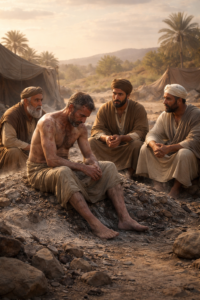 Bildad the Shuhite speaks again, responding sharply to Job. His tone is severe and accusatory.
- Bildad rebukes Job for speaking “words” without knowledge (18:2).
- He presents a grim description of the fate of the wicked, emphasizing:
- Darkness overtaking them (18:5–6)
- Traps, snares, and sudden destruction (18:7–10)
- Terror, disease, and removal from the earth (18:11–21)
- Bildad concludes by asserting that this is the portion of the wicked, clearly implying Job’s suffering proves guilt.
Doctrinal Background:
Bildad assumes a rigid doctrine of retributive justice: suffering always equals personal sin. Though many statements about the wicked are generally true, he misapplies them to a righteous man.
Job 19 — Job’s Response: Faith in a Living Redeemer
Job answers Bildad with deep sorrow but also profound faith.
- Job laments relentless persecution by friends (19:2–5).
- He describes God’s sovereign hand in his affliction (19:6–12), without accusing God of injustice.
- Job details abandonment by relatives, friends, and servants (19:13–19).
- He pleads for compassion: “Have pity upon me” (19:21).
Key High Point:
“For I know that my redeemer liveth, and that he shall stand at the latter day upon the earth” (19:25).
- Job expresses confidence in bodily resurrection and personal vindication before God (19:26–27).
Doctrinal Significance:
This is one of the clearest Old Testament declarations of:
- A living Redeemer
- A future resurrection
- Personal, physical vindication
Job 20 — Zophar’s Second Speech
Zophar the Naamathite responds with impatience and anger.
- He claims Job’s words disturb him (20:2–3).
- Zophar insists the triumph of the wicked is always short-lived (20:5).
- He vividly portrays:
- Sweet sin turning bitter (20:12–14)
- God forcing the wicked to vomit stolen gain (20:15)
- Judgment consuming their substance and offspring (20:19–28)
Theological Error:
Zophar presents absolute, immediate judgment theology, leaving no room for delayed justice or innocent suffering.
Job 21 — Job Refutes the Friends’ Theology
Job directly challenges their claims using observable reality.
- Job asks them to listen silently (21:2–5).
- He points out that many wicked prosper, live long lives, and die peacefully (21:7–13).
- These same men openly reject God (21:14–15).
- Job notes judgment is often delayed, not immediate (21:30).
Key Argument:
“Where is the house of the prince? and where are the dwelling places of the wicked?” (21:28)
Job demonstrates that their theology does not match facts or God’s sovereign timetable.
Job 22 — Eliphaz’s Final Accusation
Eliphaz the Temanite abandons restraint and falsely accuses Job of specific sins.
- He claims Job’s wickedness is “great” (22:5).
- He invents charges:
- Oppression of the poor (22:6–9)
- Withholding water and bread
- He urges Job to repent to restore prosperity (22:21–30).
Critical Issue:
Eliphaz speaks without evidence, illustrating how bad theology produces slander and cruelty.
Key People and Places
- Job — A righteous man suffering severely, yet clinging to faith and integrity.
- Bildad the Shuhite — Represents traditional wisdom and rigid retribution theology.
- Zophar the Naamathite — The harshest speaker, emphasizing swift judgment.
- Eliphaz the Temanite — The eldest friend, increasingly dogmatic and accusatory.
- The Redeemer (Goel) — Anticipated divine vindicator and restorer (19:25).
Main Doctrinal and Spiritual Themes
1. Misapplied Truth
The friends speak many general truths about wickedness but wrongly apply them to Job.
2. Sovereignty of God
God allows suffering for purposes beyond human understanding.
3. Future Vindication
Job’s hope rests not in present circumstances but in God’s final justice.
4. Resurrection Hope
Job affirms bodily resurrection and personal restoration before God.
5. The Danger of Dogmatic Theology
Unbiblical certainty leads to cruelty and false judgment.
Practical Applications and Lessons
- Do not assume suffering proves sin.
- Comfort requires compassion, not accusation.
- God’s justice is certain but not always immediate.
- Faith may shine brightest in despair.
- True hope rests in a living Redeemer, not circumstances.
Comments are closed