
Chapter Summaries
 Jeremiah 52 serves as a historical appendix that records the fall of Jerusalem, the judgment upon Zedekiah, the destruction of the temple, the carrying away of the people, and the later release of Jehoiachin in Babylon. It is closely parallel to 2 Kings 24:18–25:30 and functions as a solemn confirmation that the word of the LORD spoken throughout Jeremiah was fulfilled exactly.
1. Zedekiah’s Reign and Rebellion (Jeremiah 52:1–3)
Zedekiah was “one and twenty years old when he began to reign,” and he reigned eleven years in Jerusalem. Like Jehoiakim, “he did that which was evil in the eyes of the LORD” (v. 2). The chapter makes plain that Judah’s fall was not merely political failure, but divine judgment: “through the anger of the LORD it came to pass in Jerusalem and Judah, till he had cast them out from his presence” (v. 3). Zedekiah rebelled against the king of Babylon, but his rebellion was not an act of faith or righteousness. It was the final movement of a nation already under God’s wrath for persistent disobedience.
2. The Siege and Fall of Jerusalem (Jeremiah 52:4–11)
Nebuchadnezzar came against Jerusalem in the ninth year of Zedekiah, in the tenth month, and his army built forts against the city. The siege continued until the eleventh year of Zedekiah. Famine became severe: “there was no bread for the people of the land” (v. 6). Eventually the city was broken up, and the men of war fled by night.
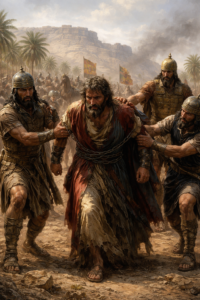
Zedekiah attempted escape, but the Chaldeans pursued him and overtook him “in the plains of Jericho” (v. 8). He was brought before Nebuchadnezzar at Riblah, where judgment was pronounced. His sons were slain before his eyes, the princes of Judah were killed, his eyes were put out, and he was bound in chains and carried to Babylon. This is one of the most tragic scenes in the Old Testament. The king who rejected God’s warnings was made to see the death of his line and then live in darkness. It is a fearful picture of the wages of sin and the certainty of divine judgment.
3. The Burning of Jerusalem and the Temple (Jeremiah 52:12–16)
In the nineteenth year of Nebuchadnezzar, Nebuzar-adan, “captain of the guard,” came to Jerusalem. He burned “the house of the LORD, and the king’s house; and all the houses of Jerusalem” (v. 13). The walls were broken down. The visible glory of the kingdom was reduced to ruin.
Yet the Babylonians left “certain of the poor of the people” to be vinedressers and husbandmen (v. 16). Even in judgment there is a remnant principle. God did not utterly annihilate Judah. Severe chastening fell, but His covenant purposes were not erased.
4. The Temple Vessels Carried Away (Jeremiah 52:17–23)
The chapter then carefully lists the temple furnishings taken by Babylon: the pillars of brass, the bases, the brasen sea, the pots, shovels, snuffers, bowls, spoons, and the vessels of gold and silver. The two pillars, Jachin and Boaz, are described in detail.
This section emphasizes the completeness of the judgment. The temple was not only burned; its sacred furnishings were stripped away. That which had been consecrated for worship was removed because the people had profaned the covenant through idolatry and stubborn rebellion. The detailed inventory underscores that nothing happened randomly. The Lord saw it all, measured it all, and permitted it all in righteousness.
5. The Deportation and Execution of Leaders (Jeremiah 52:24–30)
Nebuzar-adan took Seraiah the chief priest, Zephaniah the second priest, and other principal men. They were brought to the king of Babylon at Riblah and slain. This represented the collapse of Judah’s religious and civil leadership under judgment.
The chapter also records numbers of captives carried away in different deportations. The repeated removals show that Judah’s fall came in stages, just as Jeremiah had long warned. God’s judgment often advances progressively when people harden themselves against repeated calls to repent.
6. The Release of Jehoiachin (Jeremiah 52:31–34)
The book closes with an unexpected note of mercy. In the thirty-seventh year of Jehoiachin’s captivity, Evil-merodach king of Babylon lifted up the head of Jehoiachin, brought him out of prison, spoke kindly unto him, changed his prison garments, and gave him a continual allowance.
This does not cancel the judgment that came before, but it does show that God had not forgotten David’s line. The book ends, not with the throne restored, but with a glimmer of hope. Even in exile, the Davidic line still lived. For a conservative Baptist reading, this points beyond the ruins of Jerusalem to the faithfulness of God in preserving His covenant promises, ultimately fulfilled in the greater Son of David, the Lord Jesus Christ.
Key People and Places
Zedekiah — Last king of Judah before Jerusalem’s destruction. He rebelled against Babylon and suffered severe judgment.
Nebuchadnezzar — King of Babylon, the earthly instrument God used to chasten Judah.
Nebuzar-adan — Captain of the guard who oversaw the destruction of Jerusalem and the carrying away of captives.
Jehoiachin — Former king of Judah taken captive earlier; later shown mercy in Babylon.
Evil-merodach — Babylonian king who released Jehoiachin from prison and treated him kindly.
Seraiah — Chief priest taken and slain by the Babylonians.
Zephaniah — Second priest, also taken in the judgment.
Riblah — Place where Nebuchadnezzar pronounced judgment on Zedekiah and executed Judah’s leaders.
Jerusalem — Capital city of Judah, besieged, broken, and burned because of the nation’s sin.
Jericho — Region where Zedekiah was overtaken while fleeing.
Babylon — Place of exile and captivity; the rod of God’s chastening upon Judah.
House of the LORD — Solomon’s temple, burned and plundered in judgment.
Main Doctrinal or Spiritual Themes
1. The certainty of God’s judgment
Jeremiah 52 proves that God’s warnings are not empty threats. What He said through Jeremiah came to pass. Divine judgment may seem delayed, but it is never uncertain.
2. Sin brings national and personal ruin
Judah’s fall came because the people and their rulers “did that which was evil.” Sin is never harmless. It destroys kings, cities, homes, worship, and testimony.
3. God is sovereign over nations
Babylon was powerful, but it was not ultimate. The chapter makes clear that these events happened “through the anger of the LORD.” World empires move under divine permission and providence.
4. Sacred things do not protect rebellious hearts
The temple, priesthood, and holy vessels could not shield Judah while the nation persisted in disobedience. Outward religion without obedience cannot avert judgment.
5. Leadership under judgment
Kings, priests, officers, and mighty men all faced accountability. Those entrusted with influence are not exempt from God’s holiness.
6. God preserves hope amid chastening
The release of Jehoiachin shows that judgment is not the end of God’s redemptive purpose. Even in captivity, the Lord preserved the royal line. His promises stand when everything visible appears ruined.
7. God is faithful to His word both in warning and in mercy
The same God who fulfilled His threats also preserved a seed of hope. He is faithful in all He says.
Practical Applications or Lessons
1. Do not treat God’s warnings lightly
Zedekiah had heard the truth repeatedly and refused submission. Men often perish not because truth was unavailable, but because it was resisted. Believers should respond quickly to God’s correction.
2. Outward religion is no substitute for obedience
Judah had a temple, priests, and sacred vessels, yet still fell. Church attendance, biblical language, and religious habits cannot replace repentance, holiness, and real submission to God.
3. Sin has consequences far beyond the sinner
Zedekiah’s rebellion affected his family, his city, and his nation. Personal disobedience often brings suffering to others. This should sober every parent, leader, and believer.
4. God’s chastening is righteous
Jerusalem’s fall was tragic, but it was not unjust. The Lord had been patient for generations. When His hand falls, it is always holy and true.
5. No earthly structure is permanent
Walls fell, palaces burned, and the temple was destroyed. Believers must not place ultimate confidence in institutions, buildings, governments, or visible strength. The Lord alone is our lasting refuge.
6. God can preserve hope in the darkest aftermath
The final verses teach that even after devastating judgment, the Lord may still show mercy and maintain His promises. A believer walking through chastening should never conclude that God has ceased to be faithful.
7. The chapter calls us to fear God and trust His word
Jeremiah 52 is a grave closing witness: God means what He says. That truth should move the lost to repentance and the saved to reverent obedience.
Comments are closed