Chapter Summaries
 Jeremiah 50 is a long prophetic chapter declaring the judgment of God against Babylon. The chapter also contains strong promises of mercy and restoration for Israel and Judah. The flow moves back and forth between Babylon’s coming destruction and God’s future dealings with His covenant people.
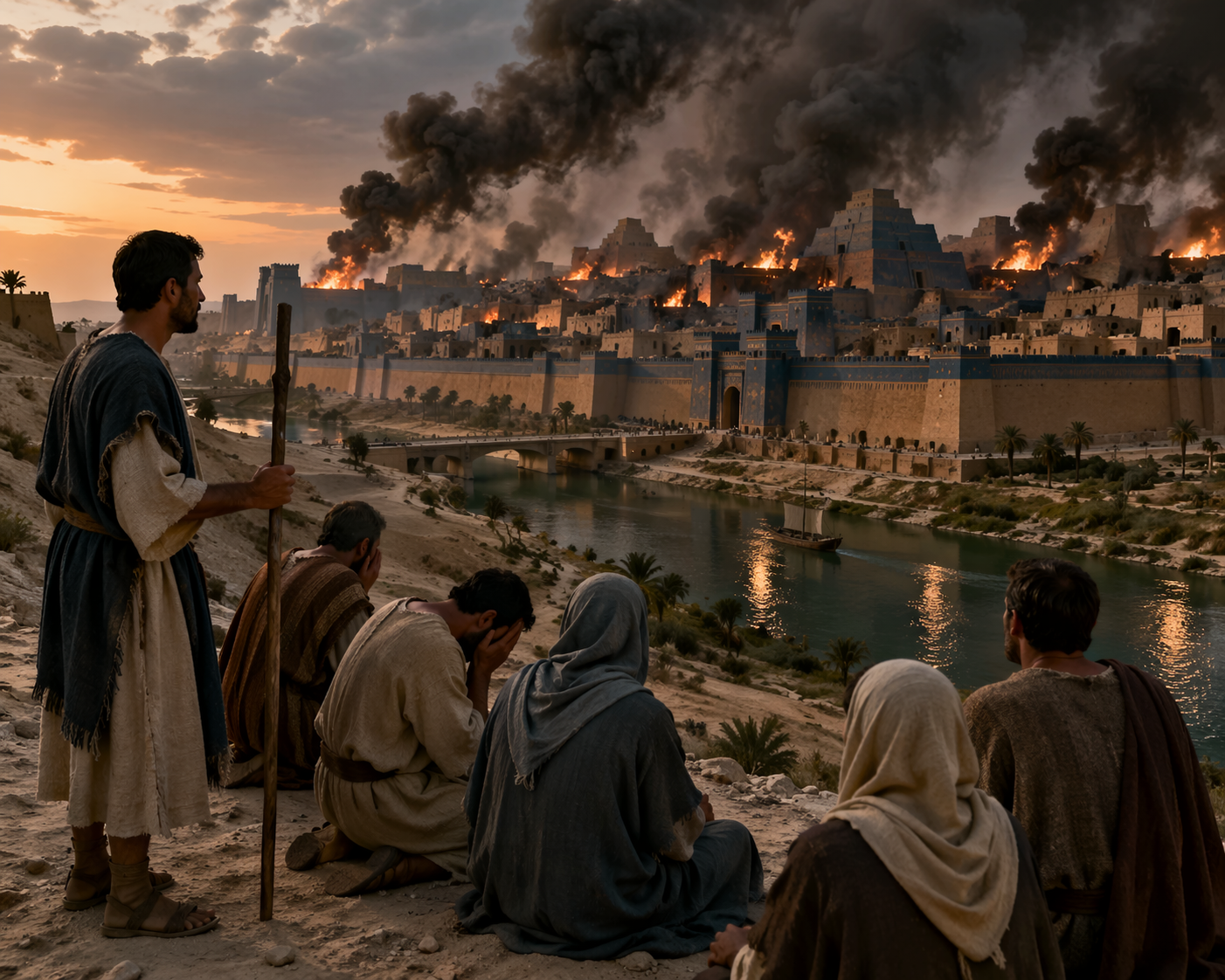
The chapter opens with a command to “Declare ye among the nations” that “Babylon is taken” and that her idols are confounded, especially Bel and Merodach (Jeremiah 50:2). The fall of Babylon is not presented as a mere accident of history, but as the deliberate act of God against a proud, idolatrous world power. Verse 3 says, “out of the north there cometh up a nation against her”, pointing to the invading force God would use to bring Babylon down.
Then the prophecy turns to Israel and Judah. In those days, “the children of Israel shall come, they and the children of Judah together, going and weeping: they shall go, and seek the LORD their God” (Jeremiah 50:4). This is one of the precious features of the chapter: while Babylon falls under wrath, God calls His scattered people back to Himself. Their return is not merely geographic; it is spiritual. They ask “the way to Zion” and bind themselves to the LORD in “a perpetual covenant that shall not be forgotten” (v. 5). That language shows repentance, renewed devotion, and restoration.
Verses 6–7 describe Israel as lost sheep led astray by false shepherds: “My people hath been lost sheep: their shepherds have caused them to go astray.” This is both an indictment of corrupt leadership and an explanation for the nation’s suffering. Yet the Lord does not excuse the nations that devoured His people. Babylon and other enemies became instruments of chastening, but they also acted in cruelty and pride, and for that they would answer to God.
Verses 8–16 urge God’s people to flee out of Babylon. The call, “Remove out of the midst of Babylon” (v. 8), has an immediate historical meaning for the Jews in exile, but it also carries a broader spiritual principle of separation from a proud, idolatrous world system. Babylon would become desolate, and the invaders would not miss their mark. The chapter emphasizes the certainty of divine judgment.
Verses 17–20 contrast Israel’s scattering with Israel’s future pardon. Israel is called “a scattered sheep” first devoured by Assyria and then by Babylon (v. 17). But the Lord of hosts promises to punish the king of Babylon as He punished the king of Assyria. Then comes a tender promise: God will bring Israel again to his habitation, feeding in Carmel and Bashan, and “the iniquity of Israel shall be sought for, and there shall be none” and “the sins of Judah, and they shall not be found” (v. 20). That is a remarkable statement of divine forgiveness. In conservative Baptist understanding, this points to God’s gracious pardon of His people and anticipates His future restoration purposes for Israel.
Verses 21–32 return to the destruction of Babylon in severe language. The land is called against Merathaim and Pekod (v. 21), names that likely carry a wordplay of bitterness and visitation/judgment. Babylon had been “the hammer of the whole earth” (v. 23), crushing other nations, but now that hammer itself would be broken. The Lord declares, “thou wast not aware” that Babylon had been found fighting against Him (v. 24). Her pride is singled out repeatedly: “Behold, I am against thee, O thou most proud” (v. 31). Pride is one of the chapter’s dominant sins. Babylon trusted in might, idols, conquest, and self-exaltation, but none can stand when God arises in judgment.
Verses 33–34 again comfort Israel and Judah. Though they were oppressed and held fast in captivity, “their Redeemer is strong; the LORD of hosts is his name: he shall thoroughly plead their cause” (v. 34). This is one of the great doctrinal jewels of the chapter. God identifies Himself as the Redeemer of His people and as the One strong enough to overthrow their oppressors. He gives rest to the land and disquietness to Babylon’s inhabitants.
The closing verses, 35–46, are a repeated sword-song against Babylon. “A sword is upon the Chaldeans” is repeated against princes, wise men, liars, mighty men, horses, chariots, and treasures. Every human support of Babylon would fail. Her waters would dry up, and the reason is plainly stated: “for it is the land of graven images, and they are mad upon their idols” (v. 38). The chapter ends with Babylon made desolate like Sodom and Gomorrah, so that no man shall abide there permanently. The report of Babylon’s fall shakes the nations, because when God judges a dominant world empire, all the earth hears it (v. 46).
Key People and Places
Jeremiah
The prophet through whom God delivers this oracle concerning Babylon.
Babylon
The great world empire used by God to chasten Judah, but later judged for pride, cruelty, and idolatry.
Bel
A chief Babylonian false god mentioned as confounded in Babylon’s fall (v. 2).
Merodach
Another major Babylonian deity, likewise brought to shame by the judgment of the true God (v. 2).
The children of Israel
The northern tribes, mentioned in connection with future return and restoration.
The children of Judah
The southern kingdom, also promised return, repentance, and pardon.
The king of Babylon
Represents Babylon’s imperial power and is specifically marked out for punishment (v. 18).
The LORD of hosts
The covenant God of Israel, the Judge of nations, and the strong Redeemer of His people.
Zion
The spiritual and national center to which the restored people set their faces (v. 5).
Carmel and Bashan
Places of fruitfulness and pasture, used to picture Israel’s restored blessing (v. 19).
Assyria
Mentioned as an earlier oppressor of Israel (v. 17).
The north
The direction from which Babylon’s conquerors would come in prophetic language (v. 3, 9, 41).
Merathaim and Pekod
Places or symbolic names connected with Babylon and its judgment (v. 21).
Chaldeans
The people of Babylon, especially in their ruling and military identity.
Sodom and Gomorrah
Used as the comparison for utter overthrow and desolation (v. 40).
Main Doctrinal or Spiritual Themes
1. God is sovereign over nations
Jeremiah 50 makes plain that empires rise and fall under God’s hand. Babylon was mighty, but not ultimate. The Lord can use a nation as an instrument and then judge that same nation for its wickedness. This guards us from fearing human power too much.
2. God judges pride
Babylon is condemned especially for pride and arrogance. The words “O thou most proud” summarize her spirit. Pride always puts the creature in the place that belongs only to God. National pride, personal pride, and spiritual pride all invite divine resistance.
3. God hates idolatry
Babylon is full of graven images, and her idols are mocked as helpless before the living God. Idolatry is not merely old pagan religion; it is the worship of anything in the place of God. The chapter shows the vanity of false worship and the certainty of its downfall.
4. God chastens His people but does not cast them off
Israel had sinned and was scattered, yet the Lord still calls them “My people” (v. 6). He disciplines His own, but He remains covenantally faithful. This is a vital truth: divine chastening is not the same as divine abandonment.
5. God restores repentant people
Israel and Judah are shown returning weeping and seeking the LORD. True restoration begins with repentance. God’s mercy is not cheap or careless; it draws sinners back to Himself in brokenness and faith.
6. God is the Redeemer of His people
Verse 34 is central: “their Redeemer is strong.” Redemption is not based on Israel’s strength but on God’s. The Lord pleads the cause of His people and acts in power on their behalf. This theme harmonizes well with the broader Bible truth that God saves and defends His own by grace.
7. Forgiveness is part of restoration
Verse 20 promises that Israel’s iniquity will be sought for and not found. That points to real pardon, not just outward relief. God’s restoration includes cleansing from sin, not merely rescue from trouble.
8. Separation from Babylon is necessary
The call to flee Babylon teaches that God’s people are not to settle comfortably in the midst of a condemned system. Historically it meant leaving literal Babylon; spiritually it teaches separation from the world’s rebellion, pride, and idolatry.
Practical Applications or Lessons
1. No earthly power is secure when it stands against God
Babylon looked invincible, yet God announced its fall before it happened. Believers should not be intimidated by powerful institutions, governments, or cultural systems that defy the Lord.
2. Pride brings destruction
Babylon’s strength became the occasion of her downfall because it fed her arrogance. A Christian should fear pride in success, knowledge, ministry, possessions, or influence.
3. God’s people must beware of wandering shepherds
Jeremiah 50:6 warns that false or unfaithful leaders can lead people astray. Believers must test leadership by the Word of God and stay anchored in truth.
4. Repentance is the path back to blessing
Israel and Judah come weeping and seeking the LORD. When believers drift, restoration begins not with excuses but with humble return to God.
5. God remembers His covenant mercy
Even when His people have failed badly, He is still merciful to those who return to Him. This is a comfort to the chastened saint, the backslider who repents, and the church that seeks renewal.
6. Idols always fail
Babylon’s gods could not save her. Modern idols such as money, power, pleasure, human approval, or national strength will also fail. Only the Lord is worthy of trust.
7. Separation from a corrupt world system is still a valid principle
The command to depart from Babylon teaches that believers should not become at home in what God has condemned. There must be moral and spiritual separation, even while living in the world.
8. The Redeemer is strong
When God’s people are oppressed, weak, or discouraged, Jeremiah 50:34 gives hope. The Lord is not a weak sympathizer; He is a strong Redeemer who is able to plead their cause and act for them.
9. God’s forgiveness is complete
The promise that Israel’s sins will not be found reminds us that when God pardons, He pardons fully. That truth is precious for every believer who comes to God in genuine repentance.
Comments are closed