Chapter Summaries
Isaiah 64
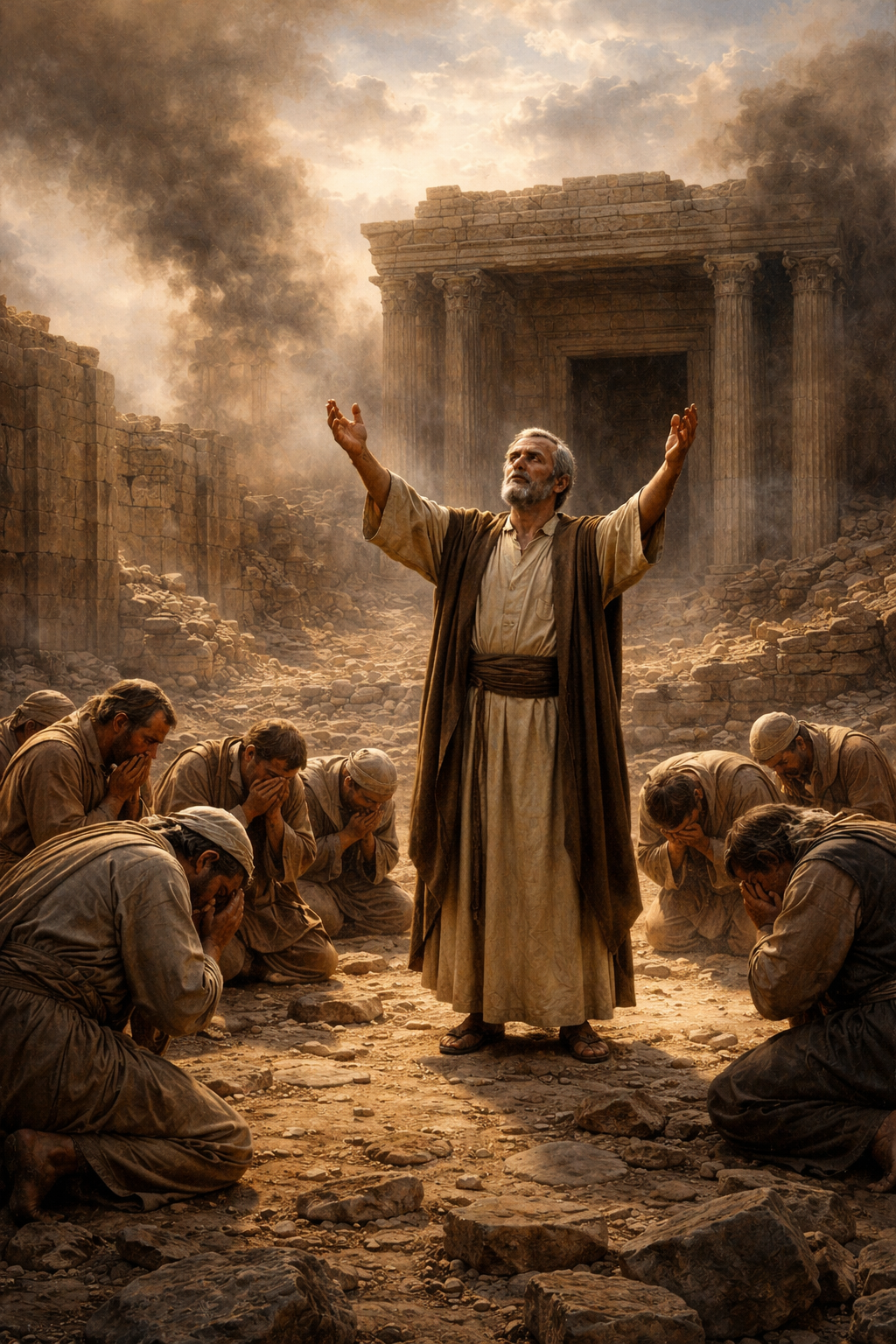
 Isaiah 64 continues a prayer of repentance and pleading that grows out of the previous chapter. The prophet cries, “Oh that thou wouldest rend the heavens, that thou wouldest come down” (64:1). This is a passionate appeal for God to visibly intervene in power, as when He acted in former days and caused “the mountains [to flow] down at thy presence.” The language emphasizes the greatness, holiness, and fearfulness of God’s acts. Isaiah is not asking for a mild encouragement, but for divine visitation that shakes the earth and makes God’s name known to His adversaries.
The chapter looks backward and forward at the same time. It recalls how God has worked for those that “waiteth for him” (64:4), showing that the Lord blesses faith and patient dependence. At the same time, it confesses the nation’s sin. Verse 5 says, “Behold, thou art wroth; for we have sinned.” The people are forced to admit that divine chastening is not unjust. Their suffering is tied to their own rebellion.
One of the clearest statements on human sinfulness appears in verse 6: “But we are all as an unclean thing, and all our righteousnesses are as filthy rags.” This is a strong reminder that sinful man cannot stand before a holy God by his own merit. Even supposed righteousness, when offered as a ground of acceptance before God, is defiled. Historically, this fits Judah’s pattern of outward religion mixed with inward corruption. Doctrinally, it lays groundwork for the need of grace rather than self-righteousness.
The chapter closes with a humble appeal based on covenant relationship and divine compassion. Isaiah says, “But now, O LORD, thou art our father; we are the clay, and thou our potter” (64:8). God is the Maker, and His people are the work of His hands. Jerusalem and the temple lie desolate, and the prophet asks whether God will continue to “refrain” Himself (64:12). The tone is broken, reverent, and urgent. The people have no plea except God’s mercy.
Isaiah 65
Isaiah 65 begins with God’s answer. The Lord declares, “I am sought of them that asked not for me; I am found of them that sought me not” (65:1). This shows the wideness of God’s sovereign dealings and points beyond Israel alone. The Apostle Paul later applies this passage to the calling of the Gentiles. At the same time, God says, “I have spread out my hands all the day unto a rebellious people” (65:2). So the chapter sets two truths side by side: God’s gracious outreach and man’s stubborn refusal.
The rebellious people are described in vivid terms. They walk “in a way that was not good, after their own thoughts” (65:2). They provoke the Lord through idolatrous practices, false worship, pride, and spiritual uncleanness. This reflects Judah’s long history of apostasy, though the wording also reaches beyond one moment and describes the general character of hardened rebellion. The sin is not merely ceremonial error. It is self-will, religious corruption, and contempt for God’s ways.
Yet judgment is not the only note. In verses 8–10 the Lord uses the image of a cluster in which “there is blessing in it,” meaning He will not destroy all for the sake of the remnant. This is an important biblical principle: God distinguishes between the rebellious mass and the faithful remnant. He promises that “mine elect shall inherit it, and my servants shall dwell there” (65:9). Conservative Baptist interpretation rightly sees here both an immediate encouragement for the faithful in Israel and a broader witness to God’s preserving grace.
The chapter then contrasts the destiny of God’s servants with that of those who forsake Him. “My servants shall eat, but ye shall be hungry… my servants shall rejoice, but ye shall be ashamed” (65:13). This sharp division shows that covenant privilege without obedient faith is worthless. Mere national identity could not shield unbelievers from judgment.
The closing section rises into millennial and eternal blessing language. The Lord says, “Behold, I create new heavens and a new earth” (65:17). The passage includes joy, peace, longevity, fruitfulness, and harmony. “The wolf and the lamb shall feed together” (65:25). Some features strongly reflect the coming kingdom reign, while the phrase “new heavens and a new earth” also reaches toward the final consummation. A sound approach recognizes that the prophet often sees the far future in one sweeping view. The emphasis is clear: sin and sorrow will not have the last word; God will establish a righteous order for His glory.
Isaiah 66
Isaiah 66 opens with a declaration of God’s majesty: “The heaven is my throne, and the earth is my footstool” (66:1). The Lord rebukes any shallow confidence in temple-centered religion apart from true humility. Though He had ordained temple worship for Israel, He makes plain that no building can contain Him. The one to whom He will look is “he that is poor and of a contrite spirit, and trembleth at my word” (66:2). This is a great summary of acceptable worship. God values reverence, brokenness, and obedience more than empty ritual.
The chapter then condemns hypocritical religion. Verse 3 compares unacceptable sacrifices to acts of murder and idolatry, not because God had rejected all sacrifice in itself, but because the worshippers’ hearts were corrupt. Outward ceremony without submission becomes abomination. This was a recurring problem in Isaiah: people honored God with forms while living in rebellion.
A major turning point appears in the promises concerning Zion. Though God’s people have been afflicted and despised, sudden blessing is coming: “Shall the earth be made to bring forth in one day? or shall a nation be born at once?” (66:8). Zion is pictured as a mother bringing forth children. This points to a future restoration and enlargement of Jerusalem’s blessing. The chapter carries strong kingdom hope as Jerusalem becomes a center of consolation, joy, and divine glory.
The final section broadens outward to the nations. God says He will gather “all nations and tongues; and they shall come, and see my glory” (66:18). Survivors are sent to distant lands to declare His glory among the Gentiles. This anticipates a worldwide acknowledgment of the Lord. The nations will bring an offering unto the Lord, and all flesh shall come to worship before Him (66:23). This shows the universal scope of God’s redemptive purpose while still maintaining Jerusalem’s significance in the prophetic picture.
The book ends with both glory and warning. The righteous worshippers enjoy the Lord’s blessing, but the rebels are a perpetual sign of judgment: “their worm shall not die, neither shall their fire be quenched” (66:24). This closing note is solemn and weighty. God is not only merciful and restoring; He is also just. The final contrast between worshippers and judged transgressors presses the reader to choose reverence, repentance, and submission to God.
Key People and Places
Key People
Isaiah
The prophet through whom the Lord delivers both confession, warning, and hope. In these chapters he speaks as intercessor, preacher, and revealer of future glory.
The LORD
The central Person throughout the passage. He is holy, sovereign, patient, just, merciful, Creator, Father, Potter, Judge, and Restorer.
The rebellious people of Israel/Judah
They represent covenant people who have sinned through hypocrisy, idolatry, and stubbornness. They are warned that outward religion cannot save them.
The servants of the LORD / the remnant / mine elect
These are the faithful ones whom God preserves and blesses. They stand in contrast to the rebellious.
The Gentiles / all nations
Especially highlighted in Isaiah 65–66 as those whom God will reach, gather, and bring to behold His glory.
Key Places
Jerusalem
The city of God’s earthly dealings with Israel, at this point seen as afflicted and desolate, yet destined for comfort, restoration, and future joy.
Zion
Often used poetically for Jerusalem and the people of God in covenant relation. In chapter 66 Zion is pictured as a mother bringing forth children.
The temple / house of God
A key background reference, especially in Isaiah 64 and 66. Its desolation shows judgment, while the rebuke of false worship shows that buildings and rituals are meaningless without a right heart.
The heavens and the earth
Used to magnify God’s rule in chapter 66 and to describe His future renewing work in chapter 65.
The nations / distant lands
Places beyond Israel that become part of the prophetic vision of worldwide worship and testimony to God’s glory.
Main Doctrinal or Spiritual Themes
1. God’s holiness and majesty
These chapters strongly emphasize that God is high above man. He rends the heavens, shakes mountains, sits with heaven as His throne, and judges all flesh. He cannot be manipulated by ceremony or contained by buildings.
2. Man’s sinfulness and inability
Isaiah 64:6 is one of Scripture’s clearest declarations that fallen man cannot produce righteousness fit to commend him before God. Human merit fails before divine holiness. This truth agrees with the broader Bible doctrine that salvation must be by grace.
3. The necessity of true repentance
The broken spirit of Isaiah 64 and the contrite heart of Isaiah 66 show what God honors. Mere ritual, heritage, or formal religion will not do. The Lord looks to those who tremble at His word.
4. Judgment upon hypocrisy and rebellion
God repeatedly condemns those who maintain outward religious forms while following “their own thoughts.” False worship, pride, and disobedience bring real judgment.
5. God’s mercy toward a remnant
Even in judgment, the Lord preserves a people for Himself. The cluster with blessing in it shows that God never loses His faithful remnant.
6. The sovereignty of God in salvation history
Isaiah 65 shows God being found by those who had not sought Him, while long appealing to a rebellious people. This fits the biblical pattern of sovereign grace and human responsibility set side by side.
7. Future kingdom blessing and final restoration
The language of new creation, peace, joy, prosperity, and worldwide worship points to God’s coming righteous order. Conservative Baptist readers commonly understand this in connection with the future reign of Christ and the final triumph of God’s purposes.
8. The universal scope of God’s glory
The closing chapter reaches to “all nations and tongues.” God’s glory is not confined to one people forever in its outward administration. The nations are brought into the scene of worship and testimony.
9. The eternal seriousness of judgment
Isaiah does not end with sentimentality. The final warning about unquenchable fire shows the dreadful reality of divine wrath against unrepentant sin.
Practical Applications or Lessons
1. Pray for God to work in power
Isaiah 64 teaches believers to long for real divine intervention, not just outward improvement. There is a place for earnest prayer that God would revive, awaken, convict, and make His name known.
2. Never trust in self-righteousness
“All our righteousnesses are as filthy rags” should humble every sinner and every saint. No one is saved by morality, religious effort, or church activity. We must rest in God’s mercy and righteousness, not our own.
3. Approach God with humility
God looks to the one who is “poor and of a contrite spirit.” Pride, presumption, and casual worship are out of place before a holy God. A trembling attitude toward Scripture is still the mark of healthy spiritual life.
4. Outward religion is not enough
Isaiah 66 warns against maintaining forms while the heart is far from God. A person may attend services, say religious words, and still be living in rebellion. God cares about truth in the inward parts.
5. God always knows His own
In corrupt times, the faithful remnant may seem small, but the Lord preserves His servants. Believers should not despair when many fall away or compromise.
6. God’s promises extend beyond present ruins
Jerusalem was desolate, yet God promised comfort and glory. When circumstances look ruined, God is still able to restore, rebuild, and fulfill every word He has spoken.
7. God’s Word must be feared, not edited
The one whom God approves is the one who trembles at His word. Believers today should receive Scripture with reverence, obedience, and confidence rather than trying to reshape it by human opinion.
8. The future belongs to God
These chapters lift the eyes beyond present sin and sorrow. God will judge evil, preserve His people, and establish righteousness. This gives hope for steadfast living in a dark world.
9. Worship and missions belong together
Isaiah 66 joins the glory of God, the gathering of nations, and worldwide testimony. Those who know the Lord should desire that all peoples hear of His glory and come under His truth.
Summary Thought
Isaiah 64–66 closes the book with a powerful combination of confession, divine answer, judgment, remnant hope, future kingdom blessing, and final warning. The passage shows a holy God dealing truthfully with sin, rejecting hypocrisy, comforting the contrite, preserving His servants, and promising a future in which His glory will be known among all nations. It is a fitting end to Isaiah: God humbles the proud, saves by grace, fulfills His word, and will finally set all things right.
Comments are closed