Overview of Genesis 31–33 — KJV
 Genesis 31–33 records Jacob’s departure from Laban, God’s protection of him on the journey back toward Canaan, Jacob’s fearful approach to Esau, the remarkable encounter at Peniel, and the peaceful meeting between the two brothers. Throughout these chapters, the plain KJV text emphasizes God’s faithfulness, providential protection, obedience to divine direction, prayer, humility, separation, and the necessity of depending upon God rather than circumstances.
These chapters also show the continuing fulfillment of what God had already promised Jacob at Bethel:
Genesis 28:15: “And, behold, I am with thee, and will keep thee in all places whither thou goest, and will bring thee again into this land…”
Genesis 31 begins the fulfillment of that promised return.
Chapter Summaries
Genesis 31 — Jacob Leaves Laban
1. God commands Jacob to return
Jacob becomes aware that Laban’s sons are accusing him of taking their father’s wealth, and he also notices that Laban’s attitude toward him has changed.
Then the LORD gives Jacob a direct command:
Genesis 31:3: “And the LORD said unto Jacob, Return unto the land of thy fathers, and to thy kindred; and I will be with thee.”
Jacob’s departure therefore was not merely a response to family tension. Explicitly, God commanded him to return.
When Jacob speaks with Rachel and Leah, he explains Laban’s treatment of him and God’s protection:
Genesis 31:7: “And your father hath deceived me, and changed my wages ten times; but God suffered him not to hurt me.”
Whatever Laban attempted regarding Jacob’s wages, Jacob attributes his preservation and prosperity to God.
Jacob also recounts God’s words identifying Himself with Bethel:
Genesis 31:13: “I am the God of Bethel, where thou anointedst the pillar, and where thou vowedst a vow unto me: now arise, get thee out from this land, and return unto the land of thy kindred.”
This directly connects Jacob’s return with his earlier encounter with God in Genesis 28.
2. Rachel and Leah agree to leave
Rachel and Leah acknowledge their estrangement from their father’s household and agree with Jacob:
Genesis 31:16: “…now then, whatsoever God hath said unto thee, do.”
The text therefore presents the departure as obedience to what God had spoken.
3. Rachel takes Laban’s images
Genesis 31:19 says:
“And Rachel had stolen the images that were her father’s.”
Later Laban calls them:
Genesis 31:30: “…my gods…”
The KJV therefore explicitly associates these images with Laban’s gods.
Scripture does not explicitly state Rachel’s motive for stealing them. Suggestions concerning inheritance customs, household authority, religious devotion, or other motives may be historically proposed, but Genesis itself does not tell us why she took them. It is therefore safer to leave her motive unstated.
4. Jacob leaves without informing Laban
Genesis says:
Genesis 31:20: “And Jacob stole away unawares to Laban the Syrian, in that he told him not that he fled.”
The chapter records the secrecy of Jacob’s departure. It does not explicitly give a divine evaluation of this particular method of leaving, so we should not make the narrative say more than it says.
Laban discovers the departure and pursues Jacob.
5. God restrains Laban
Before Laban reaches Jacob, God speaks to him in a dream:
Genesis 31:24: “Take heed that thou speak not to Jacob either good or bad.”
Laban himself acknowledges:
Genesis 31:29: “It is in the power of my hand to do you hurt: but the God of your father spake unto me yesternight…”
This is a strong demonstration of God’s providential protection. Laban possessed the ability and apparently the opportunity to harm Jacob, but God intervened.
Jacob later recognizes this protection:
Genesis 31:42: “Except the God of my father, the God of Abraham, and the fear of Isaac, had been with me, surely thou hadst sent me away now empty.”
Jacob does not credit his own skill for his preservation. He gives the credit to God.
6. Laban searches for his images
Laban searches Jacob’s possessions. Jacob, unaware that Rachel had taken the images, confidently permits the search.
Rachel hides them and Laban does not find them.
The chapter records Rachel’s deception concerning the matter. Scripture does not excuse her conduct.
7. Jacob rebukes Laban
After the unsuccessful search, Jacob recounts his twenty years of service.
He describes years of difficult labor, financial loss, changed wages, and demanding conditions. His conclusion again centers upon God’s intervention.
The narrative therefore contrasts human injustice with divine faithfulness.
8. Jacob and Laban establish a boundary
They establish a covenant and raise a heap of stones.
The famous words concerning Mizpah are:
Genesis 31:49: “The LORD watch between me and thee, when we are absent one from another.”
This verse is sometimes treated as though it were simply a warm expression of friendship. The surrounding verses give a more guarded context.
Laban says:
Genesis 31:52: “This heap be witness, and this pillar be witness, that I will not pass over this heap to thee, and that thou shalt not pass over this heap and this pillar unto me, for harm.”
Thus, Mizpah in this context concerns God witnessing between two separated parties and a boundary against harm. The text should not be stripped from that context.
Laban departs, and Jacob’s long association with his household comes to an end.
Genesis 32 — Jacob Prepares to Meet Esau and Wrestles at Peniel
1. The angels of God meet Jacob
The chapter begins:
Genesis 32:1: “And Jacob went on his way, and the angels of God met him.”
Jacob names the place Mahanaim.
This is another explicit indication that Jacob’s journey is taking place under divine oversight.
The text does not tell us everything the angels did or why they appeared at that particular moment, so speculation should be avoided.
2. Jacob sends messengers to Esau
Jacob learns that Esau is approaching with four hundred men.
His reaction is explicit:
Genesis 32:7: “Then Jacob was greatly afraid and distressed…”
Jacob divides his company into two bands, reasoning that if Esau attacks one, the other may escape.
His planning is recorded plainly, but the spiritual centerpiece of this section is Jacob’s prayer.
3. Jacob prays according to God’s promise
Jacob appeals to God’s previous command:
Genesis 32:9: “…the LORD which saidst unto me, Return unto thy country, and to thy kindred, and I will deal well with thee…”
Then comes one of Jacob’s clearest expressions of humility:
Genesis 32:10: “I am not worthy of the least of all the mercies, and of all the truth, which thou hast shewed unto thy servant…”
This is an important biblical principle.
Jacob does not present his merit as the reason God should deliver him. He acknowledges God’s mercy and truth.
He then asks specifically:
Genesis 32:11: “Deliver me, I pray thee, from the hand of my brother, from the hand of Esau…”
Jacob also appeals to what God had promised concerning his seed.
There is a sound lesson here regarding prayer: Jacob brings God’s own word before Him while acknowledging his personal unworthiness.
4. Jacob sends gifts ahead to Esau
Jacob arranges substantial gifts and sends them ahead in separate groups.
His stated purpose is:
Genesis 32:20: “I will appease him with the present that goeth before me, and afterward I will see his face; peradventure he will accept of me.”
This is Jacob’s own reasoning, explicitly stated.
We should not claim that the gifts caused Esau’s favorable reception, because Scripture does not say that. Genesis 33 will show Esau receiving Jacob warmly, but the text does not disclose the precise cause of Esau’s changed disposition.
5. Jacob is left alone
Jacob sends his family and possessions across the brook Jabbok.
Then:
Genesis 32:24: “And Jacob was left alone; and there wrestled a man with him until the breaking of the day.”
The KJV initially calls the one wrestling with Jacob “a man.”
Later Jacob says:
Genesis 32:30: “I have seen God face to face, and my life is preserved.”
Hosea provides additional inspired commentary:
Hosea 12:4: “Yea, he had power over the angel, and prevailed…”
Therefore the KJV gives us three relevant statements:
- Genesis describes the figure as “a man.”
- Hosea calls him “the angel.”
- Jacob says, “I have seen God face to face.”
Many conservative interpreters understand this as a divine manifestation, often identifying the person with a preincarnate appearance of Christ. Genesis 32 itself does not explicitly use the title “Christ,” so that identification should be recognized as a theological conclusion rather than wording directly stated in the chapter.
6. Jacob receives the name Israel
The man asks Jacob his name and declares:
Genesis 32:28: “Thy name shall be called no more Jacob, but Israel: for as a prince hast thou power with God and with men, and hast prevailed.”
The change is explicitly connected with his prevailing in this encounter.
We should also note that Scripture continues to use both Jacob and Israel afterward. Therefore one should not infer from Genesis 32:28 that the name Jacob immediately disappears from the biblical record.
7. Jacob is physically marked by the encounter
Jacob’s thigh is affected during the wrestling.
Genesis 32:31 says:
“…and he halted upon his thigh.”
The physical consequence is explicit.
It may suggest a continuing reminder of his encounter and human weakness, but Scripture does not explicitly state that this was the theological purpose of his limp. We should therefore distinguish the fact from the devotional inference.
Jacob calls the place Peniel, explaining:
Genesis 32:30: “For I have seen God face to face, and my life is preserved.”
Genesis 33 — Jacob Meets Esau
1. Esau approaches with four hundred men
Jacob sees Esau coming and arranges his household.
Genesis specifically records the order in which the family approaches and says Rachel and Joseph were placed “hindermost.”
Jacob himself goes before them.
2. Jacob bows before Esau
Genesis 33:3 says:
“…and bowed himself to the ground seven times, until he came near to his brother.”
The text records Jacob’s humility before Esau but does not call this act worship.
In its immediate setting it is part of Jacob’s approach to the brother whom he feared.
3. Esau receives Jacob warmly
Instead of the violence Jacob feared:
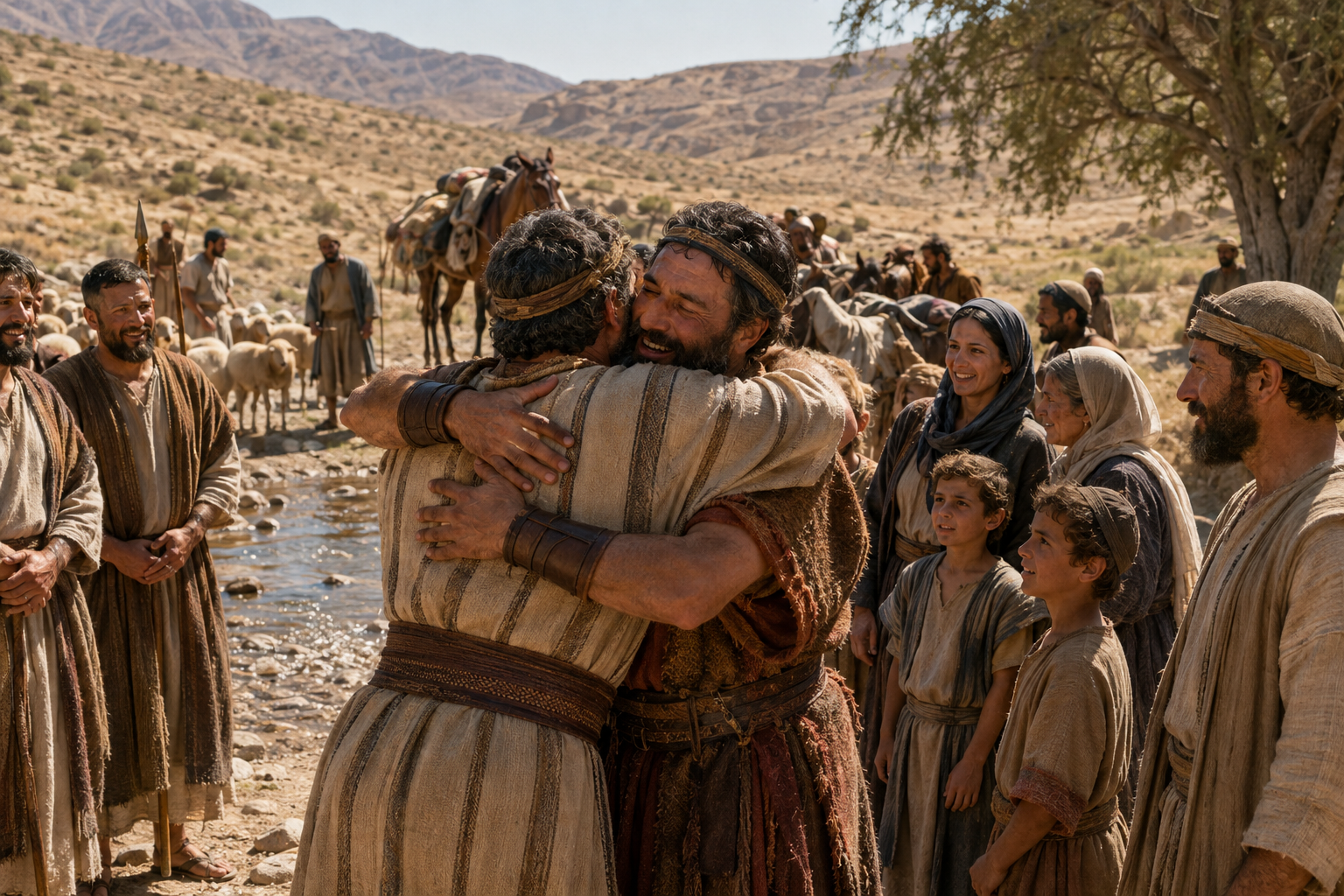
Genesis 33:4: “And Esau ran to meet him, and embraced him, and fell on his neck, and kissed him: and they wept.”
This is one of the striking reversals in the narrative.
Earlier, after Jacob had received Isaac’s blessing, Genesis 27:41 records:
“And Esau hated Jacob…”
and Esau had purposed to kill him.
By Genesis 33, Esau embraces him.
Scripture does not explicitly tell us what changed Esau’s heart or disposition during the intervening years. It is proper to recognize God’s providence over the entire situation, but we should not invent a conversation, spiritual experience, or psychological explanation that Scripture does not provide.
4. Esau meets Jacob’s family
Esau asks about the women and children.
Jacob answers:
Genesis 33:5: “The children which God hath graciously given thy servant.”
Once again Jacob recognizes God’s grace in what he possesses.
5. Esau initially refuses Jacob’s gift
Esau says:
Genesis 33:9: “I have enough, my brother; keep that thou hast unto thyself.”
Jacob urges him to receive it.
Jacob makes the remarkable statement:
Genesis 33:10: “…for therefore I have seen thy face, as though I had seen the face of God, and thou wast pleased with me.”
Jacob is not declaring Esau to be God. The comparison concerns the favorable reception Jacob has received.
Esau eventually accepts the gift.
6. Esau offers to accompany Jacob
Esau proposes that they travel together.
Jacob explains that the children and livestock cannot travel rapidly and says he will proceed according to their pace.
Esau also offers to leave some of his people with Jacob, but Jacob declines.
Esau then returns:
Genesis 33:16: “So Esau returned that day on his way unto Seir.”
The meeting therefore ends peacefully.
The chapter does not explicitly describe every future detail of Jacob and Esau’s relationship. It simply records this particular meeting and its peaceful conclusion.
7. Jacob goes to Succoth
Jacob travels to Succoth, where he builds himself a house and makes booths for his cattle.
The place receives its name in connection with those booths.
8. Jacob comes into Canaan
Genesis 33:18 says:
“And Jacob came to Shalem, a city of Shechem, which is in the land of Canaan…”
The KJV identifies Shalem as “a city of Shechem.”
Jacob pitches his tent before the city.
He purchases a parcel of land from the children of Hamor, Shechem’s father, for one hundred pieces of money.
9. Jacob builds an altar
The chapter closes:
Genesis 33:20: “And he erected there an altar, and called it El-elohe-Israel.”
The journey therefore ends this portion of the narrative with an altar associated with the God who had protected Jacob and brought him back into Canaan.
Key People and Places
Jacob
Son of Isaac and grandson of Abraham. In these chapters God commands him to leave Laban and return toward Canaan. He fears Esau, prays for deliverance, wrestles at Peniel, receives the name Israel, and meets Esau peacefully.
Israel
The name given to Jacob in Genesis 32:28:
“…for as a prince hast thou power with God and with men, and hast prevailed.”
The Scriptures continue to use both Jacob and Israel afterward.
Laban
Rachel and Leah’s father and Jacob’s father-in-law. Genesis 31 records the final major confrontation between Jacob and Laban. Laban admits that God warned him concerning Jacob.
Rachel
Jacob’s wife and Laban’s daughter. She steals Laban’s images. Scripture does not state her motive.
Leah
Jacob’s wife and Rachel’s sister. She joins Rachel in agreeing that Jacob should obey God’s command to leave their father’s country.
Esau
Jacob’s brother. He approaches with four hundred men, causing Jacob great fear, but he ultimately runs to Jacob, embraces him, kisses him, and weeps with him.
Reuben, Simeon, Levi, Judah, Joseph, and the other children
Jacob’s children accompany him. Joseph is specifically named with Rachel in Genesis 33.
Laban’s sons
They accuse Jacob of taking what belonged to their father, contributing to the tension at the beginning of Genesis 31.
Bethel
The location of Jacob’s earlier vision in Genesis 28. God identifies Himself in Genesis 31:13 as:
“the God of Bethel.”
Gilead
The region where Laban overtakes Jacob.
Mizpah
Associated with the covenant and boundary between Jacob and Laban. In context it involves the LORD watching between separated parties and the heap serving as a witness against crossing for harm.
Mahanaim
The name Jacob gives the place where the angels of God meet him.
Seir
The country associated with Esau in these chapters.
Edom
Genesis 32:3 identifies Esau’s location as:
“the land of Seir, the country of Edom.”
Jabbok
The brook Jacob crosses immediately before his wrestling encounter.
Peniel
Named by Jacob because:
“I have seen God face to face, and my life is preserved.”
Succoth
Where Jacob builds a house and booths for his cattle.
Shalem / Shechem
Genesis 33 places Jacob here in the land of Canaan. He purchases land and erects an altar.
Canaan
The land toward which Jacob returns, consistent with God’s earlier promise concerning his return.
Main Doctrinal or Spiritual Themes
1. God Faithfully Keeps His Word
The controlling truth behind these chapters is God’s faithfulness to what He had previously promised Jacob.
At Bethel God had said:
Genesis 28:15: “…I will keep thee in all places whither thou goest, and will bring thee again into this land…”
Now God says:
Genesis 31:3: “Return unto the land of thy fathers…and I will be with thee.”
Genesis 31–33 shows Jacob being preserved through Laban’s pursuit, brought through fear of Esau, and returned into Canaan.
God’s faithfulness does not rest upon the perfection of His servants.
That does not excuse sin. Rather, it magnifies the reliability of God’s own word.
2. God’s Providence Can Restrain Men
Laban plainly says:
Genesis 31:29: “It is in the power of my hand to do you hurt: but the God of your father spake unto me…”
Laban had power to harm Jacob, but God intervened.
God is therefore shown as sovereignly able to place boundaries upon what men intend to do.
That does not mean believers will never suffer. Scripture plainly teaches otherwise. But Genesis 31 specifically demonstrates that no man can finally overturn what God has determined to accomplish.
3. Obedience Must Follow God’s Revealed Word
God said:
“Return unto the land of thy fathers.”
Jacob returned.
Rachel and Leah correctly said:
Genesis 31:16: “…whatsoever God hath said unto thee, do.”
That is a sound principle for every believer.
Biblical faith is not built upon impressions, mystical feelings, or human speculation. It responds obediently to what God has actually said.
For believers today, God’s authoritative revelation is found in the Scriptures.
4. God’s Mercy Is Not Earned by Human Merit
Jacob prays:
Genesis 32:10: “I am not worthy of the least of all the mercies, and of all the truth, which thou hast shewed unto thy servant…”
That statement is consistent with the broader biblical truth of grace.
Man cannot put God in his debt.
In New Testament terms:
Ephesians 2:8-9: “For by grace are ye saved through faith; and that not of yourselves: it is the gift of God: Not of works, lest any man should boast.”
Genesis 32 is not presenting a complete New Testament explanation of justification, but Jacob’s confession beautifully reflects the proper attitude of a man receiving mercy: “I am not worthy.”
5. Prayer Should Rest Upon God’s Word
Jacob’s prayer is rooted in what God had already spoken.
He says in substance: Thou saidst…
That pattern appears repeatedly throughout Scripture.
Faith does not demand that God honor promises He never made. Biblical prayer lays hold upon what God has actually revealed.
Jacob combines:
- acknowledgment of God’s identity,
- remembrance of God’s command,
- confession of unworthiness,
- a specific request,
- and appeal to God’s promise.
That is a valuable pattern for prayer.
6. Fear Does Not Remove the Need for Prayer
The text frankly says:
Genesis 32:7: “Then Jacob was greatly afraid and distressed…”
The Bible does not hide Jacob’s fear.
But neither does Jacob remain merely afraid. He prays:
Genesis 32:11: “Deliver me, I pray thee…”
The lesson is not that a believer will never experience fear. The lesson is that fear should drive the believer toward God rather than away from Him.
7. God Sometimes Brings His Servants to Human Weakness
After the wrestling encounter:
Genesis 32:31: “…and he halted upon his thigh.”
That physical consequence is explicit.
It may suggest that Jacob thereafter carried a bodily reminder of the encounter, but Scripture does not explicitly tell us why God allowed the injury beyond what occurs in the event itself.
Therefore we should avoid building an elaborate doctrine around the limp.
The safe observation is simple: Jacob prevailed in the encounter yet walked away physically weakened.
8. God Alone Deserves Worship and Recognition
Jacob repeatedly acknowledges God:
“the God of Abraham”
“the fear of Isaac”
“the God of Bethel”
and finally erects an altar called:
“El-elohe-Israel.”
Meanwhile, Laban possesses objects he calls “my gods.”
The narrative therefore places the true God who protects, speaks, commands, and preserves Jacob against the powerless objects Laban searches for among the household belongings.
One should not go beyond the text regarding precisely how Laban used those objects, but the contrast is striking.
9. Separation Can Be Necessary
The covenant between Jacob and Laban establishes a clear boundary.
Neither is to cross the heap for the purpose of harming the other.
There are circumstances in which continued closeness is not required in order to avoid hostility.
Romans later gives the principle:
Romans 12:18: “If it be possible, as much as lieth in you, live peaceably with all men.”
Peace does not always require unrestricted fellowship.
10. Peace Between Estranged People Is Possible
Jacob had strong reason to fear Esau because of Genesis 27.
Yet Genesis 33 records:
“Esau ran to meet him, and embraced him…and kissed him: and they wept.”
We must not invent the explanation for Esau’s changed behavior, because Scripture does not provide it.
But the event demonstrates that situations which appear threatening to man may end very differently under God’s providence.
Practical Applications or Lessons
1. Go where God tells you to go
Jacob had spent many years with Laban, but God’s command was plain:
“Return unto the land of thy fathers.”
When God’s Word clearly speaks, obedience should not be postponed until circumstances become comfortable.
The believer’s responsibility is not to rewrite God’s command but to obey it.
2. Do not mistake difficult circumstances for God’s absence
Jacob’s years with Laban included conflict, changed wages, exhausting labor, and tension.
Yet Jacob could say:
Genesis 31:42: “…the God of Abraham, and the fear of Isaac, had been with me…”
Hardship and divine presence are not opposites.
God may be faithfully working in circumstances that are personally unpleasant.
3. Give God the credit for preservation
Jacob repeatedly acknowledges what God had done.
Believers should resist the temptation to attribute every success to intelligence, planning, personality, or ability.
Psalm 115:1: “Not unto us, O LORD, not unto us, but unto thy name give glory…”
4. Do not allow possessions to become gods
Laban pursued Jacob’s company partly because his “gods” were missing.
There is irony in a man having to search for gods that someone else can hide.
The living God, by contrast, appears to Laban and speaks with authority.
Anything that must be protected by man cannot take the place of the God who protects man.
5. Do not assign motives the Bible does not reveal
Rachel stole the images.
That is explicit.
Why she stole them is not explicit.
This is an important interpretive lesson extending far beyond Genesis 31.
Sound Bible study distinguishes between:
- what the text says,
- what the text requires us to conclude,
- what the text may suggest,
- and what Scripture simply does not reveal.
Conservative interpretation should be conservative with the text itself.
6. When afraid, pray specifically
Jacob did not offer a vague prayer:
“Deliver me, I pray thee, from the hand of my brother, from the hand of Esau.”
He named the danger.
Believers may bring specific burdens before the Lord.
Philippians 4:6: “…in every thing by prayer and supplication with thanksgiving let your requests be made known unto God.”
7. Pray with humility
Jacob said:
“I am not worthy of the least of all the mercies…”
That spirit stands opposite to entitlement.
Everything God gives beyond judgment is mercy.
The Christian should therefore approach God confidently because of His grace, yet humbly because no blessing has been earned by personal merit.
8. Rest in God’s promises rather than imagined outcomes
Jacob knew what God had promised concerning his future.
He did not know exactly how the meeting with Esau would unfold.
That distinction matters.
Faith rests upon what God has revealed. Presumption claims certainty about details God has not revealed.
9. Human planning must never replace dependence upon God
Jacob made elaborate preparations concerning Esau.
He also prayed.
The Bible records both.
We should therefore avoid simplistic claims that every act of preparation demonstrated unbelief. The chapter does not explicitly say that.
The sound application is that planning must never become a substitute for prayer or dependence upon God’s providence.
Proverbs 21:31: “The horse is prepared against the day of battle: but safety is of the LORD.”
10. Be cautious about sentimentalizing Mizpah
“The LORD watch between me and thee…”
is beautiful biblical language, but its original context is not merely affectionate friendship.
The heap marks separation and serves as a witness that neither man is to cross it to harm the other.
Bible verses should be understood in their context before they are turned into devotional slogans.
11. Peace may come from an unexpected direction
Jacob anticipated possible destruction.
Instead, Esau embraced him.
We cannot say precisely why Esau changed, because Scripture does not explain it.
But believers can learn not to treat feared outcomes as though they were already accomplished facts.
God knows tomorrow; we do not.
12. Remember God’s mercy after the crisis has passed
Genesis 33 does not end merely with Jacob surviving Esau.
It ends with an altar.
That is significant in the plain flow of the narrative.
Jacob had prayed for deliverance; afterward he erected an altar.
Believers likewise should not pray earnestly in trouble and then forget God when peace arrives.
Psalm 50:15: “And call upon me in the day of trouble: I will deliver thee, and thou shalt glorify me.”
Overall Message of Genesis 31–33
Genesis 31–33 shows the faithfulness of God toward Jacob in spite of threatening circumstances and human conflict.
In Genesis 31, God brings Jacob out from Laban and protects him from harm.
In Genesis 32, Jacob faces fear, prays on the basis of God’s promise, encounters God at Peniel, and receives the name Israel.
In Genesis 33, the feared encounter with Esau becomes a peaceful meeting, and Jacob proceeds into Canaan and erects an altar.
The controlling truth is not that Jacob handled every circumstance perfectly. The chapters never require such a conclusion.
The stronger and safer conclusion is that God kept His word.
Jacob himself summarizes the matter well:
Genesis 32:10: “I am not worthy of the least of all the mercies, and of all the truth, which thou hast shewed unto thy servant…”
That is the proper perspective of faith: God is faithful, His mercy is undeserved, His Word is trustworthy, and His servants should obey what He has spoken.
Comments are closed