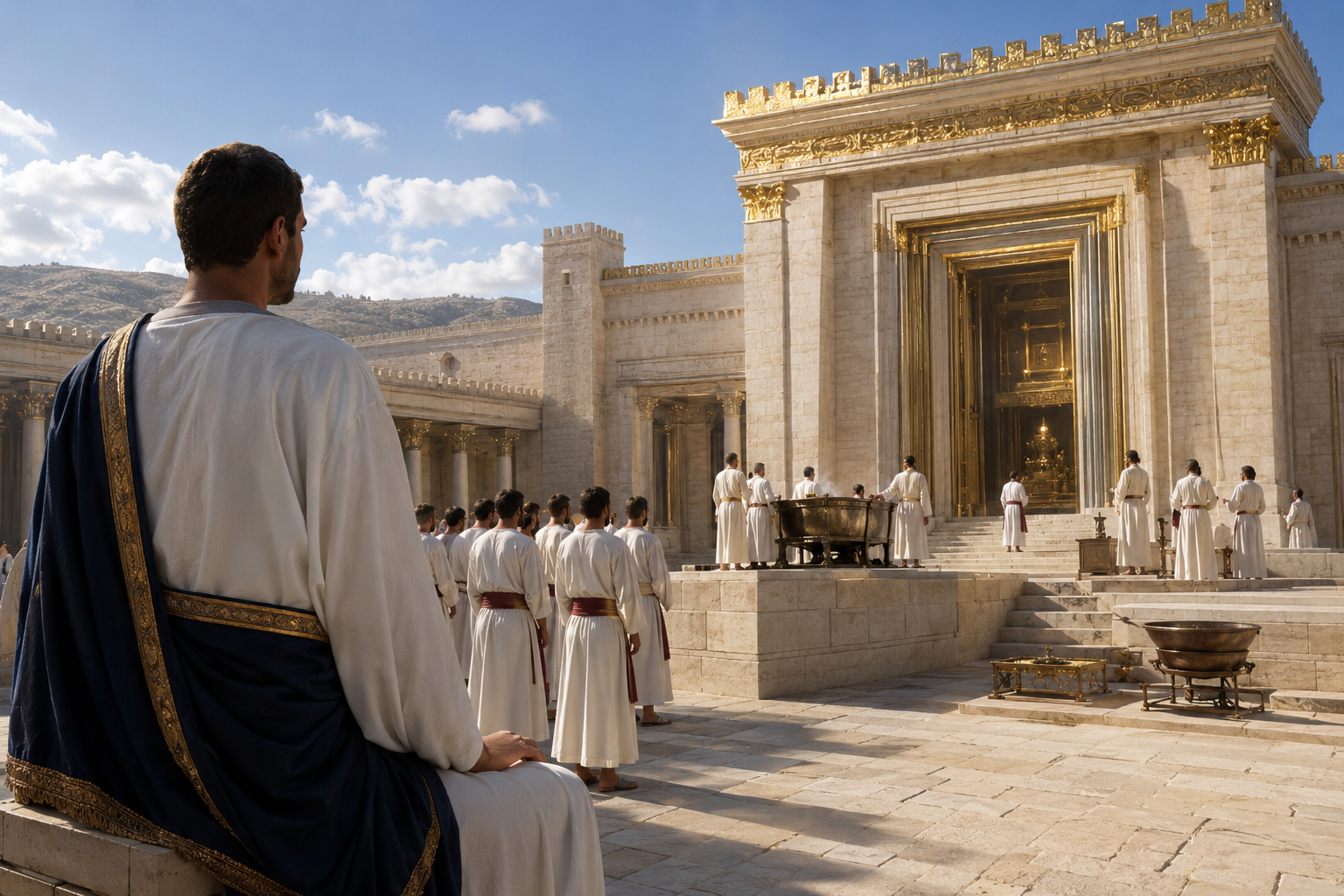
 Ezekiel 44–46 continues the vision of the future temple, priesthood, worship, offerings, and ordered service in the restored kingdom. From a conservative Baptist, premillennial, dispensational view, these chapters describe the future millennial temple order connected with Israel’s national restoration, not the Church replacing Israel. The details are too specific to be reduced to mere allegory. The passage emphasizes the holiness of God, the sanctity of His house, the distinction between clean and unclean, and the ordered worship of Jehovah.
Chapter Summaries
Ezekiel 44 — The Shut East Gate, the Glory of the LORD, and the Priesthood
The chapter opens with Ezekiel being brought back “the way of the gate of the outward sanctuary which looketh toward the east; and it was shut” (Ezekiel 44:1). The LORD explains:
“This gate shall be shut, it shall not be opened, and no man shall enter in by it; because the LORD, the God of Israel, hath entered in by it, therefore it shall be shut.”
— Ezekiel 44:2
This east gate is holy because the glory of the LORD has entered by it. The emphasis is not on man’s convenience, but on God’s majesty. The “prince” may sit in it “to eat bread before the LORD,” but even he does not enter in the ordinary manner of priestly service.
Ezekiel then sees “the glory of the LORD” filling the house of the LORD, and he falls upon his face (Ezekiel 44:4). God commands him to mark carefully “the entering in of the house, with every going forth of the sanctuary” (Ezekiel 44:5). In other words, God’s worship is not to be treated casually.
The LORD rebukes Israel for bringing “strangers, uncircumcised in heart, and uncircumcised in flesh” into His sanctuary (Ezekiel 44:7). This was a violation of holiness. God’s house had been profaned by careless worship, unqualified ministers, and disregard for His commandments.
The Levites who had gone astray after idols would still have a place of service, but not the highest priestly ministry. They would “bear their iniquity” and minister in lesser duties, such as keeping charge at the gates and slaying burnt offerings and sacrifices for the people (Ezekiel 44:10–14). This shows both judgment and mercy: sin has consequences, but God still uses repentant servants within proper bounds.
By contrast, “the priests the Levites, the sons of Zadok,” who kept the charge of God’s sanctuary when Israel went astray, are given the privilege of drawing near:
“They shall come near to me to minister unto me, and they shall stand before me to offer unto me the fat and the blood.”
— Ezekiel 44:15
The sons of Zadok represent faithful priestly service. Their garments, conduct, marriages, teaching, judgment, and inheritance are all regulated. They must teach the people “the difference between the holy and profane,” and cause them “to discern between the unclean and the clean” (Ezekiel 44:23).
Their inheritance is unique:
“I am their inheritance: and ye shall give them no possession in Israel: I am their possession.”
— Ezekiel 44:28
This is a powerful reminder that those who minister before God must be satisfied with God Himself.
Ezekiel 45 — The Holy Portion, the Prince, Just Measures, and Offerings
Ezekiel 45 describes the division of a holy portion of land. A section is set apart for the LORD, the sanctuary, the priests, the Levites, the city, and the prince. The arrangement shows order, separation, and sacred priority. God’s portion comes first.
The chapter also rebukes Israel’s rulers:
“Let it suffice you, O princes of Israel: remove violence and spoil, and execute judgment and justice.”
— Ezekiel 45:9
The princes are commanded to use “just balances,” “a just ephah,” and “a just bath” (Ezekiel 45:10). God connects worship with righteousness. A man cannot be right in the temple and crooked in the marketplace. False weights, oppression, and dishonest gain are condemned.
The offerings described include burnt offerings, meat offerings, drink offerings, sin offerings, and peace offerings. From a conservative dispensational view, these sacrifices in the millennial kingdom are best understood as memorial and ceremonial, looking back to Christ’s finished work, not competing with or adding to His atonement. Hebrews makes clear that Christ offered Himself “once for all” (Hebrews 10:10). Therefore, these sacrifices cannot take away sin in the saving sense; they function within Israel’s restored temple order as God-appointed memorial worship.
The “prince” has responsibilities in worship, including providing offerings for appointed feasts, new moons, sabbaths, and solemnities (Ezekiel 45:17). This prince should not be identified as the Lord Jesus Christ Himself, because the prince offers a sin offering for himself in Ezekiel 45:22. Christ has no sin. The prince is better understood as a future Davidic ruler under Messiah’s authority.
The chapter also mentions the Passover:
“In the first month, in the fourteenth day of the month, ye shall have the passover.”
— Ezekiel 45:21
This points to restored national worship for Israel in the kingdom age, under the reign and authority of the LORD.
Ezekiel 46 — Worship Order, Sabbaths, New Moons, the Prince, and Temple Kitchens
Ezekiel 46 gives further detail about worship procedures. The east gate of the inner court is shut during the six working days, but opened on the sabbath and new moon:
“Thus saith the Lord GOD; The gate of the inner court that looketh toward the east shall be shut the six working days; but on the sabbath it shall be opened, and in the day of the new moon it shall be opened.”
— Ezekiel 46:1
The prince worships at the threshold of the gate while the priests prepare his offerings. The people also worship “at the door of this gate before the LORD in the sabbaths and in the new moons” (Ezekiel 46:3).
The chapter regulates burnt offerings, meat offerings, freewill offerings, and the movement of worshippers through the temple courts. If the people enter by the north gate, they are to go out by the south gate; if they enter by the south gate, they go out by the north gate (Ezekiel 46:9). This orderly movement prevents confusion and disorder in worship.
The prince enters and exits in relation to the people, but with his own assigned place and responsibilities. Again, he is important, but he is still under divine regulation. Authority in God’s kingdom is never independent of God’s Word.
Ezekiel 46 also gives instruction about the prince’s inheritance. He may give gifts to his sons, which remain theirs, but if he gives a gift to a servant, it returns in the year of liberty (Ezekiel 46:16–17). He is forbidden to oppress the people:
“Moreover the prince shall not take of the people’s inheritance by oppression, to thrust them out of their possession.”
— Ezekiel 46:18
The chapter closes with Ezekiel being shown places where the priests boil the trespass offering and sin offering, and where they bake the meat offering, so that they do not carry them into the outer court “to sanctify the people” improperly (Ezekiel 46:20). There are also courts for boiling the sacrifices of the people. Even practical matters such as preparation areas are ordered by God.
The lesson is plain: God is holy not only in doctrine, but also in details.
Key People and Places
The LORD / The God of Israel
The central Person in the passage is the LORD Himself. His glory fills the house, His presence sanctifies the east gate, and His commands regulate worship. The temple exists for Him, not for man.
Ezekiel
Ezekiel is the prophet receiving and recording the vision. He is commanded to “mark well” and “behold with thine eyes, and hear with thine ears” (Ezekiel 44:5). He is not inventing worship; he is receiving revelation.
The Prince
The prince has a special role in worship, offerings, inheritance, and leadership. He is not best understood as Christ Himself, since he offers a sin offering for himself. He appears to be a future ruler under the authority of Messiah in the restored kingdom order.
The Levites
The Levites who went astray after idols are restricted to lesser service. They may minister in certain outward duties, but they are not permitted to draw near in the highest priestly service. This shows that failure in holiness affects future usefulness.
The Sons of Zadok
The sons of Zadok are faithful priests who kept charge when others went astray. They are allowed to come near unto the LORD. They teach the people the difference between holy and profane, clean and unclean.
Israel
Israel remains central in the passage. These chapters concern Israel’s restored worship, land, priesthood, feasts, and national order. This should not be confused with the Church.
The Sanctuary / Temple
The temple is the center of worship. Its gates, courts, chambers, priestly areas, and sacrificial arrangements are carefully described.
The East Gate
The east gate is shut because “the LORD, the God of Israel, hath entered in by it” (Ezekiel 44:2). It is a visible reminder of divine glory and holiness.
The Holy Portion
A separated portion of land is set apart for the LORD, the priests, the Levites, the city, and the prince. This reflects God’s ordered arrangement for Israel in the kingdom.
The Gates: North, South, and East
The gates regulate access, movement, and worship. God’s people are not left to worship by personal preference; they worship according to divine command.
Main Doctrinal or Spiritual Themes
1. The Holiness of God
The dominant theme is holiness. The shut east gate, priestly restrictions, clean and unclean distinctions, and regulated offerings all teach that God is holy. Worship must not be casual, careless, or man-centered.
“Her priests have violated my law, and have profaned mine holy things: they have put no difference between the holy and profane.”
— Ezekiel 22:26
Ezekiel 44–46 shows the correction of that failure.
2. God’s Glory Must Govern Worship
When Ezekiel sees the glory of the LORD filling the house, he falls upon his face. True worship begins with reverence. The purpose of the temple is not entertainment, novelty, or religious performance, but the honour of Jehovah.
3. Separation from Uncleanness
God rebukes Israel for allowing the uncircumcised in heart and flesh to enter His sanctuary. In the Old Testament context, this involved covenant separation. The spiritual principle remains: God’s people must not blur the line between holiness and worldliness.
4. Faithfulness Matters
The sons of Zadok are honoured because they remained faithful when others went astray. God remembers faithfulness. Men may overlook quiet obedience, but God does not.
5. Sin Has Consequences
The Levites who departed from God are not treated as though nothing happened. They are not cast away entirely, but their service is limited. Forgiveness does not always remove earthly or ministerial consequences.
6. God Requires Just Leadership
The princes are commanded to remove violence and spoil, and to execute judgment and justice. Civil and spiritual leadership must be righteous. God hates oppression, fraud, and abuse of authority.
7. Worship and Daily Conduct Cannot Be Separated
The command for just balances shows that a man’s religion is not confined to the sanctuary. God cares about business dealings, property rights, honesty, and justice.
8. Israel and the Church Are Distinct
These chapters concern Israel, her land, her temple, her priesthood, her prince, and her kingdom worship. The Church does not replace Israel. The promises of restoration to Israel will be fulfilled literally under the reign of Messiah.
9. The Millennial Temple Worship Looks Back to Christ’s Finished Work
Because the New Testament plainly teaches the finality of Christ’s sacrifice, the offerings in Ezekiel’s temple cannot be saving sacrifices. They are best understood as memorial, ceremonial, and governmental sacrifices within the future kingdom order, pointing back to the finished work of Christ.
“But this man, after he had offered one sacrifice for sins for ever, sat down on the right hand of God.”
— Hebrews 10:12
10. God Is a God of Order
The gates, offerings, priestly duties, inheritance laws, and temple kitchens all show divine order. God’s work is not to be handled carelessly.
Practical Applications or Lessons
1. Worship Must Be Reverent
Ezekiel falls upon his face when the glory of the LORD fills the house. Modern believers should approach God with reverence, humility, and fear. Casual religion is foreign to Scripture.
2. God’s House Must Not Be Profaned
Israel had allowed improper persons and practices into the sanctuary. Churches today must guard doctrine, preaching, music, leadership, ordinances, and fellowship according to Scripture, not worldly trends.
3. Believers Must Discern Between Holy and Profane
The priests were responsible to teach the people “the difference between the holy and profane” (Ezekiel 44:23). A faithful ministry does not blur moral lines. It teaches God’s people to discern truth from error, purity from defilement, and obedience from compromise.
4. Faithfulness in Dark Times Is Precious to God
The sons of Zadok stood faithful when others went astray. A believer may live in a compromising generation, but he is still responsible to obey God. Faithfulness is not measured by the crowd, but by loyalty to the LORD.
5. Past Failure May Limit Future Service
The unfaithful Levites were still allowed to serve, but not in the same nearness as the sons of Zadok. This is a sober warning. Sin forgiven is still sin that may leave consequences. God is merciful, but His work is holy.
6. Leaders Must Not Abuse Authority
The prince is forbidden to take the people’s inheritance by oppression. Whether in government, home, church, or business, authority is a stewardship under God. Leadership must protect, not exploit.
7. Honesty Is Part of Holiness
God commanded “just balances.” A Christian should be honest in money, time, labor, contracts, promises, and speech. Dishonesty in business is not a small flaw; it is sin before God.
8. God Cares About Details
The temple vision includes gates, measurements, offerings, kitchens, movement patterns, and priestly garments. The lesson is that obedience is not only general but particular. God’s commands should be followed carefully.
9. Access to God Is a Privilege, Not a Right to Be Handled Lightly
The restrictions around the sanctuary remind us that sinful man does not approach God on his own terms. Today, the believer comes to God through the Lord Jesus Christ, our great High Priest, but that access should produce gratitude and reverence, not carelessness.
10. The LORD Himself Is the Greatest Inheritance
To the priests, God says, “I am their inheritance” (Ezekiel 44:28). The greatest blessing is not land, position, possessions, or recognition, but God Himself. Every servant of the Lord should learn contentment in Him.
Concluding Summary
Ezekiel 44–46 presents a holy, ordered, future temple system connected with Israel’s restoration and kingdom worship. The glory of the LORD fills the house. The east gate is shut because the LORD entered by it. Faithful priests are honoured, unfaithful Levites bear consequences, the prince is regulated, the people worship in order, and righteousness is required in both sanctuary and society.
The plain KJV text teaches that God is holy, His worship is sacred, His servants must be faithful, and His promises to Israel will stand. For believers today, the passage calls us to reverence, separation, honest living, faithful service, and careful obedience to the Word of God.
How useful was this post?
Click on a star to rate it!
Average rating 0 / 5. Vote count: 0
No votes so far! Be the first to rate this post.
We are sorry that this post was not useful for you!
Let us improve this post!
Tell us how we can improve this post?
Comments are closed