
 Ezekiel 36–39 forms one of the great prophetic sections of the Old Testament concerning Israel’s restoration, national cleansing, spiritual renewal, and future deliverance from enemy invasion. From a conservative Baptist, dispensational, premillennial view, these chapters should be read plainly: God is speaking primarily to Israel, not replacing Israel with the Church. The promises concern the land, the nation, the covenant faithfulness of God, and the future vindication of His holy name.
These chapters also contain rich spiritual application for believers today, especially concerning repentance, cleansing, the new birth, God’s faithfulness, and the certainty that God will glorify Himself among the nations.
Chapter Summaries
Ezekiel 36 — Israel Restored for the LORD’s Name
Ezekiel 36 opens with God speaking to the mountains of Israel. The land had been wasted, mocked, occupied, and spoken against by the heathen. The enemies had said, “Aha, even the ancient high places are ours in possession” (Ezekiel 36:2). God answers that He has heard the shame and reproach cast upon His people and His land.
The LORD promises that the land of Israel will be restored. He says, “ye shall shoot forth your branches, and yield your fruit to my people of Israel; for they are at hand to come” (Ezekiel 36:8). This is not merely a symbolic promise. The passage speaks of mountains, hills, rivers, valleys, cities, wastes, agriculture, and population. The plain reading points to Israel’s restoration to her land.
God makes clear that Israel’s restoration is not because Israel deserved it. He says, “I do not this for your sakes, O house of Israel, but for mine holy name’s sake” (Ezekiel 36:22). Israel had profaned the name of the LORD among the heathen, but God would sanctify His great name before the nations.
The heart of the chapter is the promise of cleansing and inward renewal:
“Then will I sprinkle clean water upon you, and ye shall be clean” (Ezekiel 36:25).
“A new heart also will I give you, and a new spirit will I put within you” (Ezekiel 36:26).
“And I will put my spirit within you, and cause you to walk in my statutes” (Ezekiel 36:27).
Doctrinally, this points to Israel’s future national conversion and spiritual restoration under the New Covenant. It also illustrates the necessity of regeneration. Man does not need mere reform; he needs a new heart. The sinner cannot cleanse himself. God must cleanse, renew, and give life.
The chapter ends with the restored land becoming “like the garden of Eden” (Ezekiel 36:35), and the heathen knowing that the LORD has rebuilt the ruined places. God also says He will yet be enquired of by the house of Israel to do it for them, showing that divine sovereignty does not eliminate prayer.
Ezekiel 37 — The Valley of Dry Bones and the Two Sticks
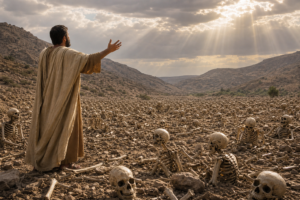
Ezekiel 37 contains one of the most striking prophetic visions in Scripture. The prophet is carried by the Spirit of the LORD into a valley “full of bones” (Ezekiel 37:1). The bones are “very dry” (Ezekiel 37:2), picturing Israel in a hopeless, dead, scattered condition.
God asks Ezekiel, “Son of man, can these bones live?” Ezekiel wisely answers, “O Lord GOD, thou knowest” (Ezekiel 37:3). The prophet is then commanded to prophesy to the bones. As he does, there is “a noise, and behold a shaking,” and the bones come together, bone to his bone (Ezekiel 37:7). Sinews, flesh, and skin come upon them, but there is no breath in them until Ezekiel prophesies to the wind. Then “the breath came into them, and they lived, and stood up upon their feet, an exceeding great army” (Ezekiel 37:10).
God interprets the vision plainly: “Son of man, these bones are the whole house of Israel” (Ezekiel 37:11). This is not the Church replacing Israel. The passage identifies the bones as Israel. The promise is national resurrection, restoration, and return: “I will open your graves, and cause you to come up out of your graves, and bring you into the land of Israel” (Ezekiel 37:12).
The second half of the chapter gives the sign of the two sticks. One stick is for Judah, and the other for Joseph, the stick of Ephraim. God commands Ezekiel to join them together, and they become “one stick” in his hand (Ezekiel 37:17). This pictures the future reunification of divided Israel. The northern and southern kingdoms will no longer be two nations. God says, “I will make them one nation in the land upon the mountains of Israel” (Ezekiel 37:22).
The chapter also points forward to the reign of Messiah. God says, “David my servant shall be king over them” (Ezekiel 37:24). This is best understood as a reference to the Davidic ruler, the Lord Jesus Christ, reigning in fulfillment of the Davidic covenant. The passage looks forward to a future kingdom of peace, obedience, and covenant blessing.
God promises, “My tabernacle also shall be with them: yea, I will be their God, and they shall be my people” (Ezekiel 37:27). This anticipates Israel restored, cleansed, united, and dwelling under the righteous reign of her King.
Ezekiel 38 — Gog’s Invasion Against Restored Israel
Ezekiel 38 introduces Gog, of the land of Magog, “the chief prince of Meshech and Tubal” (Ezekiel 38:2). God commands Ezekiel to prophesy against him. Gog leads a confederacy of nations against Israel. The listed names include Persia, Ethiopia, Libya, Gomer, and Togarmah (Ezekiel 38:5–6).
The invasion occurs when Israel has been regathered and is dwelling securely. Gog comes “against the mountains of Israel” (Ezekiel 38:8). The enemy thinks to take spoil and prey, saying, “I will go up to the land of unwalled villages” (Ezekiel 38:11). This attack is not accidental; God permits it and overrules it for His glory. The LORD says, “I will bring thee against my land, that the heathen may know me” (Ezekiel 38:16).
Conservative dispensational interpreters commonly understand this as a future invasion connected with the latter days, though faithful men have differed on its exact timing in relation to the Tribulation. What must not be missed is the plain doctrinal point: Israel is the target, God is sovereign over the nations, and the LORD will use this invasion to sanctify Himself before the heathen.
God’s judgment comes with great shaking, pestilence, blood, overflowing rain, great hailstones, fire, and brimstone (Ezekiel 38:19–22). The chapter ends with the LORD’s declared purpose:
“Thus will I magnify myself, and sanctify myself; and I will be known in the eyes of many nations” (Ezekiel 38:23).
This chapter teaches that the nations may rage, but God rules. He is not reacting helplessly to world events. He brings the counsel of the heathen to nothing and fulfills His own Word.
Ezekiel 39 — Gog Destroyed and God’s Name Sanctified
Ezekiel 39 continues the prophecy against Gog. God declares, “I am against thee, O Gog” (Ezekiel 39:1). The invading armies are brought upon the mountains of Israel and destroyed. God says, “I will smite thy bow out of thy left hand, and will cause thine arrows to fall out of thy right hand” (Ezekiel 39:3).
The destruction is so complete that the weapons of the enemy provide fuel for seven years (Ezekiel 39:9). The burial of the dead takes seven months, and the place is called “The valley of Hamongog” (Ezekiel 39:11). These details argue for a real, earthly judgment, not a vague spiritual metaphor.
The purpose is again repeated: “So will I make my holy name known in the midst of my people Israel” (Ezekiel 39:7). God will not allow His name to be profaned forever. The heathen will know that He is the LORD, “the Holy One in Israel.”
The chapter then looks beyond judgment to Israel’s restoration. God says, “Now will I bring again the captivity of Jacob, and have mercy upon the whole house of Israel” (Ezekiel 39:25). Israel will remember her shame and trespasses, but God will be sanctified in them before the nations.
The closing promise is deeply important:
“Neither will I hide my face any more from them: for I have poured out my spirit upon the house of Israel, saith the Lord GOD” (Ezekiel 39:29).
This points to Israel’s future spiritual restoration. God’s Spirit will be poured upon the house of Israel. This harmonizes with other prophetic passages concerning Israel’s repentance and restoration, such as Zechariah 12:10 and Romans 11:26, while maintaining the proper distinction between Israel and the Church.
Key People and Places
The LORD / Lord GOD
The central Person in these chapters is the LORD Himself. He acts for His holy name, restores Israel, judges the heathen, cleanses His people, gives a new heart, and sanctifies Himself before the nations. The repeated phrase “they shall know that I am the LORD” shows the chief purpose of these events.
Ezekiel
Ezekiel is the prophet and watchman. He speaks God’s words to Israel, to the land, to the dry bones, and against Gog. His task is not to invent a message but to declare what the LORD says.
The House of Israel
Israel is the primary subject of the prophecy. The chapters speak of Israel’s land, shame, scattering, restoration, cleansing, reunification, and future security. The “whole house of Israel” in Ezekiel 37:11 must be understood plainly.
Judah and Joseph / Ephraim
In Ezekiel 37, Judah represents the southern kingdom, while Joseph or Ephraim represents the northern kingdom. The two sticks becoming one picture the future unity of Israel under one King.
David My Servant
“David my servant” in Ezekiel 37:24 points to the promised Davidic ruler. In the larger prophetic light, this looks to Christ, the Son of David, who will reign righteously over restored Israel.
Gog
Gog is the leader of the future hostile confederacy that invades Israel. He is proud, ambitious, and covetous, but ultimately he is overthrown by God.
Magog, Meshech, Tubal, Persia, Ethiopia, Libya, Gomer, Togarmah
These names identify nations or peoples associated with Gog’s confederacy. The exact modern identification of each name is debated, and speculation should be avoided. The clear point is that a coalition of Gentile powers will come against Israel in the latter days.
The Mountains of Israel
The mountains of Israel are repeatedly mentioned. They were once desolate and mocked, but God promises fruitfulness, habitation, and restoration.
The Valley of Dry Bones
This is the setting of Ezekiel’s vision in chapter 37. It pictures the hopeless condition of Israel apart from God’s life-giving power.
The Valley of Hamongog
This is the burial place of Gog’s defeated multitude in Ezekiel 39. It becomes a testimony to God’s judgment upon the enemies of Israel.
Main Doctrinal or Spiritual Themes
1. God’s Holy Name
The repeated motive in these chapters is not Israel’s merit, but God’s name. “I do not this for your sakes… but for mine holy name’s sake” (Ezekiel 36:22). God is zealous for His own glory. He will not allow His name to be endlessly profaned by Israel’s sin or the heathen’s reproach.
2. The Faithfulness of God to Israel
God’s promises to Israel are not cancelled by Israel’s failure. Israel sinned grievously and was judged, but God’s covenant purposes remain. These chapters strongly support the dispensational distinction between Israel and the Church. The land promises, national restoration, and kingdom hope belong plainly to Israel.
3. Cleansing and Regeneration
Ezekiel 36 teaches that man needs inward cleansing. “A new heart also will I give you” (Ezekiel 36:26). This agrees with the broader biblical truth that salvation is of the LORD. Sinners are not saved by works, sacraments, religious heritage, or self-improvement. They must be cleansed by God and made new.
4. The Work of the Spirit
God says, “I will put my spirit within you” (Ezekiel 36:27), and later, “I have poured out my spirit upon the house of Israel” (Ezekiel 39:29). The Spirit’s work brings life, obedience, and restoration. In Ezekiel 37, the breath entering the slain pictures divine life given where there was only death.
5. National Restoration of Israel
The dry bones are not interpreted as the Church, but as “the whole house of Israel” (Ezekiel 37:11). The two sticks show Israel reunited. The land is restored. The people are cleansed. The King reigns. This points forward to the fulfillment of God’s promises to Israel in connection with the future kingdom.
6. The Sovereignty of God Over the Nations
Gog and his allies think they are acting by their own power and greed, but God is overruling all things. The LORD says He will bring Gog against His land so that the heathen may know Him. Evil rulers are responsible for their wickedness, yet God remains sovereign over history.
7. Judgment Upon the Enemies of God
Ezekiel 38–39 teaches that God will judge those who oppose His people and defy His name. The judgment upon Gog is terrible and public. God is longsuffering, but He is not indifferent to evil.
8. The Future Kingdom Hope
Ezekiel 37 looks forward to one nation, one King, one Shepherd, peace, obedience, and God’s sanctuary among His people. This agrees with the premillennial hope of Christ’s literal reign. The promises are too specific and earthly to be reduced to mere allegory.
Practical Applications or Lessons
1. God Restores What Sin Has Wasted
Israel’s land was desolate, and the people were scattered, but God promised restoration. Sin brings ruin, but God is able to rebuild what judgment has broken. A believer who has fallen should not presume upon grace, but neither should he despair when he turns back to the LORD.
2. God Acts for His Name’s Sake
God’s highest purpose is His own glory. This humbles man. Israel could not boast in herself, and neither can the Christian. Salvation, cleansing, usefulness, and blessing are all of grace.
3. Outward Religion Cannot Replace a New Heart
Ezekiel 36 shows the need of inward change. Religious form without a changed heart is not enough. The sinner needs cleansing from God. The believer also needs daily submission to the Word and Spirit of God.
4. Dry Bones Can Live When God Speaks
The valley of dry bones is a picture of human hopelessness and divine power. God can revive a nation, a church, a family, or a backslidden believer. The preacher’s duty is to prophesy the Word faithfully. Life comes from God.
5. Majority Opinion Does Not Determine Truth
In Ezekiel’s day, Israel looked hopeless, and the heathen mocked. Yet God’s Word stood sure. The believer must not measure truth by public opinion, cultural approval, or visible circumstances. God’s promises are stronger than man’s predictions.
6. God’s People Should Care About God’s Reputation
Israel profaned God’s name among the heathen. Christians should take warning. Our conduct should not bring reproach upon the name of the Lord. Separation, holiness, honesty, faithfulness, and obedience matter.
7. The Nations Are Not in Control
Ezekiel 38–39 reminds us that world powers do not control history. God does. This gives believers confidence in troubled times. Wars, rulers, alliances, and threats are all under the sovereign hand of God.
8. God Will Keep His Promises Literally
These chapters warn against spiritualizing away plain promises. God said Israel would be restored to the land, cleansed, reunited, and defended. The safest interpretation is to believe God meant what He said.
9. Judgment Is Certain
Gog’s destruction is a solemn reminder that rebellion against God ends in judgment. Men may gather armies, devise plans, and boast in power, but God can break them in a moment.
10. Hope Belongs to Those Who Trust the LORD
Ezekiel 36–39 moves from shame to cleansing, from death to life, from division to unity, and from invasion to victory. The LORD is able to save, restore, defend, and reign. The believer’s hope rests not in man’s strength, but in God’s unchanging Word.
Final Doctrinal Summary
Ezekiel 36–39 teaches that God will restore Israel to her land, cleanse her from sin, give her spiritual life, reunite the nation, establish His covenant purposes, defeat her enemies, and sanctify His holy name before all nations. These chapters should be interpreted plainly, not allegorically. They do not teach replacement theology. They affirm God’s faithfulness to Israel and point forward to the future kingdom under the rule of the Messiah.
Comments are closed