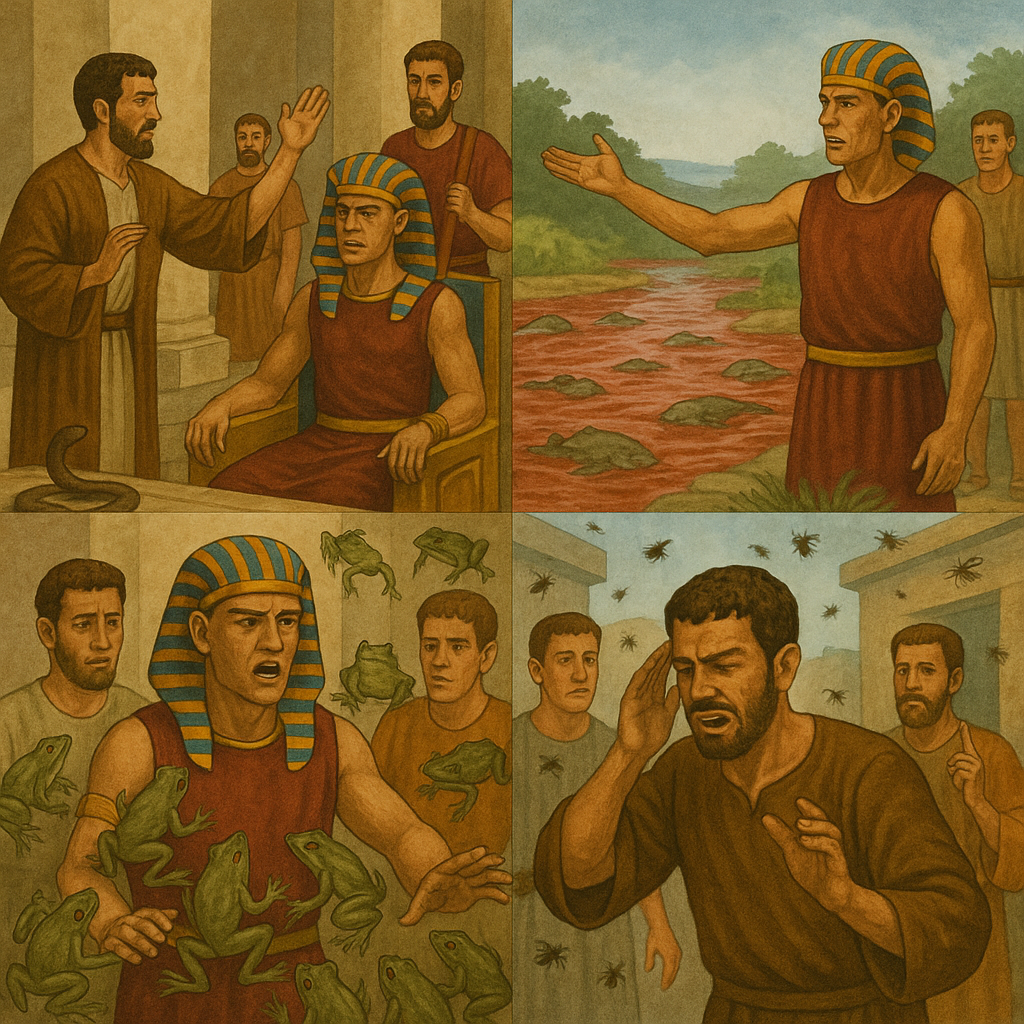
Exodus 7–8 records the beginning of the LORD’s open judgments upon Pharaoh and Egypt. Moses and Aaron stand before Pharaoh with the word of God, Aaron’s rod becomes a serpent, and the first four plagues follow: the waters turned to blood, frogs, lice, and swarms of flies. Throughout the account, God demonstrates His authority, Pharaoh repeatedly refuses to submit, and a clear distinction eventually appears between Egypt and the land of Goshen where Israel dwells.
The controlling purpose is stated plainly in Exodus 7:5:
“And the Egyptians shall know that I am the LORD, when I stretch forth mine hand upon Egypt, and bring out the children of Israel from among them.”
The chapters are therefore not merely accounts of extraordinary disasters. They are historical acts of divine judgment through which the LORD vindicates His word and makes His power known.
Chapter Summaries
 Exodus 7 — Aaron’s Rod and the Waters Turned to Blood
Moses and Aaron obey the LORD — Exodus 7:1–7
The LORD continues His commission to Moses. Moses is to speak what God commands, Aaron is to speak unto Pharaoh, and the demand remains that Pharaoh send the children of Israel out of his land.
God tells Moses:
“And I will harden Pharaoh’s heart, and multiply my signs and my wonders in the land of Egypt.”
— Exodus 7:3
God also declares the result of the judgments:
“And the Egyptians shall know that I am the LORD.”
— Exodus 7:5
The text emphasizes obedience:
“And Moses and Aaron did as the LORD commanded them, so did they.”
— Exodus 7:6
Their ages are explicitly given. Moses was eighty years old, and Aaron was eighty-three years old, when they spoke unto Pharaoh (Exodus 7:7).
This is significant practically: Scripture does not present advanced age as preventing God from using a servant whom He has called. We should not go beyond the text and claim that their ages were themselves part of a special divine lesson, but the ages do demonstrate that these men were not young when this confrontation took place.
Aaron’s rod becomes a serpent — Exodus 7:8–13
The LORD anticipates Pharaoh asking for a miracle. Aaron casts down his rod before Pharaoh:
“and it became a serpent.”
— Exodus 7:10
Pharaoh’s wise men, sorcerers, and magicians also cast down rods, which became serpents through their enchantments.
But the decisive statement is:
“but Aaron’s rod swallowed up their rods.”
— Exodus 7:12
Whatever ability the Egyptian magicians possessed, the narrative makes God’s superiority unmistakable. Their demonstration does not defeat, overturn, or equal the LORD’s purpose.
The passage does not explicitly explain the nature or mechanism of the magicians’ enchantments. Therefore, it is better not to invent details about how they accomplished what is recorded.
Pharaoh nevertheless refuses to hearken.
The hardening of Pharaoh
Exodus 7–8 requires careful wording.
God explicitly says:
“And I will harden Pharaoh’s heart”
— Exodus 7:3
Yet Exodus also explicitly records Pharaoh hardening his own heart:
“But when Pharaoh saw that there was respite, he hardened his heart”
— Exodus 8:15
And again:
“And Pharaoh hardened his heart at this time also”
— Exodus 8:32
Elsewhere in the immediate narrative, Scripture says Pharaoh’s heart “was hardened” (Exodus 7:22; 8:19).
Therefore, the KJV presents both God’s sovereign action and Pharaoh’s personal responsibility. We should affirm both without allowing a theological system to erase either one.
The passage does not teach that Pharaoh was an innocent man desiring to obey God but prevented from doing so. Before these plagues, Pharaoh had already answered Moses:
“Who is the LORD, that I should obey his voice to let Israel go? I know not the LORD, neither will I let Israel go.”
— Exodus 5:2
At the same time, God’s announcement that He would harden Pharaoh appears even earlier in Exodus 4:21. Therefore, it would also go beyond the wording of Scripture to claim that every aspect of God’s hardening occurred only after Pharaoh first hardened himself.
The safe biblical conclusion is this: God is sovereign; Pharaoh is responsible; and the inspired text teaches both. Exodus 7–8 gives no support to fatalism, nor does it establish Calvinistic regeneration or irresistible grace.
First plague: the waters become blood — Exodus 7:14–25
The LORD tells Moses:
“Pharaoh’s heart is hardened, he refuseth to let the people go.”
— Exodus 7:14
Moses is instructed to meet Pharaoh in the morning at the river’s brink.
The command is again:
“Let my people go, that they may serve me in the wilderness.”
— Exodus 7:16
Aaron stretches out the rod over the waters of Egypt. The KJV specifically names:
- streams,
- rivers,
- ponds,
- pools of water,
- and water in vessels of wood and stone.
The waters become blood. The fish die, the river stinks, and the Egyptians cannot drink the water of the river.
The Egyptian magicians imitate the sign:
“And the magicians of Egypt did so with their enchantments”
— Exodus 7:22
But nothing in the chapter says they could undo God’s judgment or restore Egypt’s water.
The Egyptians dig around the river for water to drink (Exodus 7:24), and seven days pass after the LORD smites the river (Exodus 7:25).
Historical note with textual restraint: the “river” in this Egyptian setting is commonly understood historically to be the Nile. However, Exodus 7 itself repeatedly calls it “the river.” Therefore, “the Nile” should be recognized as the ordinary geographical identification rather than presented as though the word “Nile” appears in the KJV passage.
Exodus 8 — Frogs, Lice, and Flies
Second plague: frogs — Exodus 8:1–15
The LORD again sends Moses to Pharaoh:
“Thus saith the LORD, Let my people go, that they may serve me.”
— Exodus 8:1
If Pharaoh refuses, frogs will cover the land.
The description is deliberately extensive. Frogs enter:
- Pharaoh’s house,
- his bedchamber,
- his bed,
- servants’ houses,
- the people’s houses,
- ovens,
- and kneadingtroughs.
The judgment penetrates ordinary Egyptian life. Neither royal status nor domestic privacy provides protection from the word of God.
The magicians also bring up frogs by their enchantments (Exodus 8:7). Again, Scripture says they reproduce something resembling the plague; it does not say they remove the plague.
Pharaoh then calls for Moses and Aaron:
“Intreat the LORD, that he may take away the frogs from me, and from my people; and I will let the people go”
— Exodus 8:8
Moses allows Pharaoh to specify the time. Pharaoh says, “To morrow.”
Moses answers:
“Be it according to thy word: that thou mayest know that there is none like unto the LORD our God.”
— Exodus 8:10
The LORD answers Moses, the frogs die, and Egypt experiences relief.
Then comes a revealing statement:
“But when Pharaoh saw that there was respite, he hardened his heart, and hearkened not unto them”
— Exodus 8:15
Relief from judgment does not produce repentance in Pharaoh. Instead, once the pressure is removed, he returns to resistance.
Third plague: lice — Exodus 8:16–19
The LORD commands Aaron:
“Stretch out thy rod, and smite the dust of the land, that it may become lice throughout all the land of Egypt.”
— Exodus 8:16
Aaron obeys.
“all the dust of the land became lice throughout all the land of Egypt.”
— Exodus 8:17
The magicians attempt to produce lice:
“but they could not”
— Exodus 8:18
This marks a clear limitation upon their ability.
They confess to Pharaoh:
“This is the finger of God”
— Exodus 8:19
The text does not say that this confession constituted saving faith or genuine repentance. It records their recognition that the plague exceeded their power.
Pharaoh still refuses to hearken.
Fourth plague: swarms of flies — Exodus 8:20–32
Moses is again told to rise early and stand before Pharaoh.
The demand remains unchanged:
“Let my people go, that they may serve me.”
— Exodus 8:20
If Pharaoh refuses, swarms of flies will come upon Pharaoh, his servants, his people, and their houses.
Then God introduces an explicit distinction:
“And I will sever in that day the land of Goshen, in which my people dwell, that no swarms of flies shall be there”
— Exodus 8:22
The LORD explains why:
“to the end thou mayest know that I am the LORD in the midst of the earth.”
— Exodus 8:22
And:
“And I will put a division between my people and thy people”
— Exodus 8:23
This separation is not merely inferred. God explicitly states it.
The judgment falls:
“the land was corrupted by reason of the swarm of flies.”
— Exodus 8:24
Pharaoh’s first attempted compromise
Pharaoh tells Moses and Aaron:
“Go ye, sacrifice to your God in the land.”
— Exodus 8:25
But Moses refuses this alteration of God’s command.
The LORD had commanded Israel to leave and serve Him in the wilderness. Moses therefore says:
“We will go three days’ journey into the wilderness, and sacrifice to the LORD our God, as he shall command us.”
— Exodus 8:27
Pharaoh then offers another limitation:
“I will let you go, that ye may sacrifice to the LORD your God in the wilderness; only ye shall not go very far away”
— Exodus 8:28
Moses does not accept Pharaoh as the authority who determines the terms upon which Israel will obey God. The LORD had given the command.
Moses intreats the LORD, the swarms depart, and:
“there remained not one.”
— Exodus 8:31
But Pharaoh again refuses:
“And Pharaoh hardened his heart at this time also, neither would he let the people go.”
— Exodus 8:32
That closes the chapter.
Key People and Places
The LORD
The central Person of the narrative. He speaks, commands, warns, judges, answers Moses’ entreaties, distinguishes Israel from Egypt, and declares that Egypt shall know that He is the LORD.
The plagues are fundamentally a revelation of His authority, not merely a contest between Moses and Pharaoh.
Moses
God’s appointed servant and spokesman in the confrontation with Pharaoh. He is eighty years old in Exodus 7:7.
Moses repeatedly delivers exactly the message God gives him and later intreats the LORD when Pharaoh requests relief.
Aaron
Moses’ brother, eighty-three years old according to Exodus 7:7. He speaks and acts alongside Moses and stretches forth the rod in several of the early signs and plagues.
Pharaoh
The ruler of Egypt. The KJV does not give his personal name in these chapters.
He repeatedly refuses God’s command, seeks relief when judgment becomes severe, proposes compromises, and hardens his heart.
Attempts to identify this Pharaoh with a particular Egyptian king belong to historical reconstruction. Scripture does not explicitly identify him by personal name, so such identifications should not be treated as biblical certainty.
The Egyptian magicians
Their personal names are not provided in Exodus 7–8.
They imitate the rod sign, the water-to-blood sign, and the frogs. When they attempt to bring forth lice, “they could not,” and they tell Pharaoh:
“This is the finger of God.”
The children of Israel
God repeatedly calls them:
“my people”
The purpose of their release is stated repeatedly:
“that they may serve me.”
Egypt
The land ruled by Pharaoh and the principal location of the judgments.
The river
The location associated particularly with the first plague. As noted above, it is commonly identified historically as the Nile, but the KJV wording in these chapters is “the river.”
Goshen
Explicitly identified in Exodus 8:22 as:
“the land of Goshen, in which my people dwell”
God exempts this land from the swarms of flies and expressly places a division between His people and Pharaoh’s people.
The wilderness
The place to which Israel is commanded to go for sacrifice and service to the LORD. Moses speaks of:
“three days’ journey into the wilderness”
— Exodus 8:27
Main Doctrinal or Spiritual Themes
1. The LORD alone possesses supreme authority
The great theme of the chapters is summed up in:
“that thou mayest know that there is none like unto the LORD our God.”
— Exodus 8:10
Pharaoh has political authority. The magicians possess abilities that impress the Egyptian court. But neither Pharaoh nor his magicians can overturn what God commands.
Aaron’s rod swallows their rods.
The magicians cannot produce lice.
Pharaoh cannot make the plagues cease.
God alone determines when judgment begins and when it ends.
2. God intends His name and power to be known
Three statements deserve to be read together:
“And the Egyptians shall know that I am the LORD”
— Exodus 7:5
“that thou mayest know that there is none like unto the LORD our God.”
— Exodus 8:10
“that thou mayest know that I am the LORD in the midst of the earth.”
— Exodus 8:22
God’s acts are revelatory. Pharaoh had said:
“Who is the LORD?”
— Exodus 5:2
These chapters begin God’s answer in judgment.
3. God’s Word is not negotiable
The command is simple and repeatedly stated:
“Let my people go, that they may serve me.”
Pharaoh attempts to alter the terms:
“sacrifice to your God in the land.”
Then:
“only ye shall not go very far away.”
Moses will not substitute Pharaoh’s conditions for God’s command.
This is a powerful principle of biblical obedience: men do not have authority to rewrite what God has said.
4. Pharaoh’s hard heart demonstrates the seriousness of resisting God
Pharaoh repeatedly receives:
- God’s command,
- visible demonstrations of divine power,
- severe judgments,
- relief from those judgments,
- and further warnings.
Yet he continues refusing to hearken.
Temporary fear of consequences is not the same thing as submission to God.
The text specifically says:
“when Pharaoh saw that there was respite, he hardened his heart.”
— Exodus 8:15
5. God’s sovereignty and human responsibility stand together
God says:
“I will harden Pharaoh’s heart.”
Scripture also says:
“Pharaoh hardened his heart.”
Neither truth should be discarded to protect a theological system.
The conservative Baptist position should follow the wording of Scripture rather than force the passage into Calvinistic determinism. Pharaoh acts willingly and is repeatedly held responsible for refusing God’s word, while God remains completely sovereign over the entire confrontation.
6. God is able to distinguish His people
Exodus 8:22–23 is explicit:
“I will sever in that day the land of Goshen”
and:
“I will put a division between my people and thy people.”
This specific protection concerns the plague of flies in this passage.
We should therefore avoid claiming that Israel was explicitly exempted from every preceding plague unless another verse establishes it. Exodus 8 makes the distinction explicit at the plague of flies.
The broader truth is certain: God knows those who belong to Him and is fully able to deal differently with different groups according to His purpose.
7. Counterfeit power is limited before God’s power
The magicians initially imitate several signs, but they cannot stop God’s judgments.
At the plague of lice:
“they could not.”
Their own conclusion is:
“This is the finger of God.”
The lesson is not that supernatural-looking manifestations automatically authenticate truth. The test is the Word and authority of God.
8. Judgment can produce temporary concessions without genuine submission
Pharaoh repeatedly changes his language while suffering.
During the frogs:
“I will let the people go.”
During the flies:
“I will let you go.”
But when relief comes, his resistance returns.
The passage therefore distinguishes between wanting consequences removed and actually bowing to God’s authority.
Practical Applications or Lessons
Obey exactly what God has said
Exodus 7:6 provides one of the simplest commendations of Moses and Aaron:
“And Moses and Aaron did as the LORD commanded them, so did they.”
Christian obedience should not consist of improving, weakening, negotiating, or modernizing God’s commands. The faithful servant does what God has said.
Do not compromise obedience for convenience
Pharaoh’s offer—
“sacrifice to your God in the land”
—sounds religious, but it contradicts God’s command.
His second proposal—
“only ye shall not go very far away”
—allows more freedom while still attempting to control obedience.
A believer should beware of compromises that retain religious language while altering biblical obedience.
Do not mistake relief for repentance
Pharaoh wanted the frogs removed.
He wanted the flies removed.
He asked Moses to pray.
Yet when relief came:
“he hardened his heart.”
A person can desperately desire escape from consequences without truly submitting to God. Biblical repentance is more than wanting trouble to stop.
Prayer must remain directed to the LORD
Moses does not rely on secret arts or human manipulation to end the plagues.
He:
“cried unto the LORD”
— Exodus 8:12
and later:
“intreated the LORD.”
— Exodus 8:30
The servant of God looks to God.
Do not be impressed merely because false religion can imitate something
The magicians produced impressive signs, but their power was limited.
Eventually:
“they could not.”
Truth is not established by spectacle. God’s Word remains the authority.
Never confuse God’s patience with His approval
God repeatedly warns Pharaoh before further judgment. Pharaoh repeatedly refuses.
A delay in further judgment should never be interpreted as divine approval of rebellion.
God’s servants must deliver God’s message even before powerful men
Moses and Aaron stand before the ruler of Egypt without changing the message.
The issue is not their personal courage alone. Their authority comes from:
“Thus saith the LORD.”
The preacher’s authority likewise rests in faithfully declaring what God has written, not in personality, position, education, or public approval.
God does not need man’s permission to accomplish His purposes
Pharaoh behaves as though Israel’s future depends ultimately upon his decision.
Yet the entire narrative shows that the LORD governs the outcome.
Pharaoh can resist.
He can bargain.
He can harden his heart.
But he cannot make God’s declared purpose fail.
Overall Message of Exodus 7–8
Exodus 7–8 presents an escalating confrontation between the command of the LORD and the stubborn refusal of Pharaoh.
God says:
“Let my people go, that they may serve me.”
Pharaoh refuses.
God answers with unmistakable acts of judgment. The river becomes blood. Frogs cover Egypt. Dust becomes lice. Swarms of flies corrupt the land. The magicians’ abilities reach their limit. Goshen is distinctly protected from the flies. Pharaoh repeatedly asks for relief and repeatedly returns to rebellion.
Above everything stands the declared purpose of God:
“And the Egyptians shall know that I am the LORD.”
The chapters teach the sovereignty of God, the certainty of His Word, the accountability of man, the danger of a hardened heart, the folly of compromise, the limitation of counterfeit spiritual power, and the necessity of complete obedience to what God has commanded.
Comments are closed